Optimizing Fluid Resuscitation in Pediatric Acute Pancreatitis

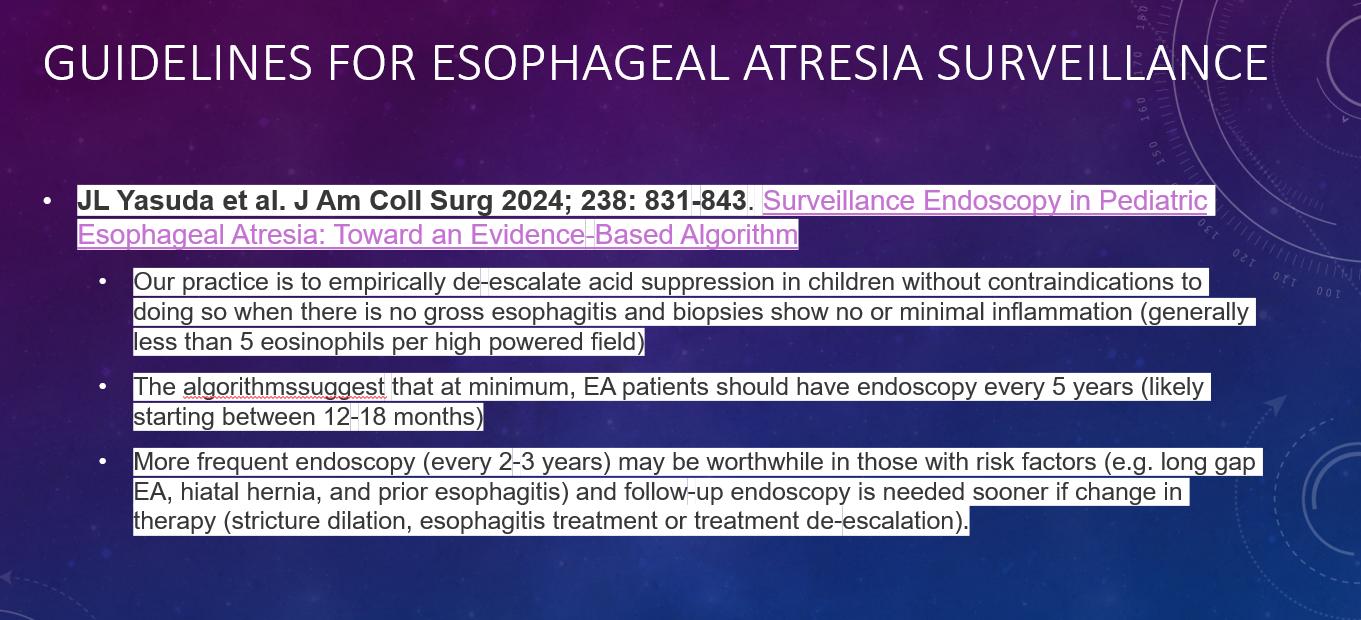
N Norris et al. J Pediatr 2025; 276: 114329. Liberal Fluid Resuscitation is Associated with Improved Outcomes in Pediatric Acute Pancreatitis

This single-center retrospective study with 227 patients (2013-2023) examined the role of liberal fluid administration/type of fluid administration and outcomes in children with acute pancreatitis. Overall, 100 patients received normal saline (NS) and 41 received lactated ringers (LR). Liberal fluid management was considered to be >1.5x the maintenance.

Key findings:

  • Patients who received liberal fluids were less likely to be admitted or transferred to the intensive care unit compared with those receiving conservative management (OR, 0.32)
  • The liberal NS fluid group with early feeding had the lower rates of moderate/severe manifestations of AP compared with other combinations of diet and fluid orders except the conservative LR group
  • Moderate/severe AP was highest in the conservative NS group (14/37 [38%]), followed by liberal LR (6/31 [19%]), liberal NS (9/63 [14%]); it was lowest in conservative LR group (0/10 [0%]).

In the discussion, the authors note that adult studies have supported a more moderate approach to IVFs (1.5 mL/kg/hr) given the risks of fluid overload in WATERFALL trial.

My take:

  1. It is surprising that so few patients received LR in this study; there has been some evidence that LR is better than NS for AP since 2014 (see blog posts below)
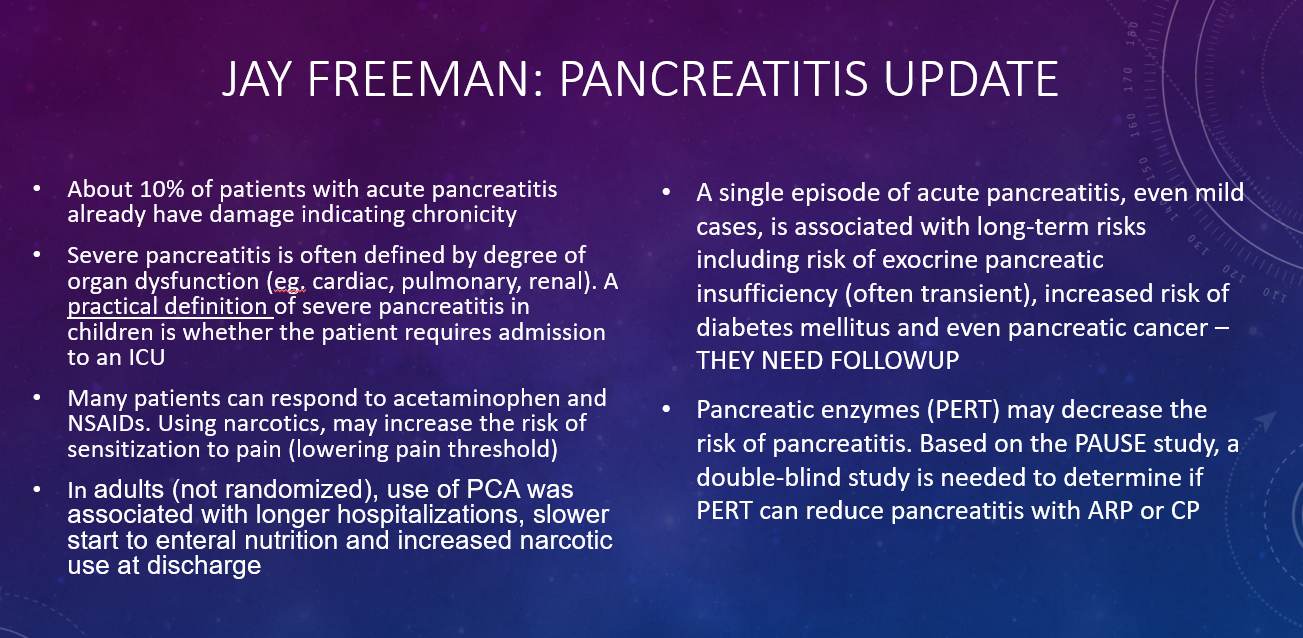
  2. Especially in those receiving NS, more liberal use of IVFs appears beneficial. Reasonable to start at 1.5 x maintenance (as recommended by Dr. Freeman)
  3. Though children generally tolerate liberal IVFs better than adults due to better cardiovascular function, a prospective randomized study is needed to determine which fluid strategy is optimal.
  4. Early enteral feeding is beneficial in most cases

View from the Rialto Bridge, courtesy of Steven Liu who has some amazing pictures

Related blog posts:

Key Advances in 2024: An Overview from GutsandGrowth (Part 4)

This year I had the opportunity to give a lecture to our group that reviewed much of the important advances that happened in 2024. Here are some of the slides (if you have any trouble reading the slides, you can search for the original blog post using author name).

Key Advances in 2024: An Overview from GutsandGrowth (Part 3)

This year I had the opportunity to give a lecture to our group that reviewed much of the important advances that happened in 2024. Here are some of the slides (if you have any trouble reading the slides, you can search for the original blog post using author name).

Key Advances in 2024: An Overview from GutsandGrowth (Part 2)

This year I had the opportunity to give a lecture to our group that reviewed much of the important advances that happened in 2024. Here are some of the slides (if you have any trouble reading the slides, you can search for the original blog post using author name).

Key Advances in 2024: An Overview from GutsandGrowth (Part 1)

This year I had the opportunity to give a lecture to our group that reviewed much of the important advances that happened in 2024. Here are some of the slides (if you have any trouble reading the slides, you can search for the original blog post using author name).

Fecal Microbiota Transplantation for Severe Constipation in Children

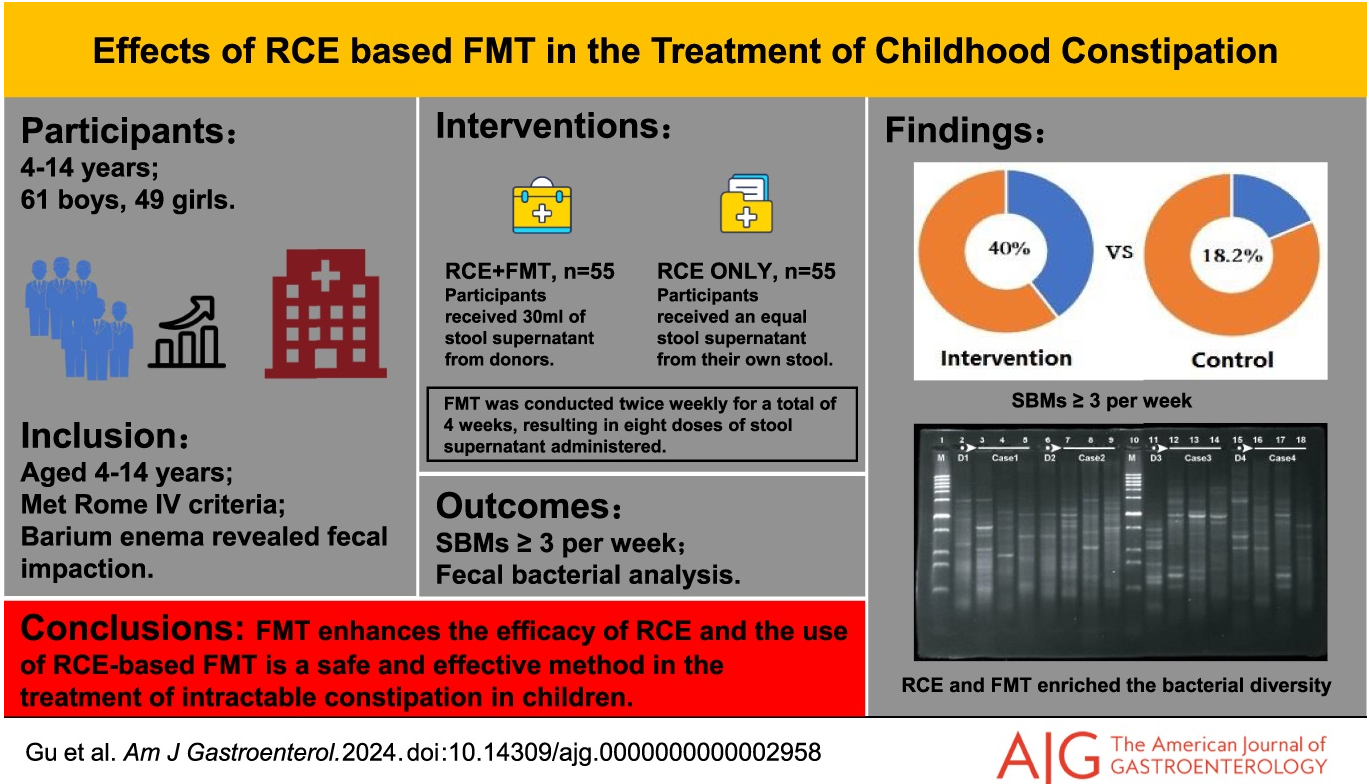
Methods: The efficacy of retrograde colonic enema (RCE) with fecal microbiota transplantation (FMT) was studied in a randomized, double-blind, controlled trial with 110 children. The initial cohort recruited was 576 patients; however, 466 were excluded for not meeting inclusion criteria. All participants received a daily RCE, followed by a 4-week FMT treatment (twice a week) and a 12-week follow-up period. 

Key findings:

  • At the end of the follow-up period, 22 patients (40.0%) in the FMT with RCE group and 10 patients (18.2%) in the placebo with RCE group had ≥ 3 spontaneous bowel movements per week

There was a low response to RCE alone which the authors attributed in part to the severity of constipation in the cohort. It is unclear the degree of compliance with the treatment protocol which was done in the home setting. There was a prior open-label study with NJ FMT which improved constipation in half of participants.

My take: Modulating the microbiome can have beneficial effects on stool frequency. This can be through diet and possibly FMT in severe cases of constipation. The availability of capsules could make this type of therapy easier but perhaps less palatable. Even if FMT proves to be a useful treatment, the optimal treatment regimen is not clear.

Related blog posts:

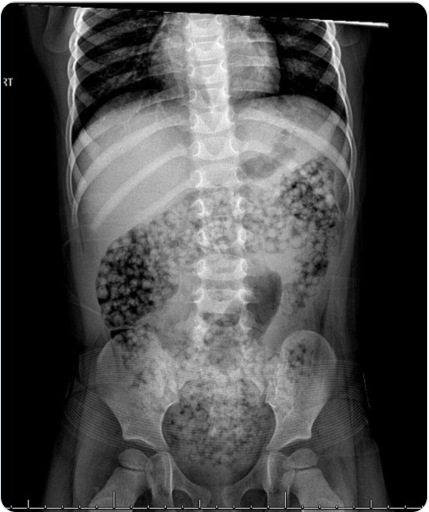
Weird Xray and Successful Treatment for Water Bead Ingestion

C Hoffman et al. J Pediatr Gastroenterol Nutr. 2024;78:448–449. Open Access! Orbeez ingestion: Successful medical management of1000 absorbent bead ingestion in a 3‐year‐old patient

An excerpt:

“There is no consensus regarding optimal management in instances of Orbeez™ ingestion. However, a review of reported cases from 2021 indicated that of 43 cases of bowel obstruction secondary to water bead ingestions, two patients required endoscopic removal and the remaining 41 required surgical enterotomy or intestinal resection. We report a case of successful medical management following ingestion of over 1000 water beads…The patient was placed on a clear liquid diet and received a mineral oil enema with minimal passage of beads. She was then started on sennosides and erythromycin ethylsuccinate to help stimulate expulsion. Stools were closely monitored and revealed passage of greater than 1000 beads over the next 24 h.”

Related blog posts:

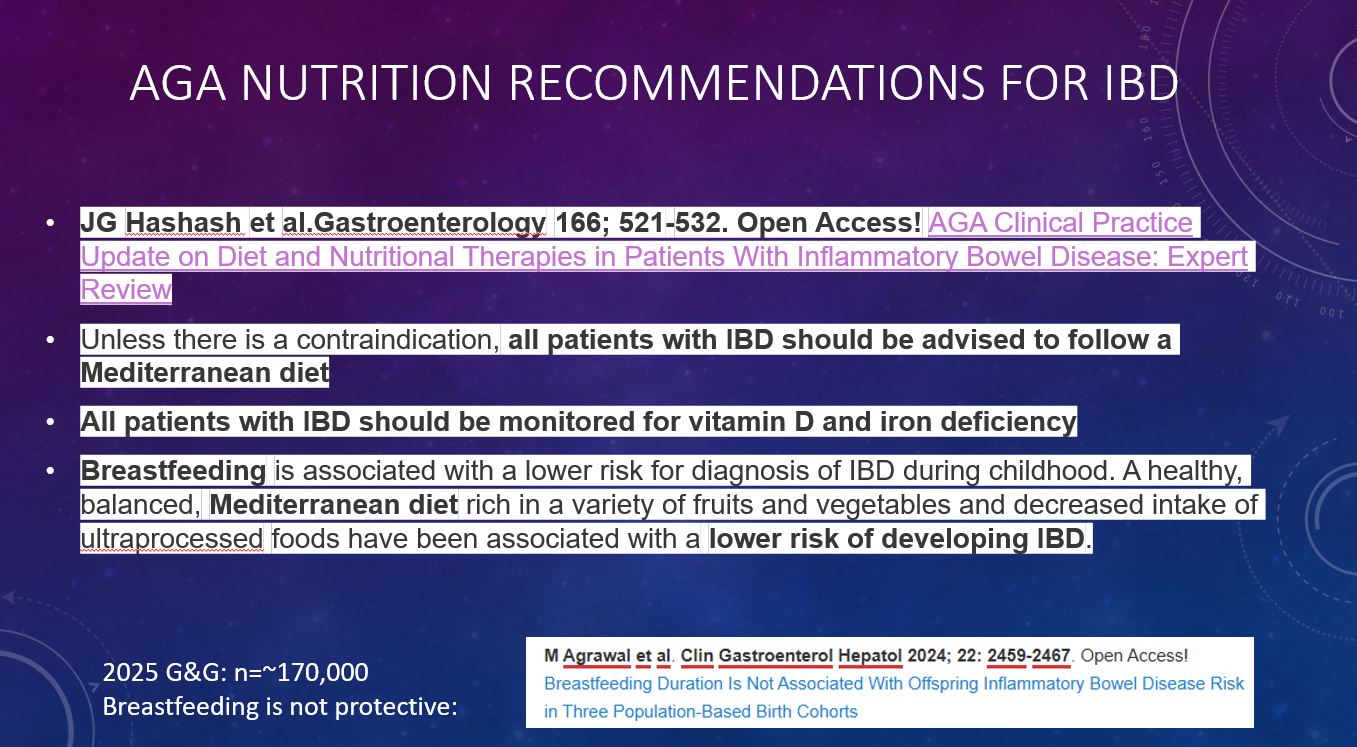
Is Breastfeeding Linked to IBD Risk in Offspring?

M Agrawal et al. Clin Gastroenterol Hepatol 2024; 22: 2459-2467. Open Access! Breastfeeding Duration Is Not Associated With Offspring Inflammatory Bowel Disease Risk in Three Population-Based Birth Cohorts

The authors utilized  prospectively collected data from 3 population-based birth cohorts (Danish National Birth Cohort, Norwegian Mother, Father, and Child Cohort, and All Babies in Southeast Sweden). This collectively included nearly 170,000 offspring.

Key findings:

  • During median follow-up of 16.3–22.3 years, between 1996 and 2021, 543 offspring were diagnosed with IBD
  • In each country, there was no association between exclusive breastfeeding duration and offspring IBD risk

Discussion:

“In contrast to majority of case-control studies, both cohort studies reported null association between breastfeeding, treated as a binary exposure (any versus no breastfeeding) or by duration, and offspring IBD risk. Similarly, 2 nested case-control studies, leveraging prospectively collected data on early life exposures as part of the population-based Jerusalem Perinatal Study and 2 United Kingdom birth cohorts (the 1946 National Survey of Health & Development and the 1958 National Child Development Study) reported null associations between breastfeeding and IBD risk.22,23 Data from these studies, which are more rigorous in methodology compared with case-control studies, are consistent with findings from our analyses.”

My take: While this study has some limitations inherent in observational data, this study with prospectively-collected data indicates that breastfeeding did not modulate the risk of developing IBD.

Related blog posts:

La Fortuna, Costa Rica

Botox for Pediatric Gastrointestinal Disorders

M Homan et al. J Pediatr Gastroenterol Nutr. 2024;79:1096–1105. Open Access! Drugs in focus: Botulinum toxin in the therapy of gastrointestinal disorders in children (Review)

Botox has been used for the following:

  • Achalasia
  • Cricopharyngeal achalasia
  • Retrograde cricopharyngeal dysfunction
  • Delayed gastric emptying
  • Anal achalasia
  • Constipation after Hirschsprung disease surgery
  • Selected functional constipation
  • Chronic anal fissure

With regard to achalasia, “Botox can be considered only in patients in whom rapid weight gain is important to improve surgical outcomes.”

With regard to gastroparesis/delayed gastric emptying in children, the authors note the following:

‘A recent retrospective study from the Mayo Clinic analysed the response to intrapyloric Botox in children (n = 20) with gastroparesis and concluded that intrapyloric Botox injection in children is safe and can provide temporary relief for patients with refractory upper gastrointestinal symptoms with and without gastroparesis.43 [This was] a meta-analysis, including six studies, 160 patients, which showed that 68% of patients responded to intrapyloric Botox irrespective of the presence of gastroparesis, while among patients diagnosed with gastroparesis the therapeutic response was 66%.43 These results suggest that intrapyloric Botox can be effective not only in children with gastroparesis but also in children with refractory functional upper gastrointestinal symptoms.’ In their conclusion, the authors note “Intrapyloric Botox injection is increasingly used for the treatment of gastroparesis but evidence supporting its use in children is still scarce.”

My take: Overall, this is a helpful review.

Related blog posts:

“Commercial Insurance Isn’t in the Health Care Business. It’s in the Financial Business.”

Katherine Eban, Vanity Fair 12/12/24: Doctors Seethe Over Insurance Companies’ “Out of Control” Tactics

A recent Vanity Fair Article echoed some of the problems that our group has experienced with insurance companies.

An excerpt:

While no one can seriously justify the decision to gun down a father of two to make a political point, Americans seem to agree on one thing: Something does need to be done about the country’s broken health insurance system.

The brutal slaying, and the frenzied manhunt that followed, have exposed widespread frustration with a system of for-profit health insurance that many Americans feel is actually killing them, one delayed-or-denied health insurance claim at a time. And doctors are as fed up as their patients…

Struggling with the seemingly arbitrary policies and undermarket reimbursements offered by UnitedHealth Group and other insurers, doctors feel trapped in a zero-sum game that has robbed them of their clinical independence.

Four companies, known collectively as BUCA—Blue Cross and Blue Shield, UnitedHealth, Cigna, and Aetna—have become so powerful that “when doctors try to negotiate, they have to take whatever that carrier gives them,” says Ron Howrigon, a health care consultant who represents doctors in their dealings with insurers…

Amid this anger, UnitedHealth stands out for its sheer size, its aggressive moves to vertically integrate healthcare, and its expansive denial of claims, say health care experts and doctors. Headquartered in Minnetonka, Minnesota, it is a behemoth that took in more than $370 billion last year, making it America’s fourth-largest corporation by revenue. It insures more than 26 million Americans. More than one tenth of US doctors are either employed by or affiliated with the UnitedHealth subsidiary Optum Health

Doctors in independent practice groups describe strong-arm tactics by the company—suddenly pushing them out of network, slashing their reimbursements, and stranding their patients with almost no notice. “Their interest is in killing private practice physicians,” says a North Carolina anesthesiologist…

The travails of Rheumatology Associates, P.C., the largest private rheumatology practice in Indiana, is a case in point. UnitedHealth offered the doctors in the group such paltry reimbursements that negotiations on a new contract ground to a halt…The group met with the Indiana attorney general’s office…

The company’s conduct was often nightmarish, even for patients in network. “Even when we get approvals on their letterhead, they would turn around, deny claims, and say they were approved incorrectly.”

“They have so much power, they are out of control. They believe they are untouchable.”

My take: In the article, a health policy physician states the following: “Commercial Insurance Isn’t in the Health Care Business. It’s in the Financial Business.”

Our group is currently out of network with UnitedHealth. We negotiated with them for more than two years and offered them rates that were as good or better than all of the other commercial insurers. Their claims about trying to negotiate rates that are “affordable for consumers and providers” are misleading. In our case, they are making their insured patients pay much more by forcing them to see other providers at an academic center with much higher costs, less availability, and longer travel distances. They don’t care about forcing patients, who have had long-standing relationships, to find new doctors or the inconvenience and cost to patient families. Their aim is to leverage their consolidation of coverage to force smaller groups to accept lower reimbursements. Over time, this will lead to even fewer options for patients.

Related blog posts: