What Can We Conclude from Five Patients Treated with a Combination of Infliximab and Tofacitinib?

Most often a letter to the editor would not grab my attention. A recent letter did: Full Text: Tofacitinib Is Safe and Effective When Used in Combination With Infliximab for the Management of Refractory Ulcerative Colitis (R Gilmore et al. Clin Gastroenterol Hepatol 2021; 1302-1303; reply 1303-1304 by JA Berinstein et al.)

This reported case series with 5 patients with severe ulcerative colitis (UC) who received a combination of tofacitinib and infliximab for at least 90 days were retrospectively reviewed. Tofacitinib dosing was de-escalated to 5 mg twice daily after 8 weeks. Thiopurine therapy was stopped with tofacitinib initiation.

Key findings:

  • Median duration of combination therapy was 9 months (range, 4–12 months). At 90 days, all patients had a reduction in Mayo score of ≥3. Four patients improved clinically and biochemically (Table 1), with 3 patients achieving steroid-free remission.
  • The only adverse event reported was one patient developing varicella zoster.

The authors letter title regarding tofacitinib being “safe and effective” is clearly overstated. The reply notes that in limited experience the group from the University of Michigan had a 50-year-old man develop severe pulmonary and CNS disease due to acquisition of legionnaires disease while on combination tofacitinib and infliximab.

My take: (borrowed from reply) “Efficacy and safety data obtained through rigorous randomized trials are needed…it is possible that long-term use of combination tofacitinib and infliximab will lead to an unacceptable risk of infection.”

Another study of tofacitinib: GR Lichtenstein et al. Inflamm Bowel Dis 2021; 27: 816-825. Tofacitinib, an Oral Janus Kinase Inhibitor: Analysis of Malignancy (Excluding Nonmelanoma Skin Cancer) Events Across the Ulcerative Colitis Clinical Program Key finding: With an exposure of 2576.4 patient years & 124 overall cohort tofacitinib-treated patients, 20 developed a malignancy

Related blog post:

Key West, FL

Are Gastroparesis and Functional Dyspepsia Part of the Same Problem?

A recent post (Is A Gastric Emptying Study Helpful in Children?) reviewed data in children indicating that gastric emptying study (GES) results did not correlate with symptom severity in children with functional dyspepsia (FD) symptoms.

Now a 12-year study in adults (n=944) (PJ Pasricha et al. Gastroenterol 2021; 160; 2006-2017. Full text: Functional Dyspepsia and Gastroparesis in Tertiary Care are Interchangeable Syndromes With Common Clinical and Pathologic Features) shows that FD is similar to gastroparesis in terms of clinical and pathological features and that diagnosis of these disorders were NOT fixed. Many patients with FD developed criteria of gastroparesis and many with gastroparesis were later reclassified as FD after followup GES.

Key findings:

  • At 48-weeks, 42% of patients with an initial diagnosis of gastroparesis were reclassified as FD based on gastric-emptying results at this time point; conversely, 37% of patients with FD were reclassified as having gastroparesis
  • In a subset of patients, full-thickness biopsies of the stomach showed loss of interstitial cells of Cajal and CD206+ macrophages in both groups compared with obese controls.
  • The 48-week clinical outcomes were similar. Symptom severity remained “on average unchanged despite the change in gastric-emptying status”

My take (borrowed from authors): This study shows that “patients initially classified as one or the other are not distinguishable by clinical features or by follow-up assessment of gastric emptying…both disorders are unified by characteristic pathologic features, best summarized as a macrophage-driven “cajalopathy” of the stomach.”

While the authors state that a GES lacks reliability, the associated editorial argues that a GES may still be useful (J Tan et al. pg 1931. Full text: Gastroparesis: A Dead-end Street After All?) As individuals with delayed GE “fail to benefiit” from neuromodulators, a GES may influence treatment. However, they note that ACG guidelines indicate that a GES is not needed and all patients with dyspepsia symptoms can be treated in a “uniform sequence of proton pump inhibitors, tricyclic antidepressants and prokinetics as third-line therapy.”

Related blog posts:

Islamorada, FL

Microscopic Disease Does Not Predict Relapse in Crohn’s Disease

AB Hu et al. Clin Gastroenterol Hepatol 2021; 19: 1226-1233. Full text: Ileal or Colonic Histologic Activity Is Not Associated With Clinical Relapse in Patients With Crohn’s Disease in Endoscopic Remission

In this retrospective study with 129 patients (mean age 25 yrs, mean disease duration 14.5 yrs) whose CD was in clinical/endoscopic remission, the authors examined factors associated with clinical relapse within 2 years; this included dose escalation, change in therapy, need for systemic steroids, or CD-related hospitalization or surgery.

Key findings:

  • Within 2 y of endoscopic evaluation, 42 patients (32.6%) had a clinical relapse.
  • There were no significant differences in proportions of patients with active ileal CD (23.8%), quiescent CD (28.6%), or normal histology (37%) between those who relapsed and those remaining in remission (P = .43). In addition, there was no no association between histologic features of active disease in ileal histology biopsies and symptom scores (Harvey Bradshaw index and simple inflammatory bowel disease questionnaire scores)
  • There were no significant differences in proportions of relapses among patients with active colonic disease (38.1%), quiescent disease (35.0%), or normal histology (27.9%, P = .73). 

My take: In terms of outcomes, clinical and endoscopic remission are important but whether histologic remission is needed is unclear (at this time).

Related blog posts:

Disclaimer: This blog, gutsandgrowth, assumes no responsibility for any use or operation of any method, product, instruction, concept or idea contained in the material herein or for any injury or damage to persons or property (whether products liability, negligence or otherwise) resulting from such use or operation. These blog posts are for educational purposes only. Specific dosing of medications (along with potential adverse effects) should be confirmed by prescribing physician.  Because of rapid advances in the medical sciences, the gutsandgrowth blog cautions that independent verification should be made of diagnosis and drug dosages. The reader is solely responsible for the conduct of any suggested test or procedure.  This content is not a substitute for medical advice, diagnosis or treatment provided by a qualified healthcare provider. Always seek the advice of your physician or other qualified health provider with any questions you may have regarding a condition.

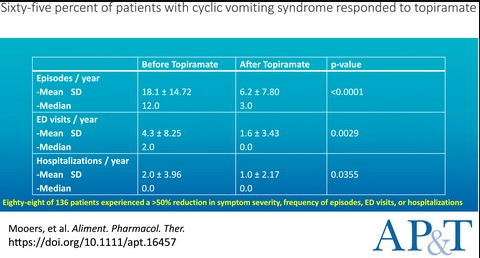
Topiramate -2nd Line Agent for Cyclic Vomiting Syndrome

H Mooers et al. AP&T 2021; https://doi.org/10.1111/apt.16457 Retrospective review of patients treated for cyclic vomiting syndrome with topiramate

“Response was defined as a global improvement in symptoms or >50% reduction in the number of CVS episodes, ED visits or hospitalisations.” 92% of patients had previously failed TCA therapy.

Key findings:

  • “Sixty-five percent (88/136) of patients responded to topiramate in an intent-to-treat analysis.”
  • “There was a significant decrease in the annual number of CVS episodes (18.1 vs 6.2, P < 0.0001), CVS-related ED visits (4.3 vs 1.6, P = 0.0029), and CVS-related hospitalisations (2.0 vs 1.0, P = 0.035).”
  • Fifty-five percent of patients experienced side effects, and 32% discontinued the medication as a result. The most common side effects were cognitive impairment (13%), fatigue (11%) and paresthesia (10%).

Related blog posts:

Sacroiliitis, NAFLD, IMIDs -Concurring Problems with Inflammatory Bowel Disease

I Levine et al. Inflamm Bowel Dis 2021; 809-815. Prevalence, Predictors, and Disease Activity of Sacroiliitis Among Patients with Crohn’s Disease

Key findings in this cross-sectional retrospective study (n=258, median age 30 yrs):

  • Overall, 17% of patients had MRI evidence of sacroiliitis, of whom 73% demonstrated bone marrow edema.
  • Female gender, back pain, and later age of CD diagnosis were associated with sacroiliitis (P = 0.05, P < 0.001, P = 0.04, respectively).
  • Disease activity (clinical, endoscopic, and radiographic), disease location and CD therapy were not associated with sacroiliitis on MRE.
  • More than two-thirds with MRE evidence of sacroiliitis were never seen by a rheumatologist.

A Lin et al. Inflamm Bowel Dis 2021; 947-955. Prevalence of Nonalcoholic Fatty Liver Disease in Patients With Inflammatory Bowel Disease: A Systematic Review and Meta-analysis

Key finding:

  • Data pooled from 27 studies showed the prevalence of NAFLD among IBD patients was 32% (substantial heterogeneity); this is “statistically significantly higher than the prevalence of NAFLD in the general population (25.2%; P < 0.001)”

M Attauabi et al. Inflamm Bowel Dis 2021; 927-939. Systematic Review with Meta-analysis: The Impact of Co-occurring Immune-mediated Inflammatory Diseases on the Disease Course of Inflammatory Bowel Diseases

A total of 93 studies were identified, comprising 16,064 IBD patients with co-occurring IMIDs and 3,451,414 IBD patients without IMIDs. IMIDs included the following:

  • Unspecified autoimmune disease
  • Diabetes type 1
  • Asthma
  • Grave disease
  • Spondyloarthropathy
  • Ankylosing spondylitis
  • Iridocyclitis
  • Uveitis
  • Rheumatoid arthritis
  • Polymyalgia rheumatica
  • Psoriasis/psoriatic arthritis
  • Primary Sclerosing Cholangitis
  • Celiac disease
  • Pyoderma gangrenosum
  • Pernicious anemia
  • Autoimmune hepatitis
  • Sarcoidosis
  • Giant cell arteritis
  • Primary biliary cholangitis
  • Hashimoto thyroiditis
  • Episcleritis
  • Sjogren syndrome

Key findings: Patients with IBD and co-occurring IMIDs were at increased risk of having extensive colitis or pancolitis (risk ratio, 1.38; 95% Cl, 1.25–1.52; < 0.01, I2 = 86%) and receiving IBD-related surgeries (risk ratio, 1.17; 95% Cl, 1.01–1.36; P = 0.03; I2 = 85%) compared with patients without IMIDs

Image below from Bahia Honda State Park (FL)

Pediatric Gastroenterology Hospitalists –Job Wanted?

A recent article (M Latorre et al. Clin Gastroenterol Hepatol 2021; 19: 871-875) describes “A Practical Guide to Establishing a Gastroenterology Hospitalist Program (in adult GI)”

Our group had flirted with the idea of a GI Hospitalist (GIH) many years ago when one of the partners expressed some interest. To establish this type of job takes a lot of planning.

Some of the key points:

  • “Proactively incorporating scheduling measures to provide the GIH with coverage and backup is important; otherwise the job can become easily overwhelming.” Outpatient faculty have to provide coverage to assure the individual is protected and covered for emergencies, weekends, and holidays. “Creating dedicated shifts with daily start and stop times allow for more control over the GIH’s hours.”
  • The authors note that when they began their GIH, the outpatient faculty rotated and assisted with afternoon consults/procedures to protect GIH from long days and burnout.
  • In adult medicine, a GIH can help improve GI practice profitability by allowing outpatient doctors to increase office revenue and endoscopic procedures. In pediatrics, it is possible that a GIH would generate more billings than outpatient counterparts due to increased procedural demands for inpatients.
  • GIH can improve patient care (timely endoscopy, focus on inpatient problems), improve continuity, and reduce costs similar to other hospitalists.

My take: If there is adequate help, especially to prevent long days and increased night call, this model could work in pediatric GI as well.

Related blog posts:

This story below was NOT from ‘The Onion.’ NPR 6/10/21:

How Insurance Companies Can Help Stop the Pandemic in the U.S.

From AJC, Hashem Dezhbakhsh: An incentive to encourage vaccination

This is a good read. An excerpt:

Vaccine hesitancy, which can prolong the pandemic, is a textbook example of a negative consumption externality, where an individual’s choice can harm or impose costs on others. Indoor smoking, drunk driving, or littering are other examples…

One policy option is to use the insurance mechanism, with risk assessment and risk pricing as its enforcing arms….

For example, a risky driver has a higher auto insurance premium than a safe driver, a smoker has a higher health insurance premium than a non-smoker,…Similarly, health insurance premiums, deductibles, and co-pays can be set higher for those who are unvaccinated...

Using risk pricing to set insurance premiums and co-pays for these individuals makes good sense and is fair policy. It incentivizes individuals to vaccinate, while also providing a fairer insurance pricing system by charging those with self-selected higher risk a higher price, instead of shifting their medical costs to others through uniform insurance pricing.

Hydrangeas

Why It Is Hard to Stop Immunosuppression with Autoimmune Hepatitis and Lower Bone Density with Fatty Livers

C Schulthei et al. Hepatology 2021; 73: 1436-1448. Full text: Next-Generation Immunosequencing Reveals Pathological T-Cell Architecture in Autoimmune Hepatitis

This is highly technical study of 60 patients with AIH. “Our key finding was a clearly biased signature of TRBV-J gene usage in peripheral and liver-infiltrating T-cells of patients with AIH, independent of AIH predisposing HLA-DRB1 alleles. This signature was unaffected by immunosuppressive treatment and not related to complete biochemical disease remission. This suggests that treatment acted on T-cell functionality rather than on the underlying pathological T-cell architecture in this disease that has a high relapse rate.”

My take (borrowed from authors): “Patients with AIH show profound and persisting T-cell architectural changes that may explain high relapse rates after tapering immunosuppression.”

Related blog posts:

LF Chun et al. J Pediatr 2021; 233: 105-111. Hepatic Steatosis is Negatively Associated with Bone Mineral Density in Children

Key findings:

  • Using a community-based sample of 235 children, the authors found that there was a significant negative relationship between liver MRI-PDFF and BMD z score R = −0.421, P < .001).
  • There was no significant association between vitamin D status and BMD z score (P = .94).
  • Children with clinically low BMD z scores were found to have higher alanine aminotransferase (P < .05) and gamma-glutamyl transferase (P < .05) levels compared with children with normal BMD z scores.

My take: This study shows another organ that is affected in children with fatty liver disease; other associated problems include increased risk for cardiovascular disorders, pancreatic dysfunction/diabetes, cancer, polycystic ovary syndrome, and neurologic disorders

Related blog posts:

Image below near the Seven Mile Road on the Florida Keys:

What is the Risk of Inflammatory Bowel Disease in Patients with Hirschsprung’s Disease

Background: It is well-recognized that enterocolitis can occur in individuals with Hirschsprung’s disease, even after surgery. Case series have described cases of inflammatory bowel disease (IBD) in individuals with Hirschsprung’s which have some overlapping features with Hirschsprung disease-associated enterocolitis (HAEC). Those with IBD, however, have a constellation of clinical findings more typical of IBD and respond to treatments used in IBD.

A recent study from Canada (CN Bernstein et al. J Pediatr 2021; 233: 98-104. Increased Incidence of Inflammatory Bowel Disease After Hirschsprung Disease: A Population-based Cohort Study) provides more data regarding IBD in individuals with HD.

Key findings:

  • In the study from Ontario, 18 of 716 (2.5%) ultimately developed IBD (168.8 per 100 000 person-years), compared with 7109 of 3 377 394 children without Hirschsprung disease (0.2%, 14.2 per 100 000 person-years); thus, this represented a 12-fold increased risk.
  • In the study from Alberta and Manitoba, the OR of having had Hirschsprung disease before a diagnosis of IBD compared with controls was 74.9 (95% CI, 17.1-328.7) and 23.8 (95% CI, 4.6-123) respectively.
  • Crohn’s disease was more common after Hirschsprung disease than ulcerative colitis.

My take: I have personally seen IBD in HD and wondered how much increased risk that HD conferred. Now the question: what is the mechanism?

Related blog posts:

Alongside the Seven Mile Bridge in the Florida Keys:

Obesity and Cellular Aging in Childhood

A provocative study (MJ Baskind et al. J Pediatr 2021; 233: 141-149. Obesity at Age 6 Months Is Associated with Shorter Preschool Leukocyte Telomere Length Independent of Parental Telomere Length) suggests that obesity in infancy can result in shortened telomere length, which is a cumulative marker for cellular aging. Also, leukocyte telomere length (LTL) is associated with known risk factors for cardiometabolic disease, including obesity and smoking

The authors prospectively studied a group of 97 woman-infant dyads from the Latinx, Eating and Diabetes cohort. Key findings:

  • Obesity at 6 months was negatively associated (β = −0.21; P < .001) with leukocyte telomere length
  • However, there was a lack of association between obesity at earlier ages (2-5 years) and preschooler LTL in the same cohort
  • Any breastfeeding at 6 months was positively associated with leukocyte telomere length

From the associated editorial: JL Buxton, fulltext: Early Warning Signs? Infant Obesity and Accelerated Cellular Aging “These results are based on data from a relatively small sample and await replication in larger cohorts recruited from different populations.”

My take: This study shows that obesity could be affecting our bodies in ways that most of us have never contemplated.

Aerial view of the “the quicksands” off the coast of Key West: