IBD Update -December 2020

DHW Little et al. Am J Gastroenterol 2020;115:1768–1774. Effectiveness of Dose De-escalation of Biologic Therapy in Inflammatory Bowel Disease: A Systematic Review (Thanks to Ben Gold for this reference)

In this systematic review, a total of 995 adult patients were included from 18 observational studies (4 prospective and 14 retrospective), 1 nonrandomized controlled trial, and 1 subgroup analysis of a randomized controlled trial.

Key findings:

  • Biologic dose de-escalation was associated with relapse rates as high as 50% at 1 year. Overall, clinical relapse occurred in 0%–54% of patients who dose de-escalated biologic therapy (17 studies).
  • Lower rates of relapse (10%–25%) were reported in studies involving patients with endoscopic and/or histologic remission
  • These results are in agreement with a previous meta-analysis, which found a 1-year risk of relapse after discontinuation of anti-TNF therapy of 36% in CD and 28% in UC ( Gisbert JP, et al.. Am J Gastroenterol 2016;111:632–47).

My take: This study shows that dose de-escalation of biologic therapy in IBD
seems to be associated with high rates of clinical relapse

C Chapuis-Biron et al. Am J Gastroenterol 2020;115:1812–1820. Ustekinumab for Perianal Crohn’s Disease: The BioLAP Multicenter Study From the GETAID (Thanks to Ben Gold for this reference too)

In this national multicenter retrospective cohort study in 207 adult patients with either active or inactive perianal Crohn’s disease (pCD) who received ustekinumab (2017-2018). The majority had received multiple biologics (~85% had at least 2 anti-TNF agents, 28% had received vedolizumab) and prior anal surgeries (mean 2.8).

Methods: Success of ustekinumab was defined by (i) clinical success at 6 months of treatment assessed by the physicians’ judgment, with (ii) no need for dedicated medical treatment for perianal lesions (antibiotics and/or topics) nor (iii) unscheduled surgical treatment. For perianal disease evaluation, clinical success was defined in the study protocol, by the absence of draining pus for fistulas, and no anal ulcers

Key findings:

  •  In patients with active pCD, success was reached in 57/148 (38.5%) patients.
  • Among patients with setons at initiation, 29/88 (33%) had a successful removal.
  • In patients with inactive pCD at initiation, the probability of recurrence-free survival was 86.2% and 75.1% at weeks 26 and 52, respectively.
  • The absence of ustekinumab optimization was associated with upper odds of success (OR 2.74). “We can suppose in our present study that optimization of treatment was needed in severe refractory patients with no or insufficient response to ustekinumab. Thus, in these nonresponders, success was not achieved despite optimization.”

My take (partly borrowed from authors): “This large multicenter dedicated study adds
substantial evidence to the growing literature on ustekinumab effectiveness in refractory CD.” For pCD, optimization of ustekinumab has a low likelihood of improving response.

Related blog posts -De-escalation:

Related blog posts -Ustekinumab/Crohn’s Disease:

COVID-19 -Now #1 Cause of Death in U.S.

S Woolf et al. JAMA. Published online December 17, 2020. doi:10.1001/jama.2020.24865: Full text: COVID-19 as the Leading Cause of Death in the United States

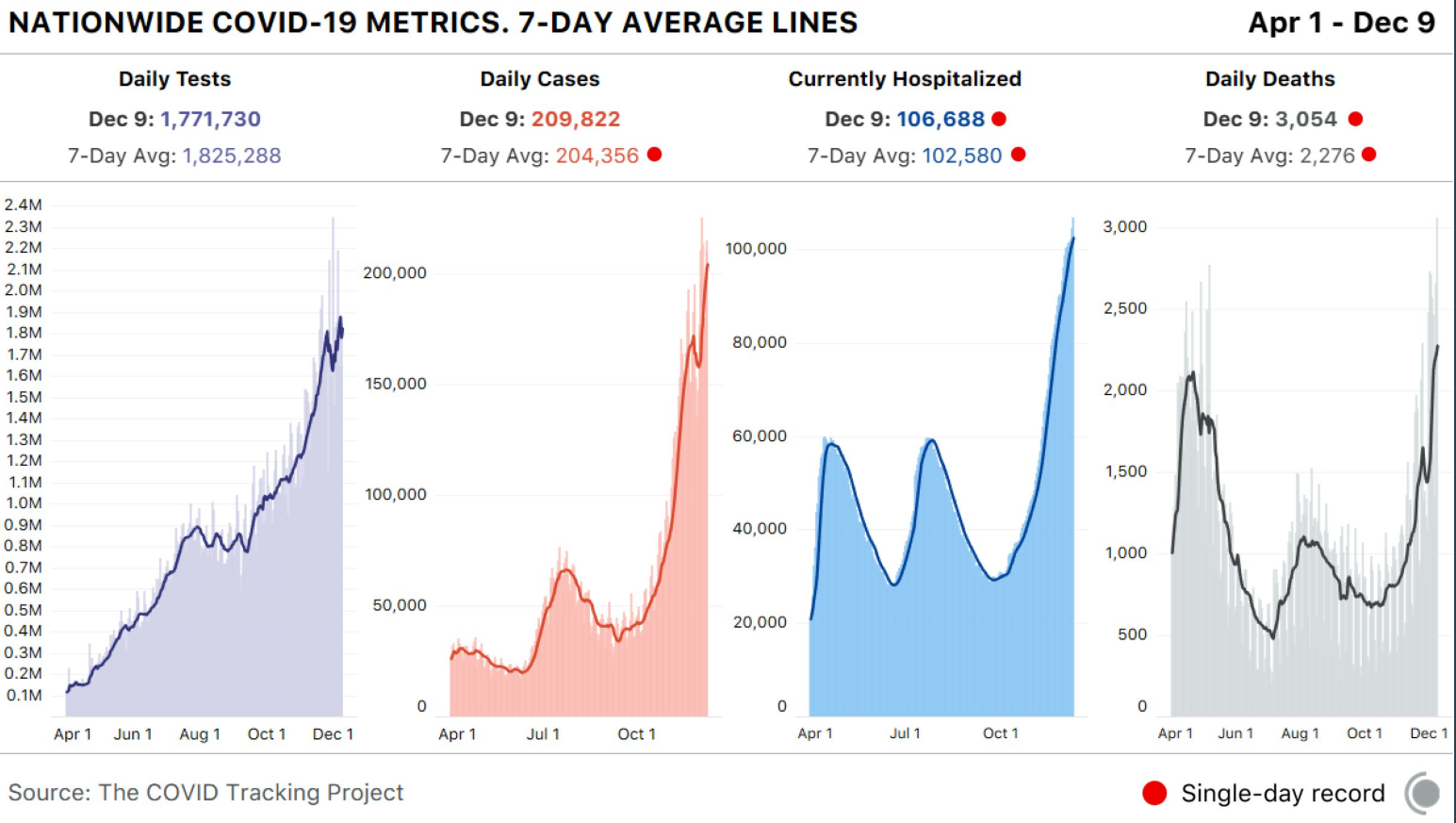
  • Between November 1, 2020, and December 13, 2020, the 7-day moving average for daily COVID-19 deaths tripled, from 826 to 2430 deaths per day
  • As occurred in the spring, COVID-19 has become the leading cause of death in the United States (daily mortality rates for heart disease and cancer, which for decades have been the 2 leading causes of death, are approximately 1700 and 1600 deaths per day, respectively)

Related blog posts:

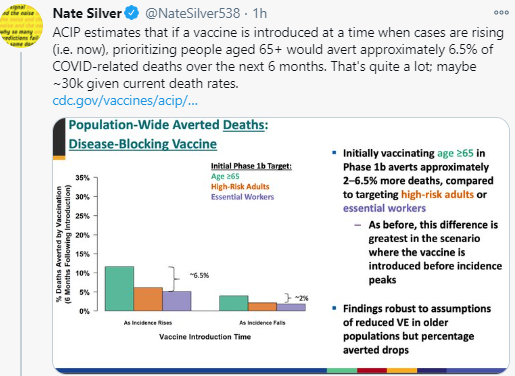
Vaccine Strategy: Nate Silver’s twitter feed suggests that after vaccination of medical personnel, focus of vaccine efforts should rely on age rather than at-risk conditions (which could affect 100 million in U.S). Using an age-based system would also be easier; it would minimize influence and wealth in the distribution of the vaccine.

COVID-19: Excess Mortality in Younger Adults

From NEJM Journal Watch: COVID-19: Excess Mortality in Younger Adults

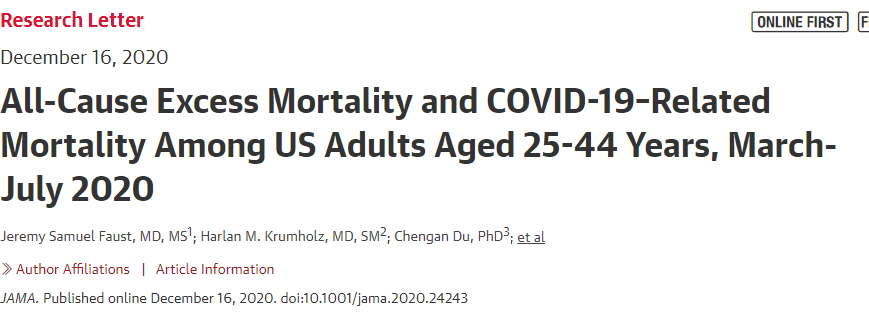
“Excess mortality in younger adults: Among U.S. adults aged 25 to 44, there were 19% more deaths than expected — or 12,000 people — from March through July 2020. In JAMA, the researchers — including Dr. Rochelle Walensky, who has been nominated to lead the CDC — report that 38% of this excess mortality was directly from COVID-19, but that proportion varied by region. Deaths from COVID-19 were similar to or exceeded unintentional deaths from opioids in this age group in 2018 in several areas of the country. The authors write that this may be an underestimate of the COVID-19 mortality burden in younger adults, as they may have been undertested.”

Link to study: All-Cause Excess Mortality and COVID-19–Related Mortality Among US Adults Aged 25-44 Years, March-July 2020

Bone Health in Children with Biliary Atresia

S Ruuska et al. JPGN 2020; 71: 707-712. Impaired Bone Health in Children With Biliary Atresia

This retrospective study from Finland details the bone health of children with biliary atresia (BA). Key findings:

  • Out of 49 patients, 7 (14%) were diagnosed with rickets during infancy. Clearance of jaundice [odds ratio 0.055, 95% confidence interval [CI] 0.00266–0.393; P < 0.01] was a protective factor against rickets.
  •  In DXA measurements, median lumbar spine aBMD anthropometrically adjusted z-scores were as follows:
    • in native liver survivors 0.8 (interquartile range [IQR] −1.9 to 1.4) at 5 and −0.3 (IQR −1.3 to 0.8) at 10 years
    • in liver transplanted patients 0.4 (IQR −0.2 to 1.1) at 5 and 0.6 (IQR −0.1 to 1.3) at 10 year.
  • Most BA patients have aBMD within normal range between 5 and 10 years of age irrespective of liver transplantation status.

My take: This study shows that early in life there is frequent bone impairment in children with BA. This generally improves in most children as cholestasis resolves (with or without liver transplantation).

Related blog posts:

Indian Rocks Beach, FL

Intestinal Inflammation in Patients with Cystic Fibrosis

An interesting study (C Tetard et al. JPGN 2020; 71: 778-781. Reduced Intestinal Inflammation With Lumacaftor/Ivacaftor in Adolescents With Cystic Fibrosis) describes the association of Lumacaftor/Ivacaftor and improvement in intestinal inflammation based on calprotectin levels.

This was a small study with 15 patients, with 9 patients having very elevated fecal calprotectin (FC) (>250) and the median level was 713 mcg/g for the entire cohort at baseline. After treatment with lumacaftor/Ivacaftor, median FC level was 102 mcg/g.

This pilot study is intriguing and makes the point that intestinal inflammation is commonly seen in children with cystic fibrosis. However, this study has some striking differences from prior studies.

My take: This study suggests that Lumacaftor/Ivacaftor is associated with a significant decrease in intestinal inflammation. When one looks at prior studies, the FC values presented in this study at baseline are much greater which could indicate significant selection bias.

Related blog posts:

Indian Rocks Beach, FL

Normative Data for Fecal Calprotectin, age 4-16 yrs

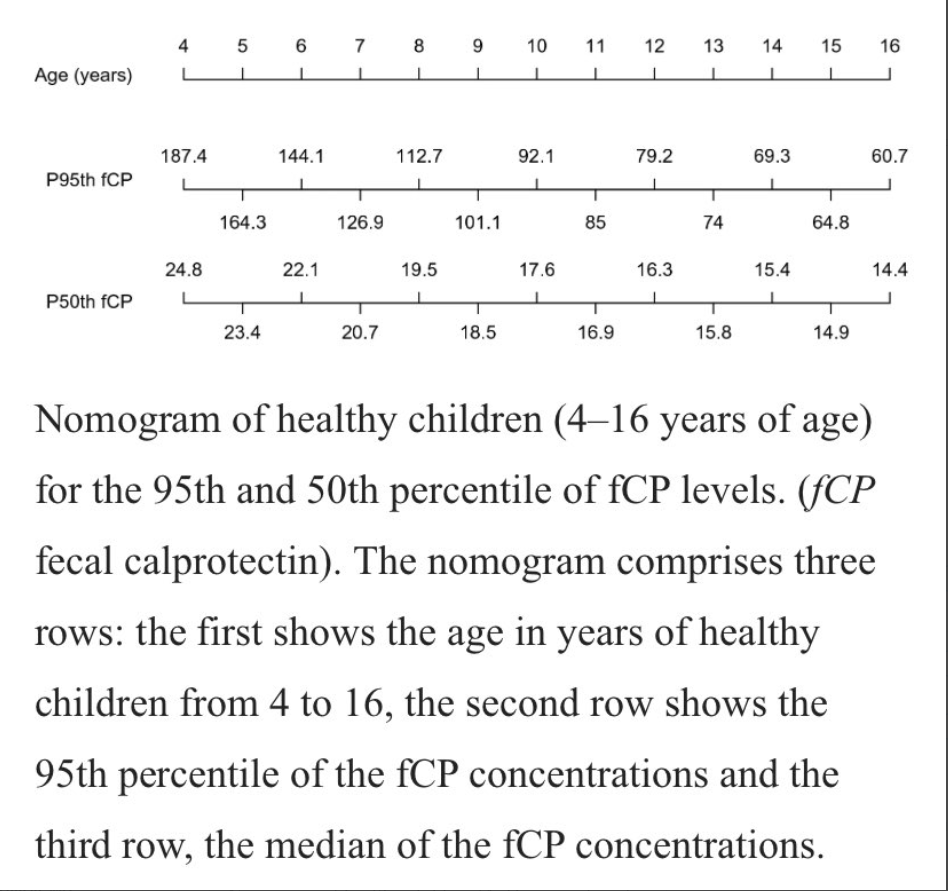
This study collected prospective data from 212 children. Key finding: The median and 95th percentile for fCP were 18.8 mg/kg and 104.5 mg/kg, respectively. “We found a statistically significant association between the 95th percentile of fCP concentrations and age (p < 0.001).”

My take: This is another study showing that calprotectin cut off values need to be higher in younger children.

Related blog posts:

Is GLP2 Worth $300K per Year?

E Ramos Boluda et al. JPGN 2020; 71: 734-739. Experience With Teduglutide in Pediatric Short Bowel Syndrome: First Real-life Data

S Hill. JPGN 2020; 71: 697-698 (editorial) Use of GLP-2 May Herald a New Era of Improved Outcome of Short Bowel Syndrome-associated Intestinal Failure

The study and associated editorial highlight the effectiveness of GLP-2 in a prospective cohort of 17 patients with short bowel syndrome. It is noted that Dr. Hill has received funding from the pharmaceutical manufacturer of the product.

Key findings:

  •  A total of 12 of 17 patients achieved parenteral independence: 3 patients after 3 months of treatment, 4 patients at 6 months, and 5 after 12 months.
  • The percentage able to wean off parenteral nutrition was 17%, 44%, and 60% at 3, 6, and 12 months respectively. Only 1 patient did not exhibit improvement
  • Plasma citrulline levels, a marker for enteral autonomy, increased from a baseline average of 20 micromol/l to 37.5, 46.75, and37.9at 3, 6, and 12 months respectively.
  • Adverse reactions included abdominal pain 30%, nauseas 18%, injection-site reactions 22%, and headache 16%.

Both the editorial and the study comment briefly on the cost of the therapy. The editorial also notes the current recommendation for surveillance endoscopy in view of a hypothetical risk of malignancy.

My take: Is GLP2 Worth the Cost? It probably depends on who is paying and long-term safety data. Perhaps, we will develop tools to improve prediction of which patients will achieve enteral autonomy with GLP2 who would otherwise require ongoing parenteral nutrition.

Related blog posts:

Treating Pediatric Hepatitis C Infections is Cost-Effective. Plus COVID-19 mRNA Vaccine Study

E Greenaway et al. J Pediatr 2020; DOI:https://doi.org/10.1016/j.jpeds.2020.08.088. Free full text: Treatment of Chronic Hepatitis C in Young Children Reduces Adverse Outcomes and Is Cost-Effective Compared with Deferring Treatment to Adulthood

Methods: A state-transition model of chronic HCV was developed to conduct a cost-effectiveness analysis comparing treatment at age 6 years vs delaying treatment until age 18 years

Key findings:

  • After 20 years, treating 10 000 children early would prevent 330 cases of cirrhosis, 18 cases of hepatocellular carcinoma, and 48 liver-related deaths
  • The incremental cost-effectiveness ratio of early treatment compared to delayed treatment was approximately $12 690/quality-adjusted life-years gained and considered cost-effective

My take (=conclusion from authors): Delaying treatment until age 18 years results in an increased lifetime risk of late-stage liver complications. Early treatment in children is cost effective. Our work supports clinical and health policies that broaden HCV treatment access to young children.

Related blog posts:


FP Polack et al. NEJM Full text link: Safety and Efficacy of the BNT162b2 mRNA Covid-19 Vaccine

Published data on the Pfizer/BioNTech vaccine

Excess Deaths From COVID-19 and Other Causes

For musical fans: 2020: The Musical YouTube Link (~8 minutes) with Jimmy Fallon and Andrew Rannells


SH Woolf et al.. JAMA 2020; 324: 510-513. Excess Deaths From COVID-19 and Other Causes, March-July 2020

The authors compared deaths from 2014-2020 using data from the National Center for Health Statistics and US Census Bureau.

Key findings:

  • Between March 1 and August 1, 2020, 1 336 561 deaths occurred in the US, a 20% increase over expected deaths (1 111 031 [95% CI, 1 110 364 to 1 111 697]). 
  • Of the 225 530 excess deaths, 150 541 (67%) were attributed to COVID-19
  • The authors conclude that the excess deaths attributed to causes other than COVID-19 could reflect deaths from unrecognized or undocumented infection with severe acute respiratory syndrome coronavirus 2 or deaths among uninfected patients resulting from disruptions produced by the pandemic

My take: The COVID-19 situation has worsened considerably in the past 2 months and the final toll from this infection will be truly staggering; this unfortunately will include its indirect effects due to deferral of care

Outcome of Zen Magnets v. Consumer Product Safety Commission

PT Reeves, B Rudolph, CM Nylund. JPGN 2020; 71:699-703. Magnet Ingestions in Children Presenting to Emergency Departments in the United States 2009–2019: A Problem in Flux

When the 10th Circuit Court, with judges Gorsuch, Ebel, and Bacharah, rolled back high-powered magnet regulations in 2016, it was expected that this would result in more suffering in children. The referenced article by Reeves et al documents the effects of this decision.

Background: In 2016, the Zen Magnets decision resulted in magnets returning to the market with warning labels “but not performance standards favored by NASPGHAN (ie, making magnets either too large to swallow or too weak to cause harm).” In this study, the authors used data from the National Electronic Injury Surveillance System (NEISS), a database of consumer product injuries.

Key findings:

  • When stratified by time period, suspected magnet ingestion (SMI)per year was 1598 during off-market period (when product was banned) compared with 2826 during on-market period.
  • An estimated 23,756 children (59% males, 42% < 5 years old) presented with a SMI from 2009 to 2019.
  • There was an average annual case increase of 6.1% (P = 0.01).
  •  After 2017, there was a 5-fold increase in the escalation of care for multiple magnet ingestions (estimated n = 1094; CI 505–1686). “Escalation of care” refers to cases designated as ‘treated and transferred,’ ‘treated and admitted/hospitalized,’ or ‘held for observation.’
  • More data on this topic from CPSC 124 page report: (Link) Informational Briefing Package Regarding Magnet Sets

My take: Regulatory action is needed to prevent harm in children from these high-powered magnets.There are two companion bills in Congress which are in committee, one entitled “Magnet Injury Prevention Act.” These are clearly needed given previous judicial branch ruling.

Related blog posts: