Bad Diets –>High Mortality

A recent article in Lancet (“Health effects of dietary risks in 195 countries, 1990–2017:
a systematic analysis for the Global Burden of Disease Study 2017″ -open access) estimated that bad diets lead to 11 million deaths per year. Thanks to Ana Ramirez for sending me this article. “High intake of sodium, low intake of whole grains, and low intake of fruits were the leading dietary risk factors for deaths and DALYs globally and in many countries.”

A summary of this study was reported on NPR: Bad Diets Are Responsible For More Deaths Than Smoking, Global Study Finds

An excerpt:

About 11 million deaths a year are linked to poor diet around the globe…

As part of a new study published in The Lancet, researchers analyzed the diets of people in 195 countries using survey data, as well as sales data and household expenditure data. Then they estimated the impact of poor diets on the risk of death from diseases including heart disease, certain cancers and diabetes. (They also calculated the number of deaths related to other risk factors, such as smoking and drug use, at the global level.)…

“Generally, the countries that have a diet close to the Mediterranean diet, which has higher intake of fruits, vegetables, nuts and healthy oils [including olive oil and omega-3 fatty acids from fish] are the countries where we see the lowest number of [diet-related] deaths,” …

What would happen if everyone around the globe began to eat a healthy diet, filling three-fourths of their plates with fruits, vegetables and whole grains? We’d run out…

Improving diets won’t be easy: A range of initiatives may be needed, including nutrition education and increased access to healthy foods, as well as rethinking agricultural production.

Related blog posts:

 

IBD Update April 2019

Briefly noted:

Link (from KT Park’s twitter feed): What New Treatments for Crohn’s disease and Ulcerative Colitis Are Being Developed?

R Wittig et al. JPGN 2019; 68: 244-50. This study from Germany, using health insurance data, identified an overall pediatric inflammatory bowel disease (IBD) incidence of 17.41 per 100,000 in 2012 compared to 13.65/100,000 in 2009.  This is one of the highest incidence rates reported and agrees with other data suggesting increasing rates of IBD in pediatric populations.

B Christensen et al. Clin Gastroenterol Hepatol 2019; 17: 486-93.  This study provides data from 20 patients (CD =9, UC =11) who were treated with a combination of a calcineurin inhibitor and vedolizumab.  The calcineurin inhibitor was used as a ‘bridge’ treatment until the slower acting vedolizumab could be effective. After 52 weeks of treatment, 33% of the CD patients and 45% of the UC patients were in steroid-free clinical remission.  Three serious adverse events associated with calcineurin treatment.

G Pellet et al. Clin Gastroenterol Hepatol 2019; 17: 494-501. Retrospective study of calcineurin inhibitor induction with vedolizumab in 39 patients with refractory ulcerative colitis (36 had failed anti-TNF Rx).  11 patients (28%) required colectomy. week 14 response and remission noted in 56% and 38% respectively. Four serious adverse events were observed.

N Nalagatla et al. Clin Gastroenterol Hepatol 2019; 17: 494-501. In a retrospective study of 213 patients with steroid refractory acute severe ulcerative colitis, the authors did not find lower rates of colectomy in patients who received an accelerated infliximab dosing.  However, they were unable to control for confounding by disease severity. Patients who received an intial dose of 10 mg/kg had a lower colectomy rate than patients who received an initial dose of 5 mg/kg. Colectomy rates for accelerated vs standard infliximab dosing –in-hospital: 9% vs 8% respectively, at 3 months: 20% vs 14% respectively, at 12 months: 28% vs 27% respectively.

Related blog posts:

Shenandoah National Park

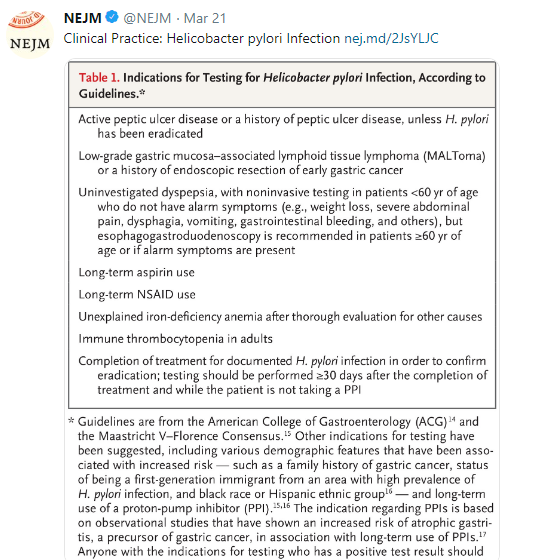
Helicobacter Pylori 2019 Review

A recent review (SE Crowe. NEJM 2019; 1158-65) provides a succinct summary of current H pylori management.

A couple of key points:

  • It is essential to test for cure after treatment 1 month afterwards
  • If retreatment is needed, use an alternative regimen
  • In the discussion of treatment, Dr. Crowe does NOT emphasize quadruple therapy except in individuals with a clarithromycin resistance probability of >25% (based on geographic incidence rates) or prior macrolide use.  She notes that in some populations that clarithromycin-based triple therapy had similar effectiveness as bismuth-based quadruple-based therapy.  Table 2 lists the 7 ACG approved treatment regimens.
  • It is noted that U.S. clarithromycin-resistance is between 21-30%.

Related blog posts:

Disclaimer: These blog posts are for educational purposes only. Specific dosing of medications/diets (along with potential adverse effects) should be confirmed by prescribing physician/nutritionist.  This content is not a substitute for medical advice, diagnosis or treatment provided by a qualified healthcare provider. Always seek the advice of your physician or other qualified health provider with any questions you may have regarding a condition.

Celiac Hepatopathy 2019

A recent retrospective study (E Benelli et al. JPGN 2019; 68: 547-51) examines a large cohort of patients (=700) who were diagnosed with celiac disease (CD) from 2010-2016 and had available liver transaminases.

Key findings:

  • ALT values >40 U/L were elevated in only 3.9% (27/700)
  • Younger age (<4.27 years) correlated with a higher risk of liver involvement with OR 3.73
  • Of these 27 patients with elevated ALT, 18 had adequate followup.  All but 3 patients normalized ALT values after at least 1 year; of these, 1 was diagnosed with sclerosing cholangitis. In the other two, one was thought to be nonadherent with gluten-free diet and one had dropped ALT to 47 U/L.
  • Thus, definitive autoimmune liver disease was identified in only one patient

My take: This study shows a lower rate of liver involvement than previous studies.

Related blog posts:

Joshua Tree National Park


Liver Shorts April 2019

CL Mack et al. JPGN 2019; 68: 495-501. This multicenter prospective open-label phase I/III trial of IVIG in biliary atresia patients status-post Kasai indicated that the infusions were tolerated.  However, though this study was not powered to detect efficacy, survival with native liver was LOWER among patients who had received IVIG (n=29): 58.6% compared to the comparison placebo group 70.5% (n=64).  Thus, despite the theoretical advantages of IVIG which targets aspects of the immune system and improvement in a murine model, in practice IVIG does not appear promising for biliary atresia.

D Kim et al. Hepatology 2019; 69: 1064-74. This study shows that despite improvements in hepatitis C mortality rates associated with newer treatments, there is an overall increase in mortality rates from cirrhosis and hepatocellular carcinoma.  This increase is driven by increasing prevalence and severity of both alcoholic liver disease and nonalchoholic fatty liver disease. The overall cirrhosis-related mortality increased from 19.77/100,000 persons in 2007 to 23.67 in 2016 with an annual increase of 2.3%. Similarly, the overall HCC-related mortality increased from 3.48/100,000 persons in 2007 to 4.41 in 2016 at annual increase of 2%. The editorial on page 931 (TG Cotter and MR Charlton) notes that each year there are more than 40,000 deaaths associated with chronic liver disease.

H Park et al. Hepatology 2019; 69: 1032-45. This study, using Truven Health MarketScan Cata, examined the outcomes of more than 26,000 patients with newly-diagnosed hepatitis C virus (HCV) infection.  Among the 30% who received oral direct-acting antiviral (DAA) therapy, there were improved outcomes in those with and without cirrhosis. In those with cirrhosis (n=2157), DAA was associated with a 72% and 62% lower incidences of HCC and DCC [decompensated cirrhosis] respectively. In noncirrhotic HCV patients (n=23,948), DAA was associated with a 57% and 58% lower incidence of HCC and DCC respectively.  In addition to improved health outcomes, DAA treatment resulted in decrease health care costs, especially for patients with cirrhosis.

Z Kuloglu et al. JPGN 2019; 68: 371-6.  In this multicenter Turkish study, the authors identified 810 children (median age 5.6 years) with unexplained transaminase elevation (62%),unexplained organomegaly (45%), obesity-unrelated liver steatosis (26%) and cryptogenic fibrosis or cirrhosis (6%).  LAL-D [lysosomal acid lipase deficiency] activity was deficient in 2 siblings (0.2%); both had LDL ~155.  Overall, even in at risk groups, LAL-D is rare.

Related posts:

Joshua Tree National Park

ESPGHAN Peutz-Jeghers Syndrome Position Paper

Management of Peutz-Jeghers Syndrome in Children and Adolescents: A Position Paper by the ESPGHAN Polyposis Working Group; Link:JPGN 2019; 68 (3): 442-452

This position paper serves as a good review and makes clear recommendations for evaluation and management.

In a single individual, a clinical diagnosis of PJS may be made when any one of the following is present:
1. Two or more histologically confirmed PJS polyps
2. Any number of PJS polyps detected in 1 individual who has a family history of PJS in close relative(s)
3. Characteristic mucocutaneous pigmentation in an individual who has a family history of PJS in close relative(s)
4. Any number of PJS polyps in an individual who also has characteristic mucocutaneous pigmentation.

SUMMARY OF RECOMMENDATIONS

  • Recommendation 1 Predictive genetic testing for an asymptomatic at risk child should be offered from the age of 3 years and should be performed earlier in a symptomatic at-risk child. (moderate recommendation, low-quality evidence, agreement 90%)
  • Recommendation 2 Lip and mucosal freckling is not diagnostic of PJS alone. Patients with lip and mucosal freckling suggestive of PJS should be referred to a geneticist for diagnostic genetic testing. Investigation of the GI tract is recommended to start no later than age 8 unless symptoms arise earlier. (weak recommendation, low-quality evidence, agreement 100%)
  • Recommendation 3 GI surveillance by upper GI endoscopy, colonoscopy, and VCE should commence no later than 8 years in an asymptomatic individual with PJS, and earlier if symptomatic…and generally be repeated every 3 years. Earlier investigation of the GI tract should be performed in symptomatic patients. (moderate recommendation, low-quality evidence, agreement 90%)
  • Recommendation 4 Patients with symptomatic intussusception should be urgently referred for surgical reduction. There is no role for radiological or endoscopic reduction of intussusception in a symptomatic child with intestinal obstruction from a PJS polyp. At laparotomy, patients should ideally undergo an intraoperative enteroscopy to clear the small bowel of other PJS polyps. (strong recommendation, low-quality evidence, agreement 100%)
  • Recommendation 5 Elective polypectomy should be performed to prevent
    polyp-related complications. Small bowel polyps >1.5 to 2 cm in size (or smaller if symptomatic) should be electively removed to prevent intussusception. Endoscopic, surgical, and combined approaches all have their merit and the choice of modality should be made on a case by case basis (weak recommendation, low-quality evidence, agreement 100%)
  • Recommendation 6 LCCSCTs [Large-cell calcifying Sertoli cell tumours of the testes] leading to feminizing manifestations including gynaecomastia are associated with the PJS and males should be assessed for this at clinical assessment.
  • Recommendation 7 There is no role for pharmacological agents as a treatment or for chemoprevention in PJS. (strong recommendation, low-quality evidence, agreement 100%)
  • Recommendation 8 Cancer in children with PJS is an extremely rare event. Children and adolescents should be routinely clinically examined for features of sex cord tumours

Related blog posts:

Near Chattahoochee River

Disclaimer: These blog posts are for educational purposes only. Specific dosing of medications (along with potential adverse effects) should be confirmed by prescribing physician.  This content is not a substitute for medical advice, diagnosis or treatment provided by a qualified healthcare provider. Always seek the advice of your physician or other qualified health provider with any questions you may have regarding a condition.

What Went Wrong with EMRs: Death by a Thousand Clicks

Link: Death by a Thousand Clicks Where Electronic Health Records Went Wrong

This lengthy article highlights a lot of issues with EMRs/EHRs including data sharing between systems, pulldown menus, disruption of physician-patient interactions, upcoding, safety risks and provides numerous personal examples.

An excerpt:

The U.S. government claimed that turning American medical charts into electronic records would make health care better, safer, and cheaper. Ten years and $36 billion later, the system is an unholy mess…

Instead of reducing costs, many say, EHRs, which were originally optimized for billing rather than for patient care, have instead made it easier to engage in “upcoding” or bill inflation…

More gravely still, a months-long joint investigation by KHN and Fortune has found that instead of streamlining medicine, the government’s EHR initiative has created a host of largely unacknowledged patient safety risks…

Compounding the problem are entrenched secrecy policies that continue to keep software failures out of public view. EHR vendors often impose contractual “gag clauses” that discourage buyers from speaking out about safety issues and disastrous software installations…

EHRs promised to put all of a patient’s records in one place, but often that’s the problem. Critical or time-sensitive information routinely gets buried in an endless scroll of data, where in the rush of medical decision-making — and amid the maze of pulldown menus — it can be missed…

[Problem with scrolldown options]: [doctors] had to read the list carefully, so as not to click the wrong dosage or form — though many do that too..

The numbing repetition, the box-ticking and the endless searching on pulldown menus are all part of what Ratwani called the “cognitive burden” that’s wearing out today’s physicians and driving increasing numbers into early retirement…

Beyond complicating the physician-patient relationship, EHRs have in some ways made practicing medicine harder,.. “Physicians have to cognitively switch between focusing on the record and focusing on the patient,” … “Texting while you’re driving is not a good idea.a.. But in medicine … we’ve asked the physician to move from writing in pen to [entering a computer] record, and it’s a pretty complicated interface.

My take: This article makes many good points.  Though, if you polled physicians in our group, hardly any would choose to go back to what we had before EMRs.

Related blog posts:

Best Predictor for Mortality from Biliary Atresia Liver Transplantation Candidates –Cardiomyopathy?

Briefly noted: A recent study (NM Gorgis et al. Hepatology 2019; 69: 1206-18, editorial 940-2 by Elizabeth Rand) indicates that cirrhotic cardiomyopathy (CCM) is very important factor for survival for biliary atresia (BA) patients requiring liver transplantation.

CCM was defined based on two-dimensional echocardiographic criteria: LV mass index ≥95 g/meter-squared or relative wall LV thickness of LV ≥0.42.

Key points:

  • Overall, 11 of 69 patients died, 4 while awaiting liver transplantation and 7 following transplantation.
  • 34 of 69 BA patients in this cohort had BA-CCM
  • All 11 who died had BA-CCM compared with no deaths in the 35 patients without CCM.

My take: Severe BA-CCM needs to be examined further; if severe, it may merit changing allocation policy.

Related blog posts:

Joshua Tree National Park

Getting the Most Out of Vedolizumab

A recent cross-sectional study (B Al-Bawardy et al. Inflamm Bowel Dis 2019; 25: 580-6) correlated vedolizumab (VDZ) trough drug levels (VDT) and clinical outcomes in 171 patients (62% Crohn’s disease (CD), 31% ulcerative colitis (UC), and 7% indeterminate colitis (IC)).

Key findings:

  • Median VDT was 15.3 microgr/mL.
  • Median VDT was 17.3 microgr/mL for patients with normal CRP compared with 10.7 for patients with high CRP.  This differnece was noted significantly for CD (20.3 vs 10.4) but not for UC.
  • No relationship  between VDT and mucosal healing was noted.
  • Shorter dose intervals and lower BMO resulted in higher VTLs
  • Only 1 patient had detectable antibodies to VDZ

A second systematic review (L Peyrin-Biroulet et al. Clin Gastroenterol Hepatol 2019; 17: 838-46) analyzed data from 10 cohorts who had received vedolizumab.  Most had prior anti-TNF exposure. Key finding: the pooled incidence rates of loss of response were 47.9 per 100 person-years of follow up among patients with CD and 39.8 per 100 person-years of follow up among patinets with UC.  Dose intensification restored response to the drug in 53.8% of secondary non-responders.

My take: While VDZ dose intensification can restore response, the utility of therapeutic drug monitoring is unclear with VDZ therapy.

Related blog posts: