Biliary Atresia and Bile Lakes

A retrospective study (DA Ginström et al. JPGN 2019; 488-94) review cholangitis associated with biliary atresia and the role of bile leaks.  This study encompasses a ~30 year period (1987-2016) and 61 patients.

Key findings: 

  • 54% had survived with their native liver at a median of 7.3 years; 28 (46%) had ≥ 1 cholangitis episodes/year
  • Cholangitis bouts were >5 times higher among patients with bile lakes
  • Management of bile lakes after 1995 (n=6) was with operative intestinal drainage (bile-lake jejunostomy) which resulted in disappearance or regression of bile lakes in all patients.  Associated with this, yearly cholangitis bouts decreased from 8.8 (4.2-14) to 1.1 (0.2-3.2). Prior to 1995, two patients were managed with PTCD; both died within one year.
  • Among patients who had surgical drainage of their bile lakes, 4 have survived jaundice-free and 2 received liver transplants at 1.3 and 4.9 years after intestinal drainage.

My take: This report provides insight into the management of bile lakes (also referred to as intrahepatic biliary cysts) indicating that bile-lake jejunostomy is effective in symptomatic patients.

Related blog posts:

Joshua Tree National Park

ESPGHAN Juvenile Polyposis Syndrome in Children –Position Paper

Management of Juvenile Polyposis Syndromes in Children and Adolescents: A Position Paper from the ESPGHAN Polyposis Working Group: Link: JPGN 2019; 68 (3): 453-462

Diagnosis: JPS is diagnosed by use of the following criteria in the absence of  extraintestinal features consistent with PHTS (Cowden syndrome [CS] or Bannayan-Riley-Ruvalcaba syndrome) (6):
1. Five or more JPs of the colon or rectum, or
2. JPs in other parts of the GI tract, or
3. Any number of JPs and a positive family history.

SUMMARY OF SOME OF THE RECOMMENDATIONS
1. Routine predictive genetic testing for paediatric patients at risk of developing JPS should start at 12 to 15 years of age. Children that develop rectal bleeding earlier than this age should undergo colonoscopy and then proceed to genetic testing if polyps are identified. Weak recommendation, very low quality of evidence.
2. Colonoscopic surveillance should commence from age 12 to 15 years, or earlier if symptomatic. Once polyps (>10 mm) are detected they should be removed and olonoscopy repeated annually until polyps >10 mm have been resected, then
repeated every 1 to 5 years. Weak recommendation, very low quality of evidence.
3. Surveillance of the upper GI tract in affected or at-risk JPS patients is not required in childhood or teenage years, unless there is unexplained anaemia or upper GI symptoms. Weak recommendation, very low quality of evidence.
4. Paediatric patients with SMAD4 mutation should be evaluated for HHT including screening and preventative treatment for cerebral and pulmonary AVMs. Weak recommendation, very low quality of evidence.
5. In JPS patients with an isolated BMPR1A gene mutation, there are no additional investigations required beyond the endoscopic procedures described above. Children with BMPR1A mutation and early onset polyposis and/or a severe phenotype and/or
extraintestinal manifestations should be evaluated for PTEN mutation. Weak recommendation, very low quality of evidence.
6. In a child with a single JP, a repeat colonoscopy is not routinely required. Weak recommendation, very low quality of evidence.
7. If a specific gene mutation has been detected in a child, then genetic testing should be offered to all first-degree family members. If no specific gene mutation was detected, then first degree relatives should be referred for screening colonoscopy at the age of 12 to 15 years. Weak recommendation, very low quality of evidence.
8. There is no role for chemoprevention in JPS. Weak recommendation, very low quality of evidence.

Related blog postUpdated Guidelines on Genetic Testing/management for Hereditary GI Cancer Syndromes

Atlanta Zoo

Disclaimer: These blog posts are for educational purposes only. Specific dosing of medications (along with potential adverse effects) should be confirmed by prescribing physician.  This content is not a substitute for medical advice, diagnosis or treatment provided by a qualified healthcare provider. Always seek the advice of your physician or other qualified health provider with any questions you may have regarding a condition.


Eosinophilic Esophagitis and Inflammatory Bowel Disease

A recent study (Limketkai BN, et al. Gut. 2019;doi:10.1136/gutjnl-2018-318074.) shows that the likelihood of eosinophilic esophagitis (EoE) is higher in patients with inflammatory bowel disease (IBD) and that the likelihood of IBD is higher in EoE patients.

Summary from Healio Gastroenterology –Risk for EoE higher in patients with IBD, and vice versa:

  • Researchers conducted a prospective cohort analysis using the Truven MarketScan database from 2009 to 2016 to define the epidemiology and clinical implications of concurrent EoE and IBD diagnoses.
  • Among their cohort comprising 134,013,536 individuals, the incidence of EoE was 23.1 per 100,000 person-years, CD was 51.2 and ulcerative colitis was 55.2.
  • Compared with patients without either diagnosis, the risk for EoE was higher in patients with CD (IRR = 5.4, P < .01; prevalence ratio [PR] = 7.8, P < .01) and UC (IRR = 3.5, P < .01; PR = 5, P < .01). Meanwhile, the risk for IBD was higher among patients with EoE (CD: IRR = 5.7, P < .01; PR = 7.6, P < .01; UC: IRR = 3.4, P < .01; PR = 4.9, P < .01).

CHOP QI: Anemia in IBD Pathway

A recent article in Gastroenterology & Enoscopy News, “QI Pathway Improves Anemia Management in Pediatric IBD” (also presented at NASPGHAN 2018 -abstract 7, J Breton et al), discusses anemia and provides a link to CHOP QI Pathway for Anemia

This link contains useful information regarding treatment options and links to recommendations on management.  This algorithm suggests using intravenous iron for anemia in all IBD patients with active disease as well as using intravenous iron for those with moderate to severe anemia.  The rationale for parenteral iron in those with active disease is due to two factors:

  1. to overcome the block to intestinal iron absorption induced by hepcidin in the setting of inflammation (making oral iron less effective in active IBD regardless of disease location)
  2. due to data showing  that oral iron may aggravate intestinal inflammation by altering the gut microbiome and increasing intestinal permeability

My take: The CHOP initiative provides some clear cut recommendations.for anemia in IBD.  Parenteral iron is more efficacious in improving anemia; however, the effects of parenteral iron on the microbiome and other potential risks (eg. increased sepsis) are not clear. In my view, more information about outcomes and costs are needed to determine the optimal approach.

Related blog posts:

Disclaimer: These blog posts are for educational purposes only. Specific dosing of medications/diets (along with potential adverse effects) should be confirmed by prescribing physician/nutritionist.  This content is not a substitute for medical advice, diagnosis or treatment provided by a qualified healthcare provider. Always seek the advice of your physician or other qualified health provider with any questions you may have regarding a condition.

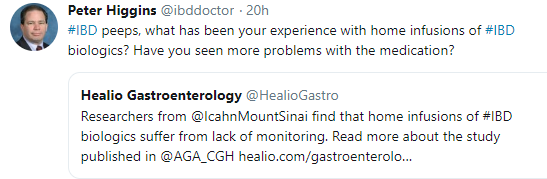
How Do Home Infusions Stack Up?

One of the advantages of infusions in the office (or hospital) compared to home infusions and home injections is close communication by those giving the infusion with the physician.  In addition, with each infusion, in these settings offers an opportunity to review the patient’s progress and adjust the patients orders.  A recent study (Fenster M, et al. Clin Gastroenterol Hepatol. 2019;10.1016/cgh.2019.03.030.) indicates that these advantages may make infusions more successful than infusions given at home.

A summary is offered by Healio Gastroenterology: Home biologic infusions in IBD suffer from lack of monitoring

Researchers conducted a matched retrospective cohort study of patients treated with infliximab or vedolizumab with home infusion (n = 69) compared with hospital infusion at a large, tertiary care IBD center.  The primary endpoint was a composite of adverse outcomes, including stopping biologic therapy, IBD-related emergency department visit or IBD-related hospitalization.

  • “Patients on home infusion were more likely to experience adverse outcomes compared with control patients (43.5% vs. 21.7%; P = .006), and they also had a shorter time to adverse outcomes than patients who got hospital infusions.”
  • “Patients with home infusions trended toward stopping therapy within 1 year (20.3% vs. 8.7%; P = .053) and stopping therapy within the complete follow-up window (27.5% vs. 15.9%; P = .099) compared with controls.”
  • Patients with home infusions had “more emergency department visits (30.4% vs. 7.2%, P < .001), they did not have significantly more hospitalizations (17.4% vs. 11.6%).”

The authors noted that the “increase in adverse events might have been related to a reduced level of monitoring observed in home infusion patients. In the year following home infusion initiation or matching, patients who persisted on home infusions had significantly fewer IBD clinic visits (1.23 vs. 1.75; P = .018) compared with controls.”

My take (borrowed from a previous post): In my experience, office-based infusions can be provided safely and in a cost-effective manner.  While the convenience and potential cost-savings of home-based infusion are desirable, before implementing broadly, issues regarding communication, safety protocols, and documentation to allow modifications in therapy need to be proactively addressed. These issues could affect a patient’s long-term response to biologic therapy.

Related blog posts:


Which is Safer and More Effective –Miralax (PEG 3350) or Lactulose?

A recent randomized multicenter study (D Jarzebicka et al. JPGN 2019; 68: 318-24) compared polyethylene glycol 3350 (PEG, aka Miralax) and lactulose for functional constipation in a cohort of 102 patients (12 weeks of treatment and 4 weeks of follow-up).

Dosing:

  • PEG 3350 dosing divided into 2 doses:
    • <8 kg:  5 g/day
    • 8-12 kg: 10 g/day
    • 12-20 kg: 15 g/day
    • >20 kg: 20 g/day
  • Lactulose was given as 1 mL/kg twice a day

A “good clinical outcome” was considered if there were three or more stools per week and an improvement in stool consistency of at least 2 types in the Bristol scale.

Key findings:

  • At week 12, a good clinical outcome was noted in 98% of PEG group compared with 90% in the lactulose group
  • PEG group had increased defecations relative to lactulose: 7.9 vs. 5.7, less stool retention: 7% vs 10%, and fewer hard stools 7% vs 13%
  • Side effects, mainly abdominal pain and bloating, were reported more frequently with lactulose than with PEG: 23 vs 15, P=0.02)

My take: This study showed that PEG 3350 was more effective and had fewer side effects than lactulose for constipation in children between 6 months of age and 6 years.

Related blog posts:

From Civil and Human Rights Museum, Atlanta

Which Symptom is Best for Indicating Reflux in Infants?

A recent study (CR Collins et al. J Pediatr 2019; 206; 240-7) showed that symptoms alone are not able to predict the degree/presence of reflux in infants.

Methods: The authors recruited ‘symptomatic’ infants with median 41 weeks postmenstrual age (median 29 weeks at birth) and employed a combination of 24-hour pH-impedance to determine acid reflux index (ARI) and subsequently used provocative esophageal infusions (with air, water then apple juice) to assess manometry and symptoms. In total, they analyzed 2635 separate esophageal stimula in 74 infants.

The authors considered ARI <3% as normal, 3-7% as indeterminate ARI, and >7% as abnormal ARI.

Symptoms that they recorded included arching, irritability, cough, gag, sneeze, gasp, bradycardia, desaturation, throat clearing, startle, grimace, grunting, mouthing, and yawning.

Key findings:

  • “The presence of physical symptoms (ARI <3: 80%; ARI 3-7: 77%; ARI >7: 81%; P=0.4), cardiorespiratory symptoms (ARI <3: 27%; ARI 3-7: 40%; ARI >7: 26%; P=0.4),or sensory symptoms (ARI <3: 26%; ARI 3-7: 22%; ARI >7: 35%; P=0.3) were also not significantly different by ARI groups”
  • All infants had a normal symptom index (SI) for acid, nonacid, or total reflex.
  • Accepted metrics, SI, SSI, and SAP, had higher association with nonacid events compared with acid events.
  • Cardiorespiratory symptoms are more likely to be elicited by esophageal infusions with both water and apple juice than air.  “Symptoms are indicators of esophageal dysmotility and maladaptive aerodigestive protective mechanisms.”
  • The authors in their discussion state that “GERD severity plays no role in the generation of symptoms.”

My take: All infants with and without reflux have a lot of “symptoms.”  Nonacid reflux is much more likely to provoke symptoms in this population than acid reflux reinforcing the idea that acid suppression is likely ineffective and potentially harmful.  “The findings of this study challenge the rationale for instituting anti-GERD therapies in neonates based on either symptoms alone or the existing acid-reflux indices or pH-impedance metrics.”

Related blog posts:

Link to article cited below from The Onion: Dog Feels Like He Always Has To Be ‘On’ Around Family Thanks to Jennifer for this reference.

Disclaimer: These blog posts are for educational purposes only. Specific dosing of medications/diets (along with potential adverse effects) should be confirmed by prescribing physician/nutritionist.  This content is not a substitute for medical advice, diagnosis or treatment provided by a qualified healthcare provider. Always seek the advice of your physician or other qualified health provider with any questions you may have regarding a condition.


What I Like About ESPGHAN Familial Adenomatous Polyposis Position Paper

Management of Familial Adenomatous Polyposis in Children and Adolescents: A Position Paper from the ESPGHAN Polyposis Working Group: Link: JPGN 2019; 68 (3): 442-441

Unlike some working groups, the working group for ESPGAN Polyposis did not equivocate in making clear cut recommendations, especially for recommendations #6a and #6b, for Familial Adenomatous Polyposis (FAP) in children.

  • SOME OF THE RECOMMENDATIONS
    Recommendation 1Predictive genetic testing should be offered to at-risk children at the age of 12 to 14 years. Families should receive genetic counselling before and at the time of testing. Children who are symptomatic with rectal bleeding should undergo earlier testing. (weak recommendation, low-quality evidence, consensus agreement 100%)
  • Recommendation 3: In those confirmed to have FAP on predictive genetic testing, and those considered at risk where genetic testing is not possible, colonic surveillance should commence age 12 to 14 years. Once adenomas have been identified, intervals between surveillance colonoscopy should be individualized depending on colonic phenotype every 1 to 3 years. Rectal bleeding or mucous discharge should lead to a colonoscopy at any age. (weak recommendation, low-quality evidence, consensus agreement 100%)
  • Recommendation 4:  Colectomy is necessary to prevent CRC in adulthood. Decision on the timing for colectomy should be determined by polyp burden and characteristics of colonic adenomas in the context of social, personal, and educational factors. IRA or IPAA have their merits and disadvantages and many factors impact on the choice of surgery. The choice should be based on patient phenotype (rectal and colonic burden) and genotype, at the discretion of the surgeon. (weak recommendation, low-quality evidence, consensus agreement 100%)
  • Recommendation 5: Despite the presence of gastric polyps in children, and the
    later risk of duodenal polyposis and ampullary cancer in adult practice, there is no justification to commence routine UGI surveillance until the age of 25 years.
    (weak recommendation, low-quality evidence, consensus agreement 90%)
  • Recommendation 6a: Routine screening for HPB [Hepatoblastoma]  in patients with FAP is not recommended. In children found to have HPB, there is no evidence that routine genetic testing or endoscopic screening for FAP is required.
    (weak recommendation, low-quality evidence, consensus agreement 100%)
  • Recommendation 6b: Children with bilateral and multiple CHRPE [congenital hypertrophy of retinal pigment epithelium] lesions should
    undergo colonoscopy at age 12 to 14 years. If CHRPE lesions are single or unilateral in the absence of relevant family history, further evaluation should not be required. (weak recommendation, low-quality evidence, consensus agreement 100%)
  • Recommendation 6c: The vast majority of desmoids tumours are sporadic; children identified to have a DT have approximately 10% risk of FAP. If the kindred is known to have FAP and the child has a desmoid, it should be presumed the child has FAP.  In a child presenting with a DT, testing the DT for a b-catenin /CTNNB1 mutation is recommended. If a b-catenin /CTNNB1 mutation is found, this indicates sporadic desmoid and further investigations for FAP are not required. If b-catenin /CTNNB1 mutation is not found, the patient should be investigated for FAP. (weak recommendation, low-quality evidence, consensus agreement 100%)
  • Recommendation 7: There is no role for the use of chemoprevention agents in
    children with FAP. (strong recommendation; moderate-quality evidence, 100%
    consensus)

Related blog posts:

Chatthoochee River

Disclaimer: These blog posts are for educational purposes only. Specific dosing of medications (along with potential adverse effects) should be confirmed by prescribing physician.  This content is not a substitute for medical advice, diagnosis or treatment provided by a qualified healthcare provider. Always seek the advice of your physician or other qualified health provider with any questions you may have regarding a condition.

 

Time to Revise ImproveCareNow Micronutrient Recommendations

With ImproveCareNow, there have been efforts to minimize variation in care.  As such, there have been suggestions to monitor labs like vitamin D, vitamin B12, and folate routinely. I have voiced concern that some of this testing is unnecessary.  For vitamin B12, deficiency in pediatrics is rare; at risk populations include those with extensive small bowel resections, gastric resections or strict vegan diet.

A recent article (J Fritz et al. Inflamm Bowel Dis 2019; 25: 445-59) which is a systematic review of micronutrients in pediatric inflammatory bowel disease provides further support for the approach of less testing.

Key points:

  • A total of 39 studies were included in the final review (2903 subjects, 1115 controls)
  • Iron deficiency and vitamin D deficiency are common in pediatric patients with IBD
  • Vitamin B12 and folate deficiency are rare
  • Zinc deficiency is uncommon but increased in patients with Crohn’s disease compared to healthy controls.
  • The authors recommend routine (at least yearly) testing for iron, vitamin D and zinc and that there is “insufficient evidence to support routine screening for other micronutrient deficiencies.”

My take: Except in patients with surgical resections and in those with unusual diets (eg. vegan), routinely checking vitamin B12, folate and most other micronutrients is unnecessary & low value care.

Related blog posts:

Vitamin B12:

Vitamin D:

Iron:

Disclaimer: These blog posts are for educational purposes only. Specific dosing of medications/diets (along with potential adverse effects) should be confirmed by prescribing physician/nutritionist.  This content is not a substitute for medical advice, diagnosis or treatment provided by a qualified healthcare provider. Always seek the advice of your physician or other qualified health provider with any questions you may have regarding a condition.
Psychosis with ADHD Treatments

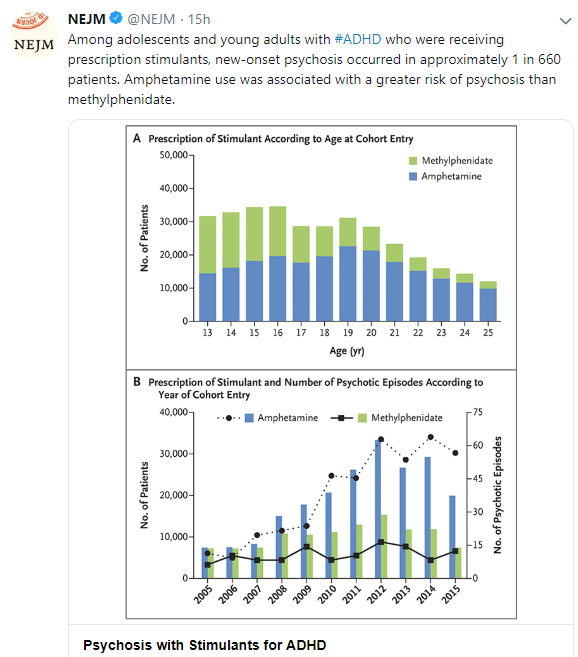
While I do not prescribe treatments for ADHD, a recent study (LV Moran et al. NEJM 380: 1128-38) was interesting, indicating that amphetamine use was associated with a greater risk of new-onset psychosis than methylphenidate.

Key points:

  • Amphetamine is used for ADHD treatment in the U.S. but rarely in other developed countries. It releases dopamine four times as much as methylphenidate.  “The changes in neurotransmission observed in primary psychosis are more consistent with those induced by amphetamine than methylphenidate”
  • Using data from two commercial insurance databases, the authors compared 221,846 patients receiving either amphetamine or methylphenidate.  There were 343 episodes of new onset psychosis (defined by diagnosis code and prescription for antipsychotic).
  • The risk of psychosis was 0.10% (n=106) in the methylphenidate group compared to 0.21% (n=237) in the amphetamine group. Overall, 1 in 660 patients had new onset psychosis with a greater risk in the patients receiving amphetamine.

My take: Only a prospective study can eliminate confounding variables and determine conclusively whether amphetamine is more likely to increase the risk of psychosis; that said, this study indicates a potential for more risk with amphetamine compared to methylphenidate.

Disclaimer: These blog posts are for educational purposes only. Specific dosing of medications/diets (along with potential adverse effects) should be confirmed by prescribing physician/nutritionist.  This content is not a substitute for medical advice, diagnosis or treatment provided by a qualified healthcare provider. Always seek the advice of your physician or other qualified health provider with any questions you may have regarding a condition