How to Improve Food Selection at Schools

A recent study (Cohen JFW et al. JAMA Pediatr 2015; 169: 431-7; thanks to Ben Gold for this reference) showed both the short-term and long-term effects of targeted interventions to improve food selection at schools.

The Modifying Eating and Lifestyles at School Study (MEALS study) was a randomized trial in 2 urban, low-income school districts in Massachusetts.  After a one month baseline, there was an initial 3 month randomization period in which there were 4 “chef” schools and 10 control schools.  As you may have guessed, the “chef” schools were assigned a chef to improve food palatability and to teach the cafeteria staff.

The recipes are available at the following link: www. projectbread.org/reusable-components/accordions/download-files/school-food-cookbook.pdf.  The recipes in this cookbook are great if you need to put together meals serving 100.  Recipes include Cachupa, Quinoa, Squash, and Kale.

During the next study period of 4 months, both groups were further divided into schools with “smart cafe” design or control design.  The smart cafes encouraged both vegetable and fruit selection/healthy food selection:

  • Veggies offered at beginning of lunch line
  • Fruits placed in attractive containers
  • Fruit options placed by cashier
  • Improved signage and images promoting fruits and veggies
  • White milk placed in front of sugar-sweetened milk (eg. chocolate milk)

Did these interventions work?  Yes, pretty much.

  • After 3 months, vegetable selection increased in chef schools with odds ratio (OR) of 1.75
  • At conclusion of study, vegetable selection increased in the chef (OR 2.54), smart cafe (OR 1.91) and chef plus smart cafe (OR 7.38)
  • At conclusion of study, fruit selection increase in the chef (OR 3.08), smart cafe (OR 1.45) and chef plus smart cafe (OR 3.10)
  • Actual consumption (not just selection) increase in chef and chef plus smart cafe schools but there was no lasting effect of smart cafe by itself.  The amount of vegetable intake approximately doubled in the chef or chef plus smart cafe, consuming an additional 0.75 cups of vegetables per week.

Conclusions (from the authors): “While using choice architecture [i.e. smart cafe design] “may be a good short-term strategy to increase healthier food consumption, it does not appear to be a successful long-term strategy…This study also reaffirms that a chef intervention focusing on school food quality, palatability, and variety is an effective method …over time…This study also confirms the importance of repeated exposures to new school foods.”

Related blog posts:

Kori Bustard, Zoo Atlanta

Kori Bustard, Zoo Atlanta

Vitamin D in Preterm Infants

Vitamin D has garnered a great deal of attention due to concerns that deficiency worsens the outcomes in so many different conditions, including respiratory tract infections, inflammatory bowel disease, diabetes mellitus (type 1), multiple sclerosis, colorectal cancer, schizophrenia, depression, cardiovascular disease, hepatocellular carcinoma and other conditions.  However, evidence of causation is typically inconclusive.

For preterm infants, a study (Onwuneme C, et al. J Pediatr 2015; 166: 1175-80) notes an association between 25-hydroxy vitamin D (25OHD) levels drawn at 24 hours of life and acute respiratory morbidity.

In this study, levels were also drawn at the time of discharge in the 94 preterm infants.  In addition, maternal 25OHD) levels were checked 24 hours after delivery. These preterm infants were either <32 weeks gestation or <1.5 kg.  The study population was predominantly Caucasian.

Key findings:

  • 92% had 25OHD ≤20 ng/mL (=”<20 group”)
  • 64% had 25OHD ≤12 ng/mL (=”<12 group”)
  • Levels of 25OHD ≤12 ng/mL were associated with increased oxygen requirement (P=.008) and greater need for assisted ventilation (P=.013).  The odds of requiring assisted ventilation were approximately 3-fold higher.
  • The authors state that the baseline characteristics for the <12 group were similar to the <20 group.
  • There was statistical difference in the rate of NEC (Bell stage ≥1) based on the 25OHD levels (P=.048)

The authors note in their discussion that they favor supplementation with 400 IU/day which is in agreement with the American Academy of Pediatrics.  Previous ESPGHAN recommendations were 800-1000 IU/day for infants.

The authors note that 25OHD did not affect sepsis outcome.  In addition, antibiotics during labor was virtually identical between the two groups.  However, no data on CRP values were provided.

Bottomline: This study shows an association between 25OHD values and several important neonatal outcomes.  Whether 25OHD is a marker (eg. epiphenomenon) for these outcomes or whether low 25OHD contributes to these outcomes remains unclear.

Related blog posts:


Short Take on Understanding Bias

A recent commentary (Rosenbaum L. NEJM 2015; 372: 1959-63) adds a couple of new terms to my lexicon regarding bias.

The author notes that there have been multiple concerns regarding industry-sponsored studies.  For example:

  • Industry-sponsored studies are more likely than government-sponsored ones to have positive results
  • Physicians who attend symposia funded by the pharmaceutical companies subsequently prescribe the featured drugs at a higher rate

While the Physician Payment Sunshine Act requires drug and device companies to disclose payments over $10, she notes that the long-term effects of this transparency are unclear.  With increased transparency, there could be a “phenomenon called ‘moral licensing’: once disclosure gets off your chest, you feel liberated and may feel licensed to behave immorally.  A corollary concern” for the audience, is that this disclosure may be interpreted as a sign of honesty or a sign of expertise rather than as a warning of potential bias.

Two new terms for me:

  • “‘Self-serving bias’: when we stand to gain from reaching a certain conclusion, we unwittingly assimilate evidence in a way that favors the conclusion.”
  • Bias blind spot“: “Studies suggest that we’re far more likely to think that drug promotions influence our colleagues than that they affect our own behavior.”

The author cautions that anti-industry bias could be detrimental as well.  If having ties to industry lessens the opportunity for individuals to voice their support (or opposition) for new drugs or devices, it could bolster individuals who may “overstate the risks and understate the benefits of these new treatments.”

Related blog posts:

Zoo Atlanta

Zoo Atlanta

IBD Shorts -Skin, Adalimumab Kinetics

From the IMAgINE study with 192 pediatric patients (Sharma S et al. Inflamm Bowel Dis 2015; 21: 783-92), the authors determined levels for adalimumab, that at week 52, were associated with remission and response.  A cutoff level of 3.6 mcg/mL had a sensitivity of 32.7%  and specificity of 88.6% for predicting remission; the same cutoff had a sensitivity of 46.2% and specificity of 83% for predicting a response.  Overall, the authors noted dose proportionality with patients who received higher (or more frequent) doses with higher serum levels.

Related posts:

“Concomitant Use of Azathioprine/6-Mercaptopurine Decreases the Risk of Anti-TNF-Induced Skin Lesions” (Soh JS et al. Inflamm Bowel Dis 2015; 21: 832-9). Among a cohort of 500 Korean patients, the incidence of psoriaform and eczematiform lesions was 6.2%.  Concomitant use of a thiopurine was associated with a hazard ratio of 0.452 (lower risk) for developing these adverse skin reactions.

Related posts:

Helicobacter Pylori: Relationship to Cancer and Dubious Beneficial Claims

I found a recent review (Gastroenterol 2015; 148: 719-31) regarding Helicobacter pylori (HP) of interest.  David Graham explores the issue of HP eradication with regard to cancer and whether there are benefits to the infection that result in detrimental effects with HP eradication.

The potential mechanisms in which HP infection can increase the risk of gastric cancer are depicted in Figure 2; the most important:

  • Inflammation induced by infection
  • Genetic/epigenetic changes –> genetic instability in gastric epithelial cells

Lessons regarding eradication therapy:

  • Sequential therapy has been shown in some studies to be effective/superior (in Italy) yet inferior in others (eg. Korea).  “The results are explained entirely by differences in patterns of drug resistance, which typically were not assessed before studies were initiated.”
  • Findings from many studies cannot be applied to other populations without resistance data.

Does HP infection reduce the risk of obesity or childhood asthma?  Probably not.

  • “Any claim that a major human pathogen also might provide a meaningful health benefit, and that plans to eradicate it should be reconsidered, is guaranteed to elicit interest from the press.”
  • As a counter example, Dr. Graham notes “because 2 events are associated does not mean that one causes the other. For example, one study reported a correlation between the number of storks in Brandenburg, Germany, and the birth rate in Berlin.” [Backen MB. Harm. In: Bracken MB. Risk, chance, and causation. New Haven: Yale University Press, 2013; 108-09.]
  • He notes that HP can both promote or inhibit acid secretion/acid reflux.  Increased acid secretion with resultant esophageal disease could increase the risk of adenocarcinoma of the esophagus; however, “the risk of developing adenocarcinoma of the stomach remains higher than the risk of adenocarcinoma of the esophagus.”  This indicates that if there is an increased esophageal cancer risk, eradication would still be favorable by lowering gastric cancer risk.
  • Asthma: “overall, the studies do not support the hypotheses that increases in childhood asthma were related to the absence of H pylori.”
  • Obesity: “A meaningful causative association between H pylori and obesity is unlikely.”
Screen Shot

Screen Shot

Take-home message: H pylori is a pathogen and should be treated as such.

Related blog posts:

University of Chicago

University of Chicago

An “Ally” For Hepatitis C Genotype 3

A new study (Hepatology 2015; 61: 1127-35) shows that an all-oral 12 week treatment of daclatasvir (DCV) with sofosbuvir (SOF) is effective in the difficult-to-treat Hepatitis C virus (HCV) genotype 3 patients. In this study, the “Ally-3” phase III study, 101 treatment-naïve and 51 treatment experienced patients were treated with a daily regimen of DCV 60 mg and SOF 400 mg.

Key findings:

  • SVR12 was 90% in treatment-naïve, and 86% among in treatment experienced.
  • Among patients without cirrhosis, the SVR12 was 96%, compared with 63% of those with cirrhosis (based on FibroTest scores)

Related blog posts:

Bottomline: This new regimen is a promising addition to the new crop of HCV drugs which will be affordable when?

A second study (Hepatology 2015; 61: 1174-82) examined the minimum target pricing for direct-acting antivirals (DAA) for HCV.  Using data on manufacturing costs, derived in large part from experience with HIV antivirals, the authors calculate that a minimum cost for a 12-week course of combination DAA could be US $171-360 per person without genotyping and the drug costs alone from US $122-192 per person.  Of course, these costs are completely theoretical and complete fantasy, at least until 2027 when some of the patents expire.

Related post: HCV Treatments: “Sticker Shock” or “Low Value …

Briefly noted: Hepatology 2015; 61: 1261-68.  N=986 Koreans with HBsAg carrier status and 40 years of age or older.  FIB-4 is highly predictive of hepatocellular carcinoma (HCC) risk in those with chronic hepatitis B. FIB-4 was defined based on age x AST , PLTS, and ALT.  Since a high FIB-4 reflects liver fibrosis, it is not unexpected that high levels were associated with HCC. A FIB-4 >/= 2.4 showed an adjusted Hazard Ratio of 21.34.

Prospective Monitoring of Calprotectin for Crohn’s Disease

A recent study (full text link: Wright EK, et al. Gastroenterol May 2015 Volume 148, Issue 5, Pages 938–947) shows that stool calprotectin levels can be useful to monitor Crohn’s disease (Links from AGA twitter feed).  This study measured levels as part of The Post-Operative Crohn’s Endoscopic Recurrence (POCER) study.

Here’s the abstract, followed by some comments:

Background & Aims

Crohn’s disease (CD) usually recurs after intestinal resection; postoperative endoscopic monitoring and tailored treatment can reduce the chance of recurrence. We investigated whether monitoring levels of fecal calprotectin (FC) can substitute for endoscopic analysis of the mucosa.

Methods

We analyzed data collected from 135 participants in a prospective, randomized, controlled trial, performed at 17 hospitals in Australia and 1 hospital in New Zealand, that assessed the ability of endoscopic evaluations and step-up treatment to prevent CD recurrence after surgery. Levels of FC, serum levels of C-reactive protein (CRP), and Crohn’s disease activity index (CDAI) scores were measured before surgery and then at 6, 12, and 18 months after resection of all macroscopic Crohn’s disease. Ileocolonoscopies were performed at 6 months after surgery in 90 patients and at 18 months after surgery in all patients.

Results

Levels of FC were measured in 319 samples from 135 patients. The median FC level decreased from 1347 μg/g before surgery to 166 μg/g at 6 months after surgery, but was higher in patients with disease recurrence (based on endoscopic analysis; Rutgeerts score, ≥i2) than in patients in remission (275 vs 72 μg/g, respectively; P < .001). Combined 6- and 18-month levels of FC correlated with the presence (r = 0.42; P < .001) and severity (r = 0.44; P < .001) of CD recurrence, but the CRP level and CDAI score did not. Levels of FC greater than 100 μg/g indicated endoscopic recurrence with 89% sensitivity and 58% specificity, and a negative predictive value (NPV) of 91%; this means that colonoscopy could have been avoided in 47% of patients. Six months after surgery, FC levels less than 51 μg/g in patients in endoscopic remission predicted maintenance of remission (NPV, 79%). In patients with endoscopic recurrence at 6 months who stepped-up treatment, FC levels decreased from 324 μg/g at 6 months to 180 μg/g at 12 months and 109 μg/g at 18 months.

Conclusions

In this analysis of data from a prospective clinical trial, FC measurement has sufficient sensitivity and NPV values to monitor for CD recurrence after intestinal resection. Its predictive value might be used to identify patients most likely to relapse. After treatment for recurrence, the FC level can be used to monitor response to treatment. It predicts which patients will have disease recurrence with greater accuracy than CRP level or CDAI score.

Some key points from the discussion:

  • The POCER study recently showed that postoperative endoscopic monitoring, together with treatment intensification for early recurrence, is superior to standard drug therapy alone in preventing disease recurrence, at least in the short term. However, such endoscopic monitoring is invasive, expensive, cannot be repeated frequently, and, in some patients, will yield a normal result.” [De Cruz, P., Kamm, M.A., Hamilton, A.L. et al. Crohn’s disease management after intestinal resection: a randomised trial. Lancet2014; (Epub ahead of print)]
  • The POCER study had all postoperative patients receive 3 months of metronidazole.  High-risk patients also received thiopurine or adalimumab (if thiopurine intolerant) therapy.  High-risk was defined as patients who were smokers, patients with perforating disease, or patients with 1 or more previous resections.
  • “In our study we have shown that FC concentration is increased markedly before surgery and decreases substantially after resection of all macroscopic disease at 6 months”
  • The present study has shown that FC concentration is sufficiently sensitive to monitor for recurrence of Crohn’s disease, and has a high enough negative predictive value to be confident that few patients with recurrence will be missed.” The authors, though, recommend serial measurement rather than relying on a single assay.
  • Calprotectin: “At each time point in our study, a cut-off value of 100 μg/g had an NPV of 90% or greater, with the best combination of sensitivity and specificity.”
  • An important limitation of these findings is that patients had to have all macroscopic disease removed at the time of surgery.  Thus, these findings are not generalizable to patients with residual upper gastrointestinal disease.
  • “These results confirm the accuracy, utility and superiority of fecal calprotectin compared with CRP or CDAI as a monitoring tool and screening test for endoscopic recurrence of Crohn’s disease in the postoperative population.”

Additional summary of this information on AGA Journals blog:  Measurement of Fecal Calprotectin.  An excerpt:

In an editorial that accompanies the article, Alain M. Schoepfer and James D. Lewis explain that the role of fecal calprotectin in assessing post-operative recurrence has been debated because of inconsistent results in mainly small studies. The strengths of the study of Wright et al include its large size, prospective design, endoscopic validation, and longitudinal inter-individual measurements of fecal calprotectin.

Tests for biomarkers such as fecal calprotectin can be repeated more frequently than colonoscopies. This advantage could overcome the lower levels of sensitivity with which single measurements of biomarkers detect recurrence. Schoepfer and Lewis say that studies are needed to determine the optimal frequency for measuring fecal calprotectin.

However, they conclude that measurement of fecal calprotectin could have an important role in monitoring Crohn’s disease recurrence after intestinal resection; it is clearly superior to measurement of c-reactive protein or CDAI score.

Proposed algorithm for using calprotectin: In the editorial, they propose that patients with low or medium risk of “permanent bowel dysfunction as a consequence of post-operative recurrence” could use fecal calprotectin measurements every 3-6 months.  They propose a cut-off of 50 mcg/g in those with medium risk and a cut-off of 100 mcg/g in those with low risk.  Those who exceeded cut-off would need colonoscopy.  Among high risk patients, they recommend proceeding directly to colonoscopy every 6-12 months to assess for recurrence.  All patients who had recurrence of disease greater than i1 would need treatment for recurrence. (Related gutsandgrowth blog: Only One Chance to Make a First Impression).

This year’s 22Q at the zoo was on May 17th, 2015:

22Q at the Zoo.  More than 100 zoos across the world participate to improve awareness of 22Q deletion syndrome

22Q at the Zoo. More than 100 zoos across the world participate to improve awareness of 22Q deletion syndrome.  With Karlene Coleman, Nancy Morris, and Jennifer Hochman.

Mediterranean Diet and Better Cognitive Function

The Mediterranean diet has been associated with a number of health benefits.  A recent study in JAMA Internal Medicine indicates that this diet may result in better cognitive function.

A summary of this study from NBC News: Diet That Helps You Live Longer May Keep Your Mind Sound

Here’s an excerpt:

They singled out 447 volunteers considered at high risk of heart disease. Heart disease and dementia are already linked — people with a higher risk of one usually have a higher risk of the other, also.

Two groups were assigned to follow the Mediterranean diet and told to add either five 5 tablespoons of extra virgin olive oil a day or a handful of mixed nuts. The third group got the low-fat advice….

The volunteers, who had an average age of 67, were tested from time to time on memory skills. The group who ate the extra nuts did better in terms of memory and the group given extra virgin olive oil performed better on tests that required quick thinking…

Just over 13 percent of those who got extra olive oil were diagnosed with mild cognitive impairment, which may or may not lead to Alzheimer’s disease. Just 7 percent of those who got nuts were diagnosed with mild cognitive impairment, while around 13 percent of those who got neither developed memory loss.

But many of the patients actually saw their memories get better over the four years. On average, those in the low-fat-only group lost some memory and thinking skills, but those who got extra nuts had their memory skills improve on average, while those who got olive oil had improvements in problem-solving and planning skills…

The findings fit in with research that has shown a Mediterranean-style diet can lower the risk of Alzheimer’s disease.

Related blog posts:

Zoo Atlanta, Eastern Diamond Rattlesnake

Zoo Atlanta, Eastern Diamond Rattlesnake

Why ImproveCareNow is Needed

A few recent articles make a strong argument for collaborative networks, like ImproveCareNow, to improve data collection to determine the most effective therapies.

  1. Kierkus J, et al. JPGN 2015; 60: 580-85.
  2. Audu GK, et al. JPGN 2015; 60: 586-91
  3. Dotson JL, et al. Inflamm Bowel Dis 2015; 21: 1109-14
  4. Saps M, et al. JPGN 2015; 60: 645-53.

A brief description of each study.

1. This study presented a multi-center randomized open-label trial of 99 pediatric patients with Crohn’s disease (CD) who were administered infliximab (IFX) along with an immunomodulator (azathioprine or methotrexate).  After a 10 week induction, 84 were randomized to either monotherapy for 54 weeks or dual therapy for 26 weeks. The authors did not find significant differences in response between the groups.  However, they reached a conclusion: “Twenty-six weeks likely represent (sic) the safe duration of combined IFX/immunomodulator therapy in our sample of pediatric patients with CD.”

2. The second study described three cases of chronic recurrent multifocal ostesomyelitis (CRMO) associated with inflammatory bowel disease.  They tried to identify all pediatric cases in UK in the last 10 years. (As an aside, I have treated one teenager with CRMO and ulcerative colitis.)

3. The third study is a retrospective single center of 30 patients with pediatric Crohn’s disease (CD) who developed intra-abdominal abscesses (IAA) over a 12-year period.  The authors note that this is “the largest single-center review of children and adolescents with CD and IAA to date.” Yet due to the small sample size, the study provides little guidance on this important medical problem; there were no predictors of successful medical or percutaneous drainage therapy.  In addition, with the increasing use of biologics, the authors note that “the issue of which patients will eventually require surgery is even less clear.” Changes in imaging (eg. MRE) and changes in medical management (eg. more enteral nutrition and less corticosteroids) are not discussed.

4. The fourth study is a comprehensive review of randomized placebo-controlled pharmacological clinical trials in children with functional abdominal pain disorders.  They found “no evidence to support the use of most commonly used drugs in children. Only 7 pharmacological RCTs on AP-FGIDs in children were found. Most studies were single center based and had a small sample size.  The methods and outcomes were heterogeneous…We found a considerable risk of bias in most studies…There is an urgent need for well-designed randomized clinical trials using age-appropriate validated outcome measures.”

Each of these studies makes a compelling argument for collaborative research networks.  The first study had a relatively small number of patients, short follow-up period, lack of blinding, and numerous methodological limitations.  How did the authors determine that 26 weeks was the time to stop dual therapy? Among adults with CD, a well-designed SONIC study (NEJM 2010; 362: 1383) showed the superiority of dual therapy during the study period.  In children, because of concerns about thiopurine safety, the best approach is still unclear. The second study identified only three patients despite examining a large population.  Similarly, the third study describes 30 patients with a common complication of CD but provides little insight.

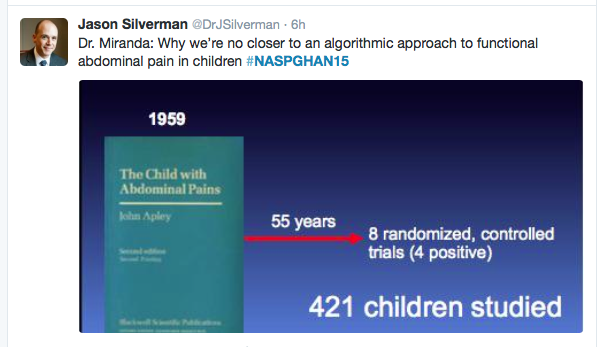
The fourth study is a cautionary tale illustrating the lack of progress due to the absence of collaborative research.  Reports indicate a high prevalence of functional abdominal pain; one study indicated that abdominal pain affects “38% of school children weekly” (J Pediatr 2009; 154: 322-6).  In fact, studies on the high prevalence of this disorder dates back for 60 years (Apley, 1975; Apley & Hale, 1973; Apley & Naish, 1958). Despite the prevalence of this problem, the data for all of the treatments is poor.  The lack of progress in defining treatments for functional abdominal pain is multifactorial, including the following:

  • Cost: For many of the available treatments, there is not a financial incentive to conduct research.
  • Biomarker: lack of objective markers for improvement
  • Disease Stigma: many people attribute functional disorders as being due solely to psychological factors
  • Physician Champions: in pediatric gastroenterology, it took concerted physician efforts over many years to develop ImproveCareNow.  Similar physician champions would be needed to improve the outcomes for children with functional disorders

Bottomline: While ImproveCareNow has a lot of work ahead including improving data reliability and ascertaining accurate outcome measures, I think the effort is forward-thinking and will make a difference in understanding and treating children with IBD.  ImproveCareNow has more than 600 participating pediatric gastroenterologists and more than 20,000 patients. What I would like to see is a sister network to address the morbidity from functional disorders so that in 60 years (or sooner), we will be better equipped to treat children with abdominal pain that is not due to IBD.

Related blog posts:

Fox Theater

Fox Theater

Clinical Features of Byler Disease

A recent article (Morris AL, et al. JPGN 2015; 60: 460-6) provides a detailed analysis of six cases of Byler disease during their first two years of life.  These cases were strictly defined and defined by homozygous c.923G>T mutation of ATP8b1.

Presenting features:

  • 2 with newborn direct hyperbilirubinemia
  • 2 with complications of coagulopathy. “Bleeding diathesis is a particular issue in the Amish community where home delivery is common and vitamin K may not be administered perinatally.”
  • 1 with failure to thrive and rickets
  • 1 was a sibling identified with newborn genetic testing

Key features:

  • Intensive fat-soluble vitamin supplementation was needed. “Vitamin K deficiency can be lethal.”
  • Poor growth was frequent (Figure 2): “growth trajectories were generally at the low end of percentiles and did not reflect parental size.” It was “typically responsive to supplementation with medium-chain triglyceride-based formula. and/or use of 30 cal per ounce formulae.”
  • Elevated serum bile acids and low normal GGT (Υ-glutamyltranspeptidase)
  • Diarrhea was commonly reported
  • Intractable pruritus in 4 of 6 children which developed between 6-12 months of age;  in two patients rifampin therapy was effective.
  • Partial external biliary diversion was used in 4 children during 2nd year of life; there was a “generally favorable response to PEBD.”
  • There were not issues noted with portal hypertension

Bottomline: This report shares some practical experience with this rare disorder.

Related blog posts: