Teaching an Old Dog a New Trick: Optimizing Thiopurine Therapy in Autoimmune Hepatitis

Key findings:

  • Over 4 years (N = 146), patients with higher average 6TGN levels were associated with those with stable complete biochemical remission (CBR) (260 pmol/0.2 mL) compared to those failing to maintain CBR (181 pmol/0.2 mL; p = 0.0014) or never achieving CBR (153 pmol/0.2 mL; p < 0.0001), with an optimal 6TGN cutoff of ≥223 pmol/0.2 mL
  • Adding allopurinol to thiopurines in difficult-to-treat patients (N = 36) raised 6TGN (168→321 pmol/0.2 mL; p < 0.0001) and lowered 6MMP (2125→184 pmol/0.2 mL; p < 0.0001), resulting in improved transaminases in all patients and long-term CBR in 75%.
  • Limitation: most of the 337 patients did NOT have sequential azathioprine metabolite monitoring. This could indicate that the 146 patients with sequential monitoring could have a selection bias favoring patients with a more aggressive disease course. Thus, the proposed 6-TGN level of 223 may not be applicable for all patients.

From editorial:

  • “In this issue of Hepatology, “Weltzsch et al1 conducted a multicenter study on the metabolic monitoring of thiopurines in AIH. The authors defined an optimal cutoff of ≥223 pmol/0.2 mL average 6TG level to maintain long-term biochemical remission (BR). Notably, 66% of patients with 6TG levels above this cutoff sustained BR rates. 
  • Allopurinol shifts the thiopurine metabolism toward 6TG production, allowing thiopurine dose reduction to 25%–30%, which improves efficacy and tolerability. (The 100 mg dose of allopurinol had more favorable 6MMP/6TG ratio).
  • However, they note that in a prior study (J Hepatol 2021; 75: 324-32), “patients with subtherapeutic 6TG levels (75–225) achieved similar BR rates (75% vs. 81%, p = 0.589) to those with therapeutic levels (225–450), while experiencing significantly fewer adverse drug reactions (44% vs. 86%, p = 0.0002).”
Proposed Algorithm

My take: This study shows in patients who have not achieved a biochemical remission, optimization of azathioprine dosing with metabolite monitoring improves biochemical remission. In those with low 6TG and low 6MMP, increasing the azathioprine should be considered. In those with low 6TG and high 6MMP, reducing azathioprine and adding allopurinol should be considered.

Related blog posts:

Disclaimer: This blog, gutsandgrowth, assumes no responsibility for any use or operation of any method, product, instruction, concept or idea contained in the material herein or for any injury or damage to persons or property (whether products liability, negligence or otherwise) resulting from such use or operation. These blog posts are for educational purposes only. Specific dosing of medications (along with potential adverse effects) should be confirmed by prescribing physician.  Because of rapid advances in the medical sciences, the gutsandgrowth blog cautions that independent verification should be made of diagnosis and drug dosages. The reader is solely responsible for the conduct of any suggested test or procedure.  This content is not a substitute for medical advice, diagnosis or treatment provided by a qualified healthcare provider. Always seek the advice of your physician or other qualified health provider with any questions you may have regarding a condition.

Botox for Pediatric Gastrointestinal Disorders

M Homan et al. J Pediatr Gastroenterol Nutr. 2024;79:1096–1105. Open Access! Drugs in focus: Botulinum toxin in the therapy of gastrointestinal disorders in children (Review)

Botox has been used for the following:

  • Achalasia
  • Cricopharyngeal achalasia
  • Retrograde cricopharyngeal dysfunction
  • Delayed gastric emptying
  • Anal achalasia
  • Constipation after Hirschsprung disease surgery
  • Selected functional constipation
  • Chronic anal fissure

With regard to achalasia, “Botox can be considered only in patients in whom rapid weight gain is important to improve surgical outcomes.”

With regard to gastroparesis/delayed gastric emptying in children, the authors note the following:

‘A recent retrospective study from the Mayo Clinic analysed the response to intrapyloric Botox in children (n = 20) with gastroparesis and concluded that intrapyloric Botox injection in children is safe and can provide temporary relief for patients with refractory upper gastrointestinal symptoms with and without gastroparesis.43 [This was] a meta-analysis, including six studies, 160 patients, which showed that 68% of patients responded to intrapyloric Botox irrespective of the presence of gastroparesis, while among patients diagnosed with gastroparesis the therapeutic response was 66%.43 These results suggest that intrapyloric Botox can be effective not only in children with gastroparesis but also in children with refractory functional upper gastrointestinal symptoms.’ In their conclusion, the authors note “Intrapyloric Botox injection is increasingly used for the treatment of gastroparesis but evidence supporting its use in children is still scarce.”

My take: Overall, this is a helpful review.

Related blog posts:

Ponsegromab: A Breakthrough for Cancer Cachexia Treatment

JD Groarke, et al. NEJM 2024; 391: 2291-2303. Ponsegromab for the Treatment of Cancer Cachexia

Background: “Growth differentiation factor 15 (GDF-15) is a stress-induced cytokine that binds to the glial cell–derived neurotrophic factor family receptor alpha-like protein (GFRAL) in the hindbrain.12 The GDF-15–GFRAL pathway has emerged as a main modulator of anorexia and body-weight regulation and is implicated in the pathogenesis of cachexia.13 …Ponsegromab (PF-06946860) is a potent, highly selective, humanized monoclonal antibody that binds to circulating GDF-15, thereby inhibiting the interaction with its GFRAL receptor.”

“A recent guideline supports low-dose olanzapine to improve appetite and weight in patients with advanced cancer,3 a recommendation that is largely based on a single-center study.4 Safe, effective, and targeted therapies for cancer cachexia are needed.10,11

Methods: In this phase 2, randomized, double-blind, 12-week trial, we assigned patients with cancer cachexia and an elevated serum GDF-15 level (≥1500 pg per milliliter) in a 1:1:1:1 ratio to receive ponsegromab at a dose of 100 mg, 200 mg, or 400 mg or to receive placebo, administered subcutaneously every 4 weeks for three doses. N=187. Of these patients, 40% had non–small-cell lung cancer, 32% had pancreatic cancer, and 29% had colorectal cancer.

Key findings:

  • Over the 12-week trial, patients treated with ponsegromab had as much as a 2.8 kg weight gain compared to placebo.
  • Improvements were observed across measures of appetite and cachexia symptoms, along with physical activity, in the 400-mg ponsegromab group relative to placebo. 

My take: This study explains a key driver of cachexia in cancer and shows that inhibition of GDF-15 can improve weight gain and physical activity.

Mark Cuban: Disrupting American Healthcare

For those of you with an interest in improving our healthcare system, I highly recommend either Eric Topol’s Ground Truths Podcast with Mark Cuban or the transcription of their discussion. Both can be found here: Mark Cuban: A Master Disrupter for American Healthcare

Mark Cuban describes the expansion of his generic pharmacy business Cost Plus Drugs. But the main focus is on other aspects of healthcare like pharmacy benefits managers, insurance companies and improving patient access.

“So a big part of my time these days is going to CEOs and sitting with them and explaining to them that you’re getting ripped off on both your pharmacy and your healthcare side….”

“Because when you see stories like we’ve all seen in news of a big healthcare, a BUCA healthcare (Blue Cross Blue Shield (BCBS), UnitedHealth, Cigna, and Aetna/CVS) plan with all the pre-authorizations and denials, typically they’re not even taking the insurance risk. They’re acting as the TPA (third party administrator) as the claims processor effectively for whoever hired them. And it goes back again, just like I talked about before. And as long as CMS hires or allows or accepts these BUCAs with these plans for Medicare for the ACA (Affordable care Act), whatever it may be, it’s not going to work. As long as self-insured employers and the 50 million lives they cover hire these BUCAs to act as the TPAs, not as insurance companies and give them leeway on what to approve and what to authorize and what not to authorize. The system’s going to be a mess, and that’s where we are today.”

In response to a post by Elon Musk that Americans are not getting a good deal with their healthcare expenditures, Mark Cuban posted the following:

“Because we’re cutting out all those ancillary costs and credit risk, I want Medicare pricing. Now the initial response is, well, Medicare prices, that’s awful. We can’t do it. Well, when you really think about the cost and operating costs of a hospital, it’s not the doctors, it’s not the facilities, it’s all the administration that cost all the money. It’s all the credit risks that cost all the money. And so, if you remove that credit risk and all the administration, all those people, all that real estate, all those benefits and overhead associated with them, now all of a sudden selling at a Medicare price for that hip replacement is really profitable.”

He also describes how his employees pay premiums but no additional costs and how to get to universal health coverage. “Why do we need insurance companies if they’re not even truly acting as insurance companies?

Related blog posts:

“Commercial Insurance Isn’t in the Health Care Business. It’s in the Financial Business.”

Katherine Eban, Vanity Fair 12/12/24: Doctors Seethe Over Insurance Companies’ “Out of Control” Tactics

A recent Vanity Fair Article echoed some of the problems that our group has experienced with insurance companies.

An excerpt:

While no one can seriously justify the decision to gun down a father of two to make a political point, Americans seem to agree on one thing: Something does need to be done about the country’s broken health insurance system.

The brutal slaying, and the frenzied manhunt that followed, have exposed widespread frustration with a system of for-profit health insurance that many Americans feel is actually killing them, one delayed-or-denied health insurance claim at a time. And doctors are as fed up as their patients…

Struggling with the seemingly arbitrary policies and undermarket reimbursements offered by UnitedHealth Group and other insurers, doctors feel trapped in a zero-sum game that has robbed them of their clinical independence.

Four companies, known collectively as BUCA—Blue Cross and Blue Shield, UnitedHealth, Cigna, and Aetna—have become so powerful that “when doctors try to negotiate, they have to take whatever that carrier gives them,” says Ron Howrigon, a health care consultant who represents doctors in their dealings with insurers…

Amid this anger, UnitedHealth stands out for its sheer size, its aggressive moves to vertically integrate healthcare, and its expansive denial of claims, say health care experts and doctors. Headquartered in Minnetonka, Minnesota, it is a behemoth that took in more than $370 billion last year, making it America’s fourth-largest corporation by revenue. It insures more than 26 million Americans. More than one tenth of US doctors are either employed by or affiliated with the UnitedHealth subsidiary Optum Health

Doctors in independent practice groups describe strong-arm tactics by the company—suddenly pushing them out of network, slashing their reimbursements, and stranding their patients with almost no notice. “Their interest is in killing private practice physicians,” says a North Carolina anesthesiologist…

The travails of Rheumatology Associates, P.C., the largest private rheumatology practice in Indiana, is a case in point. UnitedHealth offered the doctors in the group such paltry reimbursements that negotiations on a new contract ground to a halt…The group met with the Indiana attorney general’s office…

The company’s conduct was often nightmarish, even for patients in network. “Even when we get approvals on their letterhead, they would turn around, deny claims, and say they were approved incorrectly.”

“They have so much power, they are out of control. They believe they are untouchable.”

My take: In the article, a health policy physician states the following: “Commercial Insurance Isn’t in the Health Care Business. It’s in the Financial Business.”

Our group is currently out of network with UnitedHealth. We negotiated with them for more than two years and offered them rates that were as good or better than all of the other commercial insurers. Their claims about trying to negotiate rates that are “affordable for consumers and providers” are misleading. In our case, they are making their insured patients pay much more by forcing them to see other providers at an academic center with much higher costs, less availability, and longer travel distances. They don’t care about forcing patients, who have had long-standing relationships, to find new doctors or the inconvenience and cost to patient families. Their aim is to leverage their consolidation of coverage to force smaller groups to accept lower reimbursements. Over time, this will lead to even fewer options for patients.

Related blog posts:

Limitations of MRE and TE in Assessing Liver Fibrosis in Pediatric MASLD

N Ravanbakhsh et al J Pediatr Gastroenterol Nutr. 2024;79:1192–1198. Comparing imaging modalities in the assessment of fibrosis in metabolic dysfunction-associated steatotic liver disease

In this retrospective review with 77 patients who had liver biopsy-proven MASLD (2017-2023), the authors examined how well magnetic resonance elastoraphy (MRE) and transient elastography (TE) identified fibrosis.

Key findings:

  • Fibrosis was identified in 90% of liver biopsies
  • The area under the receiver operating characteristic curves (AUROC) of MRE and TE for detection of high-grade fibrosis were 0.817 and 0.750, respectively
  • Only 20% of patients had severe fibrosis on liver biopsy; thus, this is a limitation given the small number
Sensitivity in detecting advanced fibrosis, defined on liver biopsy was defined as Metavir Stage ≥ 3.

Conclusion of authors: “MRE and TE did not accurately predict high-grade fibrosis on liver biopsy. Between the two noninvasive imaging modalities, the correlation of identifying high-grade fibrosis was not statistically different.”

My take: Even MRE is not very accurate at identifying fibrosis. Given the huge numbers of individuals (pediatric and adult) with MASLD, the lack of reliable non-invasive markers is a problematic. As effective treatments become available, being able to determine if they are working is essential.

Related blog posts:

Inpatient Admission to Achieve Enteral Autonomy in Children with Intestinal Failure

Happy New Year!

——-

A Fialdowski et al. J Pediatr 2024; 275: 114226. Achieving Enteral Autonomy in Children with Intestinal Failure Following Inpatient Admission: A Case Series

This retrospective review identified 6 patients (out of 153) who were weaned off parenteral nutrition (PN) as part of an inpatient admission.

Key findings:

  • Except for one admission of 8 days, all of these patients required a prolonged admission 1-5 months.
  • Two of the patients were receiving PN primarily due to abdominal pain in the absence of a recognizable motility disorder.
  • Two of the patients had a suspected factitious disorder imposed on a medical disorder; one received this diagnosis.
  • All patients had chronic feeding intolerance despite favorable prognostic factors including underlying necrotizing enterocolitis (n=1), preserved ileocecal valve (n=5), longer bowel length (n=5), and retention of entire colon (n=5).
  • Post-pyloric feeds aided conversion to EN in 5 patients.

My take: In order to achieve enteral autonomy, hospital admission may be needed for patients who require long-term PN despite favorable prognostic factors.

  • Be prepared for a lengthy stay
  • Anticipate the need for an interdisciplinary team (eg. nutrition, social work, and others).

Related blog posts:

From the Lake by Georgia O’Keefe (1924). High Museum, Atlanta.

Early Acid Blocker Use Linked to Lung Disease in CF

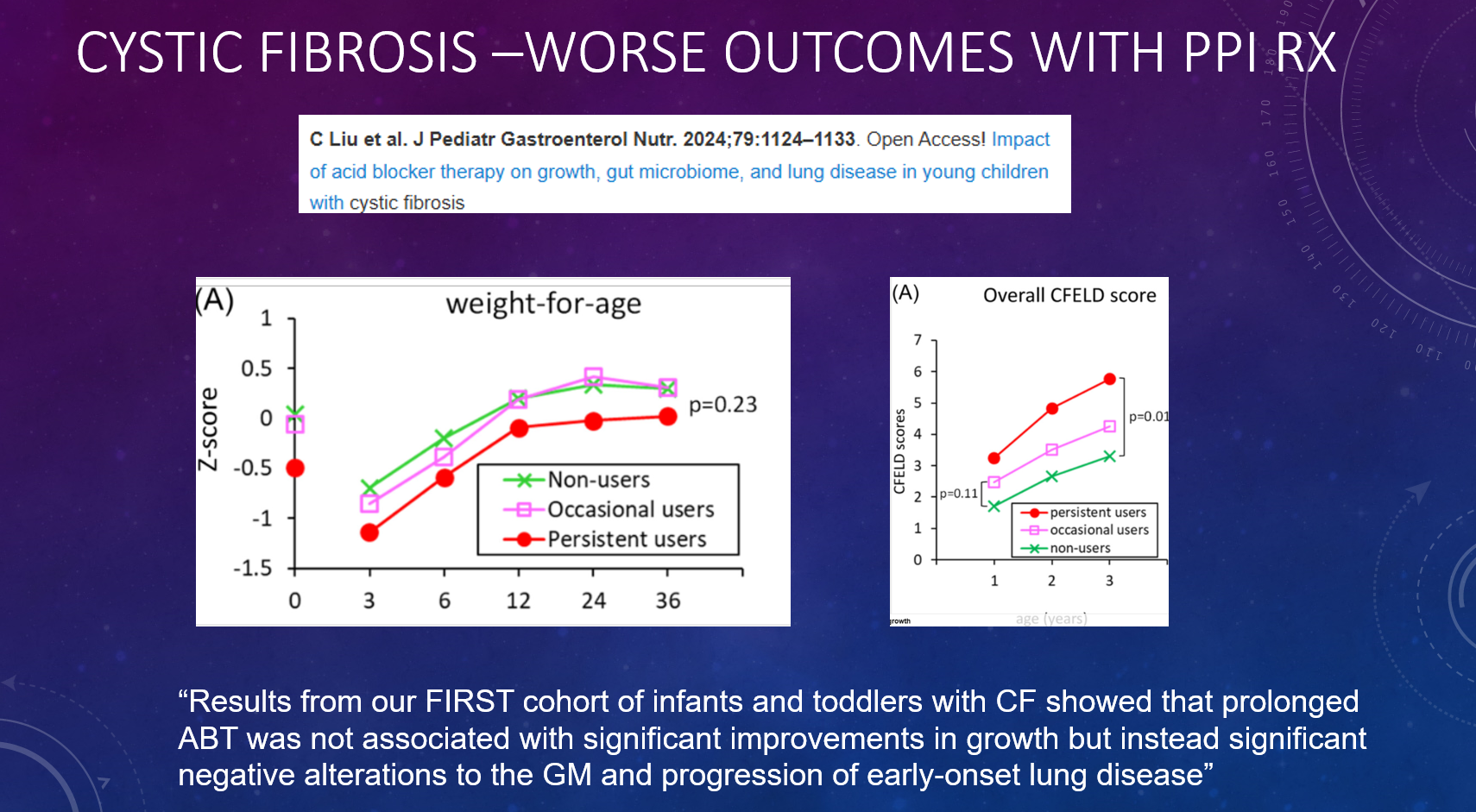
C Liu et al. J Pediatr Gastroenterol Nutr. 2024;79:1124–1133. Open Access! Impact of acid blocker therapy on growth, gut microbiome, and lung disease in young children with cystic fibrosis

Background: Historically, acid suppression has been given as adjuvant therapy to optimize PERT and thereby improve growth and nutritional needs in CF

Methods: This was a prospective cohort of 145 infants followed in 6 CF centers. This was a retrospective study examining the effects of acid blocker therapy and outcomes at 3 years of life in children with cystic fibrosis.

Key findings:

  • Acid blocker therapy (ABT) use before age 3 years was frequent, with 81 (56%) of patients on H2 receptor antagonist (H2RA) or proton pump inhibitor (PPI), and higher among pancreatic insufficient (60%) versus pancreatic sufficient (26%) children.
  • Growth improvements were not significantly greater.

  • Early-onset lung disease was more severe, in persistent ABT users compared to nonusers of ABT.
  • ABT was associated with reduced gut microbiome diversity
CFELD =CF Early-Onset Lung Disease

Discussion:

  • “Results from our FIRST cohort of infants and toddlers with CF showed that prolonged ABT was not associated with significant improvements in growth but instead significant negative alterations to the GM and progression of early-onset lung disease. Evidence from our study is in line with the growing body of literature advocating for more judicious PPI therapy as it has been associated with adverse outcomes such as pulmonary infections, fractures, and anemia.2224


  • One limitation, which was NOT discussed in the article, was selection bias. Since there was not randomization of PPI use, it could be that PPI prescription was more common in children with more severe disease.

My take (borrowed in part from authors): Despite the potential for selection bias, it is clear that “acid blockers are not benign.” Given the potential for worse outcomes, PPI prescription should be restricted to those with a clear indication.

Related blog posts:

Stopping Insurance Coverage in the Middle of Your Procedure

Recently, an example of the arbitrary and poorly-conceived nature of many insurance policies played out publicly in the past few weeks.

USAToday 12/5/24: Anthem BCBS drops controversial new plan to cap anesthesia coverage after backlash

Excerpts:

“After receiving intense backlash, a health insurance provider has rolled back its plan to implement a new policy that would have limited its coverage for anesthesia used during procedures…According to a description of the policy on Anthem’s website, billing guidelines would change in some states beginning in February 2025 to cap the amount of anesthesia care the company would cover based on time limits pre-set by the insurer…This would mean that if a patient’s procedure ran long, the insurer would not pay for the care.”

“The proposition concerned not only members of the public, who began making tongue-in-cheek comments online about being woken up mid-surgery to swipe a credit card, but professional organizations, doctors and lawmakers alike.

[The goal was]  “implementing practices to “safeguard” its insured against “potential anesthesia provider overbilling”…“This is just the latest in a long line of appalling behavior by commercial health insurers looking to drive their profits up at the expense of patients and physicians providing essential care,” said ASA president Donald E. Arnold”

My take: The surprising part about this story is that the policy was reversed before implementation. Insurance companies are adept at implementing cost-saving policies that do not consider the health consequences.

Related blog posts:

Conversations on Palliative Care for Children

K Wu. NEJM 2024; 391; 2288-2289. Well Known to Us.

This commentary focuses on the personal experience of being an hospital-based physician tasked with taking care of chronically-ill complex and neurologically-compromised children through recurrent and prolonged admissions.

An excerpt:

Teetering on the precipice of death at every admission, they are a testament to how far medicine has come in keeping people alive — and how far it still has to go in treating their underlying conditions. Having realistic conversations about long-term outcomes and palliative care for these patients remains difficult, with pediatricians afraid of disrupting fragile relationships with parents who have endured so much.1

With increasing numbers of such children being admitted to PICUs and limited expansion of capacity,2-4 questions have been raised about the value and necessity of the care provided to them — not in terms of their condition in isolation, but in terms of who else is being deprived of care. Patients with complex, chronic, life-limiting, multiorgan conditions are often described as “well known to us,” but they’re also called “bed blockers” — a label reflecting one answer to the uncomfortable ethical question of which patients are most deserving of limited resources.5

Often all I could do was bear witness to their sickness and wellness, their deterioration and recovery, again and again. But in their short lives filled with suffering and struggle and a constant parade of caregivers, I was their pediatrician, and I had become well known to them.

Related blog post: Navigating Difficult Conversations in Children’s GI Healthcare