Deluge of Liver Disease Due to COVID-19?

Two articles in a recent issue of Hepatology describe both direct and indirect effects of COVID-19 on the liver.

The first study with 2273 patients (MM Phipps et al Hepatology 2020; 72: 807-817. Full Text: Acute Liver Injury in COVID‐19: Prevalence and Association with Clinical Outcomes in a Large U.S. Cohort), with retrospective data, describes how most cases of COVID-19 are mild. Severe cases of liver disease are generally a marker for elevated inflammatory markers and severe systemic disease. Key findings:

  • 45% had mild (ALT <2 x ULN), 21% moderate (ALT 2-5 x ULN), and 6.4% severe liver injury (SLI) (ALT >5 x ULN).
  • Patients with SLI had a more severe clinical course, including higher rates of intensive care unit admission (69%), intubation (65%), renal replacement therapy (RRT; 33%), and mortality (42%).
  • In multivariable analysis, peak ALT was significantly associated with death or discharge to hospice (OR, 1.14; P = 0.044), controlling for age, body mass index, diabetes, hypertension, intubation, and RRT

Going into this new year, the more concerning effects of COVID-19 pandemic for the liver is likely to be the increase is severe chronic liver disease related to alcohol (and perhaps fatty liver disease too). The second article (BL Da et al. Hepatology 2020; 72: 1102-1108. Coronavirus Disease 2019 Hangover: A Rising Tide of Alcohol Use Disorder and Alcohol‐Associated Liver Disease) discusses the expectation of increased liver disease due to alcohol use disorder (AUD) and alcohol-associated liver disease (ALD). Key points:

  • In China, reports indicate a “>2-fold increase in harmful drinking after COVID-19, an effect likely repeated in the United States where an estimated 12.7% of the population has AUD and ALD is responsible for the highest hospitalization cost burden among all chronic liver diseases (CLDs).”
  • Increased alcohol use is likely to worsen other chronic liver diseases in addition to ALD
  • In addition, all of these effects are compounded by avoidance of health care facilities and delays in care

My take: COVID-19 infections have direct effects on the liver. However, the increased use of alcohol as well as weight gain are likely to be more important in terms of liver-related morbidity and mortality.

Most Popular 2020 Posts

I want to thank all of you who take an interest in my blog, particularly those who give suggestions, references, and encouragement. The following posts were the most popular from the past year.

Related post: Favorite Posts of 2020

Sandy Springs at Sunrise

Favorite Posts of 2020

These are some of my favorite posts of the past year.

Humor:

GI:

Endoscopy:

Liver:

Nutrition

COVID-19:

Other:

From Picnic Island, Tampa Bay

“Hang in There. Help is On The Way.”

The NY Times published an excellent segment on COVID-19. Here’s a link: “Hang in There. Help is On The Way.”

A guide to the last months (we hope) of the pandemic:

  • Hunker Down for a Little Bit Longer
    • Rising case counts and rising test positivity rates mean there is more virus out there — and you need to double down on precautions, especially if you have a high-risk person in your orbit.
    • Whether your bubble is just your immediate household — or you’ve formed a bubble with others — take some time to check in with everyone and seal the leaks.
    • Mask up. You’re going to need it for a while.
    • Watch the clock, and take the fun outside… If you’re spending time indoors with people who don’t live with you, wear a mask and keep the visit as short as possible. (Better yet, don’t do it at all.) 
    • Take care of yourself, save a medical worker.
  • Scale Back Your Holiday Plans
    • The only way to drive down infection rates for now will be to avoid large indoor gatherings, wear masks, cancel travel and limit your holiday celebrations to just those who live in your home.
    • Socialize outdoors the Scandinavian way.
  • Take Care of Yourself at Home
    • The vast majority of patients with Covid-19 will manage the illness at home. Check in with your doctor early in the course of your illness, and make a plan for monitoring your health and checking in again if you start to feel worse.
    • If you feel sick, you should be tested for Covid-19. A dry cough, fatigue, headache, fever or loss of sense of smell are some of the common symptoms of Covid-19. After you take your test, stay isolated from others and alert the people you’ve spent time with over the last few days, so they can take precautions while you’re waiting for your result.
    • While every patient is different, doctors say that days five through 10 of the illness are often the most worrisome time for respiratory complications of Covid-19.
  • Look for Better Days This Spring
    • The vaccines will be much less effective at preventing death and illness in 2021 if they are introduced into a population where the coronavirus is raging — as is now the case in the United States.
    • An analogy may be helpful here, says David Leonhardt, who writes The Morning newsletter for The Times. He explains that a vaccine that’s 95 percent effective, as Moderna’s and Pfizer’s versions appear to be, is a powerful fire hose. But the size of a fire is still a bigger determinant of how much destruction occurs.

The print version has some additional advice. From Dr. Fauci: “We have crushed similar outbreaks historically. We did it with smallpox. We did it with polio, We did it with measles. We can do it with coronavirus…The future doesn’t need to be bleak. It’s within our hands to really shape the future, both by public health measures and by taking up the vaccine.”

COVID-19 -Now #1 Cause of Death in U.S.

S Woolf et al. JAMA. Published online December 17, 2020. doi:10.1001/jama.2020.24865: Full text: COVID-19 as the Leading Cause of Death in the United States

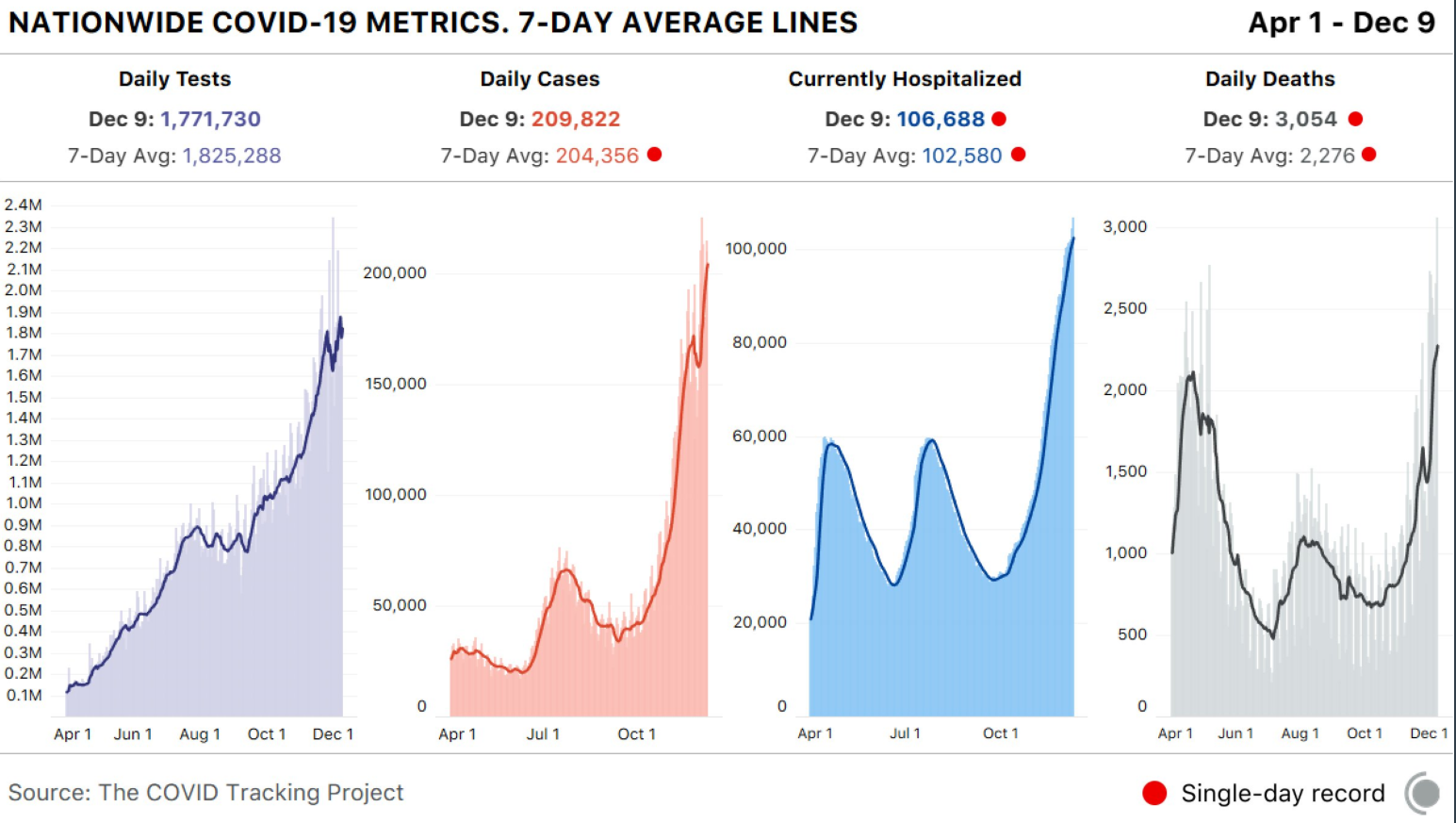
  • Between November 1, 2020, and December 13, 2020, the 7-day moving average for daily COVID-19 deaths tripled, from 826 to 2430 deaths per day
  • As occurred in the spring, COVID-19 has become the leading cause of death in the United States (daily mortality rates for heart disease and cancer, which for decades have been the 2 leading causes of death, are approximately 1700 and 1600 deaths per day, respectively)

Related blog posts:

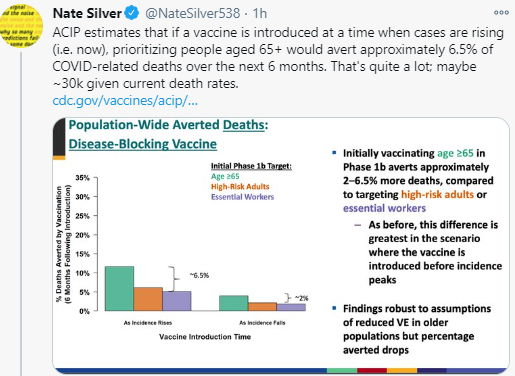
Vaccine Strategy: Nate Silver’s twitter feed suggests that after vaccination of medical personnel, focus of vaccine efforts should rely on age rather than at-risk conditions (which could affect 100 million in U.S). Using an age-based system would also be easier; it would minimize influence and wealth in the distribution of the vaccine.

COVID-19: Excess Mortality in Younger Adults

From NEJM Journal Watch: COVID-19: Excess Mortality in Younger Adults

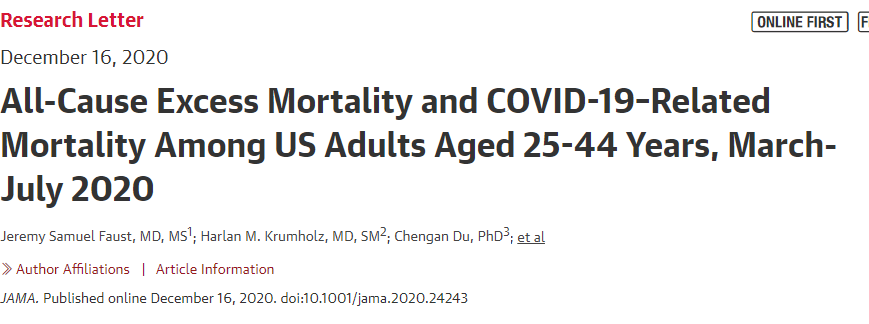
Excess mortality in younger adults: Among U.S. adults aged 25 to 44, there were 19% more deaths than expected — or 12,000 people — from March through July 2020. In JAMA, the researchers — including Dr. Rochelle Walensky, who has been nominated to lead the CDC — report that 38% of this excess mortality was directly from COVID-19, but that proportion varied by region. Deaths from COVID-19 were similar to or exceeded unintentional deaths from opioids in this age group in 2018 in several areas of the country. The authors write that this may be an underestimate of the COVID-19 mortality burden in younger adults, as they may have been undertested.”

Link to study: All-Cause Excess Mortality and COVID-19–Related Mortality Among US Adults Aged 25-44 Years, March-July 2020

Treating Pediatric Hepatitis C Infections is Cost-Effective. Plus COVID-19 mRNA Vaccine Study

E Greenaway et al. J Pediatr 2020; DOI:https://doi.org/10.1016/j.jpeds.2020.08.088. Free full text: Treatment of Chronic Hepatitis C in Young Children Reduces Adverse Outcomes and Is Cost-Effective Compared with Deferring Treatment to Adulthood

Methods: A state-transition model of chronic HCV was developed to conduct a cost-effectiveness analysis comparing treatment at age 6 years vs delaying treatment until age 18 years

Key findings:

  • After 20 years, treating 10 000 children early would prevent 330 cases of cirrhosis, 18 cases of hepatocellular carcinoma, and 48 liver-related deaths
  • The incremental cost-effectiveness ratio of early treatment compared to delayed treatment was approximately $12 690/quality-adjusted life-years gained and considered cost-effective

My take (=conclusion from authors): Delaying treatment until age 18 years results in an increased lifetime risk of late-stage liver complications. Early treatment in children is cost effective. Our work supports clinical and health policies that broaden HCV treatment access to young children.

Related blog posts:


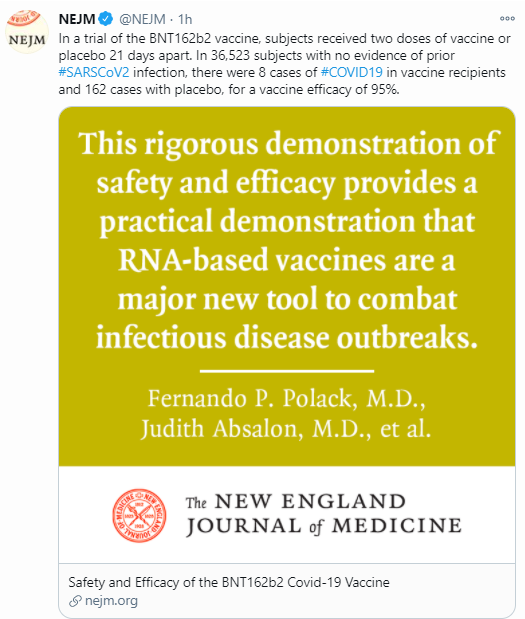
FP Polack et al. NEJM Full text link: Safety and Efficacy of the BNT162b2 mRNA Covid-19 Vaccine

Published data on the Pfizer/BioNTech vaccine

Excess Deaths From COVID-19 and Other Causes

For musical fans: 2020: The Musical YouTube Link (~8 minutes) with Jimmy Fallon and Andrew Rannells


SH Woolf et al.. JAMA 2020; 324: 510-513. Excess Deaths From COVID-19 and Other Causes, March-July 2020

The authors compared deaths from 2014-2020 using data from the National Center for Health Statistics and US Census Bureau.

Key findings:

  • Between March 1 and August 1, 2020, 1 336 561 deaths occurred in the US, a 20% increase over expected deaths (1 111 031 [95% CI, 1 110 364 to 1 111 697]). 
  • Of the 225 530 excess deaths, 150 541 (67%) were attributed to COVID-19
  • The authors conclude that the excess deaths attributed to causes other than COVID-19 could reflect deaths from unrecognized or undocumented infection with severe acute respiratory syndrome coronavirus 2 or deaths among uninfected patients resulting from disruptions produced by the pandemic

My take: The COVID-19 situation has worsened considerably in the past 2 months and the final toll from this infection will be truly staggering; this unfortunately will include its indirect effects due to deferral of care

Outcome of Zen Magnets v. Consumer Product Safety Commission

PT Reeves, B Rudolph, CM Nylund. JPGN 2020; 71:699-703. Magnet Ingestions in Children Presenting to Emergency Departments in the United States 2009–2019: A Problem in Flux

When the 10th Circuit Court, with judges Gorsuch, Ebel, and Bacharah, rolled back high-powered magnet regulations in 2016, it was expected that this would result in more suffering in children. The referenced article by Reeves et al documents the effects of this decision.

Background: In 2016, the Zen Magnets decision resulted in magnets returning to the market with warning labels “but not performance standards favored by NASPGHAN (ie, making magnets either too large to swallow or too weak to cause harm).” In this study, the authors used data from the National Electronic Injury Surveillance System (NEISS), a database of consumer product injuries.

Key findings:

  • When stratified by time period, suspected magnet ingestion (SMI)per year was 1598 during off-market period (when product was banned) compared with 2826 during on-market period.
  • An estimated 23,756 children (59% males, 42% < 5 years old) presented with a SMI from 2009 to 2019.
  • There was an average annual case increase of 6.1% (P = 0.01).
  •  After 2017, there was a 5-fold increase in the escalation of care for multiple magnet ingestions (estimated n = 1094; CI 505–1686). “Escalation of care” refers to cases designated as ‘treated and transferred,’ ‘treated and admitted/hospitalized,’ or ‘held for observation.’
  • More data on this topic from CPSC 124 page report: (Link) Informational Briefing Package Regarding Magnet Sets

My take: Regulatory action is needed to prevent harm in children from these high-powered magnets.There are two companion bills in Congress which are in committee, one entitled “Magnet Injury Prevention Act.” These are clearly needed given previous judicial branch ruling.

Related blog posts: