Does a Low Vitamin D Level Increase the Risk of Crohn’s Disease? And Other Biomarkers

A recent study (BN Limketkai et al. Clin Gastroenterol Hepatol 2020; 18: 1769-76Levels of Vitamin D Are Low After Crohn’s Disease Is Established But Not Before) takes advantage of stored serum from U.S. military personnel.

Key finding: By examining 240 with Crohn’s disease (CD) along with 240 control patients, the authors show that vitamin D levels prior to CD diagnosis are not associated with the development of CD up to 8 years preceding the diagnosis.

Two other articles on predictive biomarkers for CD and an associated editorial:

  • N Nair et al. Gastroenterol 2020; 159: 383-5. Association Between Early-life Exposures and Inflammatory Bowel Diseases, Based on Analyses of Deciduous Teeth
  • J Torres, F Petralia et al. Gastroenterol 2020; 159: 96-104Serum Biomarkers Identify Patients Who Will Develop Inflammatory Bowel Diseases Up to 5 Years Before Diagnosis
  • New Biomarkers for Crohn’s Disease (editorial) C Bernstein. Gastroenterol 2020; 159: 30-32. Key points from editorial:
    • “In the article by Nair et al, the authors relate the presence of heavy metals in baby teeth to the later development of Crohn’s disease…The finding of metals that can be tracked to the in utero state suggests that the offspring who will ultimately present with IBD and have high values of these metals are likely acquiring these metals from their mothers.”
    • “In the study by Torres et al, a serum bank of Department of Defense recruits was accessed to study for microbial antibodies and immune-inflammatory markers for ≤5 years antedating diagnoses of either Crohn’s disease or ulcerative colitis. Anti-Flagellin X and ASCA-IgA were predictive of Crohn’s disease…The authors have convincingly showed that these microbial antibodies and immune-inflammatory mediators are present years before the first clinical manifestation of Crohn’s disease. These phenomena very likely are early biological manifestations of Crohn’s disease. They may not be risk factors that Crohn’s disease is coming, but rather that it is already present.”

My take: Stored tissue/blood eventually may help predict who will develop CD.  Given a lack of current treatment options in those at risk, the importance of these predictive markers is unclear.

Briefly Noted: How to Approach Crohn’s Disease Complicated by an Intra-abdominal Abscess

A recent review (T Qazi, M Regueiro. Practical Gastroenterology 2020: June Issue, 10-18. Full PDF Link: Crohn’s Disease Complicated by an Intra-abdominal Abscess: Poke, Prod, or Cut?)

The article is a good review & the algorithm below provides some good guidance -if difficult to visualize, then it may be worthwhile to look at source article.

The authors propose initial management with antibiotics, minimization of steroids, nutritional support and drainage.

Medical treatment is favored after initial management:

  • Newly diagnosed Crohn’s disease
  • Extensive disease
  • No fibrostenoting disease
  • Active perianal disease

Surgical treatment is favored after initial management:

  • Long-standing disease
  • Stricture with dilatation
  • Abscess >6 cm in size
  • Prior surgical intervention

The authors note that “recent studies have suggested that roughly 30% of patients
treated with PD are able to avoid future surgical resection.”

Related blog posts:


IBD Update -August 2020

S Jansson et al JPGN 2020; 71: 40-5. This retrospective study (1998-2008) showed that pediatric patients with extraintestinal manifestations (EIM) had more severe IBD course than patients with IBD without an EIM.  EIM often had a temporal relationship with a relapse of IBD as well. Of 333 patients, 14 had an EIM at diagnosis and 47 had an EIM develop during followup.

PA Olivera, JS Lasa et al. Gastroenterol 2020; 158: 1554-73. This systematic review and meta-analysis ultimately included 82 studies with 66,159 patients (including those with IBD and other immune-mediated diseases) exposed to a JAK inhibitor; two-thirds of studies were randomized controlled trials.  Key findings:

  • Incidence rates of serious infections, herpes zoster infection, malignancy, and major cardiovascular events were 2.81, 2.67, 0.89, and 0.48 per 100 person year respectively. After meta-analysis, the authors conclude that there is an increased risk of herpes zoster (RR 1.57), but all other adverse events were not increased among patients treated with JAK inhibitors
  • Mortality was not increased in those receiving JAK inhibitors compared to placebo

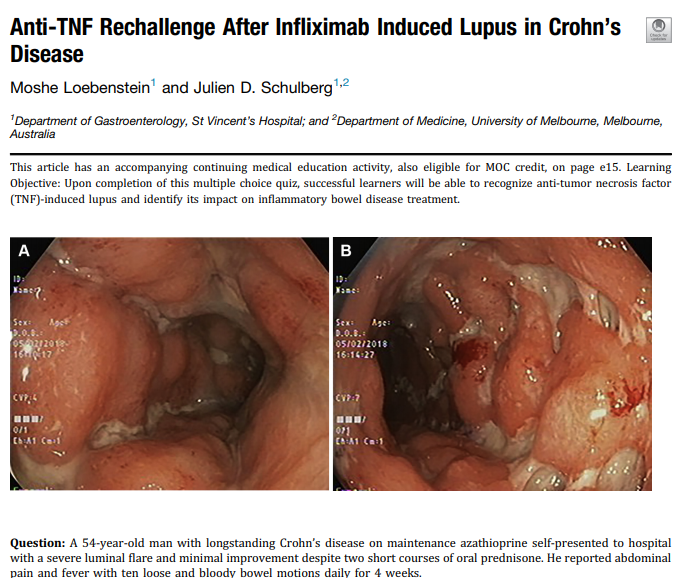
Loebenstein, JD Schulberg. Gastroenterol 2020; 158: 2069-71.  This case report describes a successful alternative anti-TNF rechallenge after infliximab induced Lupus in Crohn’s disease.  The authors note that in a previous study, 14 of 20 IBD patents with drug-induced lupus secondary to an anti-TNF agent were rechallenged with an alternative anti-TNF agent and 13/14 tolerated rechallenge without recurrent lupus (Inflamm Bowel Dise 2013; 19: 2778-86).

These images show active disease prior to intervention. The article provides f/u images showing endoscopic remission after re-starting a different anti-TNF agent.

Ustekinumab Over Vedolizumab as 2nd Line Agent for Crohn’s Disease

A recent study: Ustekinumab is associated with superior effectiveness
outcomes compared to vedolizumab in Crohn’s disease patients with prior failure to anti-TNF treatment. VBC Biemans et al. Aliment Pharmacol Ther 2020; 52: 123-134.  Thanks to Ben Gold for this reference.

Methods: Crohn´s disease patients, who failed anti-TNF treatment and started
vedolizumab or ustekinumab in standard care as second-line biological, were
identified in the observational prospective Dutch Initiative on Crohn and
Colitis Registry.  128 vedolizumab- and 85 ustekinumab-treated patients fulfilled
the inclusion criteria. Median age in the cohorts were 37 and 39 respectively.

Key findings (at 52 weeks):

  • After adjusting for confounders, ustekinumab-treated patients were more likely to achieve corticosteroid-free clinical remission (odds ratio [OR]: 2.58, 95% CI: 1.36-4.90, P = 0.004), biochemical remission (OR: 2.34, 95% CI: 1.10-4.96, P = 0.027), and combined corticosteroid-free clinical and biochemical remission (OR: 2.74, 95% CI: 1.23-6.09, P = 0.014).
  • Safety outcomes (infections: OR: 1.26, 95% CI: 0.63-2.54, P = 0.517; adverse events: OR: 1.33, 95% CI: 0.62-2.81, P = 0.464; hospitalisations: OR: 0.67, 95% CI: 0.32-1.39, P = 0.282) were comparable between the two groups

My take: This study indicates that ustekinumab is likely a more effective 2nd line agent for Crohn’s disease.

Related blog posts:

Curcumin Was NOT Effective For Post-operative Crohn’s Disease, Goldman Sachs Take on Masks

NBC/NY Link: Goldman Sachs Says National Mask Mandate Could Slash Infections, Save Economy From 5% Hit


Briefly noted: G Bommelear et al. Clin Gastroenterol Hepatol; 2020; 18: 1553-60. Oral Curcumin No More Effective Than Placebo in Preventing Recurrence of Crohn’s Disease After Surgery in a Randomized Controlled Trial

Methods:

  • Double-blind randomized controlled trial at 8 referral centers in France, from October 2014 through January 2018, with 62 consecutive patients with CD undergoing bowel resection.
  • Patients received azathioprine (2.5 mg/kg) and were randomly assigned to groups given oral curcumin (3 g/day; n = 31) or an identical placebo (n = 31) for 6 months, and were then evaluated by colonoscopy.
  • The primary endpoint: postoperative recurrence of CD in each group (Rutgeerts’ index score ≥i2) at month 6

Key findings:

  • Postoperative recurrence at 6 months: (Rutgeerts’ index score ≥i2): 58% receiving curcumin vs 68% receiving placebo (P = .60).
  • Severe recurrence: 55% receiving Curcumin 55%vs 26% receiving placebo –had a severe recurrence of CD (Rutgeerts’ index score ≥i3) (P = .034).
  • Clinical recurrence of CD (CD activity index score >150) at 6 months: 30% with curcumin compared with 45%  receiving placebo (P = .80)

My take: Curcumin was ineffective in preventing recurrent post-operative Crohn’s disease

Related blog posts:


Can Microscopic Colitis Lead to Crohn’s Disease or Ulcerative Colitis?


A recent prospective cohort “ESPRESSO” study (H Khalili et al. Gastroenterol 2020; 158: 1574-83) from 1990-2017 examined the risk of incident inflammatory bowel disease (IBD) in subjects with microscopic colitis, n=13,957 (& each matched with 5 controls). ESPRESSO = Epidemiology Strengthened by histoPathology Reports in Sweden.

Key findings:

  • In the microscopic colitis group, there were 323 incident cases of ulcerative colitis (UC) and 108 cases of Crohn’s disease (CD)
  • Mean times to diagnosis were 3.2 years for UC and 3.3 years for CD
  • Microscopic colitis was associated with an aHR of 12.6 for CD and 17.3 fo rUC
  • The absolute excess risk compared to matched control over a 10-year period were 2.6% for UC and 0.9% for CD

My take: Individuals with microscopic colitis are at increased risk of developing UC and CD.

Related blog post/related article:


IBD Briefs June 2020

SA Draiweesh et al. Safety of Combination Biologic and Antirejection Therapy Post-Liver Transplantation in Patients with Inflammatory Bowel Disease. Inflamm Bowel Dis 2020; 26: 949-59. In this case series of 19 patients, 14 who had liver transplantation for PSC, there was no increased risk of serious infections among patients receiving biologic therapy in combination with antirejection medications.

A Malian et al. Pedictors [sic] of Perianal Fistula Relapse in Crohn’s Disease. Inflamm Bowel Dis 2020; 26: 926-31. In this retrospective study with 137 patients, fistula relapse rates were not different in patients receiving infliximab or adalimumab (P = 0.66). In patients treated by anti-TNF at inclusion, discontinuation of anti-TNF therapy (odds ratio 3.49, P = 0.04), colonic location (OR 6.25, P = 0.01), and stricturing phenotype (odds ratio 4.39, P = 0.01) were independently associated with fistula relapse in multivariate analysis.

M-H Wang et al. Unique Phenotypic Characteristics and Clinical Course in Patients With Ulcerative Colitis and Primary Sclerosing Cholangitis: A Multicenter US Experience. Inflamm Bowel Dis 2020; 26: 774-81. Among 522 patients with UC, 56 (10.7%) had PSC. Compared with UC alone, patients with UC-PSC were younger (younger than 20 years) at diagnosis (odds ratios [OR], 2.35; adjusted P = 0.02) and had milder UC severity (adjusted P = 0.05), despite having pancolonic involvement (OR, 7.01; adjusted P < 0.001).  In the biologics era (calendar year 2005 to 2015), patients with UC-PSC less commonly received anti-TNF therapy compared with patients with UC (OR, 0.38; adjusted P = 0.009), but their response rates were similar.

B Barberio et al. Matrix Metalloproteinase 3 Predicts Therapeutic Response in Inflammatory Bowel Disease Patients Treated with Infliximab. Inflamm Bowel Dis 2020; 26: 756-62. Retrospectively, 73 IBD patients who had received IFX for at least 1 year were enrolled: 35 patients were responders and 38 were nonresponders at 52 weeks…The MMP3 levels were similar at baseline (19.83 vs 17.92 ng/mL), but at postinduction, patients who failed to respond at 1 year had significantly higher levels than patients who responded (26.09 vs 8.68 ng/mL, P < 0.001); the difference was confirmed at week 52 (29.56 vs 11.48 ng/mL, P < 0.001)…The MMP3 serum determination may represent an early marker of response to infliximab.


“No Solid Conclusions” for Alternative/Complementary Therapies for Inflammatory Bowel Disease

In this clinical review (N Chande et al Inflamm Bowel Dis 2020; 26: 843-51) assess evidence from Cochrane reviews of four popular nontraditional treatments for inflammatory bowel disease (IBD):

  • Fecal Microbiota Transplantation (FMT)
  • Nutritional Therapies including Enteral Nutrition (EN)
  • Naltrexone for Crohn’s Disease (CD)
  • Cannabis for IBD

So what does the literature have to say about these treatments:

  • FMT: FMT for mild to moderate ulcerative colitis (UC) increased the proportion of patients achieving clinical remission. “However, the number of included studies was small and the quality of evidence was low.”  Other problems included uncertainty regarding serious adverse events and short duration of followup.
  • “As a result, no solid conclusions [the authors did not indicate this as a pun] can be drawn at this time.”

  • Nutritional Therapies: For remission in CD, “EN may be more effective than corticosteroids in children, although the opposite was true in adults.”
  • “Exclusion diets did not promote clinical remission or reduce clinical relapse in UC”
  • “The overall certainty of evidence in these studies were generally very low, largely due to sparse data.”

  • Naltrexone for Crohn’s Disease (CD): “The paucity of data makes it impossible to draw any firm conclusions about the effectiveness and safety” of low dose naltrexone.

  • Cannabis for IBD: “The risk of adverse events was significantly higher in cannabis-treated patients”…though these events were generally mild (eg. sleepiness, confusion, nausea).
  • “The results of these studies suggest that cannabis is not effective for the treatment of IBD”  This conclusion is limited by the small number of patients in prior studies.  Cannabis may be helpful as an adjunct for some symptoms though this “warrants further study.”

Related blog posts:


Ionizing Radiation Exposure in Adults with Inflammatory Bowel Disease

From The Onion:


In the largest reported cohort to date, GC Nguyen et al (Inflamm Bowel Dis 2020; 26: 898-906) describe the ionization radiation exposure (IRE) in individuals (≥18 years) with inflammatory bowel disease (IBD).

Methods: N=72,933 with IBD,1994-2016. During 1st 5 yrs after diagnosis, IRE was estimated in a retrospective matched cohort in Ontario.

Key findings:

  • IBD patients were exposed to nearly 6-fold IRE due to abdominal imaging compared to controls: 18.6 mSv vs 2.9 mSv
  • Patients with CD had higher IRE than UC: 26 mSv vs 12 mSv (P<0.001).  CD patients were more likely to have >50 mSv exposure (15.6% vs 6.2%) and >100 mSv 5.0% vs 2.1%
  • Women were less likely to have high IRE compared to males
  • Residents in the poorest neighborhoods were 27% more likely to have IRE >100 mSv.  Socioeconomic status was an independent factor after accounting for comorbidities. The authors speculate that this could be related to increased use of emergency rooms where they may be more likely to receive a CT.
  • The use of CT scan began to decline after 2007…likely explained by the rise of MRE studies.

While strict guidelines on IRE are lacking, the International Commission on Radiological Protection has suggested that occupational exposure (eg. nuclear workers) should be limited to <100 mSv over 5 years and not more than 50 mSv in a single year.

My take: We need to continue efforts to reduce IRE due to concerns about subsequent secondary malignancies. This likely means avoiding CT for non-emergencies and working with our ED colleagues to think carefully about lifetime IRE in IBD patients.

Related blog posts:

Additional references:

  • -AJR 2001; 176: 289-96. Estimated risks of radiation-induced fatal cancer from pediatric CT
  • -Br J Radiol 2012; 85: 523-28.  Justification of CTs -some not needed
  • -AJR 2010; 194: 868-73.  Lower CT radiation doses in pediatric patients.  ‘Image gently’
  • -Arch Intern Med 2009; 169: 2078-86.

From LA Times:


Expert Guidance on Inflammatory Bowel Disease (Part 3)

A recent issue of Clinical Gastroenterology and Hepatology focused solely on the clinical features and management of inflammatory bowel disease. Even for those with expertise in IBD, there is a lot of useful information and concise reviews of what is known.

Here are some of my notes from this issue (part 3):

RP Hirten et al. Clinical Gastroenterol Hepatol: 2020; 18: 1336-45. A User’s Guide to De-escalating Immunomodulator and Biologic Therapy in Inflammatory Bowel Disease

This article emphasizes the need for assessment of bowel disease activity before attempting de-escalation and provides a list of risk factors for flare-up off therapy.

Some of the Risk factors for Disease Flare with De-escalation:

  • Disease activity/abnormal biomarkers (CRP, WBC, Hemoglobin, Calprotectin)
  • Perianal disease
  • Penetrating disease
  • Extensive disease involvement
  • Abnormal bowel wall thickening on MRE
  • Young age at diagnosis
  • Short treatment duration
  • Prior surgeries

Key points:

  • In individuals on combination therapy, dropping immunomodulator therapy (but not biologic therapy) did NOT increase the short term risk of a flare up in a recent Cochrane review.  However, this did impact anti-TNF kinetics and lowers anti-TNF troughs.
  • With regard to stopping biologics, among patients in deep remission, the authors advise counseling patients (CD and UC) that stopping biologic agents results in a “40-50% relapse over the following 2 years that will further increase over time.”
  • Careful followup is recommended if a patient elects to stop biologic therapy. “CD and UC are progressive relapsing conditions…and approximately 80% of subjects” require re-initiation of biologic therapy with 7 years.”
  • “Repeat colonoscopy or imaging should be performed if a significant change in symptoms occurs or abnormal biomarkers are detected.”
  • In patients who resume infliximab, the authors advocate for an initial induction of 0, 4, and 8 weeks.  The presence of antidrug antibodies at week 2 “precludes drug administration and alternative agent should be started.”

Related blog posts:

M Kaur et al Clinical Gastroenterol Hepatol 2020; 18: 1346-55. Inpatient Management of Inflammatory Bowel Disease-Related Complications

This article reviews the approach to acute severe ulcerative colitis which has been discussed recently on this blog post and offers management recommendations for complications related to Crohn’s disease including abscesses, strictures/bowel obstruction.  With regard to abscess management, the authors note that medical therapy is more likely to be effective in those with a first-time abscess, spontaneous origin, right lower quadrant location, and smaller abscess size (<3 cm).  Stricture with upstream dilatation of bowel, multi-loculated abscesses and steroid use are features that make therapy less likely to be successful.

Related blog posts -ASUC:

Abscess-related blog posts:

EL Barnes et al Clinical Gastroenterol Hepatol 2020; 18: 1356-66. Perioperative and Postoperative Management of Patients With Crohn’s Disease and Ulcerative Colitis

This article reviews risk factors for disease recurrence after surgery, presurgical management (eg. minimize steroids, improve nutrition, do not delay surgery based on preoperative biologic exposure), postoperative strategies and management of pouchitis.

  • In those at high risk for postoperative disease recurrence, the authors advocate anti-TNF therapy plus an immunomodulator with colonoscopy at 6-12 months. In those at low risk, many are placed on no medications and have a colonoscopy at 6 months postoperatively.
  • The section on pouchitis lists alternatives to metronidazole and ciprofloxacin if these lose efficacy.  This includes amoxicillin-clavulanate, sulfamethoxazole-trimethoprim, doxycycline and vancomycin.
  • Related blog post: What’s Going on With Pouchitis?

S Singh et al Clinical Gastroenterol Hepatol 2020; 18: 1367-80. Management of Inflammatory Bowel Diseases in Special Populations: Obese, Old, or Obstetric

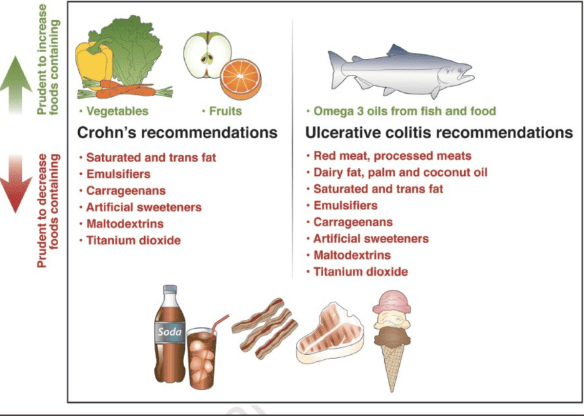
A Levine et al Clinical Gastroenterol Hepatol 2020; 18: 1381-92. Dietary Guidance From the International Organization for the Study of Inflammatory Bowel Diseases

  • The authors recommend more vegetables and fruits with CD (but low insoluble fiber if stricture present)
  • “Prudent to reduce intake of red and processed meat” with UC
  • “Prudent to increase dietary omega-3 fatty acids” from marine fish but not from dietary supplements with UC
  • ‘Prudent to use a low FODMAP diet for patients with persistent symptoms for CD and UC despite resolution of inflammation’
M Collins et al Clinical Gastroenterol Hepatol 2020; 18: 1393-1403.Management of Patients With Immune Checkpoint Inhibitor-Induced Enterocolitis: A Systematic Review

This study reviews colitis induced by immune checkpoint inhibitors which are similar to young patients with inherent CTLA4b deficiency.

Related blog posts:

Disclaimer: This blog, gutsandgrowth, assumes no responsibility for any use or operation of any method, product, instruction, concept or idea contained in the material herein or for any injury or damage to persons or property (whether products liability, negligence or otherwise) resulting from such use or operation. These blog posts are for educational purposes only. Specific dosing of medications (along with potential adverse effects) should be confirmed by prescribing physician.  Because of rapid advances in the medical sciences, the gutsandgrowth blog cautions that independent verification should be made of diagnosis and drug dosages. The reader is solely responsible for the conduct of any suggested test or procedure.  This content is not a substitute for medical advice, diagnosis or treatment provided by a qualified healthcare provider. Always seek the advice of your physician or other qualified health provider with any questions you may have regarding a condition.