#NASPGHAN17 Annual Meeting Notes (Part 2): Year in Review

This blog entry has abbreviated/summarized this presentation. Though not intentional, some important material is likely to have been omitted; in addition, transcription errors are possible as well.

This first slide shows the growth in NASPGHAN membership:

Year in Review

Melvin Heyman  Editor, JPGN

This lecture reviewed a number of influential studies that have been published in the past year.  After brief review of the study, Dr. Heyman summarized the key take-home point.


Update on Chronic Cough

It is not uncommon for a pediatric gastroenterologist to see a patient with a chronic cough due to concerns about potential gastroesophageal reflux disease (GERD).  As such, a recent clinical practice article (JA Smith, A Woodcock. NEJM 2016; 375: 1544-51) by lung specialists was of interest, even though this article was not targeted to the pediatric population.

Key points:

  • The authors define a chronic cough as lasting more than 8 weeks and note that it common with respiratory conditions (eg. chronic obstructive pulmonary disease, asthma, and bronchiectasis) and some non-respiratory conditions (eg. gastroesophageal reflux and rhinosinusitis).  Medications, particularly ACE inhibitors, can trigger a chronic cough as well.
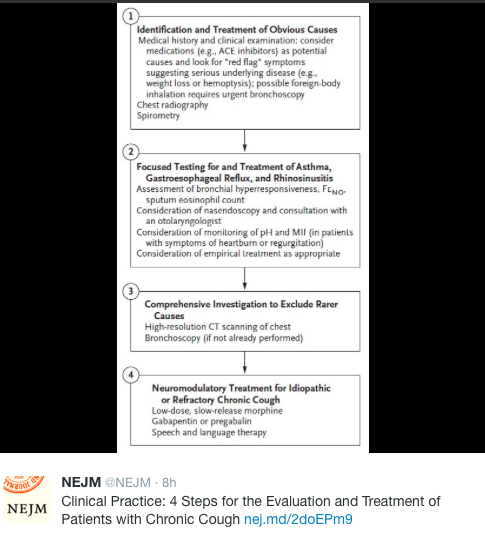
  • Steps in evaluation: 1. H&P, CXR, spirometry. 2. Consider metacholine challenge, ENT evaluation, consider empiric treatment (eg. inhaled glucocorticoids, PPI), and consider GERD evaluation. 3. High-resolution CT and bronchoscopy.
  • For many patients, there is likely to be an abnormality in neuronal pathways controlling cough and the term “cough hypersensitivity syndrome” has been coined.  Figure 2 (below) illustrates the neuronal pathways.
  • For refractory patients, potential therapies would include low-dose morphine, gabapentin or pregabalin, and speech language therapy.

screen-shot-2016-10-26-at-8-24-57-pm

GERD:

  • Guidelines “suggest a trial of treatment with acid-suppression therapy” (eg. twice-daily PPIs for up to 3 months).
  • “Most randomized, controlled trials of reflux treatment for cough have not shown a significant improvement in association with this type of treatment.”
  • Subgroups of patients with heartburn, regurgitation, or excessive acid reflux on esophageal pH monitoring “appeared marginally more likely to have a response to PPI treatment.”  pH or impedance tests “are poorly predictive of a response of cough to acid suppression.”

My take: In the absence of clinical reflux, reflux therapy is unlikely to help with chronic cough.  However, in patients with an adequate workup, an empiric course of a PPI is likely more preferable than empiric morphine or gabapentin.

Related blog posts:


screen-shot-2016-10-22-at-4-01-47-pm

Does Reflux Lead to Increased Aspiration Pneumonia?

This post’s title question turns out to be quite tricky.  According to a recent study (RL Rosen et al. JPGN 2016; 63: 210-17), reflux burden, even in children that aspirate did not correlate with increased hospitalization.

Here are the details:

Methods: Prospectively recruited cohort of 116 children who had both pH-impedance testing along with modified barium swallow. The authors considered pathologic reflux to have at least 73 episodes on pH-impedance or if pH<4 for >6% of study period.

Key findings:

  • There was no statistical correlation between pH-impedance study results and total number of admissions even with or without adjusting for aspiration status (and neurologic complications).

When the authors tried to reconcile these findings, they offered three competing potential explanations for these results:

  • Reflux has little impact on hospitalziations
  • Our methods for measuring reflux are not good
  • Even “normal” reflux can be a problem for those prone to complications; therefore, reflux burden is not consequential.

What is clear is that pH-impedance studies cannot predict which patients are at risk for increased complications.  This is supported by data showing that ‘reflux-related’ hospitalizations may not improve after fundoplication (Pediatrics 2006; 118: 2326-33; J Pediatr Surg 2008; 43: 59-63).  One particularly important limitation was that the cause of hospitalizations was determined by medical record review.

My take: A simple algorithm for preventing aspiration pneumonia does not exist.  Even the role of reflux testing is uncertain.

Related blog posts:

The accompanying article guaranteed that the pizza would pass through the body within 30 minutes.

The accompanying article guaranteed that the pizza would pass through the body within 30 minutes!!!


More advice on Proton Pump Inhibitors

L Laine, A Nagar. Am J Gastroenterol 2016; 111: 913-15.

This reference explains how these clinicians discuss the long-term use of proton-pump inhibitors with their adult patients.  Thanks to Ben Gold for this reference.  Here are a couple pointers:

  • “The recent studies about CKD (chronic kidney disease) and dementia, similar to many prior studies assessing PPI risk, are retrospective observational studies…This results in differences between PPI users and non-users in factors that may impact study outcomes and confound results.”
  • Gastroesophageal reflux disease: The authors suggest that PPIs for GERD can be stopped >2 weeks after symptoms resolve.  For infrequent symptoms, H2RAs, lifestyle modifications and intermittent PPIs often suffice.
  • Barrett’s esophagus: “observational sutdies suggest that PPIs may decrease progression to neoplastic Barrett’s esophagus”

WHAT WE TELL PATIENTS: “Because of inherent risk of bias and low effect sizes we cannot conclude that associations of PPIs and adverse outcomes such as dementia and CKD in recent observational studies are vailid…Nevertheless, we cannot conclude that risks do not exist…we need to ensure that benefits outweigh potential risk.  If PPIs are indicated, using the lowest effective dose and, if possible, intermittent rather than daily therapy..should decrease the risk of potential side effects.”

On the same topic, Paul Moayyedi (in Gastroenterology and Endoscopy News, August 2016): “Every study has shown that sicker patients tend to be prescribed PPIs…Sick patients tend to develop other illnesses so PPIs will be associated with about any disease you can imagine in a database.”  As such, he asserts that weak associations (OR <2) are usually due to cofounding factors.  “The only benefit [these studies]..have is that it is another opportunity to discuss with the patients about stopping their PPI therapy, as there are a significant proportion…on these drugs unnecessarily.”

purple flowers

Linking Reflux and Tooth Erosion

Every now and then a dentist sends a kid to our GI practice due to eroded teeth because of concerns about reflux damaging the enamel.  While it is recognized that reflux may damage teeth, the exact frequency is unclear.  Other questions:

  • Which asymptomatic kids with poor dentition require GI evaluation?
  • What is the best way to evaluate these children?
  • If reflux is identified, how long should they remain on treatment? Forever?
  • How effective is reflux treatment in reducing tooth damage?

While none of these questions have been definitely answered, Rosen et al (JPGN 2016; 62: 309-13) show that acid reflux rather than nonacid reflux is predictive of tooth erosion. In this study, the authors used a prospective cohort of 27 children (age ≥3 years)–ALL of them were ON acid suppression (for >1 year) at the time of pH-MII testing.  Key findings:

  • Prevalence of tooth erosion was 10 or 27 (37%)
  • There was correlation with acid reflux episodes (& time in reflux) and tooth erosion, r=0.44, P=0.02
  • There was correlation with reflux index as well, r=0.54, P=0.004,  In the tooth erosion group, the mean reflux index was 7.3% compared with 1.6% in no dental erosion group.
  • There was no correlation with nonacid reflux with tooth erosion

The authors’ discussion highlights many prior relevant studies and indicates that a pH-metry study alone (rather than pH-MII) “may be adequate.” They note some of the limitations of this study which included a small number of patients and potential referral bias, as these children had suspected GERD.  In the methods section, the authors state that their standard practice, at the time of the study, was to maintain patients on prior acid suppression medication.  It would be useful to acknowledge that many experts, at this time, recommend doing pH-MII studies as well as standard pH studies off all acid suppression due to improved sensitivity/accuracy.

My take: This study shows that in the 10 children with tooth erosion who had suspected GERD, there was correlation with acid reflux but not with nonacid reflux.

Related blog post: Notes from PPI Webinar GutsandGrowth

Unrelated but interesting: Are medical errors really the 3rd leading cause of death in U.S.? Here’s NPR’s summary of a recent BMJ article which makes that claim: Only Heart Disease and Cancer Exceed Medical Errors As Cause of U.S. Death

Gibbs Gardens

Gibbs Gardens


Proton Pump Inhibitors Webinar

For those who missed the live NASPGHAN webinar, it is also available on demand: Link: Proton Pump Inhibitors Webinar. CME credit is available too.

Overall, this is a terrific review and intended for a high level audience. Here are a couple of key points from the talk:

  • Dr. Jennifer Lightdale introduced the webinar.  She noted that there has been a tremendous rise in the use of proton pump inhibitors (PPIs) in children over the past 15 years, including in infants.
  • Preponderance of evidence does not support use of PPIs for reducing GER symptoms or crying in infants.
  • PPIs are extremely effective at acid suppression.
  • Excellent discussion by Dr. Rachel Rosen on Nonerosive Reflux Disease (NERD) and distinguishing this entity from erosive reflux disease, hypersensitive esophagus, and functional heartburn.
  • On a microscopic level, NERD is similar to erosive reflux with microscopic inflammation and dilated intracellular spaces.
  • With regard to testing, it is recommended that for impedance studies, that acid suppression be stopped prior due to improved sensitivity/accuracy.
  • For those at odds with their pulmonologists and ENT colleagues, Dr. Ben Gold reviewed the literature on asthma, cough, and laryngeal-pharyngeal pathology related to reflux. The sensitivity of laryngoscopic findings to identify reflux is poor.  “There is insufficient evidence to recommend for OR against the use of acid suppression therapy.”
  • Dr. Jose Garza reviewed the indications for PPI use which include eosinophilic esophagitis/PPI-REE, erosive esophagitis, NSAID prophylaxis, Upper GI bleeding, and H pylori therapy.
  • Dr. Carlo DiLorenzo provided an in-depth discussion of the potential risks of PPI therapy and explained some of the context as well as absolute risks.  He noted that besides the risk of infection, particularly C difficile, other risks demonstrated in adults have not yet been confirmed in children.
  • “Prolonged acid suppression should be used only when indicated.”  Thus, management should include strategies for treatment discontinuation in the majority of those receiving PPI therapy.

Related blog posts:

Isla Verde, San Juan

Isla Verde, San Juan


PPIs and Associated Heart Risk

A NY Times review PPIs and Heart Attacks of PLos One study showing an association between PPI usage (eg. prilosec, prevacid, and nexium) and heart attacks -this study does not prove any causality, but is likely to spark some questions. Excerpt:

The widely used drugs known as proton pump inhibitors, or P.P.I.’s — gastric reflux preventives like Prilosec and Prevacid — may increase the risk for heart attack, according to analysis of data involving almost three million people.

A significant limitation of the study, in PLOS One, is that P.P.I. usage may be a marker of a sicker patient population, more subject to heart disease in any case.

Here’s NPR’s take on the same study: Data Dive -Possible Link Between PPIs and Heart Attacks

“The increase in risk is about 16 to 20 percent, depending on the particular drug involved”…

Someone with a low risk of heart attack doesn’t have much to worry about. “If your risk of a cardiovascular event or a heart attack is one in a million, now it is 1.2 in a million,” [Nigham] Shah [one of the authors] says.

“The problem is, it’s very easy to do studies of this sort that lead to conclusions that can be misleading,” says Dr. David Juurlink, a drug-safety researcher at the University of Toronto…

“Having a bad diet, drinking too much alcohol, smoking and all sorts of other things … might lead people to be on a PPI,” Juurlink says. One would expect those people to be at higher risk of heart attack, which leads Juurlink to think the medicine is likely not to blame.”


Also noted:

pH Probe Testing: Rumors of My Death are Premature

Several years ago, an “obituary” was written for the pH probe (Putnam PE,J Pediatr.  2010; 157(6):878-80) due to the presumed superiority of pH-impedance (pH-MII) studies in detecting gastroesophageal reflux disease (GERD)  As noted in previous blogs (see below), there have remained a number of concerns with the assumption that pH-MII is an improvement over pH studies without impedance.  Several recent studies elaborate on those concerns:

  1. Cheng F-K F, et al. Clin Gastroenterol Hepatol 2015; 13: 867-73
  2. Patel A, et al. Clin Gastroenterol Hepatol 2015; 13: 884-91
  3. Vaezi MF. Clin Gastroenterol Hepatol 2015; 13: 892-94 (editorial)

In the first study, the authors identified 221 patients and retrospectively reviewed GERD testing from 2006-2011.  Prior to testing, 97% had received prescribed PPIs before testing; however, PPIs were discontinued for at least 1 week prior to evaluation which included upper endoscopy, esophageal manometry, and pH-MII.

  • 21 (10%) had erosive esophagitis
  • 61 (27%) had nonerosive reflux disease with increased pH
  • 18 (8%) had nonerosive reflux disease with abnormal impedance
  • 30 (14%) had hypersensitive esophagus
  • 18 (8%) had functional heartburn
  • 30 (14%) had other functional disorders
  • 43 (19%) were undetermined

Thus, this retrospective study showed that the majority (roughly 2/3rds) of patients with GERD symptoms on PPI therapy did not have GERD based on objective testing.  The authors chose to test off PPI therapy “because we postulated that the pretest probability of GERD diagnosis was low, primarily given their lack of response to PPI.”

In the second study, 187 subjects (≥18 years) underwent pH-MII testing in a prospective study from 2005-2010.  49.7% were tested off proton pump inhibitor therapy. Abnormal acid exposure time consistently predicted symptomatic outcome.  The authors note that performing pH-MII off PPI therapy best predicts response to antireflux therapy

In the third reference, the editorial which commented on the second, there are several useful points:

  • “There is little doubt that pH-impedance testing provides a more sensitive means of comprehensively identifying reflux events in a given patient. However, to date, studies have failed to demonstrate that it provides any significant additional clinical benefit.”
  • “Caution must be exercised when incorporating the added objective data from non-acidic or weakly acidic reflux events into treatment decision-making…Studies including Patel et al have not shown that knowledge regarding continued non-acid or weakly acid reflux events alter patient outcomes.”
  • “Wireless pH testing is generally better tolerated and provides longer measurement duration”
  • The use of symptom indices are too subjective.  “Recent data question the use of these indices especially in those with refractory symptoms and minimal reflux by pH or impedance testing.”  SI and SAP could be altered by chance occurrences….”A colleague expert in esophageal diseases …once said: “I know the tests are no good but I don’t know what else to use.'”
  • “Let us simplify our approach on the basis of available data and not use measures that we know are suboptimal at best.”

After looking at these studies and the previous pH probe obituary, I’m reminded of a story.  Several religious leaders were asked what they wanted someone to say at their funeral.  A few stated that they wanted their congregants/flock to comment on their values, like piety and charity.  However, one said, “I hope they say, ‘Look he’s moving!'”

Bottomline: There is no reliable evidence that pH-MII testing improves outcomes over conventional pH probe testing. In fact, the use of pH-MII, by lowering the specificity for GERD, could have a detrimental effect.  With either test, holding acid suppression for 1 week (with PPIs) is likely to be helpful in interpreting the results.

Related blog posts:

Disclaimer: These blog posts are for educational purposes only. Specific dosing of medications/diets (along with potential adverse effects) should be confirmed by prescribing physician/nutritionist.  This content is not a substitute for medical advice, diagnosis or treatment provided by a qualified healthcare provider. Always seek the advice of your physician or other qualified health provider with any questions you may have regarding a condition.

Zoo Atlanta

Zoo Atlanta

How Proton Pump Inhibitors Can Cause Infections

In yesterday’s blog, the editorial on “Acid-reducing agents in infants and children: friend or foe?” also commented on an additional study (JAMA Pediatr. 2014. doi: 10.1001/jamapediatrics.2014.696) which addresses the issue of how proton pump inhibitors (PPIs) may contribute to an increased risk of infections.  It is well-known that use of PPIs (and to a lesser extent histamine-2 receptor antagonists) contribute to a significant increased risk of community-acquired pneumonias and gastrointestinal infections (probably including necrotizing enterocolitis in infants).

In this study, (from the editorial) “acid suppression was associated with a positive gastric culture (P =.003) and increased median concentration of gastric bacteria (P<.001). Full-column nonacid reflux was associated with higher concentrations of bacteria in the lung.”

In this era of pioneering microbiome research, it is not surprising that chronic changes in gastric acid production could cause these results.  This is something to consider when calculating risks and benefits, particularly in situations where the benefits are quite minimal.

Here’s the abstract:

Importance  The use of acid suppression has been associated with an increased risk of upper and lower respiratory tract infections in the outpatient setting but the mechanism behind this increased risk is unknown. We hypothesize that this infection risk results from gastric bacterial overgrowth with subsequent seeding of the lungs.

Objectives  To determine if acid-suppression use results in gastric bacterial overgrowth, if there are changes in lung microflora associated with the use of acid suppression, and if changes in lung microflora are related to full-column nonacid gastroesophageal reflux.

Design, Setting, and Participants  A 5-year prospective cohort study at a tertiary care center where children ages 1 to 18 years were undergoing bronchoscopy and endoscopy for the evaluation of chronic cough. Acid-suppression use was assessed through questionnaires with confirmation using an electronic medical record review.

Main Outcomes and Measures  Our primary outcome was to compare differences in concentration and prevalence of gastric and lung bacteria between patients who were and were not receiving acid-suppression therapy. We compared medians using the Wilcoxon signed rank test and determined prevalence ratios using asymptotic standard errors and 95% confidence intervals. We determined correlations between continuous variables using Pearson correlation coefficients and compared categorical variables using the Fisher exact test.

Results  Forty-six percent of patients taking acid-suppression medication had gastric bacterial growth compared with 18% of untreated patients (P = .003). Staphylococcus (prevalence ratio, 12.75 [95% CI, 1.72-94.36]), Streptococcus (prevalence ratio, 6.91 [95% CI, 1.64-29.02]), Veillonella (prevalence ratio, 9.56 [95% CI, 1.26-72.67]), Dermabacter (prevalence ratio, 4.78 [95% CI, 1.09-21.02]), and Rothia (prevalence ratio, 6.38 [95% CI, 1.50-27.02]) were found more commonly in the gastric fluid of treated patients. The median bacterial concentration was higher in treated patients than in untreated patients (P = .001). There was no difference in the prevalence (P > .23) of different bacterial genera or the median concentration of total bacteria (P = .85) in the lungs between treated and untreated patients. There were significant positive correlations between proximal nonacid reflux burden and lung concentrations of Bacillus (r = 0.47, P = .005), Dermabacter (r = 0.37, P = .008), Lactobacillus (r = 0.45, P = .001), Peptostreptococcus (r = 0.37,P = .008), and Capnocytophagia (r = 0.37, P = .008).

Conclusions and Relevance  Acid-suppression use results in gastric bacterial overgrowth of genera including Staphylococcus and Streptococcus. Full-column nonacid reflux is associated with greater concentrations of bacteria in the lung. Additional studies are needed to determine if acid suppression–related microflora changes predict clinical infection risk; these results suggest that acid suppression use may need to be limited in patients at risk for infections.

Related blog posts:

GERD Treatment in Infants: “Friend or Foe”

From a recent JAMA Peds editorial: (JAMA Pediatr. Published online August 18, 2014. doi:10.1001/jamapediatrics.2014.1263)

An excerpt:

Gastroesophageal reflux disease (GERD) is common in infants and children and has been estimated to affect as much as 3.3% of the pediatric population.1 Despite this, we still struggle with the management of GERD. With a growing body of literature that illustrates a lack of efficacy and alarming adverse effects, there is increasing reason to limit the empirical use of acid suppression therapy in children.

Other points highlighted in this editorial:

  • 36% of pediatricians prescribe PPIs for infants with uncomplicated regurgitation -“despite evidence and recommendations against this approach.”
  • 39% of pediatricians prescribed proton pump inhibitors (PPIs) for infants with unexplained crying
  • Conditions predisposing a child for severe GERD include those with neurological impairment, repaired esophageal atresia, cystic fibrosis, hiatal hernia, repaired achalasia, and lung transplantation.
  • In the related article ((JAMA Pediatr. doi: 10.10001/jamapediatrics.2014.1273), the authors reviewed 8 studies of histamine-2 receptor antagonists (H2RAs) and noted no improvement in overall symptoms infants.  In older age groups, H2RAs were more effective than placebo in symptom reduction, and histological healing.

Take-home message: “It is becoming clearer that in many circumstances, prescribing acid-reducing medication to infants is doing no good and increasing the risk of harm.”

Related blog posts: