Unknown's avatar

About gutsandgrowth

I am a pediatric gastroenterologist at GI Care for Kids (previously called CCDHC) in Atlanta, Georgia. The goal of my blog is to share some of my reading in my field more broadly. In addition, I wanted to provide my voice to a wide range of topics that often have inaccurate or incomplete information. Before starting this blog in 2011, I would tear out articles from journals and/or keep notes in a palm pilot. This blog helps provide an updated source of information that is easy to access and search, along with links to useful multimedia sources. I was born and raised in Chattanooga. After graduating from the University of Virginia, I attended Baylor College of Medicine. I completed residency and fellowship training at the University of Cincinnati at the Children’s Hospital Medical Center. I received funding from the National Institutes of Health for molecular biology research of the gastrointestinal tract. During my fellowship, I had the opportunity to work with some of the most amazing pediatric gastroenterologists and mentors. Some of these individuals included Mitchell Cohen, William Balistreri, James Heubi, Jorge Bezerra, Colin Rudolph, John Bucuvalas, and Michael Farrell. I am grateful for their teaching and their friendship. During my training with their help, I received a nationwide award for the best research by a GI fellow. I have authored numerous publications/presentations including original research, case reports, review articles, and textbook chapters on various pediatric gastrointestinal problems. In addition, I have been recognized by Atlanta Magazine as a "Top Doctor" in my field multiple times. Currently, I am the vice chair of the section of nutrition for the Georgia Chapter of the American Academy of Pediatrics. In addition, I am an adjunct Associate Clinical Professor of Pediatrics at Emory University School of Medicine. Other society memberships have included the North American Society for Pediatric Gastroenterology Hepatology and Nutrition (NASPGHAN), American Academy of Pediatrics, the Food Allergy Network, the American Gastroenterology Association, the American Association for the Study of Liver Diseases, and the Crohn’s and Colitis Foundation. As part of a national pediatric GI organization called NASPGHAN (and its affiliated website GIKids), I have helped develop educational materials on a wide-range of gastrointestinal and liver diseases which are used across the country. Also, I have been an invited speaker for national campaigns to improve the evaluation and treatment of gastroesophageal reflux disease, celiac disease, eosinophilic esophagitis, hepatitis C, and inflammatory bowel disease (IBD). Some information on these topics has been posted at my work website, www.gicareforkids.com, which has links to multiple other useful resources. I am fortunate to work at GI Care For Kids. Our group has 17 terrific physicians with a wide range of subspecialization, including liver diseases, feeding disorders, eosinophilic diseases, inflammatory bowel disease, cystic fibrosis, DiGeorge/22q, celiac disease, and motility disorders. Many of our physicians are recognized nationally for their achievements. Our group of physicians have worked closely together for many years. None of the physicians in our group have ever left to join other groups. I have also worked with the same nurse (Bernadette) since I moved to Atlanta in 1997. For many families, more practical matters about our office include the following: – 14 office/satellite locations – physicians who speak Spanish – cutting edge research – on-site nutritionists – on-site psychology support for abdominal pain and feeding disorders – participation in ImproveCareNow to better the outcomes for children with inflammatory bowel disease – office endoscopy suite (lower costs and easier scheduling) – office infusion center (lower costs and easier for families) – easy access to nursing advice (each physician has at least one nurse) I am married and have two sons (both adults). I like to read, walk/hike, bike, swim, and play tennis with my free time. I do not have any financial relationships with pharmaceutical companies or other financial relationships to disclose. I have helped enroll patients in industry-sponsored research studies.

Drug Waste Costing Billions. Who benefits? Pharmaceutical Companies

From NY Times: Waste in Cancer Drugs Costs $3 Billion a Year

Here’s an excerpt:

The federal Medicare program and private health insurers waste nearly $3 billion every year buying cancer medicines that are thrown out because many drug makers distribute the drugs only in vials that hold too much for most patients, a group of cancer researchers has found…

If drug makers distributed vials containing smaller quantities, nurses could pick the right volume for a patient and minimize waste…according to researchers at Memorial Sloan Kettering Cancer Center, whopublished a study on Tuesday in BMJ…

“Drug companies are quietly making billions forcing little old ladies to buy enough medicine to treat football players, and regulators have completely missed it,” said Dr. Peter B. Bach, director of the Center for Health Policy and Outcomes at Memorial Sloan Kettering and a co-author of the study…

Some non-cancer drugs also generate considerable waste, includingRemicade, an arthritis drug sold by Johnson & Johnson for which an estimated $500 million of the drug’s $4.3 billion in annual sales comes from quantities that are thrown away, researchers found.

My take: this is another indictment of our pharmaceutical companies willful neglect of medication costs or cynical manipulation of our healthcare system.

Related blog posts:

Why Georgia Cannot Provide More Healthcare

RE: Georgia Senate Resolution 756.

From Jay Bookman: Ga. can’t afford health care for its people, but tax cuts? Sure!..

Here is an excerpt:

Medicaid cannot be expanded in Georgia, extending much-needed health insurance to some 400,000 of our fellow citizens, because the state budget is under too much strain.

Sure, expanding Medicaid would save lives and improve the quality of life for many others, many of them lower-income working people whose jobs don’t include health coverage. Sure, it would bring billions of new federal dollars into the state and help rescue a health-care delivery system that is now collapsing in much of rural Georgia. Sure, it would create thousands of jobs, and sure, federal tax money would no longer be flowing out of Georgia to subsidize Medicaid coverage for people in other states…

Yet on Monday, a supermajority of the state Senate voted to slash the state income tax by an amount roughly equivalent to that needed to fund Medicaid expansion.

Related blog posts:

My day on the beach is about to get worse

My day on the beach is about to get worse. Flamenco beach.

European Experience with Biosimilars

While there are numerous concerns regarding the use of biosimilar products, the preliminary experience with biosimilar infliximab has been favorable.

Full text link: European Experience of Infliximab Biosimilars for IBD (Gastroenterology & Hepatology)

Key points:

  • Biosimilars are leading to cost reductions of 30-40%.  In addition, to lowering the cost of infliximab, this is leading to reductions in costs for adalimumab and vedolizumab which are competing as 1st line therapies.
  • In the authors study of the first 210 patients, they did not find any difference in terms of immunogenicity or side effects.  In addition, efficacy was comparable to the ‘originator’ drug.

My take: Infliximab and adalimumab have been blockbuster medications for pharmaceutical companies, in part because they provide a great clinical benefit.  However, if biosimilars are truly biosimilar, the cost reductions will result in their widespread adoption.

Related blog post: Biosimilars -Position Statement  GutsandGrowth  This position statement: “Treatment of a child with sustained remission on a specific medication should not be switched to a biosimilar until clinical trials in IBD are available to support the safety and efficacy of such a change”

Castillo San Felipe del Morro

Castillo San Felipe del Morro

More on Hidradenitis Suppurativa and Inflammatory Bowel Disease

In a population-based inception cohort study (S Yada et al. Clin Gastroenterol Hepatol 2016; 14: 65-70) of 679 patients with inflammatory bowel disease (IBD) followed for a median of more than 19.8 years, it was determined that patients with IBD were ~9 times more likely to develop hidradenitis suppurativa (HS) compared with general population. 8 of 679 patients developed HS; only one had HS prior to IBD.

Other findings:

  • Most Crohn’s disease patients with HS had perianal disease.  Most ulcerative colitis patients developed HS after colectomy.
  • Female sex and obesity were risk factors for HS.

In a second retrospective study (N Kamal et al. Clin Gastroenterol Hepatol 2016; 14: 71-9), the authors identified 15 patients with CD and HS.  10 patients had perianal disease.  In this population, “both diseases were characterized by their severity, requirement of systemic medical therapies including anti-TNF and high operative rate.” this article contained some very helpful pictures.

Unrelated article: F Wang, JL Kaplan, BD Gold et al. Cell Reports; 2016: 14: 945-55.  This highly technical study used two independent cohorts of patients with Crohn’s disease and non-IBD controls.  One cohort, RISK, had over 700 patients and ~30,000 mean number of reads per sample; the other cohort, PIBD-CC, and 87 patients and ~3000 mean number of reads per sample.  Overall, the study showed associations between Crohn’s disease and bacteria in the lumen and the study helps provide an information-based method to depict dysbiosis.

Related blog post: Add it to the list

San Juan

San Juan

“Cat in the Hat” Effect with Transjugular Intrahepatic Portosystemic Shunt (TIPS)

IL Holster et al (Hepatology 2016; 63: 581-89) provide useful data on the use of transjugular portosystemic shunt (TIPS) compared with endoscopic therapy/Beta-blocker for prevention of variceal rebleeding.

In this multicenter randomized trial, TIPS was compared with either endoscopic variceal ligation or glue injection along with beta-blocker treatment in 72 patients with either a first or 2nd episode of variceal bleeding.  The median followup was 23 months.

Key findings:

  • 0 of 37 (0%) of TIPS patients had rebleeding compared with 10 of 35 (29%) in the endoscopic group.
  • TIPS mortality 32% compared with endoscopic group mortality of 26% (P=0.418)
  • Hepatic encephalopathy was 35% (TIPS) vs 14% (endoscopic group) (P=0.035)

This study shows that rebleeding is common in the endoscopic therapy group but that TIPS, while fixing bleeding, often resulted in other problems.  In “The Cat in the Hat” analogy, this would equate to moving the bathtub stain to the dress or curtains but not really improving the situation.

My take: It is helpful to see how these treatment strategies compare.  The data from this study does not clearly point to one strategy over another for dealing with this serious consequence of cirrhosis.

Related blog posts:

Statue at Ferry Dock, Culebra

Statue at Ferry Dock, Culebra

Sertraline and Liver Disease

A recent case report (MA Conrad, HC Lin. J Pediatr 2016; 169: 313-5) on sertraline-associated cholestasis provided a good reason to take a quick review on the NIH Liver Toxicity website:

Hepatotoxicity with sertraline (zoloft)

Liver test abnormalities have been reported to occur in up to 1% of patients on sertraline, but elevations are usually modest and infrequently require dose modification or discontinuation.  Rare instances of acute, clinically apparent episodes of liver injury with marked liver enzyme elevations with or without jaundice have been reported in patients on sertraline.  The onset of injury is usually within 2 to 24 weeks and the pattern of serum enzyme elevations has varied from hepatocellular to mixed and cholestatic.  Autoimmune (autoantibodies) and immunoallergic features (rash, fever, eosinophilia) are uncommon.  Actue liver failure due to sertraline has been described but is very rare.

The case report describes a 15 yo who developed jaundice (peak bilirubin 33.7 mg/dL with a direct fraction of 29.2 mg/dL) after 6 months of treatment with 75 mg per day.  After negative blood tests, he had a liver biopsy which was notable for rare bile ducts.  A jaundice chip was negative for underlying disorders like Alagille syndrome.  Urine bile acids were negative as well.  His laboratories normalized completely four months after cessation of sertraline.

It is interesting to note that sertraline has been used therapeutically for patients with pruritus due to cholestasis (Understanding Cholestatic Pruritus | gutsandgrowth)

My take: This case report describes bile duct paucity (vanishing bile ducts) as a result of sertraline therapy.  For practitioners, the bottom line is that SSRIs rarely cause liver toxicity; however, for patients with persistently-abnormal liver chemistries on SSRI therapy, discontinuation and identification of a safe alternative medication may be warranted.

Castillo San Felipe del Morro

Castillo San Felipe del Morro

Hepatitis B & C -Winter 2016

The large randomized pediatric entecavir study for Hepatitis B virus (HBV) is now in print: MM Jonas et al. Hepatology 2016; 63: 377-87.  Full link to this study on previous blog: Pediatric Entecavir Data  This study has led to FDA approval for use of entecavir in children as young as 2 years.  One interesting aspect of the study was the 2.6% drug resistance rate in the second year of the study.  This further validates current recommendations to treat children with “immune active” phases (e.g. abnormal transaminases and abnormal histology).

Briefly noted:

H Roberts et al. Hepatology 2016; 63: 388-97.  This study provides prevalence data for chronic HBV, 1988-2012.  During 2011-12, there were approximately 850,000 Americans with chronic HBV infections.  Migration of persons from HBV endemic countries has “largely contributed to prevalence rates remaining constant since 1999.”

JM Wilder et alHepatology 2016; 63: 437-44. This study showed that ledipasvir/sofosbuvir was similarly effective in black and non-black patients, with SVR12 rates of 95% and 97% respectively.  This is important because older interferon-based treatments were much less effective in black patients.

TB Dick et al. Hepatology 2016; 63: 634-43.  This review provides in-depth guidance regarding drug-drug interactions relevant to the new direct-acting antiviral agents used to treat Hepatitis C viral infection.

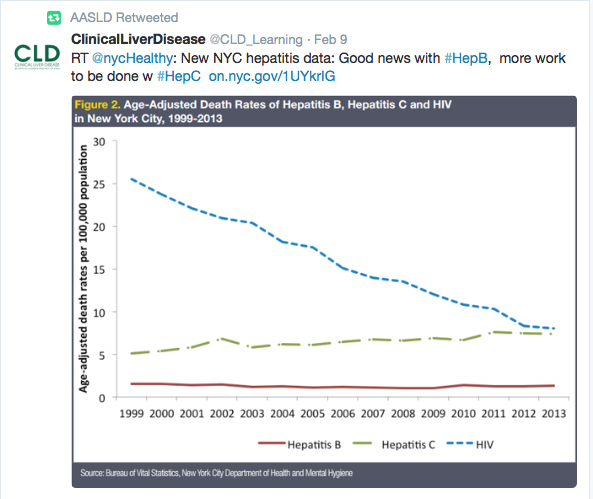
NY City Data for HIV, HBV, HCV

NY City Data for HIV, HBV, HCV

NPR: Understanding “Sleep Munchies”

From NPR: Sleep Munchies: Why It’s Harder to Resist Snacks When We’re Tired

An excerpt:

There’s lots of evidence that getting too little sleep is associated with overeating and an increased body weight.

The question is, why? Part of the answer seems to be that skimping on sleep can disrupt our circadian rhythms. Lack of sleep can also alter hunger and satiety hormones.

Now, a new study finds evidence that sleep deprivation (getting less than five hours of sleep per night) produces higher peaks of a lipid in our bloodstream known as an endocannabinoid that may make eating more pleasurable.

So, what’s an endocannabinoid? If you look at the word closely, you may already have a clue. The prefix endo means inner, or within. And cannabinoid looks like … you got it: cannabis.

My take: Another good reason to avoid being on call -it could lead to sleep deprivation/weight gain.

Old San Juan

Old San Juan

Ondansetron for Gastroenteritis

Another study (AS Danewa et al J Pediatr 2016; 169: 105-9) has shown that ondansetron (zofran) is effective for gastroenteritis. In children (n=170) between 3 months and 5 years with acute diarrhea and vomiting in India, a single dose of ondansetron (0.2 mg/kg) syrup prior to the use of oral rehydration therapy (ORT) improved outcomes.

Failure of ORT was 31% in those treated with ondansetron compared with 62% given placebo (P<.001).  there was fewer vomiting episodes and lower rates of IVF usage in those who received ondansetron.

Related blog posts:

Castillo San Felipe del Morro

Castillo San Felipe del Morro

Microbiome Predicts Constipation plus two

In brief:

G Parthasarathy et al. Gastroenterol 2016; 150: 367-79.  Mucosal and fecal microbiota samples were collected from 25 healthy women and 25 women with chronic constipation.  Key finding: The mucosal, but not fecal, microbiota profile were 94% predictive of constipation. The associated editorial (pg 300) provides a framework for understanding these findings and show the complexity of trying understand the interations between diet, motility and microbes.

S Fukudo et al. Gastroenterol 2016; 150: 358-66.  This prospective study of Ramosetron for 576 women with IBS-D.  Key finding: 50.7% of treatment patients reported global improvement compared with 32.0% of control patients.  Patients had less abdominal pain, less discomfort, and better stool consistency.  Ramosetron, a 5-HT3 antagonist, has not been reported to cause ischemic colitis (in contrast to alosetron).

In followup to a post earlier in the week, another worrisome study on the Zika virus in pregnancy from NEJM. Here’s an excerpt:

Fetal abnormalities were detected by Doppler ultrasonography in 12 of the 42 ZIKV-positive women (29%) and in none of the 16 ZIKV-negative women. Adverse findings included fetal deaths at 36 and 38 weeks of gestation (2 fetuses), in utero growth restriction with or without microcephaly (5 fetuses), ventricular calcifications or other central nervous system (CNS) lesions (7 fetuses), and abnormal amniotic fluid volume or cerebral or umbilical artery flow (7 fetuses).

Farjado, Puerto Rico

Farjado, Puerto Rico