Granulomatous Lung Disease: Case for GI Doctors

JB McCannon et al. NEJM 2023; 389: 1902-1911. Case 35-2023: A 38-Year-Old Woman with Waxing and Waning Pulmonary Nodules

In this case report, A 38-year-old woman was evaluated because of dyspnea, chest discomfort, and waxing and waning pulmonary nodules. She had a prior history of ulcerative colitis. This article reviews reasons for pulmonary nodules including cancer, infection, vasculitis, connective tissue disorders, sarcoidosis and inflammatory bowel disease (IBD) which has a number of pulmonary manifestations including necrobiotic nodules.

In this case, the granulomatous lung disease was attributed to be an extraintestinal manifestation of IBD. She was treated with TNF-alpha targeted therapy which has been effective in a prior case report (J Crohns Colitis 202; 14: 480-489).

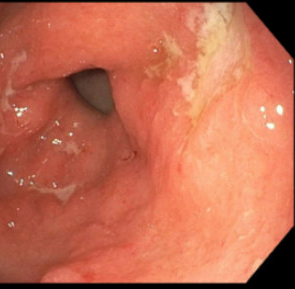
My first reaction to this article — I have seen this! However, our case was atypical in that the 15 year old patient presented with respiratory symptoms (no preceding GI diagnosis). It was noted that her gastric wall was severely thickened as an incidental finding on her chest CT which showed extensive tiny pulmonary nodules. Her endoscopy showed disease isolated to her stomach. Both her gastric findings and CT of her chest resolved with infliximab treatment. This included mucosal healing of her stomach on followup endoscopy.

CT scan showing severely thickened gastric wall
Mucosal appearance of stomach with erythema and numerous ulcerations prior to treatment

Related blog post: IBD Update January 2015 (Part 1) NEJM 2014; 371: 2418-27 -case report of 9 yo with  Crohn’s Disease and pulmonary nodules

How Important is Follow-up in Patients with Celiac Disease

M Ulnes et al. JPGN 2023; 77: 640-647. Open Access! Lack of Follow-Up for Celiac Disease During Childhood Not Associated With Poor Health Outcomes: A Regional Swedish Cohort Study

In this Swedish cross-sectional cohort study with 162 children who had been diagnosed with celiac disease (CD) between 2013-2018, the authors examined the outcomes of children who had continued follow-up compared to those who had not been seen in 24 months. The average disease duration of study participants was 5.3 years.

Key findings:

  • Similar rates of TTG IgA normalization: 94% vs 91% for those without and those with follow-up respectively
  • Similar rates of very good dietary adherence 65% vs 72% for those without and those with follow-up respectively
  • Lack of follow-up was not significantly associated with growth, symptom scores, or HRQoL.

It is possible that there is a selection bias in that patients without symptoms may be less likely to followup.

My take: Based on this study, it looks like good education after diagnosis is crucial and that regular follow-up is less important in achieving good outcomes.

Related blog posts:

More Cognitive Problems, Worse Outcomes with Hirschsprung’s Disease

H Gagnon et al. JPGN 2023; 77: 592-596. Short and Long-Term Outcomes in Hirschsprung Disease: Are the Syndrome-Associated Patients Really Doing Worse?

In this retrospective single-center study with 76 pediatric patients with Hirschsprung’s disease (HD), the authors compared the outcomes of those who had associated syndromes (or neurocognitive issues) (SA-HD, n=24) to those with isolated (I-HD, n=52). Most patients had undergone a Soave procedure (n=67). Only 11 patients were available for followup data at 10 years of age.

Key findings:

  • SA-HD patients became bowel continent at a significantly older age (mean age 8.43 vs 4.94 years)
  • SA-HD patients had urinary incontinence at a significantly older age (P = 0.0136, 5 years)
  • SA-HD patients had more constipation at all ages: at age 3 years (29% vs 17%), at age 5 years (55% vs 22%), and at 10 years (83% vs 20%)
  • SA-HD included Down syndrome (38%), cognitive impairment (29%), MEN (8%), hypoventilation syndrome (aka Ondine) (8%), oro-facio-digital (8%), Smith-Lemli-Opitz (4%) and Bardet-Biedl (4%). The authors note that expected toilet training completion for Down syndrome is between 4.7-6.6 years of age compared to 2.3-3.4 years for neurotypical kids.

My take: Since SA-HD includes children with high rates of cognitive impairment, it is not surprising that there were delays in toilet training, higher rates of constipation and higher rates of urinary retention.

The study reinforces the need for long-term follow-up in this cohort. NASPGHAN has provided a useful position paper (JPGN 2023; 76: 533-546. Open Access! Evaluation and Management of Postsurgical Patient With Hirschsprung Disease Neurogastroenterology & Motility Committee: Position Paper of North American Society of Pediatric Gastroenterology, Hepatology, and Nutrition (NASPGHAN)).

Related blog posts:

Diagrams of 3 common pull-through operations for Hirschsprung disease.
From left to right: full-thickness rectosigmoid dissection (Swenson), a recto-rectal pouch procedure (Duhamel), and an endorectal dissection (Soave). JPGN 2023; 76(4):533-546.

Selecting Patients with Rectal Prolapse Who May Benefit from Surgery

L Rincon-Cruz et al. JPGN 2023; 77: 603-609. Influence of Initial Treatment Strategy on Outcomes for Children With Rectal Prolapse

In this single-center retrospective cohort, the authors analyzed 67 pediatric patients with rectal prolapse who had surgical evaluation; the median duration of follow-up was nearly 4 years.. Key findings:

  • The resolution rate with surgery as initial management was 79% (n = 11/14). Medical management included stool softeners, avoiding straining, and minimizing time on toilet.
  • The resolution rate was 33% (n = 8/24) with sclerotherapy alone and additional 21% (n = 5/24) resolving after a subsequent surgical procedure
  • Medical management was successful in 100% (n=29) (patients who responded would not need subsequent procedural approach); 27 of these patients were less than 5 years of age.
  • 82% of patients had constipation
  • A psychiatric comorbidity was noted in 24 patients, 19 of whom had either sclerotherapy (n=12) or surgery (n=7).

The authors note that rectal prolapse is often self-limited with reported spontaneous resolution of 60-90%. The treatment algorithm proposed by the authors is for medical management alone if less than 5 years of age. In children older than 5 years, they recommend initial sclerotherapy (with D50W) followed by surgical correction (rectopexy or transanal resection of the prolapsing segment) if not successful after one session.

My take: I have not had to refer a patient for surgical management in more than 25 years of clinical GI practice. However, in patients older than 5 years, surgical approaches (rectopexy or resection of prolapse) may be needed in highly selected patients, like in this study which only included patients seen by surgery (referral bias).

Related blog post: How Commonly Does Cystic Fibrosis Present as Rectal Prolapse?

Disclaimer: This blog, gutsandgrowth, assumes no responsibility for any use or operation of any method, product, instruction, concept or idea contained in the material herein or for any injury or damage to persons or property (whether products liability, negligence or otherwise) resulting from such use or operation. These blog posts are for educational purposes only. Specific dosing of medications (along with potential adverse effects) should be confirmed by prescribing physician.  Because of rapid advances in the medical sciences, the gutsandgrowth blog cautions that independent verification should be made of diagnosis and drug dosages. The reader is solely responsible for the conduct of any suggested test or procedure.  This content is not a substitute for medical advice, diagnosis or treatment provided by a qualified healthcare provider. Always seek the advice of your physician or other qualified health provider with any questions you may have regarding a condition.

When Hospitals Look Like The Ritz (But Cost Even More)

The Atlantic, Elisabeth Rosenthal (11/17/23): Hospitals Have Gotten Too Nice

This article starts off discussing a recent trend of how medical problems are often described as a “journey.” However, the main focus is the trend of hospitals developing expensive amenities further adding to huge medical bills.

An excerpt:

So much of being seriously ill has been rebranded in American health care as a kind of adventure…But on these journeys, you don’t get to go anywhere—except maybe the hospital or doctor’s office, which is likely, too, to have bought into the travel concept. In the past two decades, American hospitals have gotten into the business of hotel-like hospitality (illness can be fun!) rather than confine themselves to the business of disease (what a downer). And although the care might stay solid, the focus on luxurious amenities and the fancy new buildings that house them is one of the factors that have helped send costs for patients soaring that much higher, to prices well above those in other developed countries…

In recent years, tight budgets, staffing shortages, and burnout have hit American hospitals. At the same time, many health centers in the U.S.—including the most prestigious ones, and even some community hospitals—have morphed into seven-star hotels…A hospital might now boast about its views, high-thread-count sheets, or food provided by a Michelin-starred chef…

Back in 2008, researchers at the National Bureau of Economic Research estimated that a hospital investing in amenities would increase demand by 38 percent, whereas a similar investment in clinical quality would lead to only a 13 percent increase…

These amenities have a cost, and they are not worth nearly what we’re paying for them as we’re billed for $100,000 joint replacements and $9,000 CT scans. Room charges in many hospitals can exceed $1,000 a night. And “facility fees” for outpatient procedures and even office visits can reach hundreds of dollars, and simply don’t exist elsewhere. A hospital’s function is to diagnose and to heal, at a price that sick people can afford. I dream of a no-frills Target- or Ikea-like hospital for care…

How about focusing on the very basic things that health systems in the U.S. should do, but—in my experience—in many cases do not, like making it easier for patients to schedule appointments? Shortening the now lengthy wait times to see physicians who take insurance plans? Paying for adequate staffing on nights and weekends, so patients don’t linger in bed pointlessly for two days until social workers return on Monday? Or ending those two-day stays in emergency rooms when all inpatient beds are full? 

Related blog posts:

Obidos, Portugal

When is the Right Time to De-escalate Dose of Tofacitinib for Ulcerative Colitis?

A Yu et al. Clin Gastroenterol Hepatol 2023; 21: 3115-3124. Open Access! Real-World Experience With Tofacitinib Dose De-Escalation in Patients With Moderate and Severe Ulcerative Colitis

On May 30, 2018, the US Food and Drug Administration (FDA) expanded the indication of tofacitinib (Xeljanz; Pfizer), an oral Janus kinase (JAK) inhibitor, for the treatment of adults with moderately to severely active ulcerative colitis. However, the optimal dosing remains unclear.

In this “real-world” study by Yu et al, a retrospective review of 162 patients was conducted (2012-2022). 52% continued 10 mg twice daily while 48% underwent dose de-escalation to 5 mg twice daily.  The primary outcome was evidence of UC disease activity–related events: hospitalization/surgery, corticosteroid initiation, tofacitinib dose increase, or therapy switch.

Key findings:

  • Cumulative incidence rates of UC events at 12 months were similar in patients with and without dose de-escalation (56% vs 58%; P = .81)
  • An induction course with 10 mg twice daily for more than 16 weeks was protective of UC events (hazard ratio [HR], 0.37) while ongoing severe disease (Mayo 3) was associated with UC events (HR, 6.41)
  • Twenty-nine percent of patients with UC events had their dose re-escalated to 10 mg twice daily, with only 63% able to recapture clinical response at 12 months

Discussion Points:

  •  “Although the product label recommends dose de-escalation after 8 or 16 weeks, clinical practice is variable in the real-world setting… In this retrospective real-world study of moderate to severe UC patients with almost half undergoing dose de-escalation, we observed that more than half of patients experienced a UC disease activity–related event within 12 months after dose de-escalation, particularly in patients with an induction course of fewer than 16 weeks and active endoscopic disease at 6 months after induction…”
  • ” Although dose de-escalation is preferable for long-term maintenance therapy to reduce the potential lifetime risk of medication-related adverse events [eg. VTE], it must be balanced with sustained remission to prevent short- and long-term disease-related complications.”
  • “In the OCTAVE study which reported higher rates of long-term remission, patients de-escalated only after having shown clinical and endoscopic remission after 52 weeks on tofacitinib 10 mg twice daily”

My take (borrowed from authors):  “Emphasis should be placed on clinical and endoscopic evidence of improvement before consideration of dose de-escalation to ensure the highest probability of treatment success.” This advice, though, may conflict with product labelling which states that “tofacitinib induction with 10 mg twice daily beyond 16 weeks is not recommended; in fact, it is recommended to stop after 16 weeks if adequate response has not been achieved.”

Related blog posts:

Belem Tower, Lisbon

Disclaimer: This blog, gutsandgrowth, assumes no responsibility for any use or operation of any method, product, instruction, concept or idea contained in the material herein or for any injury or damage to persons or property (whether products liability, negligence or otherwise) resulting from such use or operation. These blog posts are for educational purposes only. Specific dosing of medications (along with potential adverse effects) should be confirmed by prescribing physician.  Because of rapid advances in the medical sciences, the gutsandgrowth blog cautions that independent verification should be made of diagnosis and drug dosages. The reader is solely responsible for the conduct of any suggested test or procedure.  This content is not a substitute for medical advice, diagnosis or treatment provided by a qualified healthcare provider. Always seek the advice of your physician or other qualified health provider with any questions you may have regarding a condition.

Increasing Burden of Eosinophilic Esophagitis

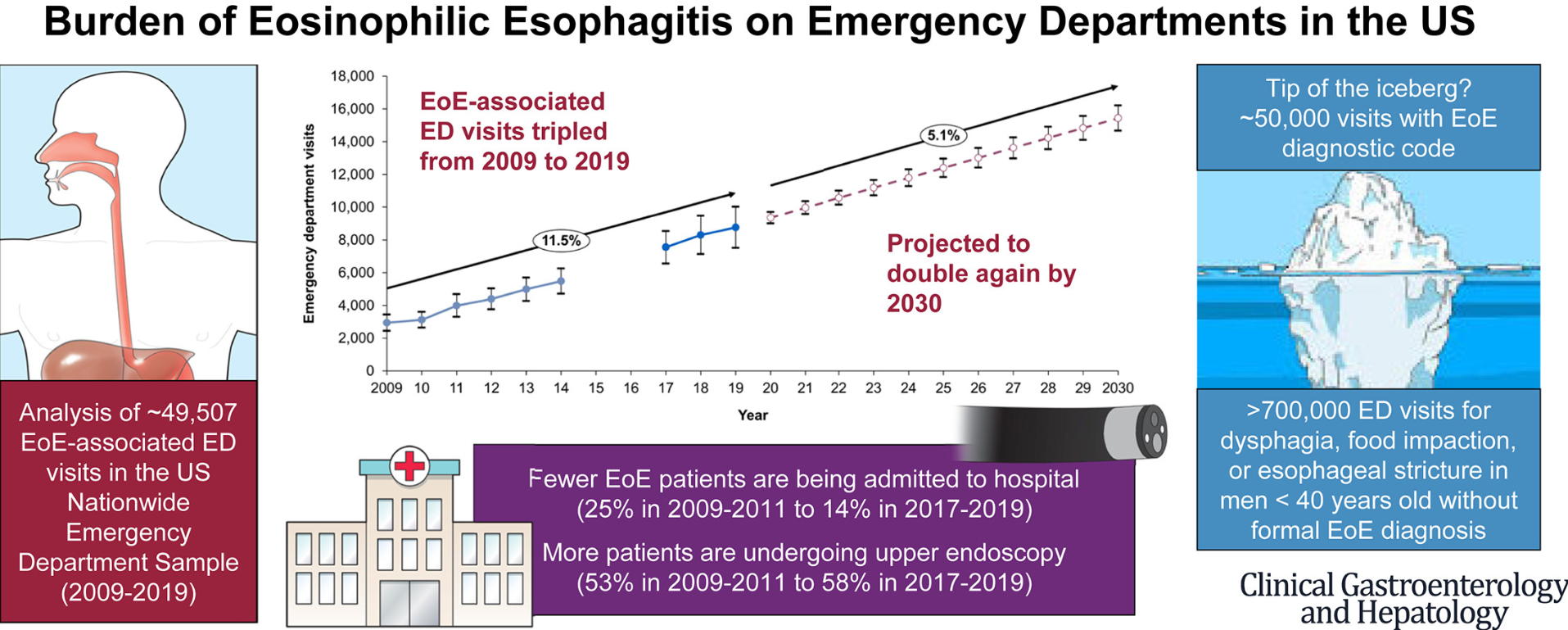
AY Lam et al. Clin Gastroenterol Hepatol 2023; 21: 3041-3050. Open Access (Partial)! Epidemiologic Burden and Projections for Eosinophilic Esophagitis–Associated Emergency Department Visits in the United States: 2009-2030

Methods: Data from the US Nationwide Emergency Department Sample (NEDS) were used to estimate weighted annual EoE-associated ED visits from 2009 to 2019. Autoregressive integrated moving average (ARIMA) models were used to project EoE-associated ED visits to 2030. NEDS is a large, publicly available, all-payer ED database in the United States, approximating a 20% stratified sample of US hospital-based EDs. 

Key points:

  1. There has been a near tripling of the frequency of EoE-associated ED visits over the course of the past decade which is correlated with an increasing prevalence of EoE. The annual volume of EoE-associated ED visits increased from 2934 in 2009 to 8765 in 2019, and is projected to reach 15,445 by 2030.
  2. Without new interventions, this article projects further increases with doubling again by 2030 (using conservative estimates).
  3. Increasingly EoE is being managed without admission, though average charges associated with ED visits for EoE have tripled since 2009. Total mean inflation-adjusted charges for an EoE-associated ED visit were $9025 US dollars in 2019.
  4. Half of EoE patients presenting to the ED required an endoscopy and 40% required a foreign body/food impaction removal.

Related blog posts:

How Reliable is a Motilist in Interpreting Manometry and FLIP Studies?

Correction: Yesterday’s post was updated after an astute observation from one of my colleagues (Jordan) to note that the pictured instrument was in fact a harpsichord rather than a piano. A harpsichord’s sound is derived from plucking a string whereas a piano’s sound comes after a hammer strikes a chord.

——–

JW Chen et al. AJG 2023; 118: 1334-1343. Interrater Reliability of Functional Lumen Imaging Probe Panometry and High-Resolution Manometry for the Assessment of Esophageal Motility Disorders

Thanks to Ben Gold for this reference. Also, congratulations to Jose Garza -our motility specialist and a coauthor of this study.

15 motility specialists completed their interpretation of 40 consecutive HRM (high resolution manometry) and 40 FLIP (functional lumen imaging probe panometry) studies. All were part of a FLIP study group. Key findings:

  • Overall, there were high levels of interrater agreement and accuracy in the interpretation of HRM and FLIP metrics and moderate-to-high levels for motility classification in FLIP
  • There were no FLIP diagnoses of normal EGJ opening in patients with established achalasia and no FLIP diagnoses of achalasia in patients with normal EGJ opening and contractility. This was true with HRM as well.
  • In non-obstructive motor disorders, raters frequently indicated that they would request alternate confirmatory testing before invasive management

My take: This is a reassuring study indicating that with the most consequential esophageal findings, there is excellent agreement among motilist interpretation. Previous studies of colonic manometry, in contrast, have found much lower levels of agreement.

Related blog posts:

Santa Justa Lift (Lisbon)

Alpha-Gal Reaction to Infliximab

G Polanco, et al. JPGN Reports 4(3):p e322, August 2023. Open Access! Delayed Hypersensitivity Reaction to Infliximab Due to Mammalian Meat Allergy

Briefly noted: Case report of a 17 yo with Crohn’s disease who developed urticaria and pruritus approximately 6 hours after her very first infliximab infusion; the patient was diagnosed with Alpha-Gal and responded to change to adalimumab which  is not glycosylated with alpha-gal.

Related blog post: Nonanaphylactic Alpha-Gal and Chronic Gastrointestinal Symptoms

Sigal Music Museum (Greenville, SC) -has a large number of very old harpsichords and pianos. A harpsichord plucks strings to make the sound whereas a piano has a small hammer that strikes the strings to make the sound. This musical instrument is a harpsichord.