Surgical Reset for Anti-TNF Therapy with Crohn’s Disease

A recent study (A Assa et al. Inflamm Bowel Dis 2017; 23: 791-97) indicates that after surgery, anti-TNFα treatment is worth another try.

In this retrospective study with 53 children, 18 had “pharmacodynamic failure” with anti-TNFα medications (PK group) and 35 were controls. “Phamacocynamic failure is characterized by either a lack of improvement of CD symptoms or  loss of response after initial improvement in the setting of adequate serum drug levels without ADAs” [antidrug antibodies].

Key findings:

  • Mean age at time of intestinal resection was 14.8 years
  • Median time from resection to anti-TNF initiation was 8 months
  • Compared to the control group, the PK group had similar response to anti-TNF therapy.   “Similar proportions of patients from both groups were in clinical remission on anti-TNF treatment after 12 months and at the end of follow-up (1.8 years)”
  • At 12 months, remission rates were 89% (PK) versus 88.5% (control)

The authors propose an explanation: “A plausible explanation for this finding is that in severely inflamed tissue with high inflammatory burden, local high levels of TNFα serves as a sink for anti-TNFα antibodies and that tissue injury and local hypoxia might further limit drug penetrance to its target.”

My take: This information is useful.  Many patients who have surgery may respond to anti-TNFα therapy subsequently.  The unanswered question: Could more frequent dosing of anti-TNFα therapy have averted surgery in some patients by overcoming areas of intense disease?

 

IBD Resources for Clinicians/IBD Tweets

Another website with a few useful resources:

  • Steroid taper calendar -helps develop a calendar (can use to print out or take a picture)
  • Imaging risk calculator -this is not that great.  In essence if you have a patient present to ER with a CRP of 1 mg/dL and ESR of 20, it states that risk of a complication like a perforation is “NOT LOW” and to consider imaging
  • IBD School Video collection -links to UM website

Note -therapeutic drug monitoring may be more useful in children due to their changing size.

Disclaimer: These blog posts are for educational purposes only. Specific dosing of medications (along with potential adverse effects) should be confirmed by prescribing physician.  This content is not a substitute for medical advice, diagnosis or treatment provided by a qualified healthcare provider. Always seek the advice of your physician or other qualified health provider with any questions you may have regarding a condition.

More IBD Cases Than Ever in Young Canadian Children

Summary of recent article (Link to full study: Benchimol EI, et al. Am J Gastroenterol. 2017;doi:10.1038/ajg.2017.97) by Healio Gastroenterology: IBD incidence rapidly increasing in young Canadian children

An excerpt:

To evaluate the recent incidence, prevalence and trends in childhood-onset IBD in Canada, Benchimol and colleagues used health administrative data from five provinces to identify children aged younger than 16 years who were diagnosed with IBD between 1999 and 2010. During this period, 3,462 children were diagnosed with Crohn’s disease, 1,382 with ulcerative colitis and 279 with unclassifiable IBD, for an overall IBD incidence of 9.68 (95% CI, 9.11-10.25) per 100,000 children.

Throughout the study period, the annual percentage change in overall IBD incidence remained statistically stable, increasing by just 2.06% per year, but the incidence increased significantly among children aged younger than 5 years, rising by 7.19% per year.

Further, the annual percentage change in the prevalence of IBD increased significantly throughout the study period (4.56%), and at the end of the study period IBD prevalence was 38.25 (95% CI, 35.78-40.73) per 100,000 children.

The investigators noted their findings confirmed the predominant form of pediatric-onset IBD was Crohn’s disease, and that more boys were affected than girls.

My take: While Canada has high prevalence of IBD, I expect that there will be similar trends in epidemiology in multiple regions in young children.  When one looks at the increases in IBD prevalence over the last 100 years (see previous post) and the emergence of IBD in non-Western countries, it is quite alarming.

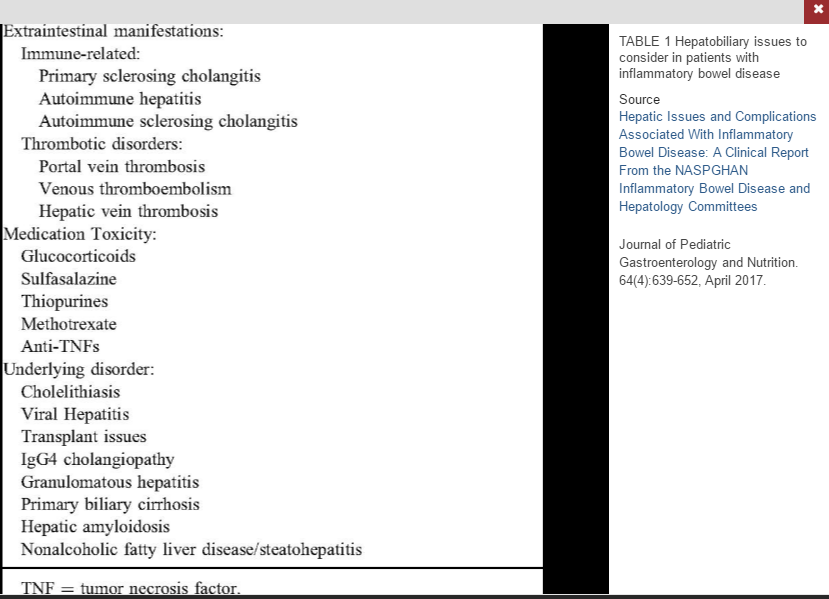
Also, last week a blog post discussed hepatic problems associated with IBD (Liver problems with IBD): here is full article text link: Hepatic Issues and Complications Associated with IBD

Related blog posts:

Liver Problems with Inflammatory Bowel Disease

A recent review (Full text: LJ Saubermann et al. JPGN 2017; 64: 639-52)  discusses the hepatic issues and complications associated with inflammatory bowel disease.

Key topics:

  • Primary Sclerosing Cholangitis (PSC)
  • Autoimmune Hepatitis (AIH)
  • Autoimmune Sclerosing Cholangitis (ASC)
  • Portal Venous Thrombosis/hypercoagulability
  • Cholelithiasis (more common in Crohn’s disease if diseased terminal ileum)
  • Viral hepatitis
  • Drug-Induced Liver Disease
  • Fatty Liver disease

Many of these topics have been discussed previously on this blog.  A couple of pointers in this review:

PSC:

  • Greater risk of colorectal carcinoma
  • IBD-PSC patients are at higher risk for pouchitis
  • GGT of >252 U/L “was highly sensitive (99%) and had good specificity (71%) for PSC” [or ASC]
  • The authors recommend “screening all newly diagnosed patients with IBD with ALT and GGT
  • Immunosuppressive therapy is NOT effective
  • Vancomycin therapy is currently being tested (clinical trials: NCT02137668 & NCT01802073)

AIH:

  • Less frequent in IBD patients than PSC
  • Most common treatment is prednisone/azathioprine
  • 40-80% of children have cirrhosis at AIH diagnosis, but “progression to end-stage liver disease is rare and …with appropriate treatment, 80% of patients achieve remission.”

ASC:

  • ASC is an overlap syndrome between AIH and PSC
  • “It is important that children with IBD and apparent AIH are routinely investigated for evidence of biliary disease with MRCP”
  • “ASC responds to the same immunosuppressive combination therapy used for AIH”

HAV/HBV Immunization:

  • HAV vaccination is effective in patients with IBD…although the rate [seroconversion] was significantly lower” in patients receiving anti-TNF therapy (92.4% vs 99.1% in one study).
  • In those needing HBV immunization: “One strategy evaluated to improve HBV immunity in adults with IBD is an accelerated course with double vaccine doses at 0, 1, and 2 months.”

Methotrexate (MTX):

  • “The extent of histological features of hepatotoxicity secondary to long-term MTX use in IBD has been infrequently described; however, the inicdence of significant abnormal histological findings appears to be rather low.”

My take: This article is a good starting point for liver-related issues in IBD.  For concerns regarding medications, the NIH livertox website is more useful and much more comprehensive.

Related blog entries:

DILI:

PSC:

AIH:


Safety of Long-term Adalimumab in Pediatrics; Weighted PCDAI

A recent study (W Faubion et al. Inflamm Bowel Dis 2017; 23: 453-60) reports on the long-term safety/effectiveness of Adalimumab in pediatric patients entering the IMAgINE 2 trial (& who completed the 52 week IMAgINE 1 trial).

Patients with a PCDAI <10 were considered to be in remission and those who had a drop in PCDAI of 15 or more were considered to have had a treatment response.

Key findings:

  • Of the 100 patients enrolled in IMAgINE 2, 41% achieved remission and 48% had a treatment response at week 240.
  • >80% of patients were “able to discontinue use of corticosteroids.”
  • Adalimumab treatment was associated with growth normalization.
  • No new safety signals were identified.

While this study provides some reassurance regarding long-term adalimumab use, it should be noted that the instruments used to assess efficacy in this trial (& many others) are suboptimal.

A recent study (D Turner et al. JPGN 2017; 64: 254-60) showed that PCDAI (and several similar versions) had “poor correlation with calprotectin” and none of the PCDAI versions “can give a valid assessment of mucosal healing.”  This study had used prospectively collected data from the ImageKids study of 100 children with Crohn’s disease.  For the weighted PCDAI, the “best cut-off to identify endoscopic mucosal healing was <12.5 points” with a sensitivity of 58% and specificity of 84%.\

wPCDAI:

History: (recall 1 week):

  • Abdominal Pain  0=None, 10=Mild (does not interfere with activities, brief), 20=Moderate/Severe
  • Patient functioning 0=No limitations, 10=Occn difficulty with activities (below par), 20=frequent limitations
  • Stools per day 0=0-1 liquid stools, no blood, 7.5=up to 2 semiformed stools with blood or 2-5 liquid nonblood, 15=Gross bleeding or ≥6 liquid stools or nocturnal diarrhea

Laboratory

  • ESR 0 points if <20, 7.5 points if 20-50, 15 points if >50
  • Albumin 0 points if ≥3.5 g/dL, 10 points if 3.1-3.4 g/dL, and 20 points if ≤3.0 g/dL

Examination

  • Weight 0= Weight gain or stable or voluntary weight loss, 5=involuntary weight loss 1-9% or involuntary weight stable, 10= weight loss ≥10%
  • Perirectal Disease 0=None or asymptomatic tags, 7.5= 1-2 indolent fistula, scant drainage, no tenderness, 15=active fistula, drainage, tenderness or abscess

Extraintestinal Manifestatons: Fever for 3 days (≥38.5), definite arthritis, uveitis, erythema nodosum, or pyoderma gangrenosum

  • Points: 0=None, 10 ≥1

Total Score 0-125: ______________________

As compared with PCDAI, the weighted PCDAI drops height velocity, abdominal examination, and hematocrit.  Turner et al note “their exclusion does not mean that they have no role in reflecting disease activity, but that the other included items, as a whole, are inclusive of the contribution of the 3 items.” Also, the weighted PCDAI simplifies the “extraintestinal manifestation” into a simple choice; overall, this affects few scores due to the low frequency of these manifestations.

Related blog posts:

Infliximab Not Associated with Malignancy

JS Hyams et al. Gastroenterology http://dx.doi.org/10.1053/j.gastro.2017.02.004

Using the DEVELOP registry, a prospective study showed no increased risk of malignancy among 5766 pediatric participants with inflammatory bowel disease.

Link: Full Abstract

Immunosuppressive therapy for inflammatory bowel disease (IBD) in pediatric patients is thought to increase risk of malignancy and lymphoproliferative disorders, including hemophagocytic lymphohistiocytosis (HLH). We compared unadjusted incidence rates and of malignancy and HLH in pediatric patients with IBD exposed to infliximab compared with patients not exposed to biologics and calculated standardized incidence ratios (SIRs).

Methods

We collected and analyzed data from 5766 participants in a prospective study of long-term outcomes of pediatric patients with IBD (NCT00606346), from 2007 through 30 June 2016. Patients were 17 years old or younger and had Crohn’s disease, ulcerative colitis, or IBD unclassified with 24,543.0 patient-years of follow-up. We estimated incidence rates for malignancy and HLH as events/1000 patient-years of follow-up. We calculated age-, sex-, and race-adjusted SIRs, with 95% CIs, using the Surveillance, Epidemiology, and End Results Program (SEER) database.

Results

Thirteen of the 15 patients who developed a malignancy and all 5 of the patients who developed HLH had been exposed to thiopurine; 10 patients with malignancy patients had also been exposed to a biologic agent. Unadjusted incidence rates showed no increased risk of malignancy (0.46/1000 patient-years) or HLH (0.0/1000 patient-years) in patients exposed to infliximab as the only biologic vs those unexposed to biologics (malignancy: 1.12/1000 patient-years; HLH: 0.56/1000 patient-years). SIRs did not demonstrate an increased risk of malignancy among patients exposed to infliximab (SIR; 1.69; 95% CI, 0.46–4.32) vs patients not exposed to a biologic agent (SIR, 2.17; 95% CI, 0.59–5.56), even when patients were stratified by thiopurine exposure.

Conclusions

In determination of age-, sex- and race-adjusted SIRs using data from a large clinical trial and the SEER database, we found that infliximab exposure did not associate with increased risk of malignancy or HLH in pediatric patients with IBD. Thiopurine exposure is an important precedent event for the development of malignancy or HLH in pediatric patients with IBD.

Related blog posts:


Vitamin D and Ulcerative Colitis Remission

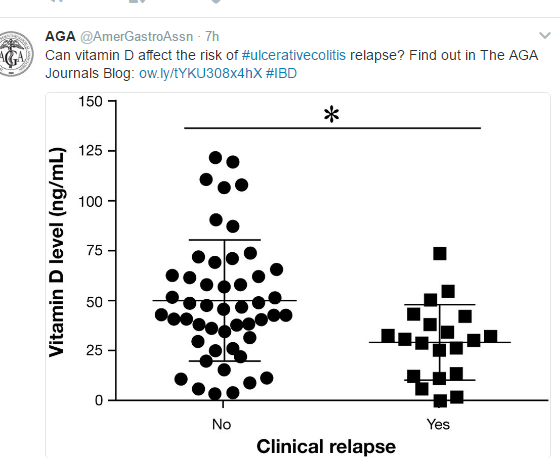
A recent study (J Gubatan et al. Clin Gastroenterol Hepatol 2017; 15: 240-6) examined a prospective study of 70 patients with ulcerative colitis (UC).  These patients (average age 48.6 yrs) were initially in clinical remission.  Key findings:

  • Mean baseline vitamin D (25-OH) level was lower among patients with subsequent relapse (29.5 ng/mL) than those without relapse (50.3 ng/mL)
  • Over 12 months, a 25-OH D value <35, was associated with a small increased risk of relapse (odds ratio1.25). 20% of patients with a value <35 had clinical relapse compared with 9% (P= .003) who had values >35.

Because vitamin D levels are inversely related to UC disease activity, this study is particularly intriguing.  By enrolling patients prospectively while in remission, this study suggests that good vitamin D levels may directly have immunoprotective and anti-inflammatory properties.

The AGA Journals blog provides an excellent summary of this study: Can Vitamin D Affect Risk of Ulcerative Colitis Relapse?

“In an editorial that accompanies the article, Stephen Hanauer reminds readers that the mean vitamin D level in the entire cohort was 44 ng/mL, and 60% of the subjects were taking vitamin D supplements. A normal vitamin D level is considered to be 20–40 ng/mL in healthy individuals, and the 35 ng/mL cut-off level used in the study was within this range.

Hanauer also mentions that in assessing the confidence intervals for risk of relapse at lower or higher vitamin D levels, there does not appear to be a dose–response effect in the odds ratios according to levels. Based on these findings, Hanauer says it would be premature to target a level of 35 ng/mL. He states that the best predictors of clinical relapse are still endoscopic and histologic markers of inflammation.”

My take: At this time, trying to maintain a normal vitamin D level is likely to be worthwhile; though, values obtained during acute flares remain unreliable.

Related blog posts:

Disclaimer: These blog posts are for educational purposes only. Specific dosing of medications/diets (along with potential adverse effects) should be confirmed by prescribing physician/nutritionist.  This content is not a substitute for medical advice, diagnosis or treatment provided by a qualified healthcare provider. Always seek the advice of your physician or other qualified health provider with any questions you may have regarding a condition.

screenshot-99

Ileocecal Resection in Pediatric Crohn’s Disease

A recent retrospective study (K Diederen et al. Inflamm Bowel Dis 2017; 23: 272-82) provides data on the likelihood of complications and recurrence following ileocecal resection in pediatric Crohn’s disease (n=122).

Key findings:

  • Severe postoperative complications were noted in 9.8%.  Risk factors included colonic disease (Odds ratio 5.6), microscopically positive resection margins (OR 10.4), and emergency surgery (OR 6.8)
  • Overall complication rate was reported as 29.5% which is similar to rates reported in adults
  • Clinical recurrence rates after 1, 5, and 10 years: 19%, 49%, and 71%
  • Surgical recurrence rates after 1, 5, and 10 years: 2%, 12%, and 22%
  • Immediate postoperative therapy reduced the risk of clinical recurrence (HR 0.3) and surgical recurrence (HR 0.5)
  • “In this study, postoperative catch-up growth was found in patients younger than 16 years in the year after surgery.” Thus, surgery could be an important to reverse growth retardation.

Complications within 30 days of surgery were categorized with the Clavien-Dindo classification. Those with grade ≥III which required either surgical, endoscopic or radiologic intervention were considered severe.  In this population, the complications included intraabdominal septic complications and/or anastomotic leakage.

My take: In some patients, ileocecal resection should NOT be a last resort.  Waiting too late, increases the risk of complications.  The task at hand is prospectively identifying those who merit surgery sooner and then convincing the family to proceed.

screenshot-118

Related blog posts:

Clostridium difficile Infection in Inflammatory Bowel Disease: Expert Updates

A recent clinical practice update (S Khanna et al. Clin Gastroenterol Hepatol; 2017; 15: 166-74) provides some succinct recommendations regarding Clostridium difficile infection (CDI) in Inflammatory Bowel Disease (IBD).

Background: In 2011, the authors note that CDI was associated with 29,000 deaths and is now the most lethal enteric pathogen in the U.S.

Differences in pathogenesis of C diff in IBD compared to those without IBD:

  • Younger age
  • Less frequent antibiotic exposure
  • More often community onset (rather than hospital onset)
  • Higher recurrence (may be related to dysbiosis)

Key recommendations:

  • In patients with IBD flare, test for CDI
  • In patients with CDI and IBD, clinicians should consider “using vancomycin instead of metronidazole.”
  • In patients with recurrent CDI and IBD, consider fecal microbiota transplantation

Figure 4 proposes a management algorithm (for adults).  If uncomplicated CDI, recommended dose of vancomycin was 125 mg q6h. If no improvement in 3-4 days, then “consider escalation of immunosuppression.” For complicated CDI, consider oral vancomycin at 500 mg q6h and IV metronidazole 500 mg q8.  In addition, consider rectal vancomycin and surgery consult.

Complicated CDI includes ICU admission, hypotension, T >38.5, ileus/megacolon, mental status changes, leukocyte count >35,000  or < 2000, or lactate >2.2 mmol/L

Another review article (Y Chen et al. Inflamm Bowel Dis 2017; 23: 200-07) is a meta-analysis that identified six studies.  One of these studies was a case-control study with nearly 400,000 patients (and about 7000 cases of C diff). Key finding: CDI results in nearly a doubling of the risk of colectomy (OR 1.90), mainly in patients with ulcerative colitis.

Related blog posts

Disclaimer: These blog posts are for educational purposes only. Specific dosing of medications (along with potential adverse effects) should be confirmed by prescribing physician.  This content is not a substitute for medical advice, diagnosis or treatment provided by a qualified healthcare provider. Always seek the advice of your physician or other qualified health provider with any questions you may have regarding a condition.


Rare Tragic Reaction to Infliximab

A recent post on the pediatric GI Listserv pointed out a troubling case report: “Fatal Central Nervous System Disease Following First Infliximab Infusion in a Child With Inflammatory Bowel Disease,” FM. Baumer et al; Pediatric Neurology 2016; 57: 91-94.

“A seven-year-old boy diagnosed with ulcerative colitis and primary sclerosing cholangitis received infliximab. Six hours following his uneventful infusion, he awoke with headache and emesis and rapidly became obtunded…Cranial computed tomography revealed hypodense lesions in the cerebral hemispheres, cerebellum, and pons accompanied by hemorrhage…Within four days he met criteria for brain death.”

The authors note that “the close temporal association between our patient’s presentation and the infliximab infusion raises concern for a drug-related cause for his cerebral injury.” While this case report is terribly sad, severe and fatal reactions can unfortunately be encountered with a wide range of medications, including commonly used antibiotics.

My take: Thus, while the vast majority of pediatric patients with inflammatory bowel disease will benefit from infliximab therapy, there are rare tragic outcomes.  img_3954