This is a terrific review of POEM; it explains the procedure technique (with pictures), outcomes, indications and adverse events. The paper indicates that more than 300 children (as young as 11 months) have had POEM in published studies with good outcomes.
Interestingly, the authors state that 20-40 procedures “should be performed for competency and that 60 are required to achieve mastery.” Also, long-term data are lacking.
My take: POEM has good data supporting its use, especially in adults. Still, it will be quite difficult for pediatric gastroenterologists to acquire sufficient expertise to do this procedure.
“Exit Glacier” in Kenai Fjords National Park. This picture shows how much the glacier has retreated since 2005 due to global warming (the ice used to extend to this sign).
Firearm-related deaths are now the leading cause of death in U.S. children. The push to make guns more available is resulting in more tragic outcomes. In the U.S., putting too much mayonnaise on a sandwich can be a death sentence:
In Georgia, the law, signed by current governor Brian Kemp, allows Georgians to carry concealed handguns without first getting a license from the state. This law along with a previous “Guns Everywhere Law” has been associated with increased gun sales and increased gun violence and deaths.
After Uvalde, Amanda Gorman published the following poem
Everything hurts, Our hearts shadowed and strange, Minds made muddied and mute. We carry tragedy, terrifying and true. And yet none of it is new; We knew it as home, As horror, As heritage. Even our children Cannot be children, Cannot be.
Everything hurts. It’s a hard time to be alive, And even harder to stay that way. We’re burdened to live out these days, While at the same time, blessed to outlive them.
This alarm is how we know We must be altered — That we must differ or die, That we must triumph or try. Thus while hate cannot be terminated, It can be transformed Into a love that lets us live.
May we not just grieve, but give: May we not just ache, but act; May our signed right to bear arms Never blind our sight from shared harm; May we choose our children over chaos. May another innocent never be lost.
Maybe everything hurts, Our hearts shadowed & strange. But only when everything hurts May everything change.
No Exaggeration: Too Many Children Are Dying in the U.S. “The sad fact is that a child or adolescent in the United States is 57% more likely to die by the age of 19 years than those in other wealthy nations.” This is due mainly to more deaths from MVAs and from gun violence.
In a nationwide Swedish cohort of 18,815 incident patients with a minimum 5 years of follow-up, 652 (3.5%) underwent formation of a stoma. The 5-year cumulative incidence of stoma formation was 2.5%, with no differences between calendar periods (2003–2006, 2007–2010, and 2011–2014).
This study captured data from 1317 patients (including 927 patients stopping infliximab and 390 patients stopping adalimumab) to develop risk prediction models. “The authors confirm many of the high risk, albeit rather intuitive, factors that are associated with the risk of relapse, including younger age, younger age at diagnosis, smoking, upper gastrointestinal tract involvement, longer disease duration, absence of concomitant immunosuppressant use, previous anti-TNF failure, and absence of clinical remission.”
The editorial notes that even in the lowest risk group, more than 20% had risk of relapse within 1 year; in addition, stopping therapy increases risk of not recapturing remission with restart of treatment. “Stopping anti-TNF therapy is a highly personalized treatment decision and is one that carries considerable risks…therapeutic discontinuation of TNF antagonists should be reserved for the very small minority of patients who are in deep remission, have a strong desire to stop treatment, have no (or very few) characteristics of high-risk CD, can tolerate a substantial disease flare, and are fully informed of the risks of therapeutic withdrawal.”
Graphical abstract below shows that 52.2% of patients who did not achieve clinical response to 8 weeks’ treatment with tofacitinib 10 mg BID in the induction studies achieved a clinical response following extended induction (delayed responders). At Month 12 of OCTAVE Open, 70.3%, 56.8%, and 44.6% of delayed responders maintained clinical response and achieved endoscopic improvement and remission, respectively. Corresponding values at Month 36 were 56.1%, 52.0%, and 44.6%.
My take: By extending the treatment induction to 16 weeks to determine response (rather than 8 weeks), the authors showed that 75% of patients with ulcerative colitis in the initial cohort respond to tofacitinib.
Design: A prospective observational single-center study in 41 children with EoE treated with the 1-food elimination diet (1FED). Upper endoscopy with biopsies was performed after 8 to 12 weeks of treatment. The primary end point was histologic remission, defined as fewer than 15 eosinophils per high-power field.
Key findings:
Histologic remission occurred in 21 (51%) children, with a decrease in peak eosinophils per high-power field from a median of 50
Endoscopic abnormalities improved in 24 (59%) patients, while symptoms improved in 25 (61%). Improved symptoms included chest pain, dysphagia, and pocketing/spitting out food
Interestingly, in terms of all symptom resolution, this was higher in the group of nonresponders 8 (40%) than in the responders 4 (19%)
Younger patients (mean 7 yrs vs 12 yrs) and patients with IgE-mediated food allergies tended to be more likely to fail dairy elimination in this study
One key caveat is that most patients continued PPI during study; thus it is unknown if stopping a PPI before starting dairy elimination would have changed treatment response. 90% of patients were receiving PPIs at enrollment
My take: This study should prompt more widespread use of dairy elimination as a first line treatment prior to consideration of medications for long-term treatment. This study also reinforces the concept that symptom improvement remains an inadequate indicator of response. Perhaps, Chick-Fil-A marketing needs to be used for our EoE patients to shun cows (cow’s milk in this case).
This article provides an updated treatment algorithm with many changes since 2015.
Key points:
New terminology. The authors provide updated terminology. The term ‘immune tolerant’ is losing favor. “There is also evidence that during the immune tolerant phase virologic events occur, such as integration of viral DNA into the host genome, which may help set the stage for the subsequent development of HCC.” As such, the new terminology focuses on “describing the 2 main characteristics of chronicity, infection alone and infection with evidence of ongoing hepatic inflammation (ie, hepatitis).” (See below)
TAF preferred over TDF. “The 4 first-line therapies available for managing CHB infection in the United States are peginterferon alfa-2a, entecavir (ETV), tenofovir disoproxil fumarate (TDF), and tenofovir alafenamide (TAF)….It is the opinion of most—but not all—members of the panel that when antiviral therapy is contemplated, TAF is preferred over TDF because of the lower risks of renal or bone side effects and higher likelihood of ALT normalization through 48 weeks.” For decompensated cirrhosis, TAF and peginterferon are NOT recommended.
Long term treatment is the rule (not the exception). “HBeAg-positive patients with evidence of less extensive fibrosis (<F3) should be treated long-term, even after HBeAg seroconversion and virologic suppression because of the risks of virologic relapse55 and ALT flares, except when treatment is initiated solely for the purpose of prevention of vertical transmission…For HBeAg-negative patients without HBsAg seroconversion, the panel does not recommend stopping treatment.”
Monitoring. “Primary nonresponse to ETV, TDF, or TAF is rare; therefore, any patients who are not responsive to these agents after 12 to 24 weeks should be evaluated for compliance.”
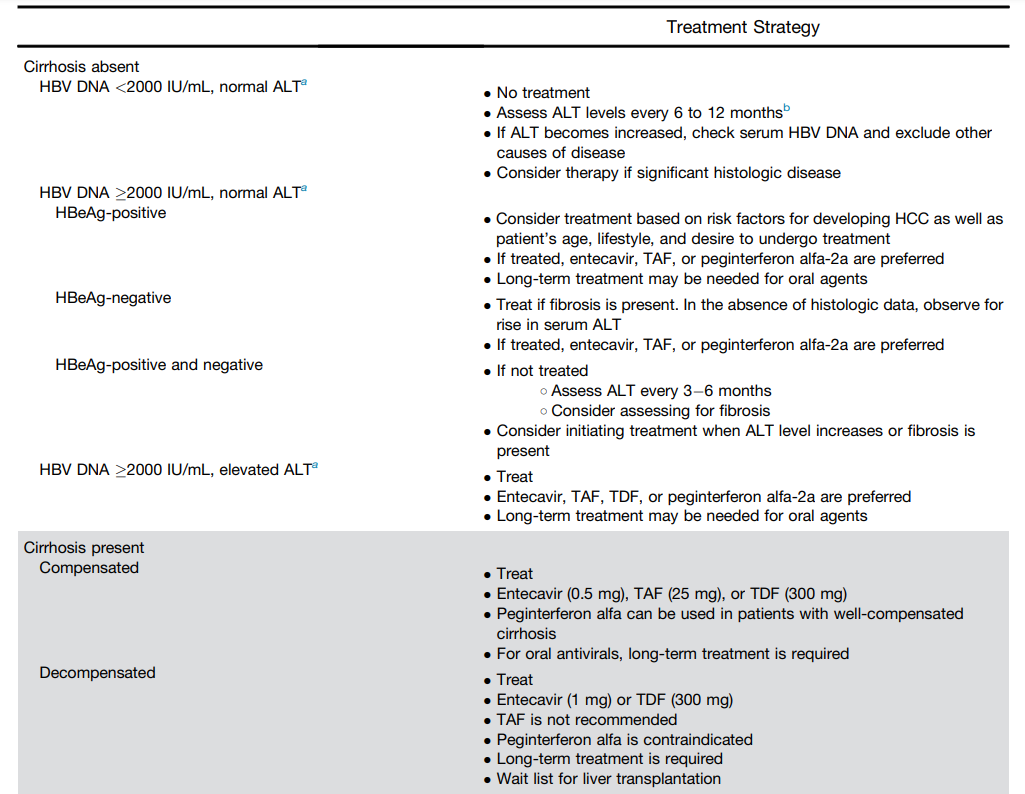
Table 1 (see below) summarizes treatment recommendations. In almost all patients with HBV, if there is elevated ALT, treatment is recommended.
Terminology:
Table for Treatment Recommendations:
In the article, more information is available, including recommendations for treatment in the setting of HIV coinfection
My take: Forget about “immunotolerant” HBV. Until better treatments emerge, patients with HBV and elevated liver enzymes are likely to need long-treatment if using TAF, TDF or entecavir.
“In an effort to reduce the risk of children and teens experiencing serious, even life-threatening injuries from swallowing dangerous, small high-powered magnets, the U.S. Consumer Product Safety Commission (CPSC) voted to approve a new federal safety standard for magnets on September 7, 2022.”
“The new mandatory federal standard requires loose or separable magnets in certain magnet products to be either too large to swallow, or weak enough to reduce the risk of internal injuries when swallowed; specifically, if the magnets fit in a small parts cylinder, then they must have a flux index of less than 50 kG2 mm2.”
“CPSC estimates 26,600 magnet ingestions were treated in hospital ERs from 2010 through 2021, and cases have been rising annually since 2018. CPSC is aware of seven deaths involving the ingestion of hazardous magnets (including two outside of the United States), the majority of these incidents likely involved magnet sets.”
“CPSC urges anyone who may own these magnets and magnet sets to discard them to protect children who may come into contact with them and unintentionally ingest them. “
This study reviewed the topic of milk allergy (both IgE-mediated and non-IgE mediated milk allergy) and provides consensus recommendations from 28 non-conflicted multidisciplinary international experts.
Key points:
“Milk allergy diagnosis can be difficult, making the condition vulnerable to overdiagnosis – and formula milk company sponsorship of milk allergy guidelines, their authors and healthcare professional education is thought to contribute to milk allergy overdiagnosis…Prescriptions for specialized formula used by bottle-fed infants with cow’s milk allergy have increased … expected volumes by up to 10-fold.”
“Consensus was reached that milk allergy does not need to be considered for changes to colour, frequency or consistency of stool, aversive feeding, occasional spots of blood in stool, nasal or respiratory symptoms, in the absence of a temporal relationship with milk protein ingestion. Exceptions to this were biopsy-proven eosinophilic gastrointestinal disorders or protein-losing enteropathy or, in a child ingesting milk protein, faltering growth or daily visible blood in stools”
“Participants noted that visible blood in the stool in an exclusively breastfed infant [has] many possible causes including infection and fissures….and the condition is generally of short duration without serious health consequences”
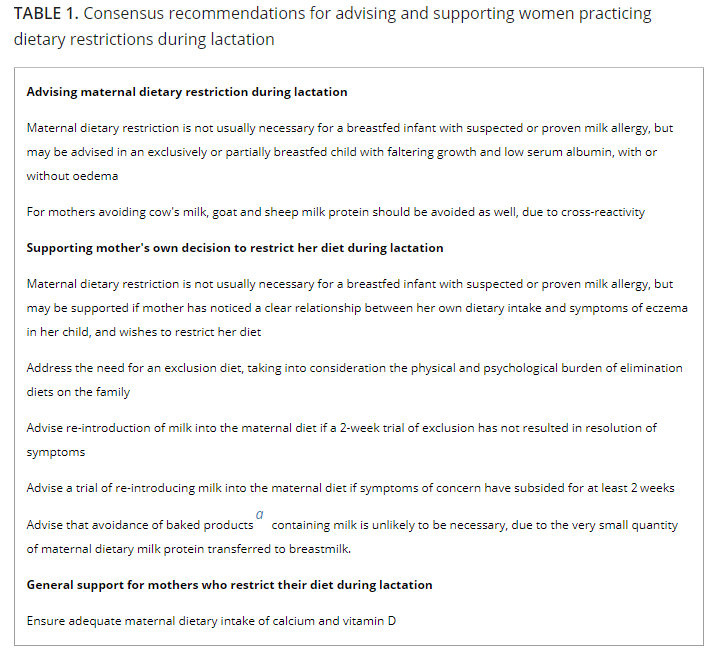
My take: Milk allergy is overdiagnosed in infancy. This guideline supports a more supportive treatment approach. Because breastmilk is hypoallergenic, maternal dietary restriction may be more harmful than helpful in those with mild symptoms (especially if not having trouble with growth or with hypoalbuminemia). Table 1 below lists some of the most important of the 38 consensus recommendations.
S Haflidadottir et al. JPGN 2022; 75: 138-144. Mycophenolate Mofetil Use Is Associated With Reduced Incidence of Food Allergy in Liver Transplanted Children. N=107. Key finding: Children treated with MMF in addition to tacrolimus 1 year after transplantation reported less food allergy (12.5% vs 37.8%, P = 0.003) and sensitization to food allergens one year after transplantation (8.9% vs 17.8%, P = 0.02) than those not receiving MMF. The effect of MMF was not due to reduced trough levels of tacrolimus.
MB Vos et al. Hepatology 2022; 76: 429-444. Open access: Randomized placebo-controlled trial of losartan for pediatric NAFLDKey finding: Losartan did not significantly reduce ALT in children (n=83) with NAFLD when compared with placebo in this multicenter, double-masked, placebo-controlled, randomized clinical trial











 gutsandgrowth