Does Irritable Bowel Syndrome Occur More Commonly in the Setting of Endometriosis?

According to a recent study (AD DiVasta et al. Clin Gastroenterol Hepatol 2021; 19: 528-537. Overlap Between Irritable Bowel Syndrome Diagnosis and Endometriosis in Adolescents), adolescents with surgically-confirmed endometriosis are at increased risk for irritable bowel syndrome.

This study derived data from a longitudinal cohort; the sample for this study followed women with and without endometriosis who completed extensive surveys (n=323) and excluded women with celiac disease or inflammatory bowel disease. Cases of IBS were based on patient reports of Rome IV criteria, though 81% were confirmed via medical record review.

Key findings:

  • “More adolescents with endometriosis (54 of 224; 24%) had comorbid IBS compared with adolescents without endometriosis (7 of 99; 7.1%). The odds of IBS was 5.26-fold higher among participants with endometriosis than without (95% CI, 2.13–13.0).”
  • “For participants with endometriosis, each 1-point increase in acyclic pain severity increased the odds of IBS by 31% (adjusted odds ratio, 1.31; 95% CI, 1.18–1.47).”

The association of endometriosis with IBS was based on Rome IV criteria, as such, the authors assert that this is “not merely a diagnostic bias” However, some of the increase may be related to referral patterns.

Useful points:

  • “In the adult literature, pain in the pelvis, menstrual-related symptoms, symptoms related to sexual intercourse, ovarian cysts, and subfertility seem to distinguish women with endometriosis from other GI conditions.”
  • “Chronic pain syndromes were more prevalent in girls with endometriosis and IBS. Rates of migraine headaches, sleep disturbance, and urinary symptoms were higher…[and] had higher prevalence rates of mood disturbance.”

Why is there overlap between these disorders?

  • The authors speculate that “the inflammatory process likely plays a role…and central pain sensitization may play a crucial role in the two diseases”

My take: Adolescents with endometriosis have a higher likelihood of IBS. Acyclic pain is a strong predictor of IBS.

Related blog posts:

Related humor: YouTube Link: SNL IBS Ad (4/10/21) Very funny!

Fifth Era of Vaccinology

A recent commentary (A Desmond, P Offit. NEJM 2021; 384: 1081-1083. Full text: On the Shoulders of Giants — From Jenner’s Cowpox to mRNA Covid Vaccines) succinctly describes the five major vaccine-related advances. The link also provides access to an audio interview with Dr. Offit

1st Advance: In 1796, Edward Jenner “found that an animal virus (cowpox) could protect against disease caused by a human virus (smallpox)… Jenner’s work ultimately led to the eradication of a disease that is estimated to have killed more than 300 million people in the 20th century”

2nd Advance: In 1885, Louis Pasteur developed an inactivated virus vaccine for rabies. This has led to the development of many other inactivated vaccines, including the influenza vaccine.

3rd Advance: In 1937, Max Theiler attenuated yellow fever virus by means of serial passage in mouse and chicken embryos. This has led to the development of numerous attenuated vaccines to prevent polio (Sabin, 1960s), measles (1963), mumps (1967), rubella (1969), varicella (1995), and rotavirus (2008).

4th Advance: In 1980, Stanford biochemists Richard Mulligan and Paul Berg developed recombinant DNA technology which led to vaccines containing purified surface proteins. This led to the hepatitis B virus (1986), human papillomavirus (2006), and influenza virus (2013) vaccines.

Some of the notable improvements related to vaccines:

  • In U.S., the incidence of polio dropped from 29,000 cases in 1955 to elimination
  • In U.S., during the “2019–2020 influenza season, the influenza vaccine prevented an estimated 7.52 million infections, 3.69 million medical visits, 105,000 hospitalizations, and 6300 deaths”
  • In U.S., the measles vaccine has nearly eliminated a virus that previously caused 2 million to 3 million infections, 50,000 hospitalizations, and 500 deaths every year
  • In U.S., “since the hepatitis B virus vaccine started being routinely recommended for newborns in the early 1990s, rates of hepatitis B virus infection among children younger than 10 years have fallen from about 18,000 per year to nearly zero”
  • Globally, “between 2000 and 2018, roughly 23 million measles deaths were prevented by vaccination…Live attenuated rotavirus vaccines are countering a virus that once killed more than 500,000 infants and young children each year”

5th Advance: In 2020 “with the recent authorization of mRNA vaccines, we have entered the fifth era of vaccinology. This class of vaccines doesn’t contain viral proteins; rather, these vaccines use mRNA, DNA, or viral vectors that provide instructions to cells on how to make such proteins. The SARS-CoV-2 pandemic will be an important test of whether these new platforms can fulfill their promise of creating safe, effective, and scalable vaccines more quickly than traditional methods.”

Related blog posts:

Changing Business of Medicine: Hospital Consolidation of Phycian Practices

As noted in yesterday’s post, in addition to private equity, hospitals have been consolidating medical practices. One incentive has been that hospitals can often charge a “facility fee.”

NPR explains this practice by highlighting a patient with a 10-fold increase in the cost of a steroid injection: Her Doctor’s Office Moved 1 Floor Up. Why Did Her Treatment Cost 10 Times More?

An excerpt: The increasingly controversial charge — basically a room rental fee — comes without warning, as hospitals are not required to inform patients of it ahead of time…

Hospitals say they charge the fee to cover their overhead for providing 24/7 care, when needed. Stamatis also noted the cost of additional regulatory requirements and services “that help drive quality improvement and assurance, but do increase costs.

But facility fees are one reason hospital prices are rising faster than physician prices, according to a 2019 research article in Health Affairs….The Centers for Medicare & Medicaid Services has attempted to curtail facility fees by introducing a site-neutral payment policy. The American Hospital Association sued over the move and plans to take the case to the Supreme Court.

My take: When hospitals own physician practices, there are often hidden costs. NPR recommends: “Ask outright if there will be a facility fee — and how much — even if there has not been one before. If it’s an elective procedure, you can search for a cheaper provider.”

Related blog posts:

Changing Business of Medicine: Private Equity

A recent commentary (JM Zhu et al. NEJM 2021; 384: 11: 981-983. Private Equity and Physician Medical Practices — Navigating a Changing Ecosystem) describes the restructuring of medical practices with a major decline in independent practices due to the growth of hospital-affiliated employees and private-equity investment in medical specialties.

Key points:

  • Between July 2016-January 2018, “hospitals and health systems acquired more than 8000 practices…Roughly 14,000 physicians left private practice”
  • Private-equity investment in medical practices has emerged as an alternative source of investment “that allows physicians to continue to hold equity and benefit financially from future transactions.”

Potential consequences of private-equity investment in medical practice:

  • Reduction in competition
  • Leverage market power with insurers & possible higher costs
  • Possible additional pressures on physicians to improve profits and reduction of physician autonomy
  • Possible improvements in value with operational improvements including sharing industry knowledge with smaller practices, adopting technology infrastructure, and helping practices assume risk with value-based payments
  • Possible prioritization of patients with better payer mix and lower complexity

My take: Mergers and acquisitions whether through hospitals or private equity make me worried that physicians will be squeezed between delivering profits and providing the best service for our patients.

Related audio interview with Dr. Jane Zhu on the growth of private equity investment in medical practices

Passive Smoking and Worsening Crohn’s Disease

S Scharrer et al. Inflamm Bowel Dis 2021; 27: 379-385. Passive Smoking Increases the Risk for Intestinal Surgeries in Patients With Crohn’s Disease

This was a retrospective cohort study which included 169 patients who never smoked actively, 91 patients (54%) were exposed to passive smoking.

Key finding:

  • Exposed patients were more likely to undergo intestinal surgery than nonexposed patients (67% vs 30%; P < 0.001). Multivariate Cox regression analysis revealed that passive smoking was an independent risk factor for intestinal surgeries (hazard ratio, 1.7; 95% CI, 1.04–2.9; P = 0.034)

The associated editorial (RA John, RB Geary, pgs 386-387, Full Text: Smoking Cessation for Patients With Crohn Disease: Not Just for the Patient?) makes several useful points:

  • Smoking has long been identified as one of the strongest environmental risk factors for both the development of Crohn disease (CD) and the worsening of the disease course.
  • Studies in smokers with CD have reported that the risk of flares and complications matches that of nonsmokers with CD after 1 year of abstinence.
  • It would be reasonable to expect that a similar risk reduction exists for patients who can become passive-smoke-free. In addition, their likelihood of remaining smoke-free themselves is increased if they live in a smoke-free household.

My take (from editorial): “Clinicians should consider widening the scope of smoking cessation counseling to include not just patients but also their cohabitants.”

Is Eosinophilic Esophagitis More Frequent in Patients with Inflammatory Bowel Disease?

A Sonnenberg et al. Clin Gastroenterol Hepatol 2021; 19: 613-615. Full Text. Comorbid Occurrence of Eosinophilic Esophagitis and Inflammatory Bowel Disease

Using the Inform Diagnostics database, which is a national electronic repository of histopathologic records from patients distributed throughout the entire United States, the authors performed a case-control study among 302,061 patients undergoing bidirectional endoscopy on the same day.

The database contained 3860 ulcerative colitis (UC) patients, 3330 Crohn’s disease (CD) patients, 1476 patients with indeterminate colitis with respect to UC or CD, and 5296 MC (microscopic colitis) patients. 

Key findings:

  •  EoE was less common in the overall IBD, CD, and MC case populations than the control population. Adjusted odds ratios (compared to control) :
    • EoE and IBD aOR 0.64
  • EoE and Crohn’s aOR 0.41
  • EoE and UC aOR 0.97
  • EoE and Indeterminate Colitis aOR 0.29
  • EoE and MC aOR 0.68

My take: (partly from authors) “Unexpectedly, the present analysis revealed statistically significant inverse relationships between EoE and CD or MC, but not UC.” Because endoscopy is often undertaken in those with a suspicion of IBD, EoE can be identified in the IBD population surreptiously; however, its frequency is likely less than in the general population.

Trends in Liver Diseases: Autoimmune Liver Diseases and Fatty Liver

1st Study: M Lamba et al. Clin Gastroenterol Hepatol 2021; 19: 573-579. Full text: Trends in Incidence of Autoimmune Liver Diseases and Increasing Incidence of Autoimmune Hepatitis

This was a population-based prospective study from Canterbury, New Zealand

Key findings:

  • Overall incidence rates were 1.93 per 100,000 for AIH (95% CI, 1.58–2.34), 0.51 per 100,000 for PBC (95% CI, 0.33–0.73), and 0.92 per 100,000 for PSC (95% CI, 0.68–1.21). 
  •  The incidence rate of AIH was significantly higher during the period of 2014–2016 (2.39 per 100,000; 95% CI, 1.76–3.23) than during the period of 2008–2010 (1.37 per 100,000; 95% CI, 0.91– 2.06) (P < .05). Incidences of PBC and PSC did not change significantly.
  • In 2016, prevalence values were 27.4 per 100,000 for AIH (95% CI, 23.58–32.0), 9.33 per 100,000 for PBC (95% CI, 7.13–12.05), and 13.17 per 100,000 for PSC (95% CI, 10.56–16.42).

My take: This study indicates that autoimmune hepatitis has been increasing in incidence.

Related blog posts:

2ndStudy: ZM Younossi et al. Clin Gastroenterol Hepatol 2021; 19: 580-589. Full text: Nonalcoholic Steatohepatitis Is the Most Rapidly Increasing Indication for Liver Transplantation in the United States

This study was an analysis of data from the Scientific Registry of Transplant Recipients (2002 through 2019).

Key findings:

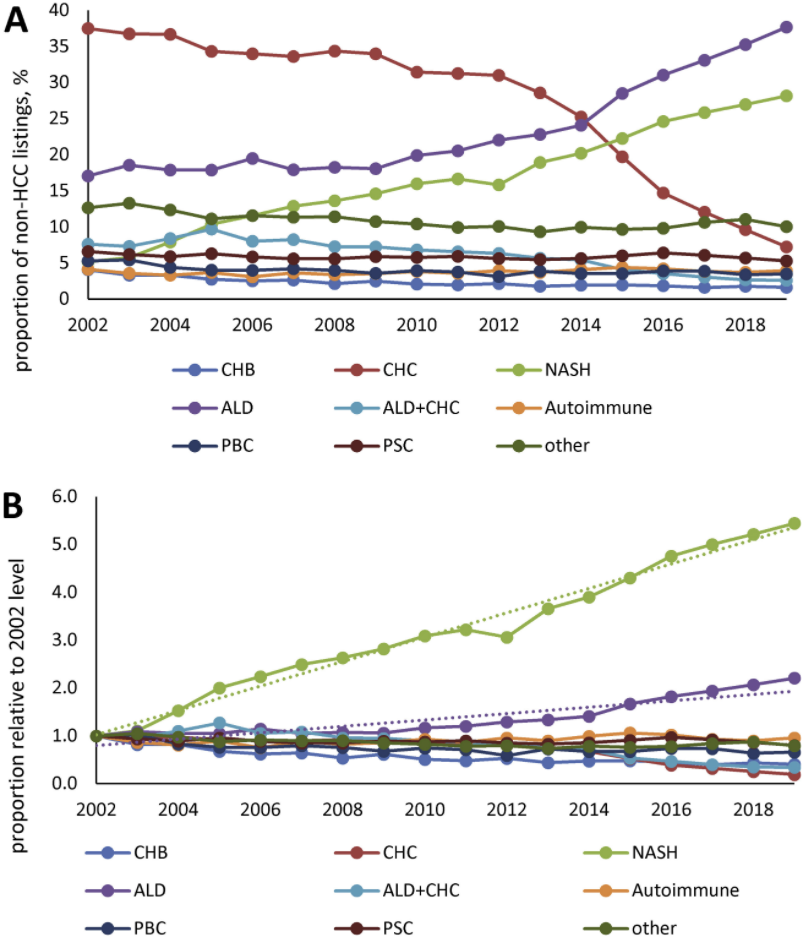
  • In 2002, the most common etiologies of non-acute liver failure on the liver transplant waitlist (in patients without HCC)
  • In 2019, among patients without HCC, NASH was the second leading indication for liver transplantation (28% of patients), after ALD (38% of patients). were chronic HCV infection (37%) and ALD (16%), whereas only 5% had NASH
  • HCC accounted for 27,799 patients (16.5%) and was commonly due to chronic HCV throughout study period

My take: Demand for liver transplantation has NOT improved despite curative therapy for chronic hepatitis C. This is due to increased liver failure related to fatty liver disease and alcoholic liver disease.

Related blog posts:

Figure 1 Prevalence of the most common CLD etiologies in waitlisted liver transplant candidates without HCC. (A) Proportion of all non-HCC listings with known etiology; (B) the proportion relative to that seen in 2002.

Juice in Infancy and Fatty Liver Disease

Briefly noted: ML Geurtsen et al. Hepatology 2021; 73: 560-570. Full text: Associations Between Intake of Sugar‐Containing Beverages in Infancy With Liver Fat Accumulation at School Age

Methods: In a population‐based prospective cohort study of 1,940 infants, we assessed sugar‐containing beverage intake (juice or soda) at 1 year with a validated Food Frequency Questionnaire. Liver fat fraction and NAFLD (liver fat fraction ≥5.0%) were assessed with MR. Key findings:

  • Compared to infants with <1.0 serving/day, those with >2.0 servings/day had the highest odds of NAFLD at 10 years of age (OR, 3.02; 95% CI, 1.34, 6.83). This was independent of sugar‐containing beverage intake and body mass index at school age
  • Liver fat fraction greater than or equal to 5% in school-aged children was almost 3-fold higher in those who consumed more than two servings of juice per day at age 1 (4.0%) than in those who drank less than one per day (1.4%)
  • The associations between juice intake in infancy and NAFLD were strongest in children with overweight or obesity at age 10 and those in families with more limited education

Major strengths of this study are the population‐based prospective longitudinal design with a large sample size, with information on sugar‐containing beverage intake in infancy and liver fat fraction measured with MR at 10 years of age.

My take: Juice and other high sugar beverages (eg soda) should be avoided, particularly at younger ages.

Related blog posts:

.

Interleukin-13 Monoclonal Antibody for Eosinophilic Esophagitis & More COVID-19 Data

A recent study (ES Dellon et al. Clin Gastroenterol Hepatol 2021; 19: 473-483. Full text: Long-term Efficacy and Tolerability of RPC4046 in an Open-Label Extension Trial of Patients With Eosinophilic Esophagitis) provides 1 year data on RPC4046, an IL-13 monoclonal antibody.

This study analyzed data from 66 patients who completed the 16-week, double-blind, induction portion of a phase 2 study of RPC4046 (180 mg or 360 mg/wk) vs placebo and then completed a 52-week LTE, receiving open-label RPC4046 360 mg/wk.  20 of the 86 initial subjects (from the 16 week induction study) did not complete the full 52-week duration of the open label extension

Key findings:

  • Overall, 42 of 66 (64%) subjects had a peak eosinophil count <15 at 52 weeks
  • In the initially-treated group, 29/57 (51%) had peak eosinophil count <15 at 16 weeks
    • 20/29 maintained a eosinophil count <15 at 52 weeks; 3 had an eosinophil count of 15 or greater at 52 weeks. Thus, 20/23 (87%) with data at 52 weeks maintained response.
  • In the initially-treated group, 28/57 (49%) had a peak eosinophil count of 15 or greater at 16 weeks
    • 10/28 (36%) had a peak eosinophil count <15 at 52 weeks and 12 continued with an eosinophil count of 15 or greater at 52 weeks. Thus, 10/22 (45%) acquired a response after the induction period.
  • In the placebo induction group (n=29), none had a peak eosinophil count <15 at week 16
    • 12/29 (43%) had a peak eosinophil count <15 at 52 weeks during open-label treatment; 9 continued with an eosinophil count of 15 or greater at 52 weeks. Thus, 12/21 (57%) developed a response without an induction treatment.

In addition to the improvements in eosinophil count, the authors identified clinical, endoscopic, and histologic improvement. “RPC4046 was well tolerated with little immunogenicity elicited in the LTE period.” Overall, the majority of treatment related adverse events were mild or moderate in severity and “no significant safety concerns.”

My take: This study shows that RPC4046 may emerge as a useful treatment for EoE.

Related blog posts:

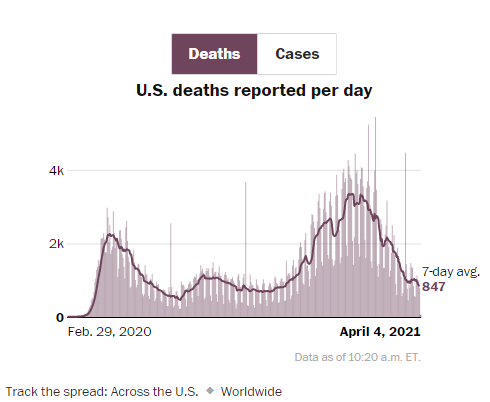
From Washington Post. U.S. Death rate from COVID-19 continues to decline, even though the number of reported daily cases has increased in last 3 weeks. With previous surges, deaths have been a lagging indicator. With the large number of vulnerable individuals vaccinated, it is unclear if the death rate will rise again or will continue to decline.
From Washington Post

Eat Your Fruits and Veggies -Ignore ‘Dirty Dozen’?

USA Today 3/17/21: These 12 fruits and vegetables contain more pesticide residue than others, ‘Dirty Dozen’ study says

An excerpt: “The 2021 “Dirty Dozen,” released Wednesday by the Environmental Working Group, ranked pesticide residue levels of fruits and vegetables based on samples taken by the U.S. Department of Agriculture and the U.S. Food and Drug Administration…’The most important thing is that everyone should be eating lots of fruits and vegetables…We do recommend you try to reduce your pesticide exposure.'”

From Detroit Free Press: Environmental group adds 3 vegetables to its annual Dirty Dozen list

“USDA’s Pesticide Data Program report finds that 99% of samples tested fell below the safety standards set by the Environmental Protection Agency…Only one in 10 Americans eat enough fruits and vegetables daily, according to the Centers for Disease Control and Prevention…Dirty Dozen list creates fear and disparages consumers from buying — organic or not.”

Related article: NY Times, Nicholas Kristof: What are Sperm Telling Us? “Scientists are concerned by falling sperm counts and declining egg quality. Endocrine-disrupting chemicals may be the problem.”

My take: It is concerning that many foods have pesticides. However, adequate fruit and vegetables in the diet offers many health advantages and this is probably a greater priority.

Related blog posts: