Unknown's avatar

About gutsandgrowth

I am a pediatric gastroenterologist at GI Care for Kids (previously called CCDHC) in Atlanta, Georgia. The goal of my blog is to share some of my reading in my field more broadly. In addition, I wanted to provide my voice to a wide range of topics that often have inaccurate or incomplete information. Before starting this blog in 2011, I would tear out articles from journals and/or keep notes in a palm pilot. This blog helps provide an updated source of information that is easy to access and search, along with links to useful multimedia sources. I was born and raised in Chattanooga. After graduating from the University of Virginia, I attended Baylor College of Medicine. I completed residency and fellowship training at the University of Cincinnati at the Children’s Hospital Medical Center. I received funding from the National Institutes of Health for molecular biology research of the gastrointestinal tract. During my fellowship, I had the opportunity to work with some of the most amazing pediatric gastroenterologists and mentors. Some of these individuals included Mitchell Cohen, William Balistreri, James Heubi, Jorge Bezerra, Colin Rudolph, John Bucuvalas, and Michael Farrell. I am grateful for their teaching and their friendship. During my training with their help, I received a nationwide award for the best research by a GI fellow. I have authored numerous publications/presentations including original research, case reports, review articles, and textbook chapters on various pediatric gastrointestinal problems. In addition, I have been recognized by Atlanta Magazine as a "Top Doctor" in my field multiple times. Currently, I am the vice chair of the section of nutrition for the Georgia Chapter of the American Academy of Pediatrics. In addition, I am an adjunct Associate Clinical Professor of Pediatrics at Emory University School of Medicine. Other society memberships have included the North American Society for Pediatric Gastroenterology Hepatology and Nutrition (NASPGHAN), American Academy of Pediatrics, the Food Allergy Network, the American Gastroenterology Association, the American Association for the Study of Liver Diseases, and the Crohn’s and Colitis Foundation. As part of a national pediatric GI organization called NASPGHAN (and its affiliated website GIKids), I have helped develop educational materials on a wide-range of gastrointestinal and liver diseases which are used across the country. Also, I have been an invited speaker for national campaigns to improve the evaluation and treatment of gastroesophageal reflux disease, celiac disease, eosinophilic esophagitis, hepatitis C, and inflammatory bowel disease (IBD). Some information on these topics has been posted at my work website, www.gicareforkids.com, which has links to multiple other useful resources. I am fortunate to work at GI Care For Kids. Our group has 17 terrific physicians with a wide range of subspecialization, including liver diseases, feeding disorders, eosinophilic diseases, inflammatory bowel disease, cystic fibrosis, DiGeorge/22q, celiac disease, and motility disorders. Many of our physicians are recognized nationally for their achievements. Our group of physicians have worked closely together for many years. None of the physicians in our group have ever left to join other groups. I have also worked with the same nurse (Bernadette) since I moved to Atlanta in 1997. For many families, more practical matters about our office include the following: – 14 office/satellite locations – physicians who speak Spanish – cutting edge research – on-site nutritionists – on-site psychology support for abdominal pain and feeding disorders – participation in ImproveCareNow to better the outcomes for children with inflammatory bowel disease – office endoscopy suite (lower costs and easier scheduling) – office infusion center (lower costs and easier for families) – easy access to nursing advice (each physician has at least one nurse) I am married and have two sons (both adults). I like to read, walk/hike, bike, swim, and play tennis with my free time. I do not have any financial relationships with pharmaceutical companies or other financial relationships to disclose. I have helped enroll patients in industry-sponsored research studies.

Interchangeability, Immunogenecity and Infliximab Biosimilars

A recent study (G Fiorino et al. IBD 2018; 24: 601-6, editorial by KH Katsanos et al 465-6) provides more data on “full interchangeability” in regards to infliximab (IFX) and biosimilars CT-P13 and SB2. Full abstract below.

Key finding in study:

  • Antibodies to infliximab (ATI) cross-reacted with any type of IFX or IFX-biosimilar

Points from the editorial:

  • “The landmark NOR-SWITCH randomized controlled trial showed that 1-time switching from RMC [Remicade] to CT-P13 is not inferior to continued treatment with the infliximab originator…there are no data regarding multiple switches…Consequently, cross-switching (switching between 2 biosimilars), reverse switching (switching from biosimilar to its originator) or multiple/repeated switching is not currently recommended.”
  • This study, however, shows that “if you have already developed antibodies to 1 infliximab product, there is no point in switching to another infliximab product.”

Abstract:

BackgroundInfliximab (IFX) biosimilars CT-P13 and SB2 have comparable efficacy, safety, and immunogenicity to the originator Remicade (RMC). However, concerns about cross-switching patients between the 3 brands were raised in the absence of cross reactivity data between them. We aimed to determine whether antibodies to infliximab (ATI) in inflammatory bowel disease (IBD) patients cross-react with RMC, CT-P13, and SB2.

MethodsBased on previous ATI status, samples from 34 patients participating in the BIOSIM01 study (13 RMC, 9 CT-P13, and 12 switchers) were selected. Patients were treated with either RMC only, or CT-P13 only, or with RMC switched to CT-P13. Additionally, 28 IFX-naïve patients were assayed as controls. In total, 180 samples were analyzed. ATI trough levels were measured in parallel with 3 different bridging Enzyme Linked Immunosorbent Assays constructed using the 3 drugs. Spearman’s coefficient and percentages of agreement were used to study the correlation between each assay.

ResultsIn total, 76 samples out of 152 IFX-treated patient samples were ATI-positive (30 RMC, 14 CT-P13, and 32 switchers). All resulted ATI-positive when either CT-P13 or SB2 bridging assays were used. The overall percentage of agreement was 100% when compared either with CT-P13 or SB2 assays. No significant differences were found among ATI levels and coefficients (Spearman’s 0.98 to 1.0, P < 0.0001).

ConclusionsATI of RMC-treated, CT-P13-treated or RMC to CT-P13 switched patients show full cross-reactivity with CT-P13 and SB2. Findings suggest that immunodominant epitopes in the reference and CT-P13 drugs are equally present in SB2. Data support full interchangeability between biosimilars in regard to immunogenicity.

My take: In patients doing well with IFX, switching to a biosimilar is not currently recommended.  In patients naive to IFX, use of IFX or biosimilar is expected to have similar efficacy.

Related study: B Kang et al. IBD 2018; 24: 607-16.  This prospective study of 36 pediatric patients did not identify any significant differences in efficacy…or immunogenicity after switching from IFX to CT-P13.

Related blog posts:

Breathing (Diaphragmatic) Helps Belching and Reflux Symptoms

A recent prospective study (A M-L Ong et al. Clin Gastroenterol Hepatol 2018; 16: 407-16) of 36 patients (median age 45) showed that diaphragmatic breathing was helpful for PPI-refractory GERD symptoms/belching.  Patients enrolled all had “troublesome belching” for 6 months and GERD. Patients underwent high resolution manometry and pH-impedance study.

Key findings:

  • 9 of 15 (60%) in the diaphragmatic treatment group reduced their belching visual analog score by ≥50%, whereas none of the control group achieved the primary outcome
  • Treatment also resulted in lower GERD symptoms based on reflux disease questionnaire score -decrease of 12.2 vs 3.1 in the control group (P=.01)
  • Treatment improved QOL scores, based on Reflux-Qual Short form (15.7 increase for treatment group compared to 2.4 decrease in control group)
  • Treatment effects were sustained at 4 months after treatment

My take: Diaphragmatic breathing can be a useful adjunct in GERD, particularly in patients with belching.

Related blog post: Treatment for rumination and belching


Foggy Morning in Sandy Springs

Does C-section Increase Risk of Celiac Disease? Probably Not

Using data from the prospective TEDDY (The Environmental Determinants for Diabetes in the Young) from 2004-2010, a recent study (S Koletzko et al. JPGN 2018; 66: 417-24) has shown that cesarean section is not associated with an increased risk of celiac disease (CD) or celiac disease autoimmunity (CDA). TEDDY participants are at increased risk for CD and type 1 diabetes (T1D) based on HLA-risk genotypes.

Key findings:

  • Of the 6087 singletons, 1600 (26%) were born via C-section
  • C-section was associated with a lower risk for CDA (HR 0.85) and a lower risk of CD (HR 0.75)

My take: While environmental factors are likely to be responsible for increasing incidence of CD, C-section compared to vaginal delivery does not appear to be a risk factor.

Related blog posts:

Amber Cove, Dominican Republic

Baclofen for Rumination

A recent randomized, placebo-controlled cross-over study by A Pauweis et al (Am J Gastroenterol 2018; 113: 97-104) indicated that baclofen improved rumination syndrome in adults (mean age 42 years). Thanks to Ben Gold for this reference.

Baclofen (dosed at 10 mg TID) had the following effects:

  • reduced rumination episodes from 13 (8-22) to 8 (3-11) (P=0.004)
  • increased lower esophageal sphincter (LES) pressure (17.8 vs. 13.1, P=0.0002) and lowered number of transient LES relaxations (4 vs 7, P=0.17)
  • overall treatment evaluation was superior after baclofen compared to placebo (P=0.03)

My take: In this study, baclofen improved symptoms of rumination and regurgitation, but not supragastric belching.

Related posts:

“Escape” stairs in Hoover Dam

Eluxadoline and Pancreatitis

It looks like eluxadoline, recently FDA-approved for IBS-D, is associated with a significant rate of pancreatitis.  The most recent report: AJ Gawron, K Bielefeldt. Clin Gastroenterol Hepatol 2018; 16: 378-84.

The authors extracted reports of eluxadoline adverse events using the Federal Adverse Event Reporting System.

  • Of the 597 reports, 98 (16.4%) were due to pancreatitis; 53 cases required hospitalization.  (The FDA separately reported 120 cases of pancreatitis –https://www.fda.gov/Drugs/DrugSafety/ucm546154.htm)
  • The FDA report, which noted the risk primarily in those with prior cholecystectomy, “listed 1 fatality caused by pancreatitis..which manifested within the first day of therapy.”

My take: This study showing a significant risk of pancreatitis changes the risk-benefit ratio of eluxadoline.  Since pancreatitis can result in hospitalization and even death, alternative therapies for IBS will be favored.

Related blog posts:

Tenofovir to Prevent Perinatal Transmission of Hepatitis B

Mother-to-child transmission of hepatitis B virus (HBV) accounts for the majority of cases of chronic HBV infection.  HBV infection affects more than 250 million people worldwide and in many cases results in cirrhosis or hepatocellular carcinoma.  As such, there has been interest in preventing perinatal transmission.

The most recent study (C Jourdain et al. NEJM 2018; 378: 911-23) again showed that tenofovir administration to pregnant women with HBV can prevent transmission.  This study enrolled 331 women.  Key findings:

  • 0% (0/147) infants in the tenofovir group developed HBV infection compared to 2% (3/147) in the control group. This did not reach statistical significance
  • The placebo group received HBV vaccination and hepatitis B immune globulin 1.2 hours and 1.3 hours after birth (median time).  This rapid provision of treatment along with completion of four doses of HBV vaccine likely helped keep the placebo group HBV infection rate low

In the related editorial (G Dusheiko. pg 952-3), it is noted that “current levels of evidence supporting antiviral therapy with TDF [tenofovir] (or possbily lamivudine or telbivudine) to reduce levels of maternal HBV DNA during pregnancy have been accepted by the” AASLD.

Related blog posts:

Childhood Obesity: It is NOT Getting Better

A recent study (AC Skinner et al. Pediatrics 2018; 141: e20173459) examined obesity prevalence data in children 2-19 years of age from a nationally representative sample (n=3340).  Specifically, the authors used NHANES data from 1999-2016. Thanks to John Pohl’s twitter feed for pointing out this reference.

PDF Link: Prevalence of Obesity and Severe Obesity in US Children, 1999-2016

This article is packed with data and breaks down obesity in categories: overweight, class I obesity, class II obesity & class III obesity.  It provides data based on gender, age, and ethnicity.

The trend in obesity prevalence is best captured in Figure 1.

Among girls:

  • In 1999-2000: class I obesity noted in 14.6% –>17.8% in 2015-16
  • In 1999-2000: class II obesity noted in 4.0% –>5.2% in 2015-16
  • In 1999-2000: class III obesity noted in 0.9% –>1.8% in 2015-16

Among boys:

  • In 1999-2000: class I obesity noted in 14.7% –>19.1% in 2015-16
  • In 1999-2000: class II obesity noted in 4.1% –>6.7% in 2015-16
  • In 1999-2000: class II obesity noted in 1.0% –>2.0% in 2015-16

My take: This article indicates that the prevalence of childhood obesity in the U.S. is not improving and does not appear to have leveled off as has been suggested by some studies.

Related blog posts:

Tanyard Creek Park


Autoimmune Hepatitis Associated with Anti-TNF Therapy

A recent study (A Ricciuto et al. J Pediatr 2018; 194: 128-35) identified an index case of autoimmune hepatitis (AIH) associated with anti-tumor necrosis factor (TNF) therapy and reviewed liver biochemistries in a cohort of 659 children.

Key findings:

  • In the index case, features of autoimmune hepatitis (AIH) on liver biopsy were noted 23 weeks after starting infliximab.   These findings resolved entirely within 4 months after withdrawal of infliximab
  • Overall, 7.7% of cohort had elevations of ALT while receiving anti-TNF therapy.  Most were mild and attributable to other causes than drug toxicity. No other cases of AIH were identified.

The authors recommend a careful investigation in those with elevations >2-3 times ULN which persists >3 months. Livertox (NIH) website notes the following for infliximab:

“The liver injury caused by infliximab is usually mild and rapidly reversed once therapy is stopped.  However, fatal instances of HBV reactivation and induction of autoimmune hepatitis due to infliximab have been reported, and regular monitoring of patients early during the course of infliximab is recommended.”

My take: Serious liver injury related to anti-TNF therapy is rare. A great place to understand the spectrum of liver problems potentially related to infliximab is the livertox website:

Related blog entries:

AIH:

Views from inside Hoover Dam, including Mike O’Callaghan–Pat Tillman Memorial Bridge

Mechanisms in Fatty Liver Disease Improved After Bariatric Surgery

A recent prospective study (V Nobili et al. J Pediatr 2018; 194: 100-8) consecutively enrolled 20 severely obese adolescents with biopsy-proven nonalcoholic fatty liver disease (NAFLD). The authors used liver histology, immunohistochemistry and cytokine analysis to assess the changes (after 12 months) induced by bariatric surgery with laparoscopic sleeve gastrectomy (LSG).

Key findings:

  • NAFLD Activity Score and fibrosis improved after LSG. Steatosis, hepatocyte ballooning, and NAS score showed a significant improvement (Z=-2.7; P=.007) at 12 months following surgery. Fibrosis improvement (Z=-2.449) was noted as well.
  • The histologic improvement “is associated with activation of local cellular compartments (hepatic progenitor cells, hepatic stellate cells, and macrophages), thus, strengthening the role of cellular interactions and hepatic adipocytokine production in the pathogenesis of NAFLD.”

This study has a large number of figures illustrating the changes in liver architecture and immunohistochemistry changes.

My take: This study shows specific improvements following LSG and shows correlation with cytokines and immunohistochemistry providing a mechanistic explanation for these improvements.

Related blog posts:

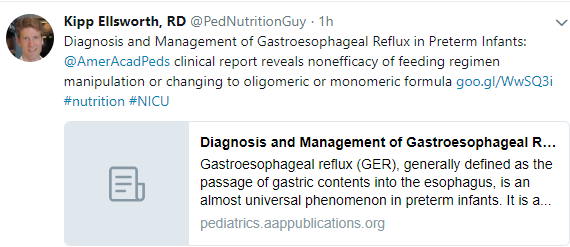
2018 Pediatric Gastroesophageal Reflux Clinical Practice Guidelines

Full text: NASPGHAN Pediatric Gastroesophageal Reflux Clinical Practice Guidelines (R Rosen et al. JPGN 2018; 66: 516-54)

This is a lengthy report with ~50 recommendations/302 references –many with several subrecommendations. I will highlight a few below. Tables 2 defines “red flags” that suggest the need for additional diagnostic tests and Table 3 provides a lengthy differential diagnosis (=everything).

R Rosen et al. JPGN 2018; 66: 516-54

The article reviews several frequent clinical diagnostic/management issues and provides two algorithms with suggested evaluation/treatment for infants and older children.  The older child algorithm (algorithm 2) suggests referral to GI if not improved with acid suppression or unable to wean after course of treatment.  For pediatric GI physicians, this algorithm suggests use of endoscopy if persistent symptoms on PPI or inability to stop PPI; pH-MII or pH-metry recommended if normal-appearing endoscopy.

Key point:

  • For infants: “if excessive irritability and pain is the single manifestation, it is unlikely to be related to GERD.”

Some of the Recommendations -My Top Ten:

  • 3.5 We suggest not to use esophago-gastro-duodenoscopy to diagnose GERD in infants and children.
  • 3.13 We suggest not to use a trial of PPIs as a diagnostic test for GERD in infants.
  • 3.14 We suggest a 4 to 8 week trial of PPIs for typical symptoms (heartburn, retrosternal or epigastric pain) in children as a diagnostic test for GERD
  • 3.15 We suggest not to use a trial of PPIs as a diagnostic test for GERD in patients presenting with extraesophageal symptoms.
  • 5.1 We suggest not to use antacids/alginates for chronic treatment of infants and children with GERD.
  • 5.4 We recommend not to use H2RA or PPI for the treatment of crying/distress in otherwise healthy infants.
  • 5.5 We recommend not to use H2RA or PPI for the treatment of visible regurgitation in otherwise healthy infants
  • 5.7 We suggest not to use H2RAs or PPIs in patients with extraesophageal symptoms (ie, cough, wheezing, asthma), except in the presence of typical GERD symptoms and/or diagnostic testing suggestive of GERD.
  • 5.10 We suggest to consider the use of baclofen prior to surgery in children in whom other pharmacological treatments have failed.
  • 6.4 We suggest to consider the use of transpyloric/jejunal feedings in the treatment of infants and children with GERD refractory to optimal treatment as an alternative of fundoplication.

My take: This is an excellent updated summary of current best clinical practices for evaluation/management of pediatric GERD.

Related blog posts:

Disclaimer: These blog posts are for educational purposes only. Specific dosing of medications/diets (along with potential adverse effects) should be confirmed by prescribing physician/nutritionist.  This content is not a substitute for medical advice, diagnosis or treatment provided by a qualified healthcare provider. Always seek the advice of your physician or other qualified health provider with any questions you may have regarding a condition.


Note full text link available online identified in Google Search