How Often Do Children with Obesity Have a Fatty Liver?

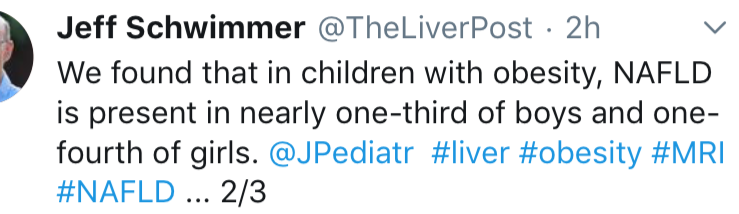
According to a recent study (EL Yu et al. J Pediatr 2019; 207: 64-70), about one-third of boys and one-fourth of girls with obesity have nonalcoholic fatty liver disease (NAFLD).

This study from San Diego with 408 children aged 9-17 years (mean 13.2 years) with obesity evaluated for NAFLD with laboratories (to exclude other etiologies) and with liver MRI proton density fat fraction (PDFF), with ≥5% considered the threshold for NAFLD.

Key findings:

  • Prevalence of NAFLD was 26% in this population, with 29.4% in males and 22.6% in females
  • The optimal cut offs of ALT for detecting NAFLD in this study were ≥30 U/L for females and ≥42 U/L for males. These are much lower than NASPGHAN guidelines which proposed ≥80 U/L or twice the ULN as thresholds for further investigation.  (The NASPGHAN recommendations are likely to have higher specificity in identifying children at greater risk for nonalcoholic steatohepatitis (NASH).)

Limitations:

  • 77% of this cohort were hispanic, thus prevalence may vary significantly in other populations.
  • MRI-PDFF -the exact cut off is unclear.  The authors note that if 3.5% were chosen, the NAFLD prevalence jumped to 49.3% (according to Table II –though the discussion stated 53.2%)

My take: Understanding the likelihood of NAFLD in children at risk is a helpful first step.  This study points to the growing use of non-invasive diagnosis with MRI.

On a related topic, briefly noted: “Obesity in Adolescents and Youth: The Case for and against Bariatric Surgery” (A Khattab, MA Sperling. J Pediatr 2019; 207: 18-22). In this review, the authors refer frequently to endocrine society guidelines (J Clin Endocrinol Metab 2017; 102: 709-57).    These guidelines generally recommend bariatric surgery only under specific conditions (eg. completion of Tanner 4 or 5 along with a BMI of 40 kg/m-squared or BMI of 35 with significant extreme comorbidities after failure of lifestyle modifications & without untreated psychiatric illness).  This review predicts increasing use of bariatric surgery in adolescents “as more data on long-term outcomes in larger cohorts become known.”

Related blog posts on fatty liver disease:

Related blog posts on bariatric surgery:


Time to Revise ImproveCareNow Micronutrient Recommendations

With ImproveCareNow, there have been efforts to minimize variation in care.  As such, there have been suggestions to monitor labs like vitamin D, vitamin B12, and folate routinely. I have voiced concern that some of this testing is unnecessary.  For vitamin B12, deficiency in pediatrics is rare; at risk populations include those with extensive small bowel resections, gastric resections or strict vegan diet.

A recent article (J Fritz et al. Inflamm Bowel Dis 2019; 25: 445-59) which is a systematic review of micronutrients in pediatric inflammatory bowel disease provides further support for the approach of less testing.

Key points:

  • A total of 39 studies were included in the final review (2903 subjects, 1115 controls)
  • Iron deficiency and vitamin D deficiency are common in pediatric patients with IBD
  • Vitamin B12 and folate deficiency are rare
  • Zinc deficiency is uncommon but increased in patients with Crohn’s disease compared to healthy controls.
  • The authors recommend routine (at least yearly) testing for iron, vitamin D and zinc and that there is “insufficient evidence to support routine screening for other micronutrient deficiencies.”

My take: Except in patients with surgical resections and in those with unusual diets (eg. vegan), routinely checking vitamin B12, folate and most other micronutrients is unnecessary & low value care.

Related blog posts:

Vitamin B12:

Vitamin D:

Iron:

Disclaimer: These blog posts are for educational purposes only. Specific dosing of medications/diets (along with potential adverse effects) should be confirmed by prescribing physician/nutritionist.  This content is not a substitute for medical advice, diagnosis or treatment provided by a qualified healthcare provider. Always seek the advice of your physician or other qualified health provider with any questions you may have regarding a condition.

Big Data for Personalized Diets

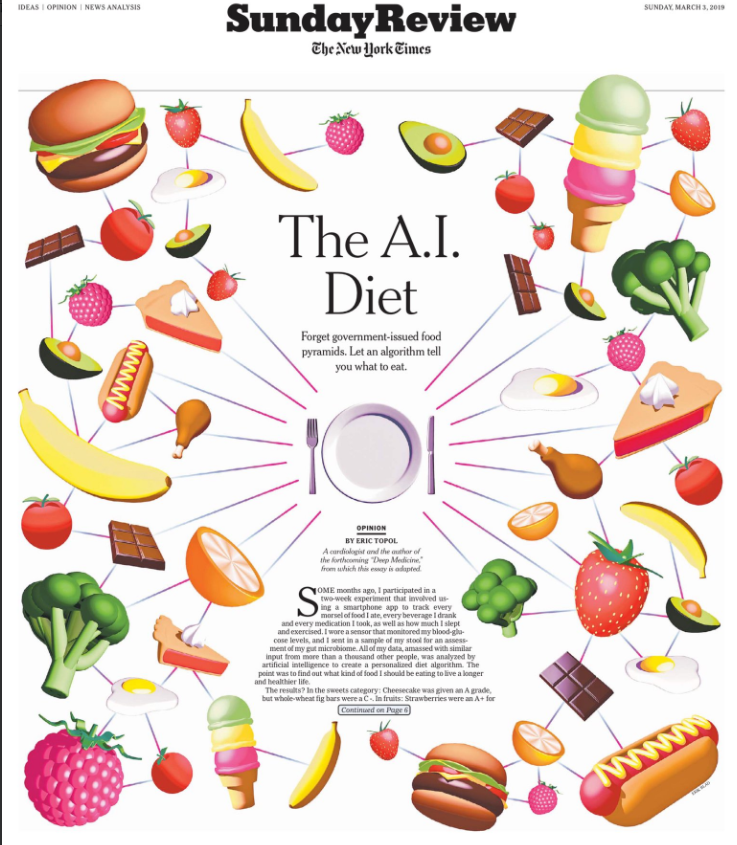
A recent commentary in the NY Times discusses the future of personalized diets.  Along the way, the commentary notes how little we know about the best diet and how difficult nutrition research is to complete.

The A.I. Diet by Eric Topol who is the author of the forthcoming “Deep Medicine,” from which this essay is adapted

An excerpt:

It turns out, despite decades of diet fads and government-issued food pyramids, we know surprisingly little about the science of nutrition. It is very hard to do high-quality randomized trials: They require people to adhere to a diet for years before there can be any assessment of significant health outcomes…

Meanwhile, the field has been undermined by the food industry, which tries to exert influence over the research it funds.

Now the central flaw in the whole premise is becoming clear: the idea that there is one optimal diet for all people…

Only recently, with the ability to analyze large data sets using artificial intelligence, have we learned how simplistic and naïve the assumption of a universal diet is. It is both biologically and physiologically implausible: It contradicts the remarkable heterogeneity of human metabolism, microbiome and environment, to name just a few of the dimensions that make each of us unique. A good diet, it turns out, has to be individualized.

My take: Dr. Topol makes some important observations and he is right that there is not a simple diet solution for everyone.  Nevertheless, in the near future, personalized medicine is not coming to our dinner tables and we have to rely on what we know right now –don’t eat too much sugar, do eat more fruits and vegetables, and don’t eat too much.

Related blog posts:

Why Fiber Matters?

A recent review article (J O’Grady et al. Aliment Phamacol Ther; 2019; 49: 506-15) highlights how fiber is important for health and its potential role in fostering a diverse microbiome. Some of the material has been covered before in a previous blog/presentation: It’s Alimentary!  “The Fiber Movement: Why Kids Need It and How to Get It” by Maria Oliva-Hemker .

In the introduction, the authors note that there had been a period of disappointment that fiber did not seem to help irritable bowel syndrome.  Though with expanding knowledge of the diet-, microbiome- host interactions, clinicians have started to appreciate the health impact of dietary fiber.

In subsequent sections, the authors detail the different types of fiber based on solubility, viscosity and fermentation.

Key actions of fiber:

  • Anti-inflammatory effects
  • Immune system modulation
  • Regulation of cell proliferation and differentiation
  • Richer microbiome diversity (may lower risk of C difficile)

The authors note that a low-fiber diet in germ-free mice can result in a reduced microbial diversity and interestingly, the “missing taxa is transmitted to subsequent generations” even if fiber is re-introduced.

Potential beneficial fiber effects beyond bulking up stools:

  • Reduced adiposity
  • Lower metabolic disease including lower cholesterol and better glucose metabolism
  • Lower incidence of chronic inflammatory diseases
  • “Potential for fiber to prevent… diverticular and neoplastic disorders”

Western Diet is Deficient in Fiber.

  • Recommendations for fiber intake of 14 g per 1000 kcal consumed, which equates to approximately 25 g for females and 38 g for males (depending on energy intake).
  • In underdeveloped countries and historically, intakes are more than 50 g (in Africa) and up to 100 g/day in ancestral humans
  • Actual intake in U.S. is only 12-18 g/day.

The authors recommend efforts to gradually titrate increased fiber in the diet as abrupt changes may be poorly tolerated due to gas and bloating.

My take: This article explains that the connection between fiber intake and a number of health outcomes is likely due, at least in part, to its modulation of the microbiome. Thus, fiber is important for much more than a good poop.

Related blog posts:

Sport Drinks Not Needed

A recent expose from 538 explains why sports drinks are unnecessary.

538: You Don’t Need Sport Drinks to Stay Hydrated

Key points:

  • Though sports drinks are highly marketed, there is little scientific evidence behind their claims
  • Water is generally better for most people
  • Hyponatremia can be provoked by drinking too much fluids

A few excerpts:

  • “As it turns out, if you apply evidence-based methods, 40 years of sports drinks research does not seemingly add up to much,” Carl Heneghan and his colleagues at the University of Oxford’s Centre for Evidence-Based Medicine wrote in a 2012 analysis published in the British medical journal BMJ. ..
  • There has never been a case of a runner dying of dehydration on a marathon course, but since 1993, at least five marathoners have died from hyponatremia they developed during a race.  At the 2002 Boston Marathon, researchers from Harvard Medical School took blood samples from 488 marathoners after the finish. The samples showed that 13 percent of the runners had diagnosable hyponatremia…Athletes who develop hyponatremia during exercise usually get there by drinking too much because they’ve been conditioned to think they need to drink beyond thirst

My take: Drink when you are thirsty.  Exceptional talent and hard work, not sports drinks, are the key if you want to “Be Like Mike.”

Related blog posts:

Joshua Tree at Joshua Tree National Park

Encouraging Healthy Eating in Hospitalized Children

Full Text (from J Peds twitter feed): All Aboard Meal Train: Can Child-Friendly Menu Labeling Promote Healthier Choices in Hospitals?  S Basak et al. J Pediatr 2019; 204: 59-65

Conclusion: “The combination of menu labeling techniques targeted to children in the inpatient hospital setting was an effective short-term tool for increasing the intake of healthier foods, although the effect of labeling waned over time.”

From the discussion: “Our findings in this study show a significantly higher odds of ordering green-light healthier option foods and lower odds of ordering red-light foods when exposed to child-friendly menu labeling. This effect waned over time, such that after 8 meals, proportions of red-light and green-light choices were similar with both menus…

Although most children’s hospital food environments include food items that have low nutritional value, this study highlights that nutrition education using menu labeling can be successfully implemented and can encourage children and their families to make healthier choices. It is our hope that labeling may also encourage hospital food providers to improve food quality at the hospital by decreasing red-light foods and increasing healthy food options at every meal. More research is needed to determine optimal techniques for various age ranges and develop menus that are age-appropriate and tailored for specific patient populations.”

My take: 1. This study from Sick Children’s is important.  We can determine more effective healthy eating strategies on a ‘captive’ audience.  2. I remember several years ago when one of my partners ruffled some feathers by asking the hospital to reconsider promoting sugar-sweetened beverages while at the same time posting billboards of obese children.

Related blog posts: