Liver Disease Associated with Inflammatory Bowel Disease

A useful review on the hepatobiliary manifestations of inflammatory bowel disease (IBD): Inflamm Bowel Dis 2014; 1655-67.

A few topics/comments from review:

Primary sclerosing cholangitis (PSC):

  • “among those with PSC, about 70% to 80% have UC and 15% to 20% have CD.  Those IBD patients with PSC are more likely to develop malignant complications and to require liver transplantation. Conversely, only about 0.4% to 7.5% of patients with IBD will develop PSC.”
  • “Currently, no medical treatment has been proven to decrease the progression of PSC.”
  • “At the time of diagnosis of PSC, IBD must be ruled out and a complete colonoscopy with multiple segmental biopsies of the mucosa needs to be performed.”  Among PSC-IBD patients, “annual surveillance colonoscopy is recommended.”
  • Further surveillance recommendations (eg. annual imaging/CA 19-9 annually) discussed in Table 2.

Cholelithiasis: Gallstones are reported in 13% to 24% of all patients with CD.  In UC, the risk of cholelithiasis “does not seem to be increased.”

Drug-induced liver disease: (see liver tox website)

  • Thiopurines
  • Methotrexate
  • Sulfasalazine/mesalamine
  • Biologic agents

Viral hepatitis in immunosuppressed IBD patients:

Hepatitis B reactivation -algorithm for screening/management of latent hepatitis B provided in Figure 3

Other liver problems seen in IBD patients:

  • Portal Vein Thrombosis
  • Nonalcoholic Fatty Liver Disease
  • Secondary amyloidosis
  • Hepatic abscess

Related blog posts:

Exceptions for Valproate-Associated Liver Failure

Recent guidelines (AASLD/NASPGHAN 2014 Guidelines for Evaluation of Pediatric …) have included valproate-associated acute liver failure (VPA-ALF) as an absolute contraindication to liver transplantation.  The reason is that most of these VPA-ALF patients have Alpers-Huttenlocher syndrome (AS) and have done poorly after transplantation due to progressive neurological decline.

AS in turn has been recognized as secondary to mutations in DNA polymerase subunit gamma (POLG1).  This gene product’s role is to maintain the integrity of mitochondrial DNA (mtDNA).

New data (Liver Transplantation 2014; 20: 1402-14, editorial 1287-89) suggests that there are exceptions for some cases of VPA-ALF.  In this report, 4 VPA-ALF patients with POLG1 mutations underwent successful liver transplantation.  Three are alive at followup 4-19 years later and one died suddenly 2 years after transplantation.

Key findings:

  • These cases had mutations in POLG1 associated with later onset and milder disease.
  • In the three long-term survivors, VPA was introduced at 14, 20 , and 21 years of life.

Take-home points:

  • For children less than 10 years of age, “VPA-ALF should remain an absolute contraindication to LT because neurological progression is almost inevitable.”  Supportive treatment, including N-acetylcysteine and carnitine should continue.
  • There is a “strong case for screening for POLG1 mutations before VPA use…even a single mutation should be seen as a contraindication to VPA.”

Related blog posts:

Also, I added a link on yesterday’s post regarding measles to a story on NPR which explores the most recent increase in cases and provides background information.  For example: “Before a vaccine was developed in the 1960s, measles caused more than 2 million deaths per year.”  And worldwide, even now, “nearly 400 kids die from measles each day. In 2013, more than 70 percent of measles deaths were confined to six countries: the Democratic Republic of Congo (DRC), Ethiopia, India, Indonesia, Nigeria and Pakistan.”

Lysosomal Acid Lipase Deficiency -Another Needle in a Haystack

A recent article (Atherosclerosis 2014; 235: 21-30) reviews lysosomal acid lipase deficiency (LAL-D) and how this rare disease needs to be considered by pediatric hepatologists.

LAL-D is a rare lysosomal storage disease which encompasses a rapidly progressive disease in infants (previously referred to as Wolman disease) as well as a later-onset condition called cholesteryl ester storage disease (CESD).  Both of these diseases are caused by mutations in the LIPA gene and share the same pathophysiology related to deficiency of LAL. The disease prevalence estimates vary widely (1 in 40,000 to 1 in 300,000) and depend on ethnicity and location.  Jewish, Iraqi, and Iranian infants appear to be at highest risk.

According to the review algorithm, patients with three or more of the following should be considered for screening:

  • ALT >1.5 ULN
  • Hepatomegaly (may be mild)
  • HDL <50 mg/dL
  • Low BMI (in adults <30 kg/m2)
  • Liver biopsy with microvesicular steatosis; grossly the liver may appear orange

Thus, the potential target patients:

  1. Non-obese individuals with persistent increases in LFTs –usually with LDL >160 and low HDL <50
  2. Non-obese NAFLD/microvesicular steatosis

Given the potential for treatment with recombinant sebelipase alfa (Synageva Biopharma) and the widely available testing, looking for LAL-D makes sense in selected patients; though, even in highly selected patients, finding cases may truly be like finding the so-called ‘needle in a haystack’ given the huge numbers of individuals with elevated ALTs who do not have LAL-D.

Note: many of the review’s authors received research grants from Synageva.  (I do not have any financial conflicts to disclose.)

Esophageal Varices and Primary Prophylaxis

This blog entry has abbreviated/summarized this presentation. Though not intentional, some important material is likely to have been omitted; in addition, transcription errors are possible as well.

One of the topics debated at this year’s meeting was the issue of whether it is worthwhile for patients with esophageal varices to undergo primary prophylaxis.

Here’s a summary:

Esophageal Banding: Proactive vs Expectant Waiting Maureen Jonas (Boston Children’s) and Karen Murray (Seattle Children’s)

Reviewed definitions of portal hypertension. Hepatic venous portal gradient (HVPG) >12 associated with variceal bleeding is the standard in adult medicine.

Management issues: primary prophylaxis, treatment of acute bleeding, and secondary prophylaxis.

Adult Data/Guidelines:

  • 1-year rate of first bleeding 5% for small varices and 15% for large varices
  • 1-year recurrent variceal bleeding ~60%
  • Compensated cirrhotics with small high-risk varices (or mod-large varices): consider treatment with beta-blocker (and/or EVL for mod-large varices).
  • Beta-blockers and EVL –similar efficacy and survival in adults.
  • Lowering HVPG by 20% lowers risk of complications
  • Beta-blockers stopped in ~20% of adults due to side effects like fatigue or shortness of breath.

Pediatrics and Beta-Blockers:

  • Beta-blockers have good safety in children in a wide range of conditions –cardiomyopathy, migraines, others. HVPG is used in adults but is very invasive.
  • Pediatric HVPG correlation to variceal development is not yet established.
  • Bleeding from varices –17-29% in biliary atresia (BA) patients over 10 years. Yearly rates: 2-9%.
  • Mortality in pediatrics from bleeding varices: 2-5% with BA, 0-2% with portal vein thrombosis.

Non-Selective Beta-blockers.

  • There are adverse effects: hypotension, bronchospasm, hypoglycemia. Am Gastroenterol 2014; 27: 20-6.  In infants/pediatric patients with shock, tachycardia is the primary response. Beta-blockers interfere with this.
  • In pediatric studies, bleeding risk has not been proven to be reduced with non-selective Beta-Blockers.

Risks of primary prophylaxis with banding or sclerotherapy:

  • Adverse effects: could convert a child not prone to bleeding into one prone to bleeding. Stricture possible.
  • Efficacy? Limited data.  Study on prophylactic sclerotherapy if grade 2/3. Median followup was only 1.7 years. JPGN 2012; 55:574
  • Sometimes cannot eradicate varices and/or recur quickly. Gastroenterol 2013; 145: 801.

Rebuttal:

  • Sometimes we have to extrapolate from adult data
  • Currently about half of pediatric GIs use primary prophylaxis in these cases (JPGN 2011; 52: 751)

Take-home message: insufficient data to demonstrate efficacy of primary prophylaxis as well as to demonstrate adverse effects of primary prophylaxis.

Related blog posts:

Parenteral Lipids & Cholestasis –a Little More Data

A recent publication in JPGN indicates that resuming low dose soy-based parenteral lipid can be effective in patients (n=7) whose cholestasis had resolved on a fish oil-based parenteral lipid. It does not resolve the larger question of whether fish oil-based parenteral lipids are truly more effective than soy-based parenteral lipids (see previous blog links below).

Here’s the abstract:

Objectives: Intestinal failure associated liver disease (IFALD) contributes to significant morbidity in pediatric intestinal failure (IF) patients. However, the use of parenteral nutrition (PN) with a fish oil-based IV emulsion (FO) has been associated with biochemical reversal of cholestasis and improved outcomes. Unfortunately, FO increases the complexity of care: as it can only be administered under FDA compassionate use protocols requiring special monitoring, is not available as a 3-in-1 solution and is more expensive than comparable soy-based lipid formulation (SO). Due to these pragmatic constraints a series of patient families were switched to low-dose (1 g/kg/day) SO following biochemical resolution of cholestasis. This study examines if reversal of cholestasis and somatic growth are maintained following this transition.

Methods: Chart review of all children with IFALD who switched from FO to SO following resolution of cholestasis. Variables are presented as medians (interquartile ranges). Comparisons performed using Wilcoxon signed-rank test.

Results: 7 patients aged 25.9 (16.2,43.2) months were transitioned to SO following reversal of cholestasis using FO. At a median follow up 13.9 (4.3,50.1) months there were no significant differences between pre- and post-transition serum alanine and aspartate aminotransferases, direct bilirubin, and weight-for-age z-scores. Due to recurrence of cholestasis, one patient was restarted on FO after four months on SO.

Conclusions: Biochemical reversal of IFALD and growth were preserved after transition from FO to SO in 6/7 (86%) patients. Given the challenges associated with the use of FO, SO may be a viable alternative in select home PN patients.

Related blog posts:


Basic Science Year in Review –#NASPGHAN 2014

John Barnard –Basic Science Year in Review

“Emerging Trends and Provocative Findings in Basic Science”

This blog entry has abbreviated/summarized this terrific presentation. Though not intentional, some important material is likely to have been omitted; in addition, transcription errors are possible as well.  To minimize these issues, I have placed a link to most of Dr. Barnard’s slides which he shared:

2014 John Barnard Slides

“Big Data” –big increase in “big data” cited in pubmed over past year.

  • Good read on this subject: Foreign Affairs: The Rise of Big Data Kenneth Cukier

Scientific fraud –more attention to this issue this past year. Two papers in Nature were retracted. One researcher committed suicide and one arrested. Scientific fraud undermines important messages & ruins credibility of other important advances.

CRISPR-Cas9: Gene editing.  CRISPRs –“RNA guides”  Cas9: “molecular scissors” (endonucleases)

Genome editing has never been easier.”  Examples:

  • Cell Stem Cell 2013: 13: 653-58. “Functional repair of CFTR by CRISPR-Cas9”
  • Also, genome editing has been used in mouse model of tyrosinemia.

Liver regeneration in zebrafish. Implication: Liver cells will be regenerated in humans. Gastroenterol 2014; 146: 789.

Microbiome Big Data:

  • J Clin Invest 2014; 124: 3617. This was a very important and complex study.  The slides explaining this study start at slide 35.
  • Pediatric Crohn disease exhibit specific ileal transcriptome and microbiome signature.
  • RISK study (CCFA). Treatment-naïve, 28 sites.
  • 1281 ileal host genes in ileocolonic Crohn’s, 1055 in Colonic Crohn’s had ileal host genes =82% similar, 232 host genes in ulcerative colitis –18% similar to ileocolonic Crohn’s.
  • Tissue microbiomes are where changes are noted; changes are not evident in luminal microbiome.
  • Antibiotics worsen dysbiosis.
  • Microbiome at diagnosis strongly correlates with Crohn’s disease.

Microbiome –affects the entire body:

  • J Clin Invest 2014; 124: 3391. Incorporation of microbes with genetically-engineered E coli can prevent obesity in mice

Recommended Reading by Dr. Barnard: “Missing Microbes” How the overuse of antibiotics is fueling our modern plagues. Martin Blaser


NASPGHAN Postgraduate Course 2014 -Liver Module

This blog entry has abbreviated/summarized the presentations. Though not intentional, some important material is likely to have been omitted; in addition, transcription errors are possible as well.  I’ve attached the course syllabus as well:

PG Course Syllabus – FINAL

Primary Sclerosing Cholangitis –Dennis Black (Le Bonheur Children’s Hospital)

  • Up-to-date review provided
  • GWAS (genome-wide association study) identified 16 significant risk loci which account for only 7.3% of overall risk; environmental influences need to be worked out
  • Pediatric studies –total of 328 patients reported to date

Is pediatric disease the same disease as in adults?

  • Incidence in pediatrics: 0.23/100,000 incidence vs 1.1/100,000 in adults
  • Mean age at diagnosis 13 years in pediatrics.
  • 30% of pediatric patients have overlap with autoimmune hepatitis which is higher than in adult patients.

Other pointers:

  •  Discussed “Autoimmune cholangitis.” Imaging needed in autoimmune hepatitis to look for primary sclerosing cholangitis.
  • IBD Association with PSC: IBD occurs in about 55% of PSC patients. If PSC diagnosed first, usually with right-sided colitis.  If IBD diagnosed first, than pancolitis is more commonly noted.
  • Add IgG4 as part of workup to rule out IgG4 cholangiopathy (sensitive to immunosuppression).

Treatment:

  • Supportive care for cholestasis (vitamins, pruritus management, etc
  • Monitoring for complications (rare cases of cholangiocarcinoma in pediatric population).  14 drugs tested to date –mainly in adults.  “All without proven positive impact on long-term outcome.”
  • Ursodeoxycholic acid –widely used but controversial because higher doses associated with worsened outcomes in adult study (Lindor et al).  Ongoing study in pediatric population with ursodeoxycholic acid.
  • Vancomycin (Aliment Pharm 37: 2013; 604.  Adults n=35). Both Flagyl and Vanc seemed to be helpful. Uncontrolled pediatric studies with vancomycin reviewed. Vancomycin study in the works for pediatric/adults.
  • No prospective randomized controlled trials in children and very little data in adults. Hard endpoints –very difficult in children/not practical in children (eg. portal hypertension, transplant, death).

PSC and Transplantation: PSC 2.6% of total transplants –long-term outcome is similar.

Related Blog Posts:

The Jaundiced Infant –Saul Karpen (Emory)

  •  “We don’t estimate jaundice very well… Our eyes do an awful job.”
  • Breastmilk Jaundice: Archives of Disease in Childhood 1978; 53: 506-16.  Only 12 of 853 had jaundice beyond 3 weeks of life.
  • Cholestasis. One of the best studies looking at etiology was recently published:  Hoerning A, et al Front Pediatr. 2014; 2: 65. N=82.  Only 1 patient had CMV.  41% had biliary atresia.

Biliary atresia (BA):

  • Reviewed study indicating that liver biopsy was most accurate means of making diagnosis of biliary atresia (blog comment: this study result may not be accurate in all settings as the interpretation relies on the ability/reliability of pathologist).  High utility of stool pigment & ultrasound (including flow).
  • In retrospective study (Pediatrics 2011; 128 e1428-33), all the BA patients had elevated direct bilirubin by 24-48 hrs of life.
  • Genetic panels and whole exome sequencing (~$4-7K) are happening now. Cost-effective.

Take-home message: Molecular understanding possible for conjugated/unconjugated hyperbilirubinemias. Direct bilirubin >1 is abnormal

Related blog posts:

Acute Liver Failure –Estella Alonso (Children’s Hospital of Chicago) (pg 43)

Points:

  • Few patients receive a full diagnostic workup (J Pediatr 2009;155:801‐6)–especially with regard to metabolic and autoimmune disorders.
  • Reviewed etiologies –most frequently “indeterminant” especially in younger patients.  Acetaminophen is most frequent etiology in teenagers and adults.
  • Systemic inflammation is common in acute liver failure (Bucuvalas, J JPGN 2013;56: 311–315). Soluble IL2 receptor alpha –significantly higher in patients that died.  Immune regulation important aspect regarding survival. Should steroids be used in cases with high inflammation?

Prognosis: Squires et al. J Pediatr 2006;148:652-8, Lee et al. JPGN 2005;40:575-81, Baliga et al. Liver Transpl 2004;10:1364-71

  • 33% ‐53% survival with native liver
  • 61% survival including LT
  • 70%‐80% after LT
  • Multiorgan failure is most common etiology of death. Bleeding is “a rare cause of mortality.”

Management:

  • Reviewed including coagulopathy/bleeding, cardiovascular collapse, hepatic encephalopathy/cerebral edema
  • Pediatric N-acetylcysteine Trial Squires, et al Hepatology 2013;57:1542‐9 N=182.  Patients with NAC seemed to do worse, but not statistically proven.  This study has stopped the widespread use of NAC in acute liver failure.
  • Discussed approach to neurological complications in ALF. Hussain et al, JPGN 2014;58:449‐56. Retrospective study (n=18). Early EEGs obtained. Hypertonic saline may be more effective than mannitol.  Hypothermia may be helpful adjunct.
  • Timing of Transplantation discussed (pg 54 in syllabus). Difficult to predict spontaneous survival.

Related blog posts:

Disclaimer: These blog posts are for educational purposes only. Specific dosing of medications/diets (along with potential adverse effects) should be confirmed by prescribing physician/nutritionist.  This content is not a substitute for medical advice, diagnosis or treatment provided by a qualified healthcare provider. Always seek the advice of your physician or other qualified health provider with any questions you may have regarding a condition.

This Year's Pumpkin

This Year’s Pumpkin

Clinical Science Year in Review in Pediatric GI – NASPGHAN 2014

For many participants at NASPGHAN, the “year in review” presentations are a highlight.  This year was no exception.

This blog entry has abbreviated/summarized this presentation. Though not intentional, some important material is likely to have been omitted; in addition, transcription errors are possible as well.

William Balistreri –Clinical Science Year in Review 

Lay press remains excellent source of information.

Benefit of microbiome. (from NPR) Now there is elephant poop coffee -$645/lb ($70/cup).  Link: No. 1 Most Expensive Coffee Comes From Elephant’s No. 2 : The ... Collecting elephant poop is probably a less ideal job than what most of us have.  As for coffee, “make mine de-crap.”

Elephant Microbiome Collector

Topic of the year: Hepatitis C

  • 25 years since identification of Hepatitis C in 1989
  • Now approaching cure (Related blog post: Wiping out Hepatitis C | gutsandgrowth). All-oral highly effective regimen –newest regimen as easy as one pill per day for 8-12 weeks. Direct-acting antivirals (DAAs). Moving past 1st generation of DAAs: telaprevir/boceprevir with interferon/ribavirin.(refs = Pawlotsky, Gastroenterology 146:1176, 2014 and Schmidt, Clinical Gastroent Hepatol 12:728, 2014)
  • New drugs for HCV –just in time –increasing risk of HCV complications. Ann Intern Med 2014; 160: 293.
  • Goal –SVR –sustained virological response
  • Reviewed large number of articles: Sofosbuvir, Simeprevir, Sofosbuvir/Ledipasvir (Harvoni).  3-D regimen: ABT-450, ABT-267, ABT-333 –will be approved in coming weeks (Related blog post:Have You Heard of Harvoni? | gutsandgrowth)
    • Gane, NEJM 368:34, 2013
    • Zeuzem, NEJM 370:1993,2014
    • Kowdley, N Engl J Med 370:1879, 2014
    • Lawitz, Lancet 383:515, 2014
    • Feld, New England Journal of Medicine, 370:1594, 2014
  • Mild side effects with newer drug therapies
  • Awaiting pediatric studies.
  • Costly $1000/pill –“if dog swallows it,” may have to look for it in the stool
  • Stay updated with recommendations: www.hcvguidelines.org  (AASLD/IDSA)

Hepatitis B –success of vaccination.

  • Preventing perinatal transmission with HBIG/vaccine. JAMA 2013; 310: 974. Those born after 1984, with much lower HCC. Ann Intern Med 2014; 160: 828; Hepatology 2014; 60: 448
  • Give antivirals (eg. telbivudine) for HBeAg-positive mothers prior to delivery. (Related blog post: Hepatology Update -Summer 2014 | gutsandgrowth) Greenup, Journ of Hepatology 61:502, 2014 AND Zhang, Hepatology 60:468, 2014
  • Antiviral therapy lowers the risk of HCC. Hepatology 2014; 147: 143 (Wu et al).
  • Make sure children with IBD are being screened for hepatitis B. ~13% may not be immune. Moses, Am J Gastro 107:133, 2012

Trend of the Year: Social Media

  • Genome sequencing –tremendous advance. Families may push for this option on their own.
  • Magnets –banned. Social media allowed this problem to be quickly identified. (Related blog post: Buckyball Recall –It’s Official | gutsandgrowth)
  • Social media allows family to share information and get answers. Internet blogging allows families to reach out to scientists.
    • Schumacher, Pediatrics 133:e1345, 2014
    • Enns, Genetics in Medicine, March 2014
  • BiliCam –can take picture with mobile phones.

Biliary Atresia

Threat of the Year: Obesity along with NAFLD

  •  NAFLD can have significant liver histologic abnormalities even with normal ALT levels. J Pediatr 2014; 164: 707.
  • Clinical burden of NAFLD is not restricted to liver-related morbidity or mortality Armstrong, HEPATOLOGY 59:1174, 2014. Also, concern for obstructive sleep apnea and cardiovascular disease.  Sundaram, J Pediatr 164:699, 2014. Pacifico, HEPATOLOGY 59:461, 2014
  • Elastography is promising tool. Xanthakos, J Peds 164:186, 2014
  • Current treatment –lifestyle changes. Snacking contributes to fatty liver. Sleep curtailment is associated with obesity. Spaeth. SLEEP 36:981, 2013, Taveras, Pediatrics 133:1013, 2014, Mitchell, Pediat 131:e1428, 2013
  • Increased antibiotics in early life associated with obesity due to alteration of microbiome. Bailey, JAMA Pediatrics, Sept 29, 2014
  • Suggestion for future: “Diet Water.”

Diet Water.jpg

For those who want to learn more from Dr. Balistreri directly, I would recommend the Aspen Conference:

Aspen Meeting

Related link: Dr. Balistreri’s Review of the Growth and Development of the Pediatric Gastroenterology Specialty.


NASPGHAN Awards 2014

I wanted to congratulate/recognize this year’s awardees at NASPGHAN and to summarize some of the associated presentations.

This blog entry has abbreviated/summarized the presentations. Though not intentional, some important material is likely to have been omitted; in addition, transcription errors are possible as well.

Major Awards:

  1. Harry Shwachman Award: Peter Whitington (Children’s Hospital of Chicago) This award is given for major life long scientific contribution to the field of pediatric gastroenterology.
  2. Distinguished Service Award: Melvin Heyman (UCSF Division Chief and JPGN editor). This award is given for excellence and service in the field of pediatric gastroenterology.
  3. AAP Murray Davidson Award: Jeffrey Hyams (Division Chief Connecticut Children’s)This award is given to an outstanding clinician, scientist and educator.

Fellow Research Award: “Bile Acid Signatures in Children Confer Protection From Clostridium Difficil Infection” ME Tessier et al (Baylor College of Medicine). Conclusions: Stool bile acids profiles are different in children with C difficile infection and could be a predisposing factor.  C diff toxins may alter bile acid profiles via inducing epithelial FGF-19 production.

Young Investigator Award “Analysis of Candidate Genes by Whole Exome Sequencing in Very Early-Onset IBD” J Kelsen (CHOP), et al. VEO-IBD cohort. Excellent presentation! (Related blog post: Just the Beginning: Mutations in Very Early Onset ..)

  • Children <5 years/extensive controls.
  • Mutation Findings: IL10RA/IL21R variants, RAG2/PIK3R1 variants
  • Presentation included phenotypic description (clinical and immunity/functional analysis)
  • Gut microbiome development being studied as well
  • Trying to combine microbiome data with genomic data.

William Balistreri Prize “A Prospective Newborn Screening Study for Biliary Atresia” Sanjiv Harpavat (Baylor College of Medicine) et al.   Excellent talk!

Background: 67 infants with biliary atresia (2007-2014) on retrospective review—ALL had elevated conjugated/direct bilirubin levels in first 24-48 hours of life. (Related blog post: Diagnosing biliary atresia earlier | gutsandgrowth)

Repeat testing at 2 weeks can identify those infants that need to be followed closely.  Workup needed for those who remained abnormal at 2 weeks of life.

This algorithm was studied at 4 different hospitals in Houston with 2-12% premature infants)

In newborn period:

  • N=11,636 –121 abnormal on newborn testing (based on hospital’s normative values -usually direct bilirubin >0.4)
  • When repeated at 2 weeks: 102 of these 121 were normal/only 12 continued to test high (2 with BA, 1 A1AT, 1 Rh disease, 8 resolved).  The two patients detected with biliary atresia is in line with the expected frequency of ~1 in 5000.
  • 7 missed retesting. 3 died (congenital heart disease), 2 missed followup, 2 had PCP refuse retesting.
  • Testing results: 100% sensitivity. Good specificity with repeat testing.

Baylor Workup approach to cholestasis:

  • 3-4 day evaluation
  • Day 1: liver panel, A1AT typing, U/S, CXR
  • Days 2-4: liver biopsy/percutaneous cholangiogram, +/- Kasai

Current AAP recommendation (per Ronald Sokol) is for all infants to have fractionated bilirubin.

Take-home message: How can we diagnose every infant on time? Possibly check every infant for direct/conjugated bilirubin in first 48 hours.

Young Clinical Investigator Award: “Poop-MD: A mobile health application accurately identifies acholic stools.” Douglas Mogul

Problem of delayed diagnosis has been improved in some studies with stool color cards. With emergence of smart phones (80% of 18-35 year olds have smart phones), opportunity to identify echoic stools with new technology.

  • PoopMD. Software determines whether stool is bloody, acholic, etc. Can email doctor and place reminder. FREE app.
  • Parents takes the picture of stool and then app analyzes.
  • Pilot study with 45 initial photographs reviewed by panel of 7 pediatricians
  • When at least 6 physicians agreed on stool color as being acholic (n=7), this was tested against app
  • App: 100% sensitivity for acholic stools. 89% specificity.
  • Working on Spanish version and improved interface.

Other awards:
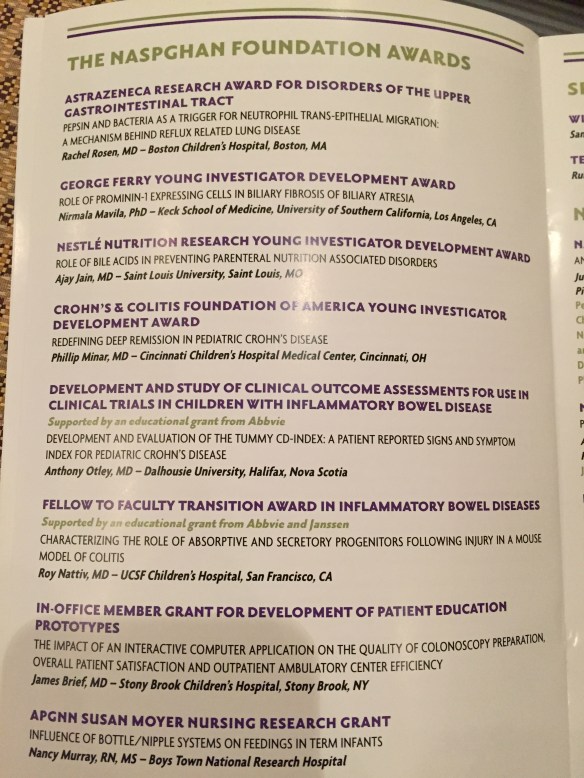
NASPGHAN Foundation Awards
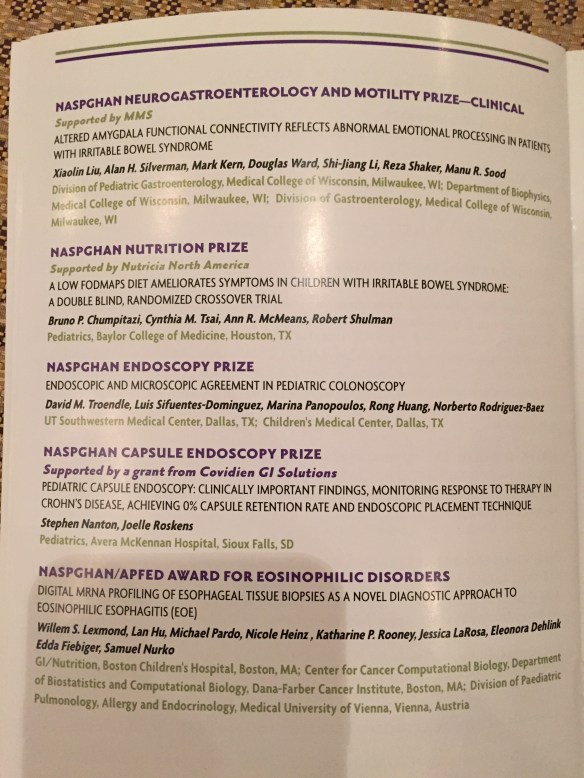
NASPGHAN Foundation Awards

Sponsored Awards

Sponsored Awards