Hepatitis C -Can We Really Accomplish Widespread Screening?

A pessimist sees the difficulty in every opportunity; an optimist sees the opportunity in every difficulty.  -Winston Churchill

The aforementioned quote leads a recent editorial (Lutchman G, Kim WR, Hepatology 2015; 1455-8) which discusses the challenges of widespread Hepatitis C virus (HCV) screening and avoiding late diagnosis/missed opportunity for timely treatment.  The associated article (Moorman AC et al. Hepatology 2015; 1479-84) reviewed a large cohort of 14,717 patients with HCV and noted that 17% (n=1056) had a ‘late diagnosis’ which resulted in high rates of hospitalization and mortality.  Late diagnosis was defined as having cirrhosis at time of diagnosis or hepatic decompensation within 12 months of initial diagnosis.

The editorialists note that the related article presents data from 2006-11 which models ‘real-life’ practice settings.  Late diagnosis was more common in African-Americans and in patients with Medicare insurance.

With regard to widespread screening, pessimists argue that “we do not have coherent strategies and resources” to implement.

  • there are too few health care providers who are qualified and interested
  • the ‘treat-all” strategy is too expensive.  “For example, in the first 3 months after the release of sofosbuvir, a large commercial health insurance carrier announced that it had spent over $100 million on hepatitis C prescriptions…cause[d] a substantial drop in its stock price”
  • “while prioritizing treatment to patients who are at risk of future problems seems the optimal solution to deliver the most benefits at the lowest costs, the problems lies in the identification of those patients.”

Optimists see the opportunity for early intervention and improved outcomes.

Bottomline: While more effective treatment is available, there are still many questions, especially who should receive treatment and how to identify those most in need.  If/when costs of therapy are reduced, some of the difficult questions will resolve.

Related blog posts:

Briefly noted:

  • “Adding Pegylated Interferon to Entecavir for Hepatitis e Antigen-Positive Chronic Hepatitis B: A Multicenter Randomized Trial (ARES Study)” Brouwer WP et al. Hepatology 2015; 1512-22). “Peg-IFN add-on therapy may facilitate the discontinuation of nucleus(t)ice analogs.”
  • “The Impact of Phlebotomy in Nonalcoholic Fatty Liver Disease: A prospective, randomized, controlled trial.” Adams LA et al. Hepatology 2015; 1555-64).  “Reduction in ferritin by phlebotomy does not improve liver enzymes, hepatic fat, or IR in subjects with NAFLD”
  • “Nonalcoholic Steatohepatitis is the Second Leading Etiology of Liver Disease Among Adults Awaiting Liver Transplantation in the United States.” Wong RJ et al. Gastroenterol 2015; 148: 547-55.
Chattahoochee River

Chattahoochee River

Increasing Inflammatory Bowel Disease Among U.S. Patients From India

An interesting epidemiology study (Malhotra R, et al. Clin Gastroenterol Hepatol 2015; 13: 683-89) shows a high prevalence of inflammatory bowel disease among U.S. residents with Indian Ancestry.

Using a national pathology database on 1,027,977 subjects who had ileocolonic biopsies from 2008-2013, the authors identified 30,812 patients who were diagnosed with inflammatory bowel disease (IBD): 20,308 with ulcerative colitis (UC), 7706 with Crohn’s disease (CD), and 2798 with indeterminate colitis (IC).

Key findings:

  • Among patients with Indian ancestry, the overall prevalence of IBD was 9.1% (n=197 compared with 1960 controls) compared with 4.3% for those of Jewish ethnicity, 2.4% for hispanic ethnicity, and 1.4% for East Asian ethnicity.  The adjusted odds ratio for patients with Indian ancestry was 2.5.
  • In addition, UC was predominant, accounting for 153 of the 197 cases; 26 were diagnosed with CD and 18 were IC.  IBD and UC were highest in subjects with roots in Gujarat.

Take-home point (from authors): “Considering the reported relatively low prevalence of IBD in India, these findings suggest that genetic factors may interact with new environmental conditions to trigger the expression of disease.”

Related blog post: Emigration -One Way to Acquire IBD

Briefly Noted:

Rungoe C, et al. “Inflammatory Bowel Disease and Cervical Neoplasia: A Population-Based Nationwide Cohort Study” Clin Gastroenterol Hepatol 2015; 13: 693-700. Using a Dutch national cohort with more than 27,000 patients, the authors showed a “2-way association between IBD, notably CD, and neoplastic lesions of the uterine cervix.” Overall the risk was mildly increased; for CD, the incidence rate ratio of cervical cancer was 1.53 (CI 1.04-2.27).

Reinisch W, et al. “Factors Associated with Poor Outcomes in Adults with Newly Diagnosed Ulcerative Colitis” Clin Gastroenterol Hepatol 2015; 13: 635-42. The tables in this article summarize clinical characteristics, biologic markers, and treatment factors associated with poor outcomes.  For clinical factors, younger age at diagnosis and age >65 years increase the risk for more severe disease. For biomarkers, increased CRP, ESR, and cal protection were associated with higher risk of progressing to colectomy. For treatment factors, not surprisingly, failing to respond to therapy and absence of mucosal healing were associated with higher risk of progressing to colectomy.

Chattahoochee River National Recreation Area

Chattahoochee River National Recreation Area

Toronto Consensus: Practice Guidelines for Nonhospitalized Ulcerative Colitis

A group of 23 experts followed a rigorous process over a 1-year period to assess the quality of evidence and develop consensus statements regarding the medical management of ulcerative colitis (UC) in adults (Bressler B, Marshall JK et al. Gastroenterol 2015; 148: 1035-58, editorial 877-80).

The need for updated guidelines has emerged due to practice variation related in part to a wider availability of treatments and diagnostic tools. It is recognized that early institution of effective therapy is associated with the best outcomes.  In addition, due to the chronic nature of ulcerative colitis and the potential for reduced durability of biologic agents, careful decision-making can improve response.

Table 4 in the article summarizes the recommendations.  I will list a few:

1. Thiopurines:

  • “In patients with UC, we recommend against the use of thiopurine monotherapy to induce complete remission.”
  • In selected patients, “we suggest thiopurine monotherapy as an option to maintain complete corticosteroid-free remission.”

2. Anti-TNF therapy:

  • “In patients with UC who fail to respond to thiopurines or corticosteroids, we recommend anti-TNF therapy to induce complete corticosteroid-free remission.”
  • “When starting anti-TNF therapy, we recommend it be combined with a thiopurine or methotrexate rather than used as monotherapy to induce complete remission.”
  • For UC patients with suboptimal response or for those who lose response to anti-TNF therapy, “we recommend dose intensification.”  Dose optimization should be informed by therapeutic drug monitoring.

3. Vedolizumab

  • Vedolizumab is recommended with primary anti-TNF failure (rather than switching to an alternative anti-TNF), whereas either a 2nd anti-TNF or vedolizumab is recommended with secondary anti-TNF failure based on therapeutic drug monitoring.

4. Fecal microbial transplant (FMT)

  • “We recommend against FMT…outside the setting of a clinical trial.”

5. 5-ASA and Corticosteroids

  • Rectal 5-ASA is recommended at 1 g daily for mild-to-moderate ulcerative proctitis.  5-ASA enemas are recommended for mild-to-moderate left-sided ulcerative colitis.
  • In patients with moderate-to-severe UC, corticosteroids are recommended as 1st line therapy for induction of remission but not for maintaining remission.  In addition, corticosteroids are recommended as 2nd-line agents for inducing remission in those with mild-to-moderate disease who do not respond to 5-ASA products.

With all of the treatments, the authors recommend followup to assure response to therapy; this followup ranges from within 2 weeks for steroids, to 4-8 weeks with 5-ASA products, to 8-14 weeks for biologic agents.

Overall, the emphasis of this consensus statement is on maximizing the response to biologic agents.  By optimizing dosing and using combination therapy, the treatment guidelines aim to lower rates of antidrug antibody formation.  This in turn should improve results and is in agreement with data from both the SONIC study and the UC-SUCCESS study.

The editorial comments that methotrexate “may be an attractive option for young male patients;” however, “the absence of data on risk of malignancy with methotrexate in IBD may reflect lower frequency of use for this indication.”

While these guidelines will be useful, there are many unanswered questions (discussed in editorial).

  • In patients on combination therapy, what is the optimal dose of the immunomodulator?
  • When or Should the immunomodulator be withdrawn?
  • For secondary failure, should a 2nd anti-TNF be used prior to vedolizumab?
  • How should these guidelines be tailored for the pediatric population (or the elderly)?
  • What is the optimal monitoring for UC patients with regard to biomarkers and endoscopy?
  • What is the appropriate role of therapeutic drug monitoring?

Bottomline: These guidelines are likely to promote the use of more combination therapy and help define the current role of vedolizumab.

Related blog posts:

Disclaimer: These blog posts are for educational purposes only. Specific dosing of medications/diets (along with potential adverse effects) should be confirmed by prescribing physician/nutritionist.  This content is not a substitute for medical advice, diagnosis or treatment provided by a qualified healthcare provider. Always seek the advice of your physician or other qualified health provider with any questions you may have regarding a condition.

How to Incorporate Budesonide Foam into UC Treatment Algorithm

A recent study (Sandborn WJ, et al. Gastroenterol 2015; 148: 740-50, editorial 701-4) shows that budesonide foam can be helpful for patients with ulcerative proctitis and ulcerative proctosigmoiditis.

Design: Two identical randomized, double-blind, placebo-controlled trials examined the use of budesonide foam in 546 patients with mild to moderate ulcerative proctitis or ulcerative proctosigmoiditis.  Patients had at least 5 cm of involved mucosa but no more than 40 cm. Dosing: 2 mg/25 mL twice daily for 2 weeks, then once daily for 4 weeks. The primary endpoint of remission was defined as an endoscopy subscore of ≤1, rectal bleeding subscore of 0, and improvement or no change from baseline in stool frequency subscore of the Mayo score. It is noted that about 90% of patients had moderate Mayo endoscopy subscore at baseline.

Key findings:

  • Combining the results of the studies, 41.2% achieved the primary end point of remission at the end of 6 weeks, compared with 24.0% of placebo patients.
  • There were 10 patients (3.7%) with low morning cortisol (compared with 0.7% of placebo-treated patients) and 14% who had abnormal ACTH testing at 6 weeks (compared with 4% of placebo-treated patients), though there no reported signs/symptoms of adrenal suppression present.

The associated editorial suggests that budesonide could be implemented in patients who did not respond to 5-ASA topical therapy (suppository for proctitis and enema for proctosigmoiditis).  In addition, the editorial questions whether a single night-time administration may be more effective by maximizing adherence.

Bottomline: Budesonide foam was superior to placebo in this study and may eliminate the need for systemic steroid use.  As the editorial suggests, 5-ASA topical therapy likely should be considered as first-line treatment.

Related blog post: Budesonide for Ulcerative Colitis

Early Look At Entyvio (Vedolizumab) in Pediatrics

From DDW 2015 and HealioGastro: Entyvio shows promise in pediatric patients

First study, abstract 321:

Namita Singh, MD, of Cedars Sinai Medical Center in New York, … presented results of a prospective observational study in which they initiated Entyvio (vedolizumab, Takeda; 6 mg/kg, maximum 300 mg) — off label — via intravenous infusion in pediatric patients…The primary clinical outcomes was clinical remission at week 6 (PUCAI ≤ 10; PCDAI ≤ 10).

The study looked at 23 patients (15 with Crohn’s; eight with ulcerative colitis) enrolled between June 2014 and October 2014; median age of vedolizumab initiation was 14 years.

At 88%, the patients with ulcerative colitis had a higher rate of remission than those with Crohn’s who were at 40% [at week 6]. This trend sustained at week 14 and Singh said all patients with ulcerative colitis were in remission at week 14.

Week 6 and week 14 remission rates overall were 46.6% and 54.5%, respectively, and week 6 remission predicted week 14 remission (P < .05).

“Week 6 remission is associated with week 14 remission,” Singh said. “This suggests that we can determine early in therapy whether a patient will be a primary responder to therapy. If not, then perhaps we should move on to another therapy.”

“Longer duration from last anti-TNF exposure is associated with higher remission rates,” Singh said.

Second study, abstract 322:

Ronen Stein, MD, from the Perelman School of Medicine at the University of Pennsylvania, also presented data on vedolizumab therapy in patients with severe pediatric IBD…In this single center, prospective observational cohort study, the primary endpoint was a decrease in PCDAI/PUCAI from baseline to weeks 6, 14 and 22 and secondary endpoints were changes in albumin, hematocrit and CRP as well as remission at the same time points.

Patients received vedolizumab infusions (300 mg) at weeks 0, 2 and 6 for induction and maintenance through week 22.

The researchers included children aged 13 years to 21 years (n = 17) with IBD who weighed 40 kg or more and had a past failure on TNF-alpha inhibitor therapy. Of these patients, 15 had Crohn’s disease and two had unclassified IBD (IBD-U).

More than three-quarters started on systemic corticosteroids at baseline; more than one quarter were on immunomodulators. Seven patients had previous abdominal surgery and 59% of patients had failed more than one biologic therapy…

At each time point in question, this study saw improvement of PCDAI (P < .001 at week 6; P < .05 at week 14; P < .0001 at week 22).

“Starting at week 6, there was a significant decrease in PCDAI that was sustained for weeks 14 and 22.”

Five patients reached remission at week 6.

“There really is no pattern to tell us which patients will be in remission at week 6. They have pretty different characteristics,” Stein said.

Briefly noted:

Link: Case description/images of 9 year old with gastric Crohn’s

Related blog posts:

I love Ria’s Bluebird –the best pancakes ever!

I Love the place: the best pancakes ever!

Do You Know How Long to Use Antibiotics for Intraabdominal Infections?

Since 2010, there have been published guidelines for complicated intraabdominal infections which recommend a treatment course of 4 to 7 days. These include guidelines from the Surgical Infection Society (SIS) and the Infectious Diseases Society of America (IDSA). Now, a new study (Sawyer RG et al. NEJM 2015; 372: 1996-2005, editorial 2062-63) provides additional support for a short course of antibiotics when there is adequate source control. The study termed “Study to Optimize Peritoneal Infection Therapy” or STOP-IT included 23 institutions from the U.S. and Canada.

Video Summary (1:33): Trial of Short-Course Antimicrobials

Rationale: While traditional therapy of 10-14 days has been based on the premise that ongoing fever and leukocytosis indicate ongoing infection, “more recent experimental data, however, suggest that a prolonged SIRS [systemic inflammatory response syndrome] may be more a reflection of host immune activity than an indication of the presence of viable microorganisms.”

Design: 518 patients were randomly assigned to either a fixed 4-day course of antibiotics or to a control group that received antibiotics for 2 days after resolution of fever, leukocytosis, and ileus (max of 10 days).  The median number of days in the control group was 8 days.

Study characteristics:

  • Mean age 52 years
  • 34% of the infections originated in colon/rectum, 14% in small bowel, and 14% in the appendix
  • 11% had cancer, 10% had inflammatory bowel disease

Source-control procedures: “defined as procedures that eliminate infectious foci, control factors that promote ongoing infection, and correct or control anatomical derangements to restore normal physiological function”

  • Percutaneous drainage 33.1%
  • Resection and anastomosis or closure 26.5%
  • Surgical drainage alone 21.2%
  • Resection and proximal diversion 10.4%
  • Simple closure 7.7%
  • Surgical drainage and diversion 1.2%

Results:

  • Surgical site infection, recurrent intraabdominal infection, or death occurred in 21.8% of the experimental 4-day group compared with 22.3% of the control group. Death occurred in 3 experimental patients and 2 control patients.
  • No significant differences were found between the two groups in terms of primary or secondary outcomes.

Limitations:

  • 18% of the experimental group and 27% of the control group deviated from the protocol.  In the control group, this included 26 patients who received less than 10 days of therapy but more than 2 days longer than the resolution of the physiological findings.
  • Patients without adequate source control were excluded

The editorial notes that if these findings are incorporated into clinical practice, more than $97 million would be saved on antibiotic costs alone; in addition, there would be less diarrhea and phlebitis.  The editorial suggests that the reason why more than 20% of both groups had complications is likely related to source control.  If inadequate course of antibiotics was the culprit, “we would have expected still more complications after treatment in the short-course therapy group.”

(From editorial): “We have encouraging data from the STOP-IT trial that suggest cost savings and improved safety.”

Take-home message Because of years of practice patterns, it is going to be difficult to stop antibiotics at 4 days when patients are still having fevers, especially since 20% will not have resolution of their infection. These data should, however, make it easier to shorten antibiotic courses.

Related blog posts:

Zoo Atlanta

Zoo Atlanta

IBD Shorts -Skin, Adalimumab Kinetics

From the IMAgINE study with 192 pediatric patients (Sharma S et al. Inflamm Bowel Dis 2015; 21: 783-92), the authors determined levels for adalimumab, that at week 52, were associated with remission and response.  A cutoff level of 3.6 mcg/mL had a sensitivity of 32.7%  and specificity of 88.6% for predicting remission; the same cutoff had a sensitivity of 46.2% and specificity of 83% for predicting a response.  Overall, the authors noted dose proportionality with patients who received higher (or more frequent) doses with higher serum levels.

Related posts:

“Concomitant Use of Azathioprine/6-Mercaptopurine Decreases the Risk of Anti-TNF-Induced Skin Lesions” (Soh JS et al. Inflamm Bowel Dis 2015; 21: 832-9). Among a cohort of 500 Korean patients, the incidence of psoriaform and eczematiform lesions was 6.2%.  Concomitant use of a thiopurine was associated with a hazard ratio of 0.452 (lower risk) for developing these adverse skin reactions.

Related posts:

Helicobacter Pylori: Relationship to Cancer and Dubious Beneficial Claims

I found a recent review (Gastroenterol 2015; 148: 719-31) regarding Helicobacter pylori (HP) of interest.  David Graham explores the issue of HP eradication with regard to cancer and whether there are benefits to the infection that result in detrimental effects with HP eradication.

The potential mechanisms in which HP infection can increase the risk of gastric cancer are depicted in Figure 2; the most important:

  • Inflammation induced by infection
  • Genetic/epigenetic changes –> genetic instability in gastric epithelial cells

Lessons regarding eradication therapy:

  • Sequential therapy has been shown in some studies to be effective/superior (in Italy) yet inferior in others (eg. Korea).  “The results are explained entirely by differences in patterns of drug resistance, which typically were not assessed before studies were initiated.”
  • Findings from many studies cannot be applied to other populations without resistance data.

Does HP infection reduce the risk of obesity or childhood asthma?  Probably not.

  • “Any claim that a major human pathogen also might provide a meaningful health benefit, and that plans to eradicate it should be reconsidered, is guaranteed to elicit interest from the press.”
  • As a counter example, Dr. Graham notes “because 2 events are associated does not mean that one causes the other. For example, one study reported a correlation between the number of storks in Brandenburg, Germany, and the birth rate in Berlin.” [Backen MB. Harm. In: Bracken MB. Risk, chance, and causation. New Haven: Yale University Press, 2013; 108-09.]
  • He notes that HP can both promote or inhibit acid secretion/acid reflux.  Increased acid secretion with resultant esophageal disease could increase the risk of adenocarcinoma of the esophagus; however, “the risk of developing adenocarcinoma of the stomach remains higher than the risk of adenocarcinoma of the esophagus.”  This indicates that if there is an increased esophageal cancer risk, eradication would still be favorable by lowering gastric cancer risk.
  • Asthma: “overall, the studies do not support the hypotheses that increases in childhood asthma were related to the absence of H pylori.”
  • Obesity: “A meaningful causative association between H pylori and obesity is unlikely.”
Screen Shot

Screen Shot

Take-home message: H pylori is a pathogen and should be treated as such.

Related blog posts:

University of Chicago

University of Chicago

Prospective Monitoring of Calprotectin for Crohn’s Disease

A recent study (full text link: Wright EK, et al. Gastroenterol May 2015 Volume 148, Issue 5, Pages 938–947) shows that stool calprotectin levels can be useful to monitor Crohn’s disease (Links from AGA twitter feed).  This study measured levels as part of The Post-Operative Crohn’s Endoscopic Recurrence (POCER) study.

Here’s the abstract, followed by some comments:

Background & Aims

Crohn’s disease (CD) usually recurs after intestinal resection; postoperative endoscopic monitoring and tailored treatment can reduce the chance of recurrence. We investigated whether monitoring levels of fecal calprotectin (FC) can substitute for endoscopic analysis of the mucosa.

Methods

We analyzed data collected from 135 participants in a prospective, randomized, controlled trial, performed at 17 hospitals in Australia and 1 hospital in New Zealand, that assessed the ability of endoscopic evaluations and step-up treatment to prevent CD recurrence after surgery. Levels of FC, serum levels of C-reactive protein (CRP), and Crohn’s disease activity index (CDAI) scores were measured before surgery and then at 6, 12, and 18 months after resection of all macroscopic Crohn’s disease. Ileocolonoscopies were performed at 6 months after surgery in 90 patients and at 18 months after surgery in all patients.

Results

Levels of FC were measured in 319 samples from 135 patients. The median FC level decreased from 1347 μg/g before surgery to 166 μg/g at 6 months after surgery, but was higher in patients with disease recurrence (based on endoscopic analysis; Rutgeerts score, ≥i2) than in patients in remission (275 vs 72 μg/g, respectively; P < .001). Combined 6- and 18-month levels of FC correlated with the presence (r = 0.42; P < .001) and severity (r = 0.44; P < .001) of CD recurrence, but the CRP level and CDAI score did not. Levels of FC greater than 100 μg/g indicated endoscopic recurrence with 89% sensitivity and 58% specificity, and a negative predictive value (NPV) of 91%; this means that colonoscopy could have been avoided in 47% of patients. Six months after surgery, FC levels less than 51 μg/g in patients in endoscopic remission predicted maintenance of remission (NPV, 79%). In patients with endoscopic recurrence at 6 months who stepped-up treatment, FC levels decreased from 324 μg/g at 6 months to 180 μg/g at 12 months and 109 μg/g at 18 months.

Conclusions

In this analysis of data from a prospective clinical trial, FC measurement has sufficient sensitivity and NPV values to monitor for CD recurrence after intestinal resection. Its predictive value might be used to identify patients most likely to relapse. After treatment for recurrence, the FC level can be used to monitor response to treatment. It predicts which patients will have disease recurrence with greater accuracy than CRP level or CDAI score.

Some key points from the discussion:

  • The POCER study recently showed that postoperative endoscopic monitoring, together with treatment intensification for early recurrence, is superior to standard drug therapy alone in preventing disease recurrence, at least in the short term. However, such endoscopic monitoring is invasive, expensive, cannot be repeated frequently, and, in some patients, will yield a normal result.” [De Cruz, P., Kamm, M.A., Hamilton, A.L. et al. Crohn’s disease management after intestinal resection: a randomised trial. Lancet2014; (Epub ahead of print)]
  • The POCER study had all postoperative patients receive 3 months of metronidazole.  High-risk patients also received thiopurine or adalimumab (if thiopurine intolerant) therapy.  High-risk was defined as patients who were smokers, patients with perforating disease, or patients with 1 or more previous resections.
  • “In our study we have shown that FC concentration is increased markedly before surgery and decreases substantially after resection of all macroscopic disease at 6 months”
  • The present study has shown that FC concentration is sufficiently sensitive to monitor for recurrence of Crohn’s disease, and has a high enough negative predictive value to be confident that few patients with recurrence will be missed.” The authors, though, recommend serial measurement rather than relying on a single assay.
  • Calprotectin: “At each time point in our study, a cut-off value of 100 μg/g had an NPV of 90% or greater, with the best combination of sensitivity and specificity.”
  • An important limitation of these findings is that patients had to have all macroscopic disease removed at the time of surgery.  Thus, these findings are not generalizable to patients with residual upper gastrointestinal disease.
  • “These results confirm the accuracy, utility and superiority of fecal calprotectin compared with CRP or CDAI as a monitoring tool and screening test for endoscopic recurrence of Crohn’s disease in the postoperative population.”

Additional summary of this information on AGA Journals blog:  Measurement of Fecal Calprotectin.  An excerpt:

In an editorial that accompanies the article, Alain M. Schoepfer and James D. Lewis explain that the role of fecal calprotectin in assessing post-operative recurrence has been debated because of inconsistent results in mainly small studies. The strengths of the study of Wright et al include its large size, prospective design, endoscopic validation, and longitudinal inter-individual measurements of fecal calprotectin.

Tests for biomarkers such as fecal calprotectin can be repeated more frequently than colonoscopies. This advantage could overcome the lower levels of sensitivity with which single measurements of biomarkers detect recurrence. Schoepfer and Lewis say that studies are needed to determine the optimal frequency for measuring fecal calprotectin.

However, they conclude that measurement of fecal calprotectin could have an important role in monitoring Crohn’s disease recurrence after intestinal resection; it is clearly superior to measurement of c-reactive protein or CDAI score.

Proposed algorithm for using calprotectin: In the editorial, they propose that patients with low or medium risk of “permanent bowel dysfunction as a consequence of post-operative recurrence” could use fecal calprotectin measurements every 3-6 months.  They propose a cut-off of 50 mcg/g in those with medium risk and a cut-off of 100 mcg/g in those with low risk.  Those who exceeded cut-off would need colonoscopy.  Among high risk patients, they recommend proceeding directly to colonoscopy every 6-12 months to assess for recurrence.  All patients who had recurrence of disease greater than i1 would need treatment for recurrence. (Related gutsandgrowth blog: Only One Chance to Make a First Impression).

This year’s 22Q at the zoo was on May 17th, 2015:

22Q at the Zoo.  More than 100 zoos across the world participate to improve awareness of 22Q deletion syndrome

22Q at the Zoo. More than 100 zoos across the world participate to improve awareness of 22Q deletion syndrome.  With Karlene Coleman, Nancy Morris, and Jennifer Hochman.

Why ImproveCareNow is Needed

A few recent articles make a strong argument for collaborative networks, like ImproveCareNow, to improve data collection to determine the most effective therapies.

  1. Kierkus J, et al. JPGN 2015; 60: 580-85.
  2. Audu GK, et al. JPGN 2015; 60: 586-91
  3. Dotson JL, et al. Inflamm Bowel Dis 2015; 21: 1109-14
  4. Saps M, et al. JPGN 2015; 60: 645-53.

A brief description of each study.

1. This study presented a multi-center randomized open-label trial of 99 pediatric patients with Crohn’s disease (CD) who were administered infliximab (IFX) along with an immunomodulator (azathioprine or methotrexate).  After a 10 week induction, 84 were randomized to either monotherapy for 54 weeks or dual therapy for 26 weeks. The authors did not find significant differences in response between the groups.  However, they reached a conclusion: “Twenty-six weeks likely represent (sic) the safe duration of combined IFX/immunomodulator therapy in our sample of pediatric patients with CD.”

2. The second study described three cases of chronic recurrent multifocal ostesomyelitis (CRMO) associated with inflammatory bowel disease.  They tried to identify all pediatric cases in UK in the last 10 years. (As an aside, I have treated one teenager with CRMO and ulcerative colitis.)

3. The third study is a retrospective single center of 30 patients with pediatric Crohn’s disease (CD) who developed intra-abdominal abscesses (IAA) over a 12-year period.  The authors note that this is “the largest single-center review of children and adolescents with CD and IAA to date.” Yet due to the small sample size, the study provides little guidance on this important medical problem; there were no predictors of successful medical or percutaneous drainage therapy.  In addition, with the increasing use of biologics, the authors note that “the issue of which patients will eventually require surgery is even less clear.” Changes in imaging (eg. MRE) and changes in medical management (eg. more enteral nutrition and less corticosteroids) are not discussed.

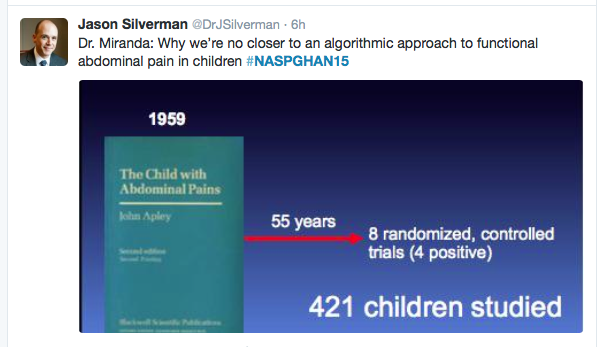
4. The fourth study is a comprehensive review of randomized placebo-controlled pharmacological clinical trials in children with functional abdominal pain disorders.  They found “no evidence to support the use of most commonly used drugs in children. Only 7 pharmacological RCTs on AP-FGIDs in children were found. Most studies were single center based and had a small sample size.  The methods and outcomes were heterogeneous…We found a considerable risk of bias in most studies…There is an urgent need for well-designed randomized clinical trials using age-appropriate validated outcome measures.”

Each of these studies makes a compelling argument for collaborative research networks.  The first study had a relatively small number of patients, short follow-up period, lack of blinding, and numerous methodological limitations.  How did the authors determine that 26 weeks was the time to stop dual therapy? Among adults with CD, a well-designed SONIC study (NEJM 2010; 362: 1383) showed the superiority of dual therapy during the study period.  In children, because of concerns about thiopurine safety, the best approach is still unclear. The second study identified only three patients despite examining a large population.  Similarly, the third study describes 30 patients with a common complication of CD but provides little insight.

The fourth study is a cautionary tale illustrating the lack of progress due to the absence of collaborative research.  Reports indicate a high prevalence of functional abdominal pain; one study indicated that abdominal pain affects “38% of school children weekly” (J Pediatr 2009; 154: 322-6).  In fact, studies on the high prevalence of this disorder dates back for 60 years (Apley, 1975; Apley & Hale, 1973; Apley & Naish, 1958). Despite the prevalence of this problem, the data for all of the treatments is poor.  The lack of progress in defining treatments for functional abdominal pain is multifactorial, including the following:

  • Cost: For many of the available treatments, there is not a financial incentive to conduct research.
  • Biomarker: lack of objective markers for improvement
  • Disease Stigma: many people attribute functional disorders as being due solely to psychological factors
  • Physician Champions: in pediatric gastroenterology, it took concerted physician efforts over many years to develop ImproveCareNow.  Similar physician champions would be needed to improve the outcomes for children with functional disorders

Bottomline: While ImproveCareNow has a lot of work ahead including improving data reliability and ascertaining accurate outcome measures, I think the effort is forward-thinking and will make a difference in understanding and treating children with IBD.  ImproveCareNow has more than 600 participating pediatric gastroenterologists and more than 20,000 patients. What I would like to see is a sister network to address the morbidity from functional disorders so that in 60 years (or sooner), we will be better equipped to treat children with abdominal pain that is not due to IBD.

Related blog posts:

Fox Theater

Fox Theater