Eosinophilic Esophagitis and Psychosocial Dysfunction

There are many medical challenges in treating patients with eosinophilic esophagitis (EoE) and this has been discussed extensively in this blog (some links below).  What is striking in managing these patients and families is how often there are significant psychosocial problems.  Does this disorder serve as an excuse for other issues? Does the altered diet create enormous stress and isolation? Is the diagnosis of EoE an epiphenomenon for many of these patients?

While these questions are not answered, a recent retrospective study from a tertiary care center does provide some data on the frequency of psychosocial dysfunction in children and adolescents with EoE (JPGN 2013; 57: 500-05).

Psychosocial evaluation was offered as part of these patients’ clinical evaluation; this took place in 64 of 152 patients during the study timeframe.  Subsequently, a retrospective review of these patients, who had been offered a 1-hour behavioral health assessment by either a psychologist or social worker, were analyzed.

Key findings:

  • 69% had some psychosocial impairment
  • 64% had social difficulties
  • 41% had anxiety
  • 33% had sleep difficulties
  • 28% had depression
  • 26% had school problems
  • 44% had adjustment problems; this was more common in older children and in children with gastrostomy tubes

The main limitations of this study are its retrospective nature and the fact that only a minority of patients were analyzed; the latter indicates a high likelihood of a selection bias. The severity of EoE was not correlated with these problems, but could have been higher  at a tertiary center.

Take-home message: As with other chronic diseases, EoE patients have frequent psychosocial health problems –this study starts to define the extent of the problem.

The Genius of Breastmilk

While there has been a lot of talk about how breastmilk improves IQ/development (see links below), there are many other reasons why breastmilk is amazing.  For example, breastmilk reduces the risk of necrotizing enterocolitis (NEC).  A recent study on this effect: J Pediatr 2013; 163: 1592-5.

In this multicenter randomized controlled trial involving 7 NICUs, the authors studied extremely premature infants whose mothers did not provide their breastmilk.  Infants were fed either a cows-milk based preterm formula (COW, n=24) or pasteurized donor human milk (HUM, n=29). Birth weight and gestational age were similar in both groups, approximately 990 g and 27.5 weeks respectively.

Results:

  • HUM patients had fewer days of parenteral nutrition: 27 vs. 36, P=.04
  • HUM patients had fewer bouts of NEC: 1 (3%) vs. 5 (21%), P=.08; surgical NEC occurred 4 times in COW group compared with 0 in HUM patients (P=.04)

Take-home message: The data from this study are in line with recent American Academy of Pediatrics policy statement that recommends the following: “premature infants should receive only human milk from their mother and that, if it is not available, pasteurized donor human milk should be used.”

Another relevant study: J Pediatr 2010; 156: 562-7.

Related blog posts:

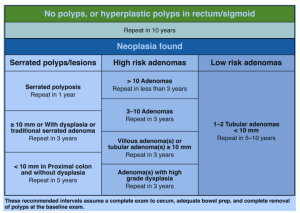
Polyps: Clinical Decision Tool

The best approach to polyps from the U.S. Multi-Society Task Force: Gastroenterology 2014; 146: 305-306.  This paper’s simple chart on page 306 could help reduce many follow-up colonoscopies that are performed at shorter than recommended intervals.

Polyp Guideline

Related blog post:  Consensus guidelines after polypectomy | gutsandgrowth)

Clostridium difficile: Colonization vs. Symptomatic Infection

A recent study provides another way to distinguish individuals colonized with Clostridium difficile from those with symptomatic infection (J Pediatr 2013; 163: 1697-704).

Methods: This study comprised two designs. “The first is a case-control study comparing children with a positive C difficile test (cases), children with diarrhea but no C difficile (symptomatic controls), and asymptomatic controls, some of whom were colonized with C difficile.  The second is a prospective-cohort study where we followed our cases for the duration of their illness.”

Results: Fecal cytokines (CXCL-5 and IL-8 mRNA) were elevated in samples from symptomatic children, whether cases or controls.

Bottomline: Inflammatory cytokines can help distinguish C difficile colonization from disease.  Of course, this may have limited utility in patients with underlying inflammatory bowel disease.

Recent posts regarding C difficile:

Teaching an Old Drug New Tricks

A couple recent articles focused on the new uses of methotrexate (MTX) and how to handle potential hepatotoxicity:

  1. J Pediatr 2014; 164: 231-36
  2. Inflamm Bowel Dis 2014; 20: 47-59

In the first medical review article, the authors note the efficacy of MTX for the following:

  • Juvenile idiopathic arthritis
  • Uveitis
  • Psoriasis
  • Crohn disease
  • Juvenile dermatomyositis
  • Localized scleroderma
  • Vasculitis

This review article discusses mechanism of action which is poorly understood along with pharmacogenomics and practical issues in usage.  The latter includes the need for supplemental folic acid.  Other points:

  • “The long-term safety of MTX is remarkable”
  • “The issue of nausea and vomiting…can be especially disturbing.”  They note that one study demonstrated that ondansetron 1 hour prior to MTX from the first injection prevented nausea, which was often difficult to treat once developed.
  • “Liver enzyme abnormalities occur frequently (up to 30% of patients) but are usually of minimal clinical significance.”  Best to draw blood tests 1-2 days before MTX dosing.
  • “In children, unlike adults, MTX-related pulmonary adverse events are very rare.”
  • “In recent years it was shown that live vaccine boosters are effective and safe during MTX use (caution may be needed if MTX is used with other immunosuppression medications)” Ref: JAMA 2013; 309: 2449–56.
  • “Use during pregnancy or within 3 months of planning pregnancy is contraindicated”

The second article was a systemic review which identified 12 high-quality studies which focused on MTX hepatotoxicity in children.  Key findings:

  • 57 of 457 developed some degree of abnormal liver biochemistries.
  • Due to hepatotoxicity, dose reductions were undertaken in 6.4% and 4.5% discontinued MTX.

The authors note that studies of MTX in adults with IBD have not demonstrated cumulative liver toxicity from MTX.  In addition, many of the patients with hepatotoxicity may have had  other reasons for abnormal liver biochemistries including other medications (eg. glucocorticoids).  “Confirmation of MTX hepatotoxicity with a liver biopsy is seldom performed in children;” as a consequence, the exact rate of MTX hepatotoxicity is unknown.

The authors propose that liver biochemistry monitoring occur at baseline, biweekly x 2, then every 2-3 months.  Also, the authors recommend:

  • If ALT < 2 times upper limit of normal (ULN), check liver biochemistries every 2 weeks
  • If persistent abnormalities, the authors recommend an ultrasound
  • If ALT ≥ 2 times ULN, repeat testing should be obtained and consider consultation with a hepatologist

Bottomline: Methotrexate is an important medication for Crohn disease –there are not very many available.  If there are persistent liver enzyme elevations, dose reduction of MTX (or cessation) may be necessary.  As a practical matter, it is advisable to obtain blood draws 1-2 days prior to MTX rather than afterwards. Nausea can be minimized with ondansetron and weekend dosing.

Related blog posts:

“Can you identify the six saltiest foods in American diets?”

From the American Heart Association Twitter Feed: http://bit.ly/SVnguk 

  1. Breads and rolls. We all know breads add carbohydrates and calories, but salt, too? It may not seem like it because a lot of bread doesn’t even taste salty, but one piece can have as much as 230 milligrams of sodium. That’s 15 percent of the recommended amount from only one slice, and it adds up quickly. Have a sandwich and muffin in one day? The bread alone could put you at about 1,000 milligrams of salt – or two-thirds of the American Heart Association’s recommended daily sodium limit of 1,500 milligrams.  Be sure to check the nutrition label as different brands of the same foods may have differing sodium levels.
     
  2. Cold cuts and cured meats. Even foods that would otherwise be considered healthy may have high levels of sodium. Deli or pre-packaged turkey can contain as much as 1,050 milligrams of sodium.  They have so much because most cooked meats would spoil in only a few days without the added sodium solution. Look for lower sodium varieties.
     
  3. Pizza. OK, everybody knows pizza’s not exactly a health food. But you’re probably thinking the big concerns are cholesterol,fat and calories. But pizza’s plenty salty, too. One slice can contain up to 760 milligrams of sodium. It doesn’t take a whole lot of math to realize two or three slices alone can send you way over the daily sodium recommendation. You may want to have fewer slices of pizza topped with vegetables and less cheese.
     
  4. Poultry. Surely chicken can’t be bad for you, right? Well, it depends on how the chicken is prepared. Reasonable portions of lean, skinless grilled chicken are great. But when you start serving up the chicken nuggets or poultry injected with added sodium solutions/marinades, the sodium starts adding up. Just 3 ounces of frozen and breaded nuggets can add nearly 600 milligrams of sodium. (And most kids probably aren’t stopping at 3 ounces.)  Check labels to be sure you are selecting the lower sodium version and that there are no added sodium solutions.
     
  5. Soup. This is another one of those foods that seems perfectly healthy. It can’t be bad if Mom gave it to you for the sniffles, right? But when you take a look at the nutrition label for some products, though, it’s easy to see how too much soup can quickly turn into a sodium overload. One cup of canned chicken noodle soup can have up to 940 milligrams of sodium.  Look for lower sodium options that taste just as great!
     
  6. Sandwiches. This covers everything from grilled cheese to hamburgers. We already know that breads and cured meats are heavy on the sodium. Add them together, and you can pretty easily surpass 1,500 milligrams of sodium in one sitting.   Top sandwiches with plenty of vegetables, such as lettuce, tomato and cucumbers.

Nice graphic: The-Salty-Six-Infographic_UCM_446591_SubHomePage.jsp

Related blog link:

Will salt intake make you fat? | gutsandgrowth

Superiority of Anti-TNF Therapy in Children

This study’s conclusion comes as no surprise:

“In children newly diagnosed with comparably severe CD, early monotherapy with anti-TNFα produced better overall clinical and growth outcomes at 1 year than early monotherapy with an immunomodulator. Further data will be required to best identify children most likely to benefit from early treatment with anti-TNFα therapy.”

Here’s the reference:

Gastroenterology Volume 146, Issue 2 , Pages 383-391, February 2014

Here’s a link to the full text article:  Increased Effectiveness of Early Therapy with Anti-Tumor Necrosis Factor-α Versus an Immunomodulator in Children with Crohn’s Disease

Methods: “From 2008 through 2012 at 28 pediatric gastroenterology centers in North America. Patients were managed by physician dictate. From 552 children (median age, 11.8 y; 61% male; 63% with pediatric CD activity index scores >30; and median C-reactive protein level 5.6-fold the upper limit of normal), we used propensity score methodology to identify 68 triads of patients matched for baseline characteristics who were treated with early anti-TNFα therapy, early immunomodulator, or no early immunotherapy.”

Another reference/link from same issue:

Accuracy of Magnetic Resonance Enterography in Assessing Response to Therapy and Mucosal Healing in Patients with Crohn’s Disease

Does Sun Exposure Lower the Risk of Crohn Disease?

An intriguing recent study suggests that individuals who spend more time outside are less likely to develop Crohn disease (CD) (Inflamm Bowel Dis 2014; 20: 75-81).

In this prospective cohort study from France, 123 cases of inflammatory bowel disease (45 CD, 71 ulcerative colitis, and 7 indeterminant colitis)  developed among the 91,870 women in the study.  The study period had a mean followup of 13.1 years and followed women between 40 and 65 years. The authors estimated residential sun exposure by utilizing a database (derived from satellite collection) containing the mean daily ultraviolet radiation dose for each French county.

Key findings:

  • Higher levels of sun exposure were associated with a decreased risk of Crohn disease with a Hazard Ratio (HR) of 0.49.
  • Sun exposure did not affect the likelihood of developing UC (HR 1.21).
  • In women with information about dietary vitamin D intake, higher sun exposure had a HR of 0.29 for developing CD.  That being said, the authors note a low dietary vitamin D intake in their population.

Despite the large cohort, this study has a number of limitations. The absolute number of IBD patients can lead to a Type 1 error (false-positive conclusion).  In addition, the age of the study population and the lack of data regarding individual sun exposure limit the conclusions as well.  Besides these factors, there may be confounders such as changes in diet and soil exposure which are not accounted for.

At the same time, there have been other studies which have shown a latitude effect.  As with this study, those living in sunny areas had a lower incidence of CD.

Bottomline: This study suggests that additional sun exposure is associated with a lower risk of developing Crohn disease.  Whether this lower risk is directly through better vitamin D levels or simply an epiphenomenon is unclear.

Other recent unrelated studies:

Gut 2013; 62: 1122-30.  A randomized phase 1 study of etrolizumab (rhuMAb β-7) in moderate to severe ulcerative colitis.  Etrolizumab is an adhesion cell molecular blocker.

Inflamm Bowel Dis 2014; 20: 21-35.  Meta-analysis of 23 randomized controlled trials of probiotics for UC, Pouchitis, and CD.  Probiotics, in particular VSL#3, increased UC remission rates and helped maintain remission in patients with pouchitis.

Inflamm Bowel Dis 2014; 20: 213-27. Review article of cutaneous manifestations of inflammatory bowel disease.  Good pictures of multiple problems including metastatic Crohn disease, erythema nodosum, pyoderma gangrenosum, Sweet’s syndrome, aseptic abscess syndrome, and epidermolysis bullosa acquisita.

Inflamm Bowel Dis 2013; 19: 1753-63.  Review on hair loss associated with inflammatory bowel disease. Remember telogen effluvium?

Related posts:

For those who read from the top to the very bottom, here’s a tangential question: Do you know what a “sun dog” is?   Sun dog – Wikipedia, the free encyclopedia

MD Job Dissatisfaction –Million $ Mistake?

A recent report indicates a high level of job dissatisfaction among physicians, leading some to conclude that it could be a million dollar mistake: http://www.cbsnews.com/news/1-million-mistake-becoming-a-doctor … (from Eric Benchimol’s twitter feed)

Here’s an excerpt:

If you are brilliant, ambitious and gifted in science, you may consider becoming a doctor. If so, think twice. According to a new survey by personal finance site NerdWallet, most doctors are dissatisfied with the job, and less than half would choose a career in medicine if they were able to do it all over again….

Worse, the cost of becoming a doctor has soared, with higher education expenses leaving the average newly minted physician with $166,750 in medical school debt, while average salaries are declining. Nearly one-third of doctors — 28 percent – saw a cut in pay last year, according to NerdWallet’s research….

To be sure, pay is still high, with of six-figure positions in the country, according to government data. But it also takes between 11 and 14 years of higher education to become a physician. That means the typical doctor doesn’t earn a full-time salary until 10 years after the typical college graduate starts making money. 

That lost decade of work costs a cool half-million dollars, if you assume this individual could have earned just $50,000 annually, and the typical medical school candidate is smart and successful enough to earn considerably more.  Add in the time and cost it takes to pay off medical school debt and a dissatisfied physician may well consider pursuing medicine a $1 million mistake.

Take-home message: Financial considerations are probably the wrong reasons to to pursue a career in medicine.

Related blog posts:

In PURSUIT of Better Treatment for Ulcerative Colitis

Patient education materials:

#1  Ulcerative Colitis For Dummies | UC Patient Resource This link connects to a free educational book promoted by Salix pharmaceuticals.  In order to receive a free download, you have to register and include your email.  I have not read this book but other similar books (eg. Colonoscopy for Dummies) by Salix have been well-written.

#2 This link, ow.ly/sPX95, is to the ImproveCareNow visit planner website.  It poses of ~ 8 questions and a text box  for “my list of things I’m concerned about and questions that I have.”  Families that use this planner may help themselves achieve more comprehensive care.

Anyone who follows this blog knows that I really enjoy a good study acronym.  The Program of Ulcerative Colitis Research Studies Utilizing an Investigational Treatment (PURSUIT) is responsible for two papers in the most recent Gastroenterology issue:

  • Gastroenterol 2014; 146: 85-95
  • Gastroenterol 2014; 146: 96-109

PURSUIT is composed of >200 sites from around the world.  The first study was a combined phase 2 and phase 3 study. It enrolled 1064 adults with moderate to severe ulcerative colitis (UC) who were randomly assigned to either placebo, 200/100 mg or 400/200 mg of SC golimumab at 0 and 2 weeks.  All patients were naive to previous anti-TNF therapies. The average duration of disease was 6 years among the participants. The primary endpoint of the phase 3 part of this study was the clinical response at 6 weeks.  Clinical response was at least a 30% improvement and a ≥3-point improvement in the Mayo score. At baseline, the average Mayo score was 8.

  • The golimumab groups had response rates of 51.8% and 55.0% respectively compared to 29.7% for placebo.
  • Approximately 18% of patients achieved a clinical remission with treatment compared with 6% of placebo patients.
  • Approximately 10% had healed mucosa compared with ~4% in the placebo group.
  • Adverse events: Rates of serious infection were 1.8% for the active treatment group compared with 0.5% for placebo-treated patients.  In the 400/200 mg dosing group, there was 1 death attributed to peritonitis and sepsis after multiple procedures for ischiorectal abscess repair.  In addition, a single case of demyelination was noted in this group.

The second study, a phase 3 double-blind trial, evaluated the efficacy of maintenance treatment of 50 mg or 100 mg SC every 4 weeks in those with a successful induction (n=464).  This study took place at 251 centers between 2007-2011. At 54 weeks, the actively-treated gourds had maintained a clinical response, using the Mayo score, in 47.1% and 50.6% respectively compared to 31.4% for placebo.  Antibodies to golimumab developed in 2.9%, two-thirds of these antibodies were neutralizing.  Antibody formation was lower in those receiving concomitant immunomodulators. 4 cases of tuberculosis were noted from endemic regions despite previous screening.  Overall, infections occurred in 28% of those treated with placebo compared with 39% of those treated with golimumab.

During the course of the study, three deaths were reported, all in the 100 mg golimumab maintenance group.  The causes were malnutrition/sepsis, cardiac failure/thrombosis, and disseminated tuberculosis (patient was receiving isoniazid). After the study, another 6 deaths were reported, including two in the placebo group.  Three malignancies were reported through week 54 in patients receiving golimumab maintenance, two of these presented in the induction period while receiving placebo rectal cancer and thyroid cancer) and one (lung adenocarcinoma) occurred in a patient with a 40-year smoking history who received golimumab for induction and maintenance.

Taken together, about 25% of patients randomized to and maintained on golimumab achieved a clinical response lasting >1 year; similarly, about 17% had clinical remission at 1 year.

In the commentary (page 13-15), Stephen Hanauer notes that better response was noted with higher serum levels and there remains “a strong possibility that optimal dosing was not achieved.”  He and the authors comment on the observation that less-severe patients had a better response, indicating that  “greater disease severity may be correlated with more rapid clearance.”

Bottomline: These studies demonstrate that golimumab is an effective treatment for UC with a similar risk of adverse reactions as other anti-TNF agents.  The published studies are complicated and take some time to analyze.

Plus more references:

Gastroenterol 2014; 146: 110-18. “Adalimumab therapy is associated with reduced risk of hospitalization in patients with ulcerative colitis.” Data for this studies was derived from ULTRA1 and ULTRA2 trials with 963 patients.  Risk for hospitalization, whether due to UC or all-causes, was reduced between 40-50% compared to placebo within the first 8 weeks of adalimumab administration.

Clin Gastroenterol Hepatol 2013; 11: 1538-49.  Excellent review on pouchitis. Figure 5 (pg 1545) provides a nice treatment algorithm.  Initial approach is antibiotics (metronidazole or ciprofloxacin); in those responsive, either prn therapy or chronic treatment.  In those not responsive, look for pathogens (eg. CMV and C difficile) or determine it is immune-mediated (PSC-associated, IgG4-associated, or autoimmune).  The immune-mediated may respond to 5-ASA/budesonide or immunomodulators.

Clin Gastroenterol Hepatol 2013; 11: 1601-08. This case-control study with 141 UC controls and 59 patients who developed colorectal neoplasia found that increased inflammation was associated with colorectal neoplasia.  Use of immune modulators reduced the risk of colorectal neoplasia.

Related blog post:

Simponi (Golimumab) Approved for Ulcerative Colitis | gutsandgrowth