An excerpt: “The Crohn’s & Colitis Foundation…launched the We Can’t Wait app, which provides an interactive map that allows users to find a restroom near them across the U.S. Driven by crowd-sourced submissions and major retail and restaurant partners that contributed their restroom location data, the app empowers IBD patients – and all users – with a tool to find restrooms more easily, both in emergency and everyday situations. The app is free and available for download now.
Background: Free treatments for HCV infection with direct-acting antivirals (DAAs) became widespread in Spain in April 2015
Key findings:
After the intervention, there was a great acceleration of the downward mortality trend from HCV, whose annual percent change (APC) went from −3.2% (95% CI, −3.6% to −2.8%) to −18.4% (95% CI, −20.6% to −16.3%). There were also significant accelerations in the downward trends in mortality from HCC.
Retrospective study: 582 children had NGTs secured traditionally and 173 received nasal bridles
Key findings:
Children with bridled NGTs were compared to their non-bridled NGT counterparts (all results below with p values <0.02):
16.67 times less likely to experience ≥1 dislodgement (OR=0.06)
2.5 times less likely to have one more ED visit (OR=0.4)
4.76 times less likely to require one more radiographic exposure (OR=0.21)
My take: After learning about bridles at N2U in 2015 (thanks Praveen Goday), they quickly became popular in our institution. They improve NG/NJ outcomes.
Bridle Link –Youtube: AMT Bridle (~3 minutes with adult model). Bridle can be placed with NG or NJ in place.
AMT bridle website -includes full length video, family brochure, and at length description
Disclaimer: This blog, gutsandgrowth, assumes no responsibility for any use or operation of any method, product, instruction, concept or idea contained in the material herein or for any injury or damage to persons or property (whether products liability, negligence or otherwise) resulting from such use or operation. These blog posts are for educational purposes only. Specific dosing of medications (along with potential adverse effects) should be confirmed by prescribing physician. Because of rapid advances in the medical sciences, the gutsandgrowth blog cautions that independent verification should be made of diagnosis and drug dosages. The reader is solely responsible for the conduct of any suggested test or procedure. This content is not a substitute for medical advice, diagnosis or treatment provided by a qualified healthcare provider. Always seek the advice of your physician or other qualified health provider with any questions you may have regarding a condition
This is a case series of six pediatric patients and young adults who developed hypersensitivity reactions during intravenous infusion with ustekinumab (UST).
Key findings:
Hypersensitivity reactions during intravenous (IV) induction dose of UST, ranging from mild allergic reactions to anaphylaxis, with no antibodies detected in the two who had testing
Reactions occurred 0-30 minutes after start of infusion
Management was with methylprednisolone in 5 of 6 patients, diphendyramine in 3 of 6, and epinephrine in 1. One patient was managed with IV diphenhydramine alone.
Four of six continued with UST subcutaneously without reactions. ***Change of formulation of UST from IV to subcutaneous was done in a controlled hospital-based setting. The other two 33% were switched to another biologic due to physician preference and were never exposed to the subcutaneous formulation
Although the exact pathogenesis of this infusion reaction remains unknown, it has been attributed to EDTA
My take: It appears that patients with UST hypersensitivity reactions can be changed to SC formulation. The authors recommend to trial a subcutaneous dose of UST in a controlled setting; in addition, they suggest testing with skin prick testing or specific IgE levels to EDTA done by allergy and immunology.
This article delves into the topic of genome screening at birth and its potential role in supplanting current newborn screening.
Rationale: “Doctors have described more than 7,000 rare diseases, generally defined as those affecting fewer than one in 2,000 people. So, though individually unusual, such illnesses are collectively a serious problem—a long-tail of need which is hard to treat because patients are few in number and their symptoms often picked up too late.”
Background: “A government-owned company called Genomics England … will soon start a pilot project intended to sequence the genomes of 200,000 babies. That could presage a national programme.”
Key points:
“On May 4th, at a meeting held in London by Genomics England, Rick Scott, the organisation’s chief medical officer, said discussions with parents and doctors had led his team to conclude that people want any genomic-screening programme for newborns to look for a far narrower set of conditions than BabySeq sought. The most appealing tests were for variants associated with a high probability of childhood illness, and which would benefit from early treatment.”
“One particular finding, according to David Bick, a clinical geneticist who advises Genomics England, is that parents want certainty. They feel it is no use being told that a child is “fairly likely” to have a condition. Rather, they want a pretty clear “yes” or “no”.”
“Many also do not want to know of adult-onset illnesses that their children may one day suffer. This means rejecting tests which might indicate a newborn’s risk, later in life, of contracting cancer, diabetes or Alzheimer’s disease.”
Potential problems: learning about degenerative diseases & mental health problems without suitable treatments, data security, mutations with variable phenotypes (variable age of onset and severity)
My take: Genomic screening could broaden the benefits of newborn screening but identifying all of an individual’s genetic flaws is likely to be more detrimental than beneficial at this point.
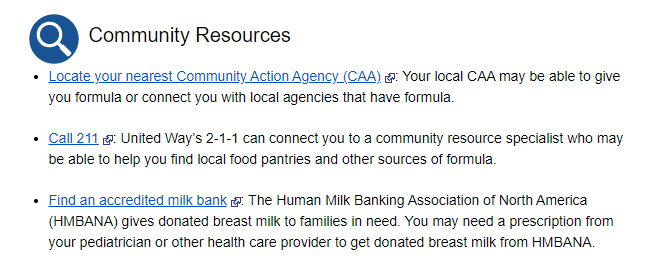
Recently DHS released a website (multiple languages) with resources/information to help with current formula shortages; some of the information links to information from NASPGHAN. The website has links to several new formulas that are being imported, like Kendamil, Nan, and Bubs, and how they are prepared (mL to ounce converter).
Everyday I see families and these terms create more work –not less.
DD Sherry (JAMA Pediatrics 2022; 176: 10-11. Amplified Pain—A Helpful Diagnosis) shares his views on chronic pain terminology with regard to rheumatology, but some of the same lessons should be applied to pediatric gastroenterology:
“The primary purpose of any diagnosis is to serve the patient. They want to know what they have, even if we, as scientists, do not know the cause or mechanism. For example, we have no idea why children have juvenile idiopathic arthritis and, even though it has the word idiopathic in it, giving the child and family this diagnosis is reassuring, allows them to stop looking for other reasons for their symptoms, lets them tell others what they have, and allows for therapy to begin.”
“Amplified pain, in essence, is when the body takes a signal and amplifies it to become symptomatic. The pain is disproportional, as is, frequently the degree of disability”
“Telling patients with amplified pain that their pain is chronic pain,… functional pain…is no help. Many of these children have already been told they are malingering”
“Using the term amplified pain is useful, understandable, and rational. These children are not exaggerating their pain complaint.”
My take: A term like amplified gut pain would be an improvement from what we have now. It could be introduced as another term for visceral hyperalgesia or as a childhood variant of IBS or FAP since it is not currently used in the literature.
JM Boster et al. Liver Transplantation 2022; 28: 483-492. Malnutrition in Biliary Atresia: Assessment, Management, and Outcomes Good review article. Malnutrition and sarcopenia negatively impact pretransplant, peritransplant, and posttransplant outcomes and survival in children with BA.
E Alexander et al. JPGN 2022; 74: 333-337. Clinical Implications for Children Developing Direct Hyperbilirubinemia on Extracorporeal Membrane Oxygenation Key findings: 36/106 (34%) children developed direct hyperbilirubinemia (DHB) on ECMO. Illness acuity scores were significantly higher in the DHB group on ECMO day 2 (P = 0.046) and day 7 (P = 0.01). Mortality rate was higher in the DHB group 72%, versus 29% in the control group (P < 0.001).
Compared with the patients who underwent transplantation a age >1 year (n = 35), those who did so at age <1 year (n = 30) had a lower FSIQ (87.1 ± 12.6 vs 96.6 ± 13.8; P = .005) and lower verbal comprehension index (87.3 ± 13.8 vs 95.4 ± 13.0; P = .020).
Transfusion of >80 mL/kg (P = .004; adjusted for age at transplantation: P = .046) was also associated with detrimental effects on FSIQ.
No difference in IQ between tests was found in those patients tested more than once, indicating no significant improvement with more time after transplantation (first testing was at median of 4.1 years after transplantation and the second testing was at a median age of 6.7 years after transplantation)
“Our findings indicate that transplantation at early age has a pronounced effect on later neurocognitive impairment, and that this effect is separate from and more pronounced than the effect of cholestasis before transplantation.”
Methods: This cohort study included patients (n=1552) with virally-suppressed chronic hepatitis B (CHB) who were hepatitis B e antigen (HBeAg)–negative (and without advanced liver disease) and stopped nucleos(t)ide analogue (NA) therapy
Key findings:
Cumulative probability of HBsAg loss was 3.2% at 12 months and 13.0% at 48 months of follow-up
HBsAg loss was higher among Whites (vs Asians: subdistribution hazard ratio, 6.8; P < .001) and among patients with HBsAg levels <100 IU/mL at end of therapy (vs ≥100 IU/mL: subdistribution hazard ratio, 22.5; P < .001)
My take: This study identifies subsets with HBeAg-negative CHB who may benefit from NA therapy cessation.
Methods: Endoscopic features were prospectively recorded (n=65) using a system specifically developed for EG, the EG Endoscopic Reference System (EG-REFS)
Key findings:
The most common endoscopic findings were erythema (72%), raised lesions (49%), erosions (46%), and granularity (35%); only 8% of patients with active histology (≥30 eosinophils/high-power field) exhibited no endoscopic findings
A strong correlation between EG-REFS scores and physician global assessment of endoscopy severity was demonstrated (Spearman r = 0.84, P < 0.0001)
EG-REFS severity was significantly correlated with active histology, defined by a threshold of ≥30 eosinophils/high-power field (P = 0.0002).
My take: This reference has a ton of terrific pictures (48 for Figure 1) which showcase the wide variety of endoscopic findings (unfortunately these are behind a paywall). Overall, the study lays the groundwork for scoring the severity of EG and for serial assessments.
Related blog posts:
NASPGHAN Toolbox App -includes link to image atlas and many other useful features








 gutsandgrowth