Targeted Therapy for Autoinflammatory Very Early Onset Inflammatory Bowel Disease

S Rudra et al. Clin Gastroenterol Hepatol 2022; 20: 1408-1410. Ruxolitinib: Targeted Approach for Treatment of Autoinflammatory Very Early Onset Inflammatory Bowel Disease

As we start to understand the genetic basis for some of the cases of very early onset inflammatory bowel disease (VEO-IBD), identifying effective targeted treatment is needed. For example, abatacept has been shown to be helpful for CTLA4 deficiency. The report cited above reports the experience of ruxolitinib for autoinflammatory phenotype (AIP) of VEO-IBD.

AIP was defined by persistent fevers, leukocytosis, elevation of at least 2 cytokines: sIL2R, IL8, IL6, CXCL9 or IFN-gamma.

Ruxolitinib is a selective JAK1/2 inhibitor which is approved for treatment of polycythemia vera, myelofibrosis, and graft-versus-host disease. As an aside, its retail cost (with 10 mg, #60) is ~$15,000 per month.

In this case report, 6 children with severe VEO-IBD were treated with average starting dose of 5.6 mg/m2/dose twice daily. Most were receiving dual therapy –3 patients were treated with IL1 blockade and 2 patinents with anti-TNF therapy.

Key findings:

  • Over 6-months, all patients had clinical response, especially with regard to fever and stool frequency
  • All patients had improvement in lab studies
  • Among the 3 with endoscopic followup, 1 had deep mucosal healing and 2 had endoscopic improvement
  • Three mild infections occurred while on treatment, but no bone marrow suppression was noted

My take: Patients with VEO-IBD represent a huge challenge. Trying to target specific therapies is difficult given that there are more than 70 monogenic defects that have been identified and many of the therapies are quite expensive (and difficult to get).

Related blog posts:

Near Santa Fe, NM

Wow, Your Liver Looks So Young!

I’ve had the good fortune to work with the same nurse, Bernadette, for 25 years. While I have joked with some patients, that in a few more years she will figure it all out, in fact, she has been terrific from day one. A few years ago, Bernadette enthusiastically told me that her physician had told her that she had the colon of a teenager; this sounds like a good thing.

I was thinking about this comment about younger body parts after reading a recent article from The Washington Post (6/6/22): Your liver is younger than you think

Key points/excerpts:

  • “Research in the journal Cell Systems reveals that humans’ livers are forever young, clocking in at less than three years old despite their hosts’ biological age…”
  • “Researchers studied the livers of 33 adults who were between ages 20 and 84 when they died…When the scientists dated the cells, they found an average age of about three years regardless of the age of the person who generated the cells. The hepatocytes “show continuous and lifelong turnover, allowing the liver to remain a young organ,” they write.”
  • “Ninety-five percent of the cells with two complete sets of chromosomes turned over within a year, but up to 12 percent of a cell subtype that have more than one pair of chromosomes can survive up to a decade.”
  • “Our bodies produce about 700 million hepatocytes each day — not bad for a three-pound organ.”

My take: The liver is amazing and can stay young even when in older bodies.

Related blog post: Why the Liver is the King of Internal Organs

Tirzepatide: Promotes Impressive Weight loss

Source Study: AM Jastreboff et al NEJM 2022; DOI: 10.1056/NEJMoa2206038. Tirzepatide Once Weekly for the Treatment of Obesity

USA Today (6/6/22): Diabetes drug helps patients lose never-before-seen amounts of weight, study shows

An excerpt:

The drug, called tirzepatide, works on two naturally occurring hormones that help control blood sugar and are involved in sending fullness signals from the gut to the brain...Those taking the highest of three studied doses lost as much as 21% of their body weight – 50-60 pounds in some cases…

Another obesity treatment approved last year called semaglutide, from Novo Nordisk, provides an average of up to about 15% weight loss. Previous generations of diet drugs cut only about 5% of weight and many carried prohibitive side effects…

About 15% of participants who received the active drug dropped out of the 72-week trial, about a third because of gastrointestinal side effects. Twenty-six percent of trial volunteers who received a placebo dropped out.

On May 13, the Food and Drug Administration approved tirzepatide, under the trade name Mounjaro, for the treatment of Type 2 diabetes…The new tirzepatide trial, called SURMOUNT-1, included more than 2,500 volunteers [without diabetes]…Nine out of 10 lost weight, and on the highest dose, 15 mg, they lost an average of 52 pounds each...

It’s too soon to know what price Lilly will set for tirzepatide. Mounjaro, the same drug used to treat diabetes at the same doses, retails for almost $1,000 a month…Semaglutide went on the market last year for weight loss and has been in short supply ever since, Rind said. It costs about $1,600 a month for the 2.4 mg weight loss dose, which is higher than the 1 or 2 mg doses used to treat diabetes. Like other weight loss drugs, semaglutide isn’t covered by many insurance plans. 

My take: This therapy, already approved for Type 2 Diabetes, appears promising for obesity but costly. More time will be needed to understand the safety profile with extended use.

Related blog post: Are We On the Verge of Pharmacologic Management of Obesity (Again)?

Atalaya Hike, Santa Fe, NM

Useful (Open Access) Reference for Colonic Motility Studies

A Rybak et al. JPGN 2022; 74: 681-692. Open Access: Colonic Function Investigations in Children: Review by the ESPGHAN Motility Working Group

This article reviews the following:

  • Colonic Transit Radiomarker Studies (aka Sitz markers)
  • Colonic Scintigraphy
  • Colonic Manometry
  • Wireless Motility Capsule (aka SmartPill)
  • Electromagnetic Capsule Tracking System
  • CINE Motility MRI

The article provides useful information for indications and for interpreting these studies along with some terrific figures.

For colonic transit radiomarkers:

  • Fecal impaction should be addressed prior to study
  • Figure 1 algorithm: If >80% of markers remain in colon on day 4 or 5, this is an abnormal study. “Children are considered as having slow transit constipation when there is a delay in transit, with the pellets spread throughout the colon. When the delay occurs and over 50% of the markers are held up in the rectosigmoid colon, children are labeled as having rectal outlet obstruction”

Related blog posts:

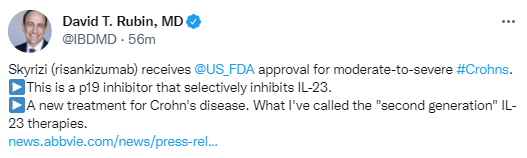
Risankizumab Receives FDA Approval for Crohn’s Disease

Abbvie Press Release: SKYRIZI® (risankizumab-rzaa) Receives FDA Approval as the First and Only Specific Interleukin-23 (IL-23) to Treat Moderately to Severely Active Crohn’s Disease in Adults

– Third approved indication for SKYRIZI (risankizumab-rzaa) is supported by safety and efficacy data from two induction and one maintenance clinical trials evaluating SKYRIZI in moderately to severely active Crohn’s disease, ADVANCE, MOTIVATE and FORTIFY1-4

– As early as week 4 in the induction studies, clinical response and clinical remission were achieved by significantly more subjects treated with SKYRIZI versus placebo, as were co-primary endpoints of endoscopic response and clinical remission at week 12 and week 521-4

About SKYRIZI® (risankizumab-rzaa)
SKYRIZI is an interleukin-23 (IL-23) inhibitor that selectively blocks IL-23 by binding to its p19 subunit.9,10 IL-23, a cytokine involved in inflammatory processes, is thought to be linked to a number of chronic immune-mediated diseases, including Crohn’s disease.10 The approved dose to treat adults with moderately to severely active Crohn’s disease is 600 mg administered by intravenous infusion over at least one hour at week 0, week 4, and week 8, followed by 360 mg administered by subcutaneous injection at week 12, and every 8 weeks thereafter.4 SKYRIZI is also approved in the U.S. to treat moderate to severe plaque psoriasis in adults who are candidates for systemic therapy or phototherapy, as well as to treat active psoriatic arthritis in adults, and the recommended dosage is 150 mg administered by subcutaneous injection at week 0, week 4, and every 12 weeks thereafter.4 Phase 3 trials of SKYRIZI in psoriasis, Crohn’s disease, ulcerative colitis and psoriatic arthritis are ongoing

Related blog posts:

NASPGAN Paper: Surgery for Chronic Pancreatitis: Choose Your Operation and Surgeon Carefully

JD Nathan et al. JPGN 2022; 74: 706-719. Open Access: The Role of Surgical Management in Chronic Pancreatitis in Children: A Position Paper From the North American Society for Pediatric Gastroenterology, Hepatology, and Nutrition Pancreas Committee

This society paper provides a terrific review of potential operations and rationale in children with chronic pancreatitis. Some of the highlights from this open access article include figures detailing the anatomical considerations of the operations (eg. Frey, Modified Puestow, TPIAT, Berger, Whipple, and Berne) and an algorithm in choosing which procedure should be considered.

Key points:

  • Surgery is indicated for children with debilitating CP who have failed maximal medical and endoscopic interventions.
  • A conventional surgical approach (eg, drainage operation, partial resection, combination drainage-resection) may be considered in the presence of significant and uniform pancreatic duct dilation or an inflammatory head mass.
  • Total pancreatectomy with islet autotransplantation is the best surgical option in patients with small duct disease.
  • The presence of genetic risk factors often portends a suboptimal outcome following a conventional operation.

My take: Fortunately, very few children need operations for chronic pancreatitis. As such, surgical expertise/judgement is particularly important.

Figure 1

Related blog posts: 

Disclaimer: This blog, gutsandgrowth, assumes no responsibility for any use or operation of any method, product, instruction, concept or idea contained in the material herein or for any injury or damage to persons or property (whether products liability, negligence or otherwise) resulting from such use or operation. These blog posts are for educational purposes only. Specific dosing of medications (along with potential adverse effects) should be confirmed by prescribing physician.  Because of rapid advances in the medical sciences, the gutsandgrowth blog cautions that independent verification should be made of diagnosis and drug dosages. The reader is solely responsible for the conduct of any suggested test or procedure.  This content is not a substitute for medical advice, diagnosis or treatment provided by a qualified healthcare provider. Always seek the advice of your physician or other qualified health provider with any questions you may have regarding a condition

Prevalence of Avoidant/Restrictive Food Intake Disorders in Pediatric Neurogastroenterology

HB Murray et al. JPGN 2022; 74: 588-592. Prevalence and Characteristics of Avoidant/Restrictive Food Intake Disorder in Pediatric Neurogastroenterology Patients

Associated commentary by SB Oliveira, A Kaul: Invited Commentary Re: Prevalence and Characteristics of Avoidant/ Restrictive Food Intake Disorder in Pediatric Neurogastroenterology Patients

This was a retrospective study with 129 consecutive neurogastroenterology patients. Key findings:

  • Eleven cases (8%) met the full criteria for ARFID (DSM, 5th ed) and 19 cases (15%) had clinically significant avoidant/ restrictive eating behaviors with insufficient information for a definitive ARFID diagnosis
  • In a separate retrospective study, the same center published data on ARFID in a general pediatric population, showing 1.5% meeting the full criteria and 2.4% with some features (KT Eddy et al. Int J Eat Disord . 2015 Jul;48(5):464-70. Prevalence of DSM-5 avoidant/restrictive food intake disorder in a pediatric gastroenterology healthcare network)

The discussion notes that while elimination diets (eg. low FODMAPs diets) are frequently used for disorders of brain-gut interaction, they may increase the risk of ARFID. “Some children may develop fear of what will happen when they try foods again.”

The insightful commentary makes several useful points:

  • A retrospective study is not the best way to determine prevalence of ARFID particularly as many practitioners have limited familiarity and documentation may be inadequate
  • Nutritional rehabilitation can improve GI function. It has been shown that patients with anorexia nervosa have delayed gastric emptying which improved with refeeding. More broadly, it is often challenging to definitively determine the cause and effect in patients with malnutrition and gut dysmotility. (This is why I rarely obtain gastric emptying studies in patients with poor nutritional status)

My take: ARFID can be difficult to manage and is important to consider in our patient population, and probably even more so in patients seen in neurogastroenterology programs. The exact prevalence of ARFID in these programs is uncertain and prospective studies are needed.

Related blog post:

I-SEE for Eosinophilic Esophagitis

ES Dellon et al Gastroenterol 2022; DOI: https://doi.org/10.1053/j.gastro.2022.03.025 Open Access: A Clinical Severity Index for Eosinophilic Esophagitis: Development, Consensus, and Future Directions “The Index of Severity for Eosinophilic Esophagitis (I-SEE)—that can be completed at routine clinic visits to assess disease severity using a point scale of 0–6 for mild, 7–14 for moderate, and ≥15 for severe EoE.”

From AGA: Eosinophilic Esophagitis Index

“The Index of Severity for EoE (I-SEE) is now available for you to use as a tool to help assess EoE patients. Developed by a multidisciplinary team of experts, the new tool is now published in Gastroenterology.”

Details about I-SEE 

  • “The I-SEE has three domains: (1) symptoms and complications, (2) inflammatory features and (3) fibrostenotic.
  • I-SEE can be used at initial diagnosis and then at each subsequent visit, with the recall being only between visits so that the severity can be assessed over time and ultimately (when data supports this step) treatment and monitoring adjusted based on severity.
  • As the number of children and adults with EoE increases worldwide, a simple system to assess and track disease activity in a meaningful way in a clinical setting is needed.
  • I-SEE is for use in adult and pediatric patients with EoE. It was created by an international team of more than 30 experts in allergy, gastroenterology and pathology.”

Link: I-SEE Tool Scoring Table

The Curtain or The Box: Therapeutic Dilemmas

X Roblin et al. Inflamm Bowel Dis 2022; 28: 720-727. Swapping Versus Dose Optimization in Patients Losing Response to Adalimumab With Adequate Drug Levels

Many times, treatment decisions are like on “Let’s Make a Deal.” That is, should I stick with what I’ve got or should I try for something better & sometimes wind up with a goat. In this referenced article, patients were under maintenance therapy with adalimumab (ADA) monotherapy (40 mg every 14 days) and had experienced a secondary loss of response (LOR) despite trough levels > 4.9 μg/mL. In this nonrandomized prospective study, patients were either swapped to vedolizumab (VDZ) or optimized on adalimumab (ADA) treatment.

Key findings:

  • At 24 months, 11 out of 70 patients (16%) in the swap group discontinued treatment compared with 36 out of 61 (59%) patients in the optimization group (P < 0.001)
  • In the optimization group, treatment discontinuation was positively associated with baseline fecal calprotectin >500 μg/g (HR, 3.5)
  • In patients selected for optimization, 56% (34/61) remained on ADA at 1 year and 41% (25/61) at 2 years

In their discussion, the authors state “current guidelines recommend switching to another class of biologics in case of LOR to ADA with therapeutic drug levels.” However, the authors note that their therapeutic level cut-off of >4.9 mcg/mL is lower than the latest recommendations. In addition, in their conclusion, they note that due to limited biologic options, “ADA optimization strategy might be considered” in a subgroup.

My take: Despite better results in the patients that swapped to VDZ in this study, I think it is important to assure adequate drug levels before choosing a new drug class. For ADA, expert recommendations have suggested a level of 8-12 as therapeutic and to avoid discontinuation if ADA level is less than 10. In this study, more than 40% remained on ADA two years after LOR in those with dosing optimization.

Related blog post:

Disclaimer: This blog, gutsandgrowth, assumes no responsibility for any use or operation of any method, product, instruction, concept or idea contained in the material herein or for any injury or damage to persons or property (whether products liability, negligence or otherwise) resulting from such use or operation. These blog posts are for educational purposes only. Specific dosing of medications (along with potential adverse effects) should be confirmed by prescribing physician.  Because of rapid advances in the medical sciences, the gutsandgrowth blog cautions that independent verification should be made of diagnosis and drug dosages. The reader is solely responsible for the conduct of any suggested test or procedure.  This content is not a substitute for medical advice, diagnosis or treatment provided by a qualified healthcare provider. Always seek the advice of your physician or other qualified health provider with any questions you may have regarding a condition.

Panoramic View -Sandia Mountain, NM