
Image Only: Liver Involvement in Autosomal Dominant Polycystic Kidney Disease
Image

Capsaicin for Cannaboid Hyperemesis Syndrome
Capsaicin is the stuff in chili peppers that makes your mouth feel hot. But it also has some medical purposes. It’s a key ingredient in creams and patches that has been used for pain relief (e.g. joint, muscle, headaches).
From our recent hospital PNT meeting –information on using Capsaicin for Cannaboid Hyperemesis Syndrome (CHS).
What is cannabinoid hyperemesis syndrome (CHS)?
- Clinical syndrome in which marijuana users develop nausea, cyclic vomiting, and abdominal pain that improves with a hot water bath or cannabis cessation
- Often refractory to standard treatment for nausea/vomiting
- No laboratory or diagnostic tests for CHS
Capsaicin Mechanism for CHS
- Transient receptor potential vanilloid subtype 1 (TRPV1) receptor is expressed in the brain, along enteric and vagal nerves, and on cutaneous receptors in the skin
- Chronic cannabis use results in inactivation of TRPV1 receptor leading to nausea & emesis
- Nociceptive heat, such as topical capsaicin, acts as a TRPV1 agonist restoring gastric motility
- Activation of TRPV1 receptor results in potent anti-emetic effects
- Capsaicin exposure results in subsequent desensitization of the sensory axons and inhibition of pain transmission initiation.
Topical Capsaicin
- Product: Capsaicin cream 0.025% (Generic)
- Dosing: Apply thin film to affected area not more than 3 to 4 times/day
- Benefits:
- Less adverse effects than unconventional antiemetics (e.g., haloperidol)
- Cost-effective
- Adverse effects: “burning sensation” on skin
- Average wholesale price: $10 per 60 gram tube
Supporting literature
- Graham J, et al.
- Case series in which capsaicin was successfully used to treat CHS in two pediatric patients presenting to the emergency department (ED).
- In a 16 yo & 20 yo, each with two ED visits, on the 2nd visit: due to history of cannabis use, CHS became working diagnosis, patients agreed to try capsaicin cream (0.025%, 1 mm-thick coating) applied to the abdomen. Thirty minutes after capsaicin application, patients pain decreased to a 3 out of 10 and her nausea resolved
References:
- Moon AM, Buckley SA, Mark NM. Successful treatment of cannabinoid hyperemesis syndrome with topical capsaicin. ACG Case Rep J. 2018 Jan 3;5:e3.
- Graham J, Barberio M, Wang GS. Capsaicin cream for treatment of cannabinoid hyperemesis syndrome in adolescents: A case series. 2017 Dec;140(6): e20163795.
My take: Capsaicin use for CHS is supported by case reports.
Disclaimer: These blog posts are for educational purposes only. Specific dosing of medications/diets (along with potential adverse effects) should be confirmed by prescribing physician/nutritionist. This content is not a substitute for medical advice, diagnosis or treatment provided by a qualified healthcare provider. Always seek the advice of your physician or other qualified health provider with any questions you may have regarding a condition.

From Barcelona chocolate museum –everything is chocolate
Aprepitant for CVS
Last year at NASPGHAN meeting (NASPGHAN Highlights and Tweets), there was data presented on aprepitant for cyclic vomiting syndrome (CVS). This came up at a recent hospital PNT meeting as well.
- Aprepitant (Emend) is an anti-emetic that works by blocking the NK1 receptor.
- It has FDA approval for prevention of nausea and vomiting in moderate and highly emetogenic chemotherapy (adults and pediatrics) and prevention of post-operative nausea and vomiting (adult only).
Supporting Data for use of Aprepitant
An abstract published in 2006 reported on the use of aprepitant in 11 children (3-16 years)2. Patients were refractory to/had poor response to pizotifen (not available in US – serotonin and histamine antagonist), propranol, and ondansetron. Aprepitant was dosed at 80 mg/m2 up to twice weekly in combination with ondansetron. Nine out of 11 patients had reduction in cycle frequency, duration of vomiting episodes and intensity of vomiting. Three patients achieved complete cycle abolishment.
Cristoferi et al retrospectively reviewed 41 patients (age range 4-16.5 years, median 8 years) treated acutely or prophylactically with aprepitant.3 The primary outcome was decrease in frequency and intensity of CVS episodes. The follow up period was 18-60 months. The majority of patients failed cyproheptadine/pizotiphen, ondansetron, and amitriptyline as prophylactic medications.
Dosing regimens utilized in Cristoferi paper:
Prophylactic regimen (oral):
- < 40 kg, 40 mg twice/week = $220/week (average wholesale price)
- >40 kg to < 60 kg, 80 mg twice/week = $408/week
- > 60 kg, 125 mg twice/week = $612/week
Acute regimen (oral):
- >20 kg, 125 mg x 1 followed by 80 mg on day 2 and day 3 = $714
- 15-<20 kg, 80 mg x 3 days = $612
- < 15 kg, 80 mg x 1 followed by 40 mg on day 2 and day 3 = $424
Response rates:
- With the prophylactic regimen, the authors reported a complete response in 3/16 (19%) and a partial response 10/16 (62%) [partial response was considered if there was ≥50% decrease in CVS episode frequency and intensity].
- With the acute regimen, the authors reported 19/25 (76%) with a complete response and 3/25 (12%) with a partial response.
My take: Aprepitant appears promising as an agent for children who fail first-line therapies like periactin, tricyclic antidepressants, and ondansetron.
References
- Bhandari S and Venkatesan T. Novel treatments for cyclic vomiting syndrome: beyond ondansetron and amitriptyline. Curr Treat Options Gastro 2016;14:495-506.
- Russell RK, et al. NK1 receptor antagonism ameliorates nausea and emesis in typical and atypical variants of treatment refractory cyclical vomiting syndrome. J Pediatr Gastroenterol Nutr 2006;42:E13.
- Cristoferi F, et al. Efficacy of the neurokin-1 receptor antagonist aprepitant in children with cyclical vomiting syndrome. Aliment Pharmacol Ther 2014;40:309-17.
Related blog posts:
- Diet of drugs for CVS
- Costs/Yield of Diagnosing Cyclic Vomiting Syndrome
- Getting in the Shower for Emetic Symptoms
Disclaimer: These blog posts are for educational purposes only. Specific dosing of medications/diets (along with potential adverse effects) should be confirmed by prescribing physician/nutritionist. This content is not a substitute for medical advice, diagnosis or treatment provided by a qualified healthcare provider. Always seek the advice of your physician or other qualified health provider with any questions you may have regarding a condition.

How Does USA Compare to Other Countries in Pediatric Liver Transplantation
A recent study (B Fischler et al. JPGN 2019; 68: 700-05) compared the similarities and differences in allocation experience among 15 countries based on a survey completed by a representative hepatologist in each country.
Key findings:
- The number of liver transplants was 4 to 9 million inhabitants younger than 18 years for 13 of the 15 respondents. USA had the 5th highest rate at ~7 per million inhabitants (Figure 2)
- USA had the 3rd highest donation rate per million inhabitants, ~26 per million. Spain had highest rate at 35 per million. This is partly related to Spain allocating all nonugent pediatric cadaveric donors to pediatric candidates.
- USA had the 3rd lowest rate of living-related liver transplantation percentage in children < 2 yrs, approximately 10%. Both Turkey and Poland had rates near 90%.
- USA had one of the lowest rates of %split liver transplantations for children <2 yrs, less than 10%. Italy, Netherlands, and New Zealand had rates near 90%.
- USA had the 4th highest waitlist mortality for children <2 yrs, approximately 11%
My take: This study indicates that the rate of split liver transplants and living related liver transplants are much lower in USA than in other countries. This is likely to reduce donor pool and contribute to increased waiting list mortality.
Related blog posts:
- More on Time to Split (2018)
- Pediatric Livers Bypassing Needy Children
- More Acceptance (of livers), Better Outcomes
- Should Younger Transplant Patients Receive Better Organs? | gutsandgrowth
- Picking winners and losers with liver transplantation allocation
- Pediatric Liver Transplantation: Past Time to Split
- More on its Past Time to Split
AAP Recommends Isotonic Maintenance IV Fluids
Full text: Feld LG et al. Pediatrics 2018; 142: pii:e20183083: Clinical Practice Guideline: Maintenance Intravenous Fluids in Children
Key Recommendation:
The American Academy of Pediatrics recommends that patients 28 days to 18 years of age requiring maintenance IVFs should receive isotonic solutions with appropriate potassium chloride and dextrose because they significantly decrease the risk of developing hyponatremia (evidence quality: A; recommendation strength: strong)
Isotonic and Hypotonic Fluids:
- Examples of isotonic/near isotonic fluids listed in Table 1 include D5 Normal Saline (0.9%), D5 Lactated Ringer’s which have osmolarities of 308 mOsm/L (same as human plasma) and 273 mOsm/L respectively.
- Examples of hypotonic fluids include D5 1/2 Normal Saline (0.45%) and D5 1/4 Normal Saline (0.2%) which have osmolarities of 154 mOsm/L and 78 mOsm/L respectively
“The administration of hypotonic IVFs has been the standard in pediatrics. Concerns have been raised that this approach results in a high incidence of hyponatremia and that isotonic IVFs could prevent the development of hyponatremia… in most patients from 28 days to 18 years of age who require maintenance IVFs. This guideline applies to children in surgical (postoperative) and medical acute-care settings, including critical care and the general inpatient ward.”
Excluded from these recommendations: “Patients with neurosurgical disorders, congenital or acquired cardiac disease, hepatic disease, cancer, renal dysfunction, diabetes insipidus, voluminous watery diarrhea, or severe burns; neonates who are younger than 28 days old or in the NICU; and adolescents older than 18 years old”
My take: It remains commonplace for patients to receive hypotonic fluids which place them at unnecessary risk for iatrogenic hyponatremia.
Related blog posts:
- Why D51/2 NS was the Right Choice for IVFs in the 1950s!
- What’s critical to you | gutsandgrowth
- We Still Have More to Learn” | gutsandgrowth
- Has Your Hospital Restricted Quarter-Normal Saline …

Magic Fountain, Barcelona
Rural Areas Main Driver for Increasing Obesity
Nature volume 569, pages260–264 (2019) : Full Text: Rising rural body-mass index is the main driver of the global obesity epidemic in adults
From Abstract:
- Here we use 2,009 population-based studies, with measurements of height and weight in more than 112 million adults, to report national, regional and global trends in mean BMI segregated by place of residence (a rural or urban area) from 1985 to 2017.
- We show that, contrary to the dominant paradigm, more than 55% of the global rise in mean BMI from 1985 to 2017—and more than 80% in some low- and middle-income regions—was due to increases in BMI in rural areas.
- In high-income and industrialized countries, we noted a persistently higher rural BMI, especially for women.

What’s the Chance You Will Be Taking an Antibiotic in the Next Year?
A recent letter (SW Olesen et al. NEJM 2019; 380: 1872-3) showed the frequency of filling antibiotic prescriptions in the U.S. from 2011-2014 using the Truven Health MarketScan Research Databases (62 million enrollees).
Key findings:
“The probability of filling an antibiotic prescription at an outpatient pharmacy was 33% … over 1 year, 47% …over 2 years, 55% …over 3 years, and 62%…over 4 years.”
My take: One-third of the population is filling an antibiotic prescription each year. That is way too much –antibiotic stewardship program personnel should have a lot of job security.

White Coat Contamination
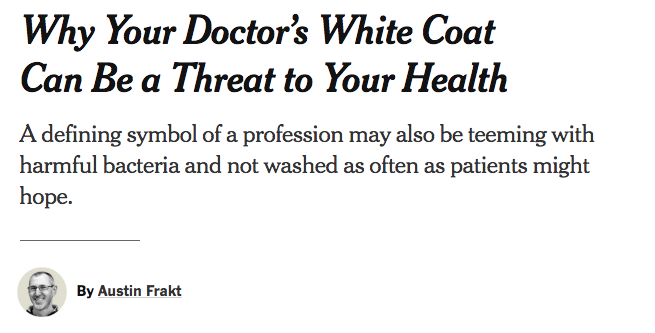
A recent NYT story: Why Your Doctor’s White Coat Can Be a Threat to Your Health
An excerpt:
A recent study of patients at 10 academic hospitals in the United States found that just over half care about what their doctors wear, most of them preferring the traditional white coat…
What many might not realize, though, is that health care workers’ attire — including that seemingly “clean” white coat that many prefer — can harbor dangerous bacteria and pathogens.
A systematic review of studies found that white coats are frequently contaminated with strains of harmful and sometimes drug-resistant bacteria associated with hospital-acquired infections. As many as 16 percent of white coats tested positive for MRSA, and up to 42 percent for the bacterial class Gram-negative rods…
The review also found that stethoscopes, phones and tablets can be contaminated with harmful bacteria. One study of orthopedic surgeons showed a 45 percent match between the species of bacteria found on their ties and in the wounds of patients they had treated. Nurses’ uniforms have also been found to be contaminated.
My take: Your white coat should probably be washed as often as you wash your underwear (if you decide to wear it).
Steroid-Free Approach in Autoimmune Hepatitis
A recent case report (A Wehrman et al. J Pediatr 2019; 207: 244-7) described steroid free treatment of autoimmune hepatitis (AIH) in 8 patients.
This retrospective review of all patients with AIH at CHOP between 2009-2014 compared patients who had AIH treated with (n=12) and without steroids (aka azathioprine monotherapy). Near normalization of ALT was defined as less than 2 x ULN.
Key findings:
- All children in the steroid group had normalization of liver enzymes by 12 months of therapy compared with only 2 of 8 in the steroid-free group. Though, near normalization of ALT occurred at a median of 5.5 months in the steroid free group (compared with 1.8 months in the steroid group).
- Adverse effects were evident in 75% of the steroid group compared with 11% of the steroid-free group
The authors conclude that “liver enzymes may take longer to normalize without steroids, but this difference was not statistically significant in our small cohort, nor did it lead to any adverse outcomes.”
My take: Standard therapy for AIH is prednisone for induction with subsequent azathioprine. This study shows that in patients unwilling to take steroids or with intolerance that azathioprine monotherapy may be an effective alternative though liver enzymes are likely to take much longer to improve.
Related blog posts:
- Azathioprine metabolite measurement for Autoimmune Hepatitis | gutsandgrowth
- Adult versus Pediatric Data: Autoimmune Hepatitis | gutsandgrowth
- Genetics of Autoimmune Hepatitis | gutsandgrowth
- Diagnosing autoimmune hepatitis
- Liver Problems with Inflammatory Bowel Disease

Barcelona/Mediterranean Sea

