Management of Acute Severe Colitis

A recent review (KG Whatley, MJ Rosen. Inflamm Bowel Dis 2019; 25: 56-66) succinctly summarizes the contemporary medical management of acute severe ulcerative colitis (ASUC).

Figure 1 provides a useful initial checklist which includes the following:

  • PUCAI score
  • Labs/Imaging: CBC/d, CMP, CRP/ESR, Stool studies (culture/C diff), AXR
  • Pre-salvage labs: TB screen, Hep B serology, VZV serology if needing anit-TNF, TPMT if contemplating thiopurine, lipids if contemplating calcineurin inhibitor
  • Endoscopy: Consider Flex Sig (unsedated) with tissue for CMV PCR if not responding to 3 days of IV steroids
  • Thromboembolism prophylaxis: Low molecular weight heparin (adults, & high-risk pediatric patients), pneumatic compression (low-risk pediatric)
  • Nutrition plan
  • Corticosteroids: methylprednisolone 1-15. mg/kg (to max of 40-60 mg daily)

Each of these recommendations is discussed. For the flex sig recommendation, the authors note that a “full colonoscopy is not recommended due to risk of perforation.” With regard to CMV, the authors acknowledge the low quality of evidence to support antiviral treatment of CMV in this setting.  In addition, the authors suggest PCP prophylaxis in those who receive triple immunosuppression or in those receiving calcineurin inhibitors.

Figure 2 provides a handy algorithm for infliximab salvage therapy in the setting of ASUC:

  • If salvage therapy with infliximab is indicated (day 3-5 of IV steroids), the authors recommend 10 mg/kg dosing.  If there is no response after 3-5 days, repeat dosing is recommended.  If there is no response after an additional 3-5 days, colectomy is recommended.
  • If there is a response to infliximab, the algorithm recommends outpatient management. At time of the 3rd dose (week 5-6), the authors obtain an IFX level.  In those with a level <15, then dosing at 4 week maintenance is recommended; whereas in those 15 and above, every 8 week maintenance is recommended.

The authors discuss some potential emerging treatments. Recommendations from the authors with regard to surgery:

  • Most patients are best served with a subtotal colectomy/end ileostomy in preparation for future ileal pouch anal anastomosis
  • “Surgery should not be delayed to enhance nutrition or taper steroids.”

My take: This article summarizes current approaches with emphasis on not waiting a long time for salvage therapies and using early therapeutic drug monitoring to assist in dosing frequency.

Related blog posts:

Disclaimer: These blog posts are for educational purposes only. Specific dosing of medications/diets (along with potential adverse effects) should be confirmed by prescribing physician/nutritionist.  This content is not a substitute for medical advice, diagnosis or treatment provided by a qualified healthcare provider. Always seek the advice of your physician or other qualified health provider with any questions you may have regarding a condition.

Death Valley


 

Experimental Use of FMT for Ulcerative Colitis

In a recent randomized, double-blind study (SP Costello et al. JAMA. 2019;321(2):156-164. doi:10.1001/jama.2018.20046), the use of fecal microbiota transplantation (FMT) was effective in 32% in inducing remission in adult patients with ulcerative colitis (UC).

Key Finding:  In this randomized clinical trial that included 73 adults with mild to moderately active ulcerative colitis, the proportion achieving steroid-free remission at 8 weeks was 32% with donor FMT vs 9% with autologous FMT, a significant difference

Abstract:

Importance  High-intensity, aerobically prepared fecal microbiota transplantation (FMT) has demonstrated efficacy in treating active ulcerative colitis (UC). FMT protocols involving anaerobic stool processing methods may enhance microbial viability and allow efficacy with a lower treatment intensity.

Objective  To assess the efficacy of a short duration of FMT therapy to induce remission in UC using anaerobically prepared stool.

Design, Setting, and Participants  A total of 73 adults with mild to moderately active UC were enrolled in a multicenter, randomized, double-blind clinical trial in 3 Australian tertiary referral centers between June 2013 and June 2016, with 12-month follow-up until June 2017.

Interventions  Patients were randomized to receive either anaerobically prepared pooled donor FMT (n = 38) or autologous FMT (n = 35) via colonoscopy followed by 2 enemas over 7 days. Open-label therapy was offered to autologous FMT participants at 8 weeks and they were followed up for 12 months.

Main Outcomes and Measures  The primary outcome was steroid-free remission of UC, defined as a total Mayo score of ≤2 with an endoscopic Mayo score of 1 or less at week 8. Total Mayo score ranges from 0 to 12 (0 = no disease and 12 = most severe disease). Steroid-free remission of UC was reassessed at 12 months. Secondary clinical outcomes included adverse events.

Results  Among 73 patients who were randomized (mean age, 39 years; women, 33 [45%]), 69 (95%) completed the trial. The primary outcome was achieved in 12 of the 38 participants (32%) receiving pooled donor FMT compared with 3 of the 35 (9%) receiving autologous FMT (difference, 23% [95% CI, 4%-42%]; odds ratio, 5.0 [95% CI, 1.2-20.1]; P = .03). Five of the 12 participants (42%) who achieved the primary end point at week 8 following donor FMT maintained remission at 12 months. There were 3 serious adverse events in the donor FMT group and 2 in the autologous FMT group.

Conclusions and Relevance  In this preliminary study of adults with mild to moderate UC, 1-week treatment with anaerobically prepared donor FMT compared with autologous FMT resulted in a higher likelihood of remission at 8 weeks. Further research is needed to assess longer-term maintenance of remission and safety.

Related blog posts:

Golden Gulch Trail, Death Valley


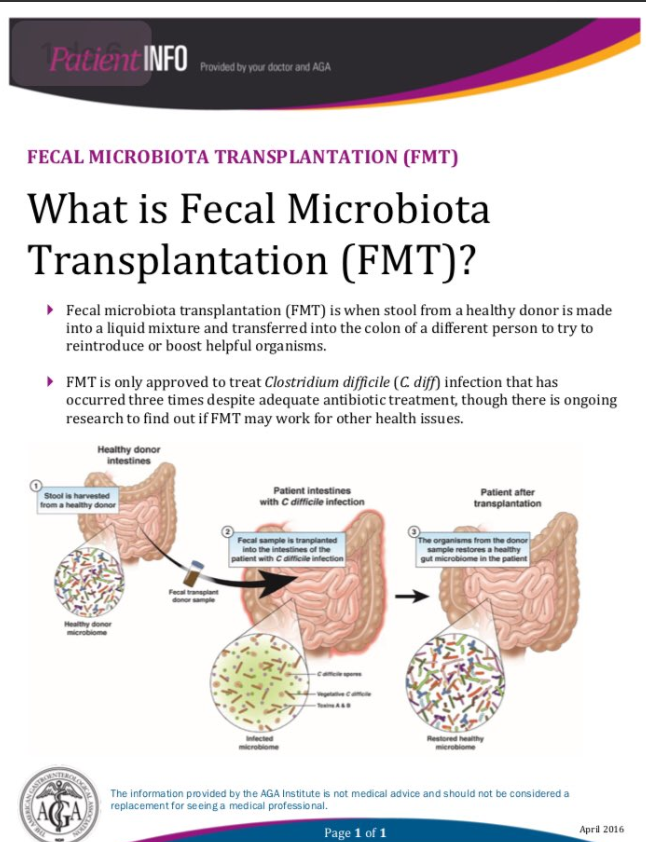
Fecal Microbioata Transplantation for Recurrent Clostridium difficile — Position Paper

A recent position paper (ZH Davidovics et al. JPGN 2019; 68: 130-43) from NASPGHAN/ESPGHAN on Fecal Microbioata Transplantation (FMT) for Recurrent Clostridium difficile infection (CDI) provides a pretty good review. Though, I think a summary table of recommendations would have made this publication much more helpful.

Here is a full-text link: Fecal Microbiota Transplantation for Recurrent Clostridium difficile Infection and Other Conditions in Children: A Joint Position Paper

A couple key points/excerpts:

In general, we concur with current adult guidelines  when considering FMT for the treatment of rCDI in children and propose FMT be considered in children with one of the following:
1. rCDI (recurrence of symptoms within 8 weeks of treatment for CDI) (either a or b)
a. At least 3 episodes of mild to moderate CDI and failure of a 6- to 8-week taper with vancomycin with or without an alternative antibiotic (eg, rifaximin, nitazoxanide).
b. At least 2 episodes of severe CDI resulting in hospitalization and associated with significant morbidity.

2. Moderate CDI not responding to standard therapy (including vancomycin) for at least 1 week. We recommend caution, however, in such cases, with repeated testing for etiologies other than CDI such as IBD.

3. Severe CDI or fulminant C difficile colitis with no response to standard therapy after 48 hours.

My take:  I think the IDSA 2017 guidelines are more useful: Clostridium difficile Guidelines (2017 IDSA/SHEA)

More related blog posts:

ESPGHAN Position Paper: Biosimilars in Pediatric Inflammatory Bowel Disease

A recent position paper from ESPGHAN/Porto Group:

Full text: Use of Biosimilars in Pediatric Inflammatory Bowel Disease: An Updated Position Statement of the Pediatric IBD Porto Group of ESPGHAN. L de Riddler et al. JPGN 2019; 68: 144-53

Key points:

  • There are sufficient data (by extrapolation from different indications, adult data and limited pediatric data) to state that in children with IBD who are indicated for IFX treatment, CT-P13 is a safe and efficacious alternative to the originator IFX for
    induction, and maintenance, of remission. 97% agreement
  • A switch from the originator infliximab to CT-P13 may be considered in children with IBD in clinical remission, following at least 3 induction infusions. 84% agreement
  • Multiple switches (>1 switch) between biosimilars and reference drug or various biosimilars are not recommended in children with IBD, as data on interchangeability is limited and traceability of the drugs in case of loss of efficacy and/or safety signals may be compromised. 97% agreement
  • Physicians/institutions should keep records of brands and batch numbers of all biological medicines (including biosimilars) administered. 89% agreement

Related blog posts:

Disclaimer: These blog posts are for educational purposes only. Specific dosing of medications/diets (along with potential adverse effects) should be confirmed by prescribing physician/nutritionist.  This content is not a substitute for medical advice, diagnosis or treatment provided by a qualified healthcare provider. Always seek the advice of your physician or other qualified health provider with any questions you may have regarding a condition.

David Brooks: “Kindness Is A Skill”

Earlier this week, David Brooks posted a thoughtful commentary that’s worth a read.  The article ostensibly is working through negotiations over disagreements but has useful points for both healthcare professionals and for everyone else.

NY Times: Kindness Is a Skill

An excerpt:

The all-purpose question. “Tell me about the challenges you are facing?” Use it when there seems to be nothing else to say…

Gratitude. People who are good at relationships are always scanning the scene for things they can thank somebody for.

Never sulk or withdraw. If somebody doesn’t understand you, not communicating with her won’t help her understand you better.

Reject either/or. The human mind has a tendency to reduce problems to either we do this or we do that. This is narrowcasting. There are usually many more options neither side has imagined yet…

Presume the good. Any disagreement will go better if you assume the other person has good intentions

Devil’s Golf Course, Death Valley

IBD Update Feb 2019

Briefly noted:

B Feagan et al. Systematic review: efficacy and safety of switching patients between reference and biosimilar infliximab. Alim Pharm Ther 2019 Jan;49(1):31-40. “While available data have not identified significant risks associated with a single switch between reference and biosimilar infliximab, the studies available currently report on only single switches and were mostly observational studies lacking control arms. Additional data are needed to explore potential switching risks in various populations and scenarios.”

MP Pauly et al. Incidence of Hepatitis B Virus Reactivation and Hepatotoxicity in Patients Receiving Long-term Treatment with Tumor Necrosis Factor Antagonists. Clin Gastroenterol Hepatol 2018; 16: 1964-73. Using data from 8887 adults, this retrospective review found  “HBV reactivation iin 39% of patients who were HBsAg+ before therapy, but not in any patients who were HBsAg-negative and anti-HBc+ before therapy.”

D Lauritzen et al. Pediatric Inflammatory Bowel Diseases: Should We Be Looking for Kidney Abnormalities? Inflamm Bowel Dis 2018; 24: 2599-2605. In a cross-sectional cohort of 56 children with IBD, the authors found 25% “had either previously reported kidney disease or ultrasonographic signs of chronic kidney disease.” The authors note that plasma cystatin C is a useful biomarker for glomerular filtration as it less dependent on nutritional status; it is increased in the setteing of a decline in GFR.

L Pouillon et al. Mucosal Healing and Long-term Outcomes of Patients with Inflammatory Bowel Diseases Receiving Clinic-Based vs Trouhg Concentration-Based Dosing of Infliximab. Clin Gastroenterol Hepatol 2018; 16: 1276-83.  This retrospective study with patients who completed TAXIT maintenance phase found that patients who received trough-based infliximab dosing had a lower discontinuation rate of infliximab compared with clinic-based dosing (2 of 21 [10%]  vs. 10 of 27 [37%]).  However, both groups had >75% of patients able to continue infliximab for more than 3 years after the trial.

N Ouldali et al. Early Arthritis Is Associated With Failure of Immunosuppressive Drugs and Severe Pediatric Crohn’s Disease Evolution. Inflamm Bowel Dis 2018; 24: 2423-30. In this retrospective study with 272 patients with Crohn’s disease, 23.9% (n=65) developed arthritis and this was associated with failure of immunosuppressive drugs with OR of 6.9 after 2 years. In this study, immunosuppressive drugs refers to thiopurines and methotrexate.  By the completion of study, a much greater proportion of those with arthritis required biologic treatment (76% vs 32%, OR 4.3)

Keep the Stool Cool for More Reliable Calprotectin

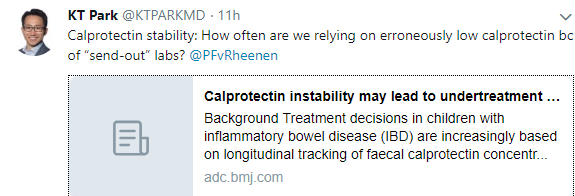
A recent study (S-M Haisma et al. Arch Dis Child http://dx.doi.org/10.1136/archdischild-2018-316584) shows that stool calprotectin levels stored at room temperature dropped nearly 20% after one day and dropped further over several days compared to baseline values, whereas calprotectin values remained reliable over six days for stool specimens stored at 4 degrees Celsius.

The authors conclude: “Calprotectin is not stable at room temperature. Children with IBD and their caretakers may be falsely reassured by low calprotectin values. The best advisable standard for preanalytical calprotectin handling is refrigeration of the stool sample until delivery at the hospital laboratory.”

Full text (link from KT Park’s twitter feed): Calprotectin instability may lead to undertreatment in children with IBD

Related blog posts:


Encouraging Healthy Eating in Hospitalized Children

Full Text (from J Peds twitter feed): All Aboard Meal Train: Can Child-Friendly Menu Labeling Promote Healthier Choices in Hospitals?  S Basak et al. J Pediatr 2019; 204: 59-65

Conclusion: “The combination of menu labeling techniques targeted to children in the inpatient hospital setting was an effective short-term tool for increasing the intake of healthier foods, although the effect of labeling waned over time.”

From the discussion: “Our findings in this study show a significantly higher odds of ordering green-light healthier option foods and lower odds of ordering red-light foods when exposed to child-friendly menu labeling. This effect waned over time, such that after 8 meals, proportions of red-light and green-light choices were similar with both menus…

Although most children’s hospital food environments include food items that have low nutritional value, this study highlights that nutrition education using menu labeling can be successfully implemented and can encourage children and their families to make healthier choices. It is our hope that labeling may also encourage hospital food providers to improve food quality at the hospital by decreasing red-light foods and increasing healthy food options at every meal. More research is needed to determine optimal techniques for various age ranges and develop menus that are age-appropriate and tailored for specific patient populations.”

My take: 1. This study from Sick Children’s is important.  We can determine more effective healthy eating strategies on a ‘captive’ audience.  2. I remember several years ago when one of my partners ruffled some feathers by asking the hospital to reconsider promoting sugar-sweetened beverages while at the same time posting billboards of obese children.

Related blog posts:


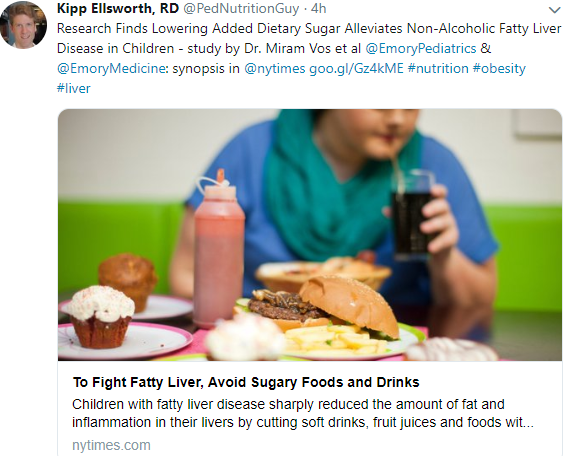
Low Free Sugar Diet for Nonalcoholic Fatty Liver Disease in Adolescent Boys

A recent randomized study (Jeffrey B. Schwimmer, MD1,2Patricia Ugalde-Nicalo, MD1Jean A. Welsh, PhD, MPH, RN3,4,5et al JAMA. 2019;321(3):256-265. doi:10.1001/jama.2018.20579) examined the beneficial effects of a low free sugar diet for Nonalcoholic Fatty Liver Disease (NAFLD) in adolescent boys.  Congratulations to the authors, particularly to Miriam Vos (my Emory colleague & corresponding author) and Jeffrey Schwimmer (whose training overlapped with mine in Cincinnati).

Key finding:

“In this randomized clinical trial that included 40 adolescent boys aged 11 to 16 years with nonalcoholic fatty liver disease followed up for 8 weeks, provision of a diet low in free sugars compared with usual diet resulted in a greater reduction in hepatic steatosis [based on MRI] from 25% to 17% in the low free sugar diet group and from 21% to 20% in the usual diet group, a statistically significant difference of −6.23% when adjusted for baseline.”

Summary of this study in NY Times: To Fight Fatty Liver, Avoid Sugary Foods and Drinks

An excerpt from NY Times:

To make the diet easier and more practical for the children in the limited-sugar group to follow, the researchers asked their families to follow it as well. They tailored the diet to the needs of each household by examining the foods they consumed in a typical week and then swapping in lower sugar alternatives. If a family routinely ate yogurts, sauces, salad dressings and breads that contained added sugar, for example, then the researchers provided them with versions of those foods that did not have sugar added to them.

Fruit juices, soft drinks and other sweet drinks were forbidden. They were replaced with unsweetened iced teas, milk, water and other nonsugary beverages. Dietitians prepared and delivered meals to the families twice a week, which helped them stick to their programs.

Full abstract:

Importance  Pediatric guidelines for the management of nonalcoholic fatty liver disease (NAFLD) recommend a healthy diet as treatment. Reduction of sugary foods and beverages is a plausible but unproven treatment.

Objective  To determine the effects of a diet low in free sugars (those sugars added to foods and beverages and occurring naturally in fruit juices) in adolescent boys with NAFLD.

Design, Setting, and Participants  An open-label, 8-week randomized clinical trial of adolescent boys aged 11 to 16 years with histologically diagnosed NAFLD and evidence of active disease (hepatic steatosis >10% and alanine aminotransferase level ≥45 U/L) randomized 1:1 to an intervention diet group or usual diet group at 2 US academic clinical research centers from August 2015 to July 2017; final date of follow-up was September 2017.

Interventions  The intervention diet consisted of individualized menu planning and provision of study meals for the entire household to restrict free sugar intake to less than 3% of daily calories for 8 weeks. Twice-weekly telephone calls assessed diet adherence. Usual diet participants consumed their regular diet.

Main Outcomes and Measures  The primary outcome was change in hepatic steatosis estimated by magnetic resonance imaging proton density fat fraction measurement between baseline and 8 weeks. The minimal clinically important difference was assumed to be 4%. There were 12 secondary outcomes, including change in alanine aminotransferase level and diet adherence.

Results  Forty adolescent boys were randomly assigned to either the intervention diet group or the usual diet group (20 per group; mean [SD] age, 13.0 [1.9] years; most were Hispanic [95%]) and all completed the trial. The mean decrease in hepatic steatosis from baseline to week 8 was significantly greater for the intervention diet group (25% to 17%) vs the usual diet group (21% to 20%) and the adjusted week 8 mean difference was −6.23% (95% CI, −9.45% to −3.02%; P < .001). Of the 12 prespecified secondary outcomes, 7 were null and 5 were statistically significant including alanine aminotransferase level and diet adherence. The geometric mean decrease in alanine aminotransferase level from baseline to 8 weeks was significantly greater for the intervention diet group (103 U/L to 61 U/L) vs the usual diet group (82 U/L to 75 U/L) and the adjusted ratio of the geometric means at week 8 was 0.65 U/L (95% CI, 0.53 to 0.81 U/L; P < .001). Adherence to the diet was high in the intervention diet group (18 of 20 reported intake of <3% of calories from free sugar during the intervention). There were no adverse events related to participation in the study.

Conclusions and Relevance  In this study of adolescent boys with NAFLD, 8 weeks of provision of a diet low in free sugar content compared with usual diet resulted in significant improvement in hepatic steatosis. However, these findings should be considered preliminary and further research is required to assess long-term and clinical outcomes.


Related blog posts: