Most Popular GutsandGrowth Posts from Past Year

These five posts were the most popular (most views) in the past year:

This is a bike path from Canmore to Banff. I had a chance to ride an electric bike which was a lot of fun.

Cirrhosis and Cardiac Function

Briefly noted: M Izzy, J Oh, KD Watt. Hepatology 2018; 68: 2008-2015.  This concise review discusses the outcome of cirrhotic cardiomyopathy after liver transplantation.

Key point: “Although it is often believed that cirrhotic cardiomyopathy resolves post-LT, the data, albeit limited, do not support this postulation…diastolic function may not improve post-transplant and may actually worsen. Improvement in systolic function was suggested by only two of six studies.”

Related blog post: Cholecardia

This figure from Hepatology November cover depicts a cirrhotic liver restricting the heart filling during diastole. (From Wiley Online Library -free access)

Which Diet is Best For a Fatty Liver?

A recent randomized controlled trial (C Properzi et al. Hepatology 2018; 68: 1741-54) compare the Mediterranean diet (MD) and a low-fat (LF) diet for non-alcoholic fatty liver disease.

A total of 48 patients completed the 12-week study and were analyzed; subjects had a mean BMI of 31.  Both groups consumed a 2400-2600 kcal diet.

Key findings:

  • Despite minimal weight loss, both groups had significant reduction in hepatic steatosis as determined by magnetic resonance spectroscopy (MRS): 25.0% in LF and 32.4% in MD.  Both had wide confidence intervals due to the small number of subjects.
  • Liver enzyme improved in both groups.
  • Weight loss was minimal, 1.6 kg and 2.1 kg in LF and MD respectively
  • Framingham Risk Score (FRS), cholesterol, triglycerides, and hemoglobin A1c were improved with MD but not with LF (all P<0.05)

The associated editorial (pg 1668-71) notes the following:

  • “Considering the current evidence, recommending the MD for patients with NAFLD might be an appropriate therapeutic option, not least because …[of the} increased risk of CVD.”
  • Longer-term RCTs are needed
  • “It has to be stressed that, in most cases, any form of healthy diet (eg. LF or MD), which leads to caloric reduction…should be encourage for patients with NAFLD…The importance of weight loss has been highlighted in patients with biopsy-proven NASH.”

My take: If you have to make a dietary recommendation, this study indicates that MD is probably a better diet than LF in patients with NAFLD.

Related blog posts:

Town of Banff


How Important Are Proton Pump Inhibitors for Intensive Care Patients?

A recent randomized, blinded study (M Krag et al. NEJM 2018; 379: 2199-2208, editorial 2263-4) describes the use of proton pump inhibitor (PPI) therapy in adults (n=3298) in the ICU at high risk for gastrointestinal bleeding. High risk features included liver disease, coagulopathy, shock, anticoagulant therapy, renal replacement treatment, and mechanical ventilation.

Key findings:

  • Stress-ulcer bleeding may be less prevalent than in the past, perhaps due to improved ICU care. GI bleeding occurred in 4.2% of placebo-treated patients compared to 2.5% of pantoprazole-treated patients
  • Overall outcomes were essentially identical. At 90 days, 510 patients (31.1%) in the pantoprazole group and 49 (30.4%) in the placebo group had died (RR 1.02).
  • Using a composite event score to weight potential good and adverse effects (eg C diff infection, myocardial infarction, bleeding, pneumonia) of PPI therapy, the authors found that this occurred in 21.9% of pantoprazole group compared with 22.6% of placebo group (22.6%).

Reduction in GI bleeding could be related in part to the more frequent use of enteral feedings.  And, the combination of enteral feeding with the use of PPI treatment may increase the risk of pneumonia.

In the associated commentary, the authors note that “prophylaxis with a PPI, if initiated, should be reserved for seriously ill patients who are at high risk for this complication.” They acknowledge a lack of a uniform definition of high risk and the “admittedly small (1.7%) difference in bleeding rates.”


Rolling Back School Lunch Standards

NY Times: Trump Administration Rolls Back Obama-Era Rules for School Lunches

An excerpt for 12/8/18:

This week, the United States Department of Agriculture announced its final plans to lower nutrition standards for grains, flavored milks and sodium in school cafeterias that were part of the Healthy, Hunger-Free Kids Act of 2010 …

The Obama-era rules required that schools must serve entirely “whole grain-rich” foods, meaning that the product — whether it is pizza, pasta or hamburger buns — must contain at least 50 percent whole grains…Under the new rules, only half of the grain products on the cafeteria’s weekly menu must be whole grain-rich….

It was unclear why the Trump administration would backtrack when schools were in good standing with the nutritional goals… more than 99 percent of schools in the country reported that they were meeting the Obama-era standards…

“It seems like a small thing,” she said. “But the behavioral research shows you have to offer nutritious food to kids over and over and be consistent.”

Related blog posts:

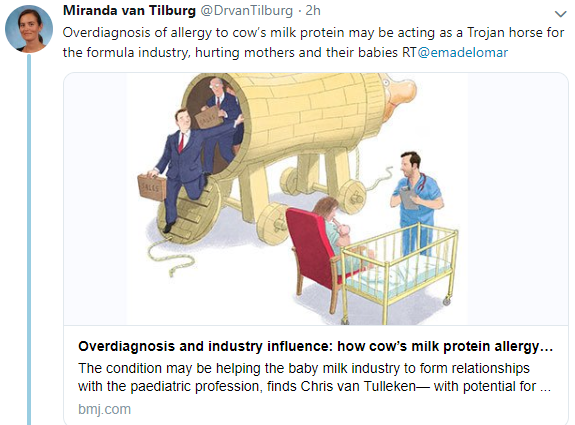
Overdiagnosis of Cow’s Milk Protein Allergy in Infants and Formula Industry Influence

From BMJ: -Link: Overdiagnosis and industry influence: how cow’s milk protein allergy is extending the reach of infant formula manufacturer

This article provides a detailed discussion of this topic. Two key points:

  • Because the diagnosis of non-IgE mediated cow’s milk protein allergy is based mainly on a formula trial/reintroduction, it is susceptible to overdiagnosis
  • Expert guidelines have been authored mainly by those with conflicts of interest

An excerpt:

Clinicians and patients who spoke to The BMJ are concerned at the wide availability of industry funded online information promoting non-specific symptoms potentially indicating cow’s milk allergy as a diagnosis in exclusively breastfed infants. Although there is evidence that cow’s milk and other food proteins can be transferred from mother to infant in breastmilk, the quantities transferred are likely to be too small to cause symptoms in most infants.


Bilary Atresia Prognosis After 2-Year Survival with Native Liver

A recent study (M Witt et al. JPGN 2018; 689-94) indicates that among patients with biliary atresia who reached 2 years of life with native liver survival (NLS), they continued to be at risk for progressive liver failure.

Key findings:

  • Upon a median follow-up of 16.4 years, NLS rates at 5, 10, 15, 18 years of age were 89%, 72%, 60%, 54%, respectively.
  • Corresponding overall survival rates were 98%, 90%, 87%, 87%, respectively
  • NLS ended in 37% by liver transplantation (LTx) and in 6% by (pre-transplant) mortality.
  • Abstract Link: Prognosis of Biliary Atresia After 2-year Survival With Native Liver

My take: This data provides more precise information for families about prognosis and reinforces the need for careful followup.

Related blog posts:

Parker Ridge, near Banff


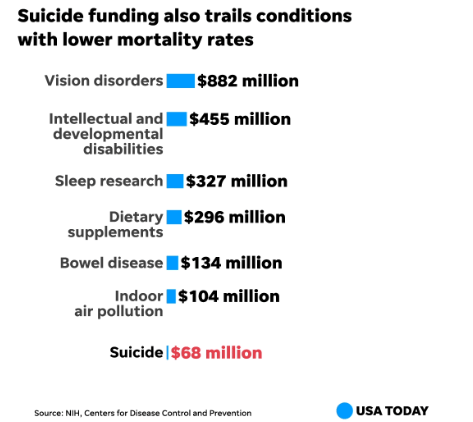
Suicide Rate Up 33% in Last 20 Years & Can We Stop It?

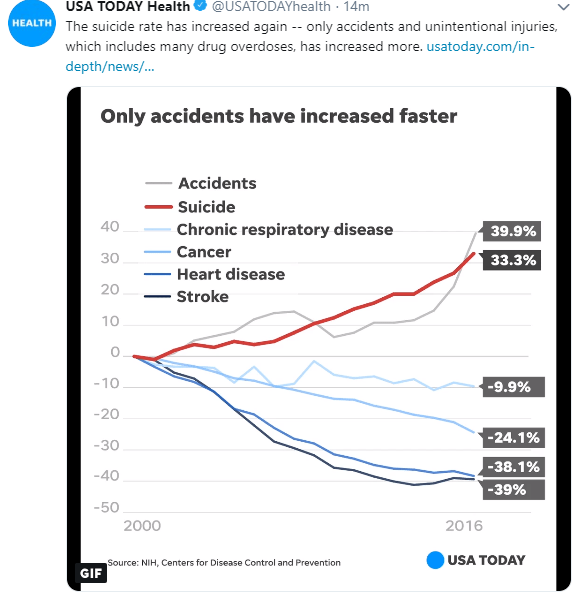
A recent article in USAToday highlights the increasing problem of suicides in U.S.:Suicide rate up 33% in less than 20 years, yet funding lags behind other top killers

Also, at the bottom of this post is more information on the topic of whether we can stop suicide from happening.

An excerpt from USAToday:

“More than 47,000 Americans killed themselves in 2017, the Centers for Disease Control and Prevention … contributing to an overall decline in U.S. life expectancy. Since 1999, the suicide rate has climbed 33 percent. 

Americans are more than twice as likely to die by their own hands, of their own will, than by someone else’s. But while homicides spark vigils and protests, entering into headlines, presidential speeches and police budgets, suicides don’t. Still shrouded in stigma, many suicides go unacknowledged save for the celebrities – Robin Williams, Kate Spade, Anthony Bourdain – punctuating the unrelenting rise in suicide deaths with a brief public outcry. 

And research suggests our ways of living may be partly to blame, in ways that don’t bode well for the future.

Alcohol and substance abuse are risk factors, and both are increasing. Isolation raises the risk, and nearly half of Americans say they sometimes or always feel alone. Increasing smartphone use has been linked to suicidal thoughts in teens. Even climate change has been found to have roughly the same effect on increasing suicides as an economic recession.”
A related commentary from the NY Times: Can We Stop Suicides? details the reasons for suicides and discusses the potential of ketamine as a treatment for depression/suicidality.


Same-Day Bowel Preparation Works for Afternoon Colonoscopies

From Gastro-Hep News: Same-Day Bowel Preparation Ideal for Afternoon Colonoscopies

An excerpt:

Same-day bowel preparation provides better cleansing and is preferred over a split-dose regimen for patients scheduled for an afternoon colonoscopy, according to results of a randomized, controlled study presented in abstract form by Dr Isabel Manzanillo-DeVore on October 9, 2018 at the American College of Gastroenterology (ACG) 2018 Annual Scientific Meeting in Philadelphia, Pennsylvania (Oral abstract 42)…

Patients in both groups were instructed to drink only clear liquids … beginning at noon the day before the colonoscopy…. In the same-day group, patients began bowel preparation at 5:30 am the day of the procedure and were told to finish a polyethylene glycol–electrolyte solution (PEG-ES; 4 L) at least 4 hours before their appointment.

Related posts:


December Liver Briefs

B Wildman-Tobriner et al. Gastoenterol 2018; 155: 1428-35.  This retrospective study which pooled data from 3 phase 2a trials with 370 subjects with nonalcoholic fatty liver disease (NAFLD) found that MRI iwth proton density fat fraction (PDFF) “did not accurately identify patients with NAS ≥4 (AUROC – 0.72) or fibrosis stage ≥3 (AUROC =0.66).”  Thus, this study indicates that currently liver histology remains the gold standard to determine severity of liver damage in paitents with NAFLD.

Related blog posts

P Nahon et al. Gastroenterol 2018; 155: 1436-1450. This study looks closer at whether direct-acting antivirals (DAA) for hepatitis C could increase the risk of hepatocellular carcinoma (HCC) in patients (n=1270) with cirrhosis. The authors found that the crude 3-year cumulative incidence of HCC were 5.9% in the DAA and 3.1% in the SVR-IFN group. However, after Cox analysis, “we found no statistically significant increase in risk of HCC associated with DAA use (HR 0.89).”  The authors indicated that patient characteristics (age, diabetes, reduced liver function) and lower screening intensity were the reasons for the increased crude rates of HCC.

Related blog post: Liver Short Takes December 2017

Love this sign –it indicates the truth of the saying:  ‘common sense is not that common’ (attributed to Voltaire)