Ozanimod for Ulcerative Colitis

The results of a phase 2 trial for Ozanimod have been published: WJ Sandborn et al. NEJM 2016; 374; 1754-62.

Ozanimod (RPC1063) is “an oral agonist of the sphingosine-1-phosphate receptor subtypes 1 and 5 that induces peripheral lymphocyte sequestration, potentially decreasing the number of activated lymphocytes circulating to the gastrointestinal tract.”

From the abstract:

METHODS

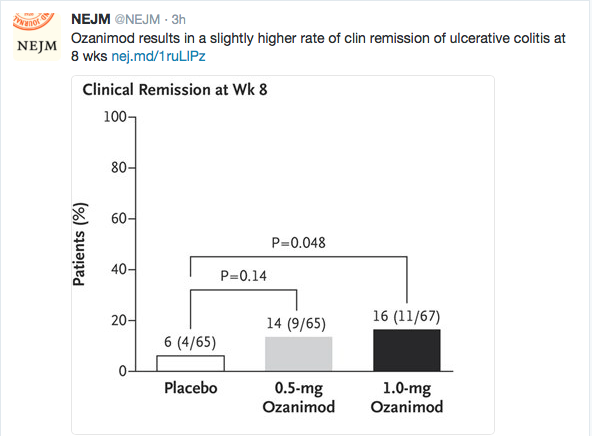
We conducted a double-blind, placebo-controlled phase 2 trial of ozanimod in 197 adults with moderate-to-severe ulcerative colitis. Patients were randomly assigned, in a 1:1:1 ratio, to receive ozanimod at a dose of 0.5 mg or 1 mg or placebo daily for up to 32 weeks. The Mayo Clinic score was used to measure disease activity on a scale from 0 to 12, with higher scores indicating more severe disease; subscores range from 0 to 3, with higher scores indicating more severe disease. The primary outcome was clinical remission (Mayo Clinic score ≤2, with no subscore >1) at 8 weeks.

RESULTS

The primary outcome occurred in 16% of the patients who received 1 mg of ozanimod and in 14% of those who received 0.5 mg of ozanimod, as compared with 6% of those who received placebo (P=0.048 and P=0.14, respectively, for the comparison of the two doses of ozanimod with placebo). Differences in the primary outcome between the group that received 0.5 mg of ozanimod and the placebo group were not significant; therefore, the hierarchical testing plan deemed the analyses of secondary outcomes exploratory. Clinical response (decrease in Mayo Clinic score of ≥3 points and ≥30% and decrease in rectal-bleeding subscore of ≥1 point or a subscore ≤1) at 8 weeks occurred in 57% of those receiving 1 mg of ozanimod and 54% of those receiving 0.5 mg, as compared with 37% of those receiving placebo. At week 32, the rate of clinical remission was 21% in the group that received 1 mg of ozanimod, 26% in the group that received 0.5 mg of ozanimod, and 6% in the group that received placebo; the rate of clinical response was 51%, 35%, and 20%, respectively. At week 8, absolute lymphocyte counts declined 49% from baseline in the group that received 1 mg of ozanimod and 32% from baseline in the group that received 0.5 mg. The most common adverse events overall were anemia and headache.

CONCLUSIONS

In this preliminary trial, ozanimod at a daily dose of 1 mg resulted in a slightly higher rate of clinical remission of ulcerative colitis than placebo. The trial was not large enough or of sufficiently long duration to establish clinical efficacy or assess safety. (Funded by Receptos; TOUCHSTONE ClinicalTrials.gov number, NCT01647516.)
Ozanimod

Related blog post: CCFA Conference Notes 2016 (part 5) -Emerging Therapies …

 

Endoscopic Surveillance after Esophageal Atresia: Low Yield In Pediatrics

A recent study of patients who had undergone repair of esophageal atresia (Koivusalo et al. JPGN 2016; 62: 562-66) confirms that “routine endoscopic surveillance had limited benefit and seems unnecessary” before 15 years of age.

A retrospective review of pediatric patients with esophageal atresia (EA) from 1980-2014) identified 209 patients with 616 biopsies.  60 patients had undergone antireflux surgery. Key findings:

  • Gr I esophagitis was noted in 37%, Gr II or III in 16%.
  • Gastric metaplasia was found in 17% and reached a prevalence of 15% by age 15 years.
  • Only 9% of patients with gastric metaplasia and 32% of patients with gr II esophagitis were symptomatic.
  • No cases of dysplasia or cancer were identified.

My take: Conditions, including esophageal atresia, that predisposed to chronic reflux esophagitis increase the risk of esophageal malignancy; however, this risk remains very low in childhood.  Therefore, surveillance for asymptomatic children is not needed prior to age 15 years.

Related blog postNever quite right | gutsandgrowth

Vik Muniz recreation of Mary Cassatt painting

Vik Muniz recreation of Mary Cassatt painting

Up close, one sees this painting is actually a collage of images

Up close, one sees this painting is actually a collage of images

Disclaimer: These blog posts are for educational purposes only. Specific dosing of medications/diets (along with potential adverse effects) should be confirmed by prescribing physician/nutritionist.  This content is not a substitute for medical advice, diagnosis or treatment provided by a qualified healthcare provider. Always seek the advice of your physician or other qualified health provider with any questions you may have regarding a condition.

Extent of Disease: Microscopic or Endoscopic Classification?

Several recent articles highlight the divergence between microscopic and endoscopic classification of disease.

  • Verstraete et al. JPGN 2016; 62: 242-5.
  • Asthon et al. JPGN 2016; 62: 246-51.
  • Pashankar et al. JPGN 2016; 62: 314-16.

The first two references describe histology in comparison to endoscopic extent of disease in pediatric Crohn’s and the 3rd reference provides information on the finding of “duodenitis.”

Verstraete et al selected 60 patients  randomly from their cohort for retrospective review.  Two physicians independently reviewed the patients.  In describing extent of disease, the extent of disease (Paris Classification) was discordant in 34 (56.6%) when comparing  macroscopic disease (imaging and endoscopy) to macroscopic/microscopic combined.  In addition, there was high interobserver variability of the physicians when the physicians reviewed just macroscopic findings (κ= 0.53).

Asthton et al examined data from 172 pediatric patients with inflammatory bowel disease.  They found that histologic disease was more extensive than endoscopic findings.  For example, among those with ileal biopsies, 49% had endoscopic findings compared with 71.3% having histologic disease.

Currently, the Paris classification relies on endoscopic findings; however, together these two studies suggest that the microscopic findings need to be considered as well. How often areas with microscopic disease will eventually develop endoscopic lesions is not clear.

Pashankar et al, reviewed pathology reports over a 5-year periods with 2772 children (mean age 10.6 years).  They identified duodenitis in 352 with a prevalence rate of 12.7%. Gastritis was seen in 64% of children with duodenitis. Interestingly, 63% of the cases with histologic duodenitis had normal endoscopic appearance. Reported reasons for duodenitis:

  • Celiac disease 32%
  • Crohn’s disease 13%
  • Ulcerative colitis 3%
  • Helicobacter pylori infection 6%
  • Functional dyspepsia 7%

The remaining children (36%) were considered to have nonspecific duodenitis.  The authors state: “this finding is similar to the high percentage of nonspecific duodenitis (60%) in adults.”

My take: It is difficult to know how important microscopic findings are in many cases.  With inflammatory bowel disease, whether/how to incorporate microscopic findings in classification is unclear.  With regard to the finding of microscopic duodenitis, when a specific etiology has not been identified, this leads to lots of questions:

  • How important is this finding?
  • How should this be treated?
  • How much additional workup and followup is needed?
  • How helpful is your pathologist –is the threshold for abnormality too low histologically?

Related blog posts:

marriage colonoscopy

What I did not know …a few items

  1. 6-Mercaptopurine (6-MP) often can be used when patients are intolerant of azathioprineS Hubener et al. Clin Gastroenterol Hepatol 2016; 14: 445-53.  This retrospective study showed that 15 of 20 patients with autoimmune hepatitis and prior azathioprine intolerance responded to 6-MP.  This is somewhat unexpected as azathioprine is metabolized into 6-MP.  However, rather than 6-thiouracil, the “imidazol component of azathioprine, which is cleaved off…might trigger adverse reactions.”  Another artical on thiopurines (Aliment Pharmacol Ther 2016; 43: 863-883) (thanks to Ben God for this reference) provides a thorough review of the pharmacogenetics and pharmocokinetics of these medications.  While this review reinforces the recommendation to check TPMT before treatment, it notes that only a small proportion of thiopurine toxicity is related to deficient TPMT activity.
  2. There is no formal validated or consensus definitions of mild, moderate, or severe IBD. L Peyrin-Biroulet et al. Clin Gastroenterol Hepatol 2016; 14: 348-54.  While the Lemann index measures the cumulative structural bowel disease, the authors propose criteria which involves three areas of severity: impact of the disease on the patient (eg. clinical symptoms), inflammatory burden (eg. biomarkers, mucosal disease, disease extent), and disease course (eg. structural disease, intestinal resection, perianal disease, extraintestinal manifestations)
  3. Fundic gland polyps (often associated with proton pump inhibitor therapy) are not premalignant lesions. There is an “inverse correlation between the FGPs and gastric neoplasia.” S Varghese et al. Gastroenterol Hepatol; 2016; 12: 153-4.
  4. Parents of newborns do not know how to use car seats.  BD Hoffman et al (J Pediatr 2016; 171: 48-54) showed that 95% of car seats were misused (291 families).  Serious misuse was present in 91%.


Related blog posts: Lemann index: Short Takes on IBD Articles | gutsandgrowth

Gibbs Gardens has >20 million daffodils

Gibbs Gardens has >20 million daffodils

Mirtazapine for Functional Dyspepsia

In a randomized, placebo-controlled pilot study (J Tack et al. Clin Gastroenterol Hepatol 2016; 385-92) with 34 patients (29 women, median age 35.9 years), the authors showed improved dyspepsia symptom scores at weeks 4 and 8 compared with baseline.

Background: Mirtazapine is an antidepressant which is associated with weight gain and improvement in nausea.

Methods: The treatment group received 15 mg each day.

Results:

  • Compared with the control group, these was improvement in early satiety, quality of life, GI-specific anxiety, nutrient tolerance, and weight loss.
  • Two patients in the treatment group dropped out due drowsiness.  Interestingly, the trend of improvement was greater at week 4 then for week 8.
  • The authors note that epigastric pain and burning did not improve.

Limitations: small number of patients, and tertiary care patient population

My take: more studies are needed for this vexing problem

Related blog posts:

Disclaimer: These blog posts are for educational purposes only. Specific dosing of medications/diets (along with potential adverse effects) should be confirmed by prescribing physician/nutritionist.  This content is not a substitute for medical advice, diagnosis or treatment provided by a qualified healthcare provider. Always seek the advice of your physician or other qualified health provider with any questions you may have regarding a condition.

Fountain at Gibbs Gardens

Fountain at Gibbs Gardens


Chronic Granulomatous Disease and GI Involvement

Chronic granulomatous disease associated inflammatory bowel disease primarily involves the anus and rectum (SK Khangura et. al. Clin Gastroenterol Hepatol 2016; 14: 395-402).  In this study from the NIH, among 78 patients with CGD-IBD enteric fisula were found in 18% (73% were perianal), colonic stictures were noted in 24% (80% in anorectal area).

Other findings:

  • -EGD showed inflammation in 21%, 74%, and 37% of patients in esophageal, gastric and duodenal biopsies respectively
  • -Small bowel disease was unusual, though two of the four patients with ileostomies had ileal ulcers
  • -” ‘Target-like lesions,’ which have a clear elevated center with surrounding erythema, were characteristic of mild disease
  • -Approximately 40% of CGD patients have GI tract involvement
  • -GI tract malignancy was not observed in this cohort
  • -24 patients had pancolitis

My take: This reference provides comprehensive details of the clinical features of a large cohort with CGD.

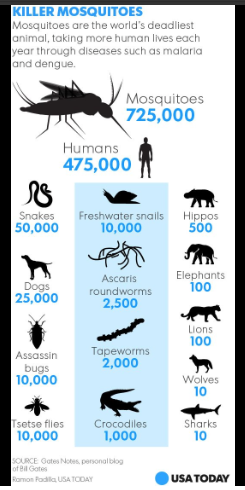
Which animals kill the most humans

Which animals kill the most humans

Understanding the Risks of Propofol for Colonoscopy

A recent article & editorial (KJ Wernli et al. Gastroenterol 2016; 150: 888-94 & 801-2) shows that the use of propofol, delivered by an anesthetist, is associated with a small increase risk of adverse events.  This finding goes against assumptions that there would be reduced complications with an anesthesia expert in the room who could manage resuscitation and airway problems.

The study analyzed claims data from more than 3 million colonoscopies in the U.S between 2008-2011 in 40-64 year-olds.

Key findings:

  • Use of anesthesia was associated with a 13% increase in the risk of any complications within 30 days.
  • The increased risk included perforation (OR 1.07), hemorrhage (OR 1.28), and abdominal pain (OR 1.07).  Interestingly, the perforation risk was increased only in those undergoing polypectomy (OR 1.26) indicating that some confounders may have been difficult to eliminate.
  • Complications secondary to anesthesia were present as well (OR 1.15) and stroke (OR 1.04).

This is not the first study to associate anesthesia with increased risk of aspiration and mechanical complications (Cooper G et al. JAMA Intern Med 2013; 173: 551-6). It is certainly possible that the increased risk is due in part to patient selection, despite attempts to control for this.

It is also important to note that better sedation has not resulted in improved colonoscopy outcomes like increased polyp detection.

Will these results change anything? No.

The small increased safety risk (detectable only in studies of millions of patients), if accurate, is not going to stop the use of anesthesia services for two reasons.

  1. Patient satisfaction
  2. Financial incentives

Patient satisfaction.  Propofol results in excellent sedation, often with complete absence of pain combined with rapid recovery and an antiemetic effect.

Financial incentives.  Many endoscopists are able to employ an anesthetist and generate additional revenue by billing for sedation (in addition to the costs of the endoscopist), whereas this is not allowed with the combination of intravenous opioids/benzodiazepines used for ‘deep sedation.’  Even in the many who do not receive revenue for these services, the rapid recovery expedites patient care and room turnover.

My take: While propofol administered by anesthetists is a little less safe and more expensive, it is here to stay, at least until incentives are created to reconsider this approach.

Georgian Terrace

Georgian Terrace

More on Anti-TNF Drug Levels (part 2) and a Few Mentions

Another study (K Papamichael et al. Clin Gastroenterol Hepatol 2016; 14: 543-9) examined therapeutic drug levels with regard to infliximab induction and mucosal healing.

In this retrospective study with 101 patients with ulcerative colitis, 54 (53.4%) achieved mucosal healing between weeks 10-14, defined by a Mayo endoscopic score of 0 or 1.  97% of patients were treated with 5 mg/kg infusions.

Key finding:

  • Infliximab threshold concentrations of 28.3 mcg/mL at week 2, 15 mcg/mL at week 6, and 2.1 mcg/mL at week 14 were associated with mucosal healing.

My take: While this study provides information on what type of levels to expect at 2, 6, and 14 weeks, what is really important is figuring out which patients need higher doses of infusions from the start.

Unrelated, briefly noted:

R Yadlapati et al. Clin Gastroenterol Hepatol 2016; 14: 535-42. In this prospective blinded cohort study of 59 subjects, oropharyngeal pH testing (Restech Dx-pH) and salivary pepsin analysis was not able to distinguish between healthy volunteers and subjects with a combination of laryngeal and reflux symptoms.

M Moris et al. Clin Gastroenterol Hepatol 2016; 14: 585-93. This study reports increasing findings of small pancreatic cysts with more (and better) MRI imaging.

Y Kawamura et al. Clin Gastroenterol Hepatol 2016; 14: 597-605. This retrospective study shows, among almost 10,000 patients with fatty liver disease, that alcohol consumption of ≥40 g/day is an independent risk factor for hepatocellular carcinoma.

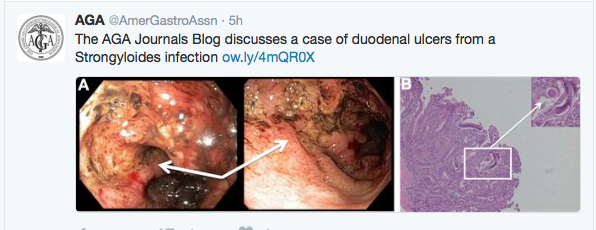
Strongloides

More on Anti-TNF Drug Levels

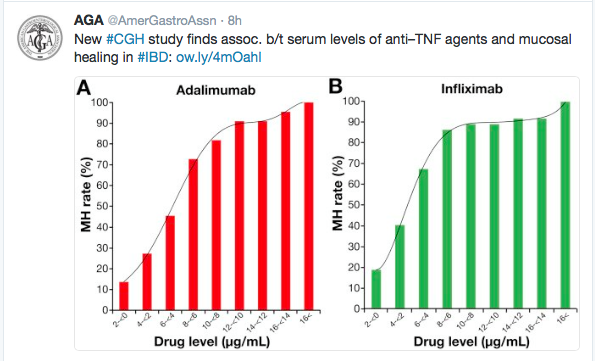
B Ungar et al (Clin Gastroenterol Hepatol 2016; 14: 550-7) report median serum levels of infliximab (n=78) or adalimumab (n=67) in correlation with mucosal healing.

In this retrospective cross-sectional study of adult patients with IBD (median age ~35 years), the authors found a correlation with higher drug troughs and mucosal healing.

“Levels of infliximab above 5 mcg/mL…and levels of adalimumab above 7.1 mcg/mL identified patients with mucosal healing with 85% specificity. Increasing levels of infliximab above 8 mcg/mL produced only minimal increases in the rate of mucosal healing, whereas the association between higher level of adalimumab and increased rate of mucosal healing reached a plateau at 12 mcg/mL”

The authors propose a “therapeutic window” of 6-10 for infliximab and 8-12 for adalimumab.

Clin Gastro Trough Levels

Remarks from DDW

Remarks from DDW

Oral Cancer and Inflammatory Bowel Disease

A recent study (KH Katsanos et al. Clin Gastroenterol Hepatol 2016; 14: 413-20) shows an increased risk of oral cancers in patients with inflammatory bowel disease (IBD). Because these cancers are infrequent, the absolute risk remains low.  However, this study provides some further insight into why other cancers may occur more often in IBD as well.

This retrospective study collated data on 7294 patients with IBD seen at a single New York center (2000-2011).  Key findings:

  • 11 patients (7 male) developed biopsy-proven oral cancer, most commonly of the tongue (n=6).  The overall oral cancer age-adjusted standardized incidence ration (SIR) was 9.77 and the SIR for tongue was 18.91.  These numbers could be influenced by a referral bias.
  • The average age for oral cancer in this study was 44 years.
  • Prior treatment for IBD had occurred in 7 patients, including 4 with a thiopurine, 1 with infliximab, and 3 with combination therapy.
  • One patient died.

Discussion:

  • Traditional risk factors for oral cancer: tobacco exposure (smoking, oral tobacco) and alcohol consumption.
  • The authors speculate that in their population that acquiring oncogenic HPV virus may have contributed to increased risk.  This is clearly a risk with cervical cancer which has been reported as increased in IBD populations as well.

Related blog postCancers Complicating Inflammatory Bowel Disease | gutsandgrowth

Gibbs Gardens

Gibbs Gardens