Good Food and Bad Food for Crohn’s Disease -No Agreement

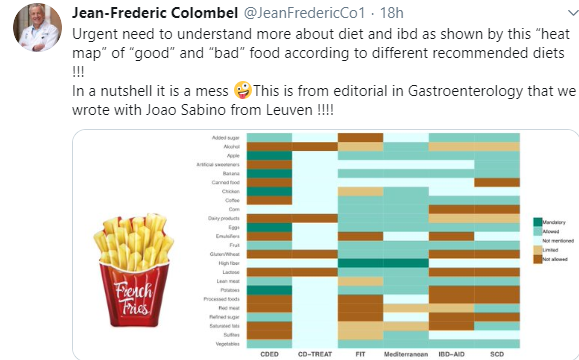
As noted in a previous blog (IBD Briefs August 2019), there have been numerous diets proposed to help with Crohn’s disease.   The chart below illustrates the lack of any consensus.

Related blog posts:

Canadian Pediatric Guidelines for Crohn’s Disease

DR Mack et al. Gastroenterol 2019; 157: 320-48Full Text: Canadian Association of Gastroenterology Clinical Practice Guideline for the Medical Management of Pediatric Luminal Crohn’s Disease

“When the consensus group met in October 2017, the most recent consensus guidelines for the treatment of CD in pediatric patients were those from” ESPGHAN/ECCO in 2014 with data from June 2013. Thus, the guideline attempts to provide more updated information and recommendations based on incorporating the latest studies.

The authors provide 25 consensus statements.  Here are a few of interest:

  • Recommendation 9: In patients with CD, we suggest exclusive enteral nutrition to induce clinical remission (Recommendation 6 recommends steroids as a treatment for clinical remission; adult Canadian guidelines recommended against using exclusive enteral nutrition)
  • Recommendation 11: In patients with CD in remission, we suggest that if partial enteral nutrition is used it should be combined with other medications to maintain clinical remission.
  • Recommendation 20: When starting infliximab in males, we suggest against using it in combination with a thiopurine.
  • Recommendation 24: In patients with moderate to severe CD who fail to achieve or maintain clinical remission with anti-TNF–based therapy, we suggest ustekinumab to induce and maintain clinical remission.
  • Recommendation 25: In patients with CD, we recommend against cannabis or derivatives to induce or maintain remission.

In addition, the authors provide 13 statements with no recommendations -here are two of them:

  • No consensus J: When starting infliximab in females, the consensus group does not make a recommendation (for or against) regarding combining it with a thiopurine to maintain a durable clinical remission.
  • No consensus L: In patients with CD who have achieved a clinical remission with anti-TNF therapy, the consensus group does not make a recommendation (for or against) regarding assessment for mucosal healing within the first year to determine the need to modify therapy.

Crater Lake, OR

IBD Briefs August 2019

A Levine et al. Gastroenterol 2019; 157: 440-50.  This study found that a Crohn’s Disease Exclusion Diet plus partial enteral nutrition induced sustained remission in a 12-week prospective randomized controlled trial with 74 children.  At week 12, “76% of 37 children given CDED plus PEN were in corticosteroid-free remission compared with 14 (45.1%) of 31 children given” EEN followed by PEN.  The associated editorial on pages 295-6 provides a useful diagram of various dietary therapy components for a large number of diets that have been given for IBD.  The editorial recommends:

“For now, simple dietetic recommendations such as consuming a well-balanced diet prepared largely from fresh ingredients and thereby avoidance of emulsifiers and additives and processed foods are appropriate for all patients.  In select patients,…a trial of dietary therapy alone with a diet such as CDED could be attempted for a short period of time, with close follow-up, and with agreement with the patient that failure to fully respond is an indication to escalate therapy.”  More dietary trials are ongoing.

Related blog posts:

NJ Samadder et al Clin Gastroenterol Hepatol 2019; 17: 1807-13. In this cohort from Utah 1996-2011 with 9505 individuals with IBD, 101 developed colorectal cancer.  Standardized incidence ratio (SIR) for CRC in patients with Crohn’s disease was 3.4, in ulcerative colitis 5.2, in patients with primary sclerosing cholangitis 14.8.  A family history of CRC increased the risk of CRC in patients with IBD to 7.9 compared to general population.  Family hx/o CRC increased the SIR by about double the CRC risk in IBD patients without a family hx/o CRC.

CR Ballengee et al. Clin Gastroenterol Hepatol 2019; 17: 1799-1806. In this study with 161 subjects from the RISK cohort, the authors found that elevated CLO3A1 levels in subjects with CD was associated with the development of stricturing disease but was not elevated in those with strictures at presentation and in those who did not develop  strictures.

AL Lightner et al IBD 2019; 25: 1152-68.  Short- and Long-term Outcomes After Ileal Pouch Anal Anastomosis in Pediatric Patients: A Systematic Review.  This review included 42 papers.

  • Rates of superficial surgical site infection, pelvic sepsis, and small bowel obstruction at <30 days were 10%, 11%, and 14% respectively.
  • Rates of pouchitis, stricture, chronic fistula, incontinence and pouch failure were 30%, 17%, 12%, 20% and 8% respectively with followup between 37-109 months.
  • Mean 24-hour stool frequency was 5.

MC Choy et al IBD 2019; 25: 1169-86.  Systematic review and meta-analysis: Optimal salvage therapy in acute severe ulcerative colitis.  Among 41 cohorts (n=2158 cases) with infliximab salvage, overall colectomy-free survival was 69.8% at 12 months.  The authors could not identify an advantage of dose-intensification in outcomes, though this was used more often in patients with increased disease severity, “which may have confounded the results.”

Hood River, OR

Combination Therapy Study Points to Central Role of Adequate Drug Levels

A recent study (JF Colombel et al. Clin Gastroenterol Hepatol 2019; 17: 1525-32) examines the effect of combination therapy and drug levels in achieving corticosteroid-free remission at week 26 (CSFR26).

The authors performed a post hoc analysis from 206 patients with Crohn’s disease (CD): 97 monotherapy with infliximab & 109 with combination infliximab/azathioprine

Key findings:

  • The proportions of patients achieving CSFR26 were not significantly greater among those receiving combination therapy vs monotherapy within the same serum infliximab concentrations
  • Mean trough infliximab concentrations in the combination therapy were higher than for monotherapy: 3.54 mcg/mL vs. 1.55 mcg/mL
  • Higher levels of antidrug antibodies were seen with monotherapy: 35.9% vs 8.3% of those with combination therapy.  Antidrug antibodies were detected only in those with lowest quartile of infliximab trough levels.

My take: This study indicates that combination therapy’s higher efficacy is due to  favorable pharmacokinetics rather than drug synergy.  If good infliximab trough levels can be achieved with infliximab monotherapy, this may obviate the need for combination therapy.  The uncertain factor is whether closer attention to trough levels will minimize the development of antidrug antibodies as effectively as the use of combination therapy.

Related blog posts:

Disclaimer: These blog posts are for educational purposes only. Specific dosing of medications/diets (along with potential adverse effects) should be confirmed by prescribing physician/nutritionist.  This content is not a substitute for medical advice, diagnosis or treatment provided by a qualified healthcare provider. Always seek the advice of your physician or other qualified health provider with any questions you may have regarding a condition.

Sagrada Familia, Barcelona

Red Meat for Dietary Cynics

A recent randomized study (L Albenberg et al. Gastroenterol 2019; 157: 128-36) examined whether a diet low in red or processed meats could reduce rates of Crohn’s disease (CD) flares.

Methods: Adults with CD were recruited into the FACES (Food and Crohn’s Disease Exacerbation Study) trial from 2013 to 2015. Participants were recruited from an internet-based cohort (n=15,600).  Eligible participants (consumed red meat at least once a week & in remission) were randomly assigned to high meat, n=118 (minimum of 2 servings per week) or low meat, n=96 (no more than 1 serving per month).  Outcomes were based on changes in sCDAI scores or need for treatment (new medication or surgery)

Key findings:

  • Any relapse occurred in 62% of participants in the high meat group compared to 42% in the low meat group.  This was not statistically significant.
  • At week 20, 18 participants in each arm had a stool calprotectin with the high meat group having a higher median: 74.5 mcg/g compared to 36.0 mcg/g (P=.13)
  • The high meat group did consume at least 2 servings per week in 98.5% of observed weeks compared to 18.8% of the low meat group.

Limitations:

  • Small number of diet participants
  • Study was not blinded and only a subset included more objective markers of response
  • Whether complete avoidance of red meat/processed meats would be more effective is unclear
  • In those in remission at baseline, it could take longer for the benefits of a dietary intervention to become evident

My take:  Limiting consumption of red and processed meats (particularly if meat is not lean) has been shown to have cardiovascular benefits.  While this study does not show a statistically-significant improvement in relapse rates in this cohort with Crohn’s disease, there are still strong arguments that a diet with increased fruits/vegetables and less red/processed meats would be beneficial.

Related Blog Posts:

Disclaimer: These blog posts are for educational purposes only. Specific dosing of medications/diets (along with potential adverse effects) should be confirmed by prescribing physician/nutritionist.  This content is not a substitute for medical advice, diagnosis or treatment provided by a qualified healthcare provider. Always seek the advice of your physician or other qualified health provider with any questions you may have regarding a condition.

Sagrada Familia, Barcelona

Vitamin D Supplementation Did Not Improve Postsurgical Outcomes in Patients with Crohn’s Disease

Link from Kipp Ellsworth Twitter Feed: Healio Gastro: Vitamin D does not prevent Crohn’s recurrence after resection

Re: Duijvestein M, et al. Abstract 144. Presented at: Digestive Disease Week; May 18-21, 2019; San Diego.

Background: “Researchers conducted a placebo-controlled trial comprising 143 patients with CD to assess the potential anti-inflammatory effects of vitamin D. Patients were randomly assigned to receive either 25,000 International Units of vitamin D3 (n = 72) or placebo (n = 71) weekly for 6 months after their first or second ileocolonic resection.”

Key Finding: “While serum vitamin D levels increased in the vitamin D group and remained unchanged in the placebo group, investigators found no difference in the incidence or severity of endoscopic recurrence at week 26 between the two groups. Cumulative clinical recurrence rates at week 26 were also comparable.”

Related blog posts:

Disclaimer: These blog posts are for educational purposes only. Specific dosing of medications/diets (along with potential adverse effects) should be confirmed by prescribing physician/nutritionist.  This content is not a substitute for medical advice, diagnosis or treatment provided by a qualified healthcare provider. Always seek the advice of your physician or other qualified health provider with any questions you may have regarding a condition

Madrid view from Círculo de Bellas Artes


AGA Recommendations for Management of Functional Symptoms in Patients with Inflammatory Bowel Disease

Full text: AGA Clinical Practice Update on Functional Gastrointestinal Symptoms in Patients With Inflammatory Bowel Disease: Expert Review (JF Columbel et al. Clin Gastroenterol Hepatol 2019; 17: 380-90).

My take: Overall, this article presents a concise review of a tricky problem and appropiriate management.  The algorithm, tables and figures are useful.

Best practice advice 1: A stepwise approach to rule-out ongoing inflammatory activity should be followed in IBD patients with persistent GI symptoms (measurement of fecal calprotectin, endoscopy with biopsy, cross-sectional imaging).

In the report, the authors note that endoscopy and cross-sectional imaging are not needed in all patients; mainly in patients with a suspected flare based on presentation, calprotectin, and blood work.

Best practice advice 2: In those patients with indeterminate fecal calprotectin levels and mild symptoms, clinicians may consider serial calprotectin monitoring to facilitate anticipatory management.

Best practice advice 3: Anatomic abnormalities or structural complications should be considered in patients with obstructive symptoms including abdominal distention, pain, nausea and vomiting, obstipation or constipation.

Best practice advice 4: Alternative pathophysiologic mechanisms should be considered and evaluated (small intestinal bacterial overgrowth, bile acid diarrhea, carbohydrate intolerance, chronic pancreatitis) based on predominant symptom patterns.

Best practice advice 5: A low FODMAP diet may be offered for management of functional GI symptoms in IBD with careful attention to nutritional adequacy.

Best practice advice 6: Psychological therapies (cognitive behavioural therapy, hypnotherapy, mindfulness therapy) should be considered in IBD patients with functional symptoms.

Best practice advice 7: Osmotic and stimulant laxative should be offered to IBD patients with chronic constipation.

Best practice advice 8: Hypomotility agents or bile-acid sequestrants may be used for chronic diarrhea in quiescent IBD.

Best practice advice 9: Antispasmodics, neuropathic-directed agents, and anti-depressants should be used for functional pain in IBD while use of opiates should be avoided.

Best practice advice 10: Probiotics may be considered for treatment of functional symptoms in IBD.

Best practice advice 11: Pelvic floor therapy should be offered to IBD patients with evidence of an underlying defecatory disorder.

Best practice advice 12: Until further evidence is available, fecal microbiota transplant should not be offered for treatment of functional GI symptoms in IBD.

Best practice advice 13: Physical exercise should be encourage in IBD patients with functional GI symptoms.

Best practice advice 14: Until further evidence is available, complementary and alternative therapies should not be routinely offered for functional symptoms in IBD.

Monticello

Mortality Risk from Childhood Inflammatory Bowel Disease

A recent study (O Olen et al. Gastroenterol 2019; 156: 614-22) was summarized quite succinctly by NEJM journal watch:

Using the Swedish National Patient Registry data, investigators identified 9442 incident cases of IBD diagnosed in patients under age 18 years from 1964 through 2014. Based on 139,000 person-years of follow-up, results were as follows:

  • There were 259 deaths among people with IBD (133 were from cancer and 54 from digestive disease).
  • The all-cause mortality rate in these patients was 2.1/1000 person-years, compared with 0.7 in matched reference individuals from the general population.
  • The average age at death was 61.7 compared with 63.9 years in the reference group.
  • The hazard ratio for death was 3.2 and was higher in those with ulcerative colitis (HR, 4.0), especially if they had concomitant primary sclerosing cholangitis (HR, 12.2), a first-degree relative with ulcerative colitis (HR, 8.3), or a history of surgery (HR, 4.6).
  • Mortality risks were similar when limited to the period after the introduction of biologics (2002–2014).

My take: This study found that having IBD diagnosed in childhood increased the risk of mortality (~1 extra death for every 700 patients followed for 1 year) especially in patients with concomitant PSC and in patients with severe ulcerative colitis.  The study did not see an effect of the newest therapies but was underpowered to directly assess this effect.

Related blog post:


Chattahoochee River, near Azalea Drive


NY Times: Five Things I Wish I’d Known Before My Chronic Illness

A recent article describes some of the challenges of dealing with Crohn’s disease (thanks to Kayla Lewis for pointing out this reference).

NY Times: Five Things I Wish I’d Known Before My Chronic Illness

Key Points:

  • Your relationships change” “It’s hard to be a good employee when you need extended time off. It’s hard to be a good friend when you cancel plans last minute. It’s hard to be a good partner or parent when you barely have the energy to get out of bed. “
  • Everyone offers you advice” “So unless someone asks for your advice, don’t offer it. If you’re on the receiving end of misguided advice, say something like, “I appreciate that you’re trying to help, but my doctors and I think this treatment is best right now” or “There’s no known cure for my disease, but I’d love if you donated toward the research to find one!”
  • You have to educate yourself — and everyone else
  • Support is everything”  Online communities can be helpful. ” The Crohn’s and Colitis Foundation has resources to help you find one. For a sometimes embarrassing “bathroom disease” like IBD, this is especially vital.”

Joshua Tree National Park