Dupixent Data in 1-11 year olds:


Rumination -clinical diagnosis:



Dupixent Data in 1-11 year olds:
Rumination -clinical diagnosis:
JAM Sleutjes et al. Inflamm Bowel Dis 2023; 29: 531-538. Open Access! Lipid Changes After Induction Therapy in Patients with Inflammatory Bowel Disease: Effect of Different Drug Classes and Inflammation
In this prospective study (n=198), the authors examined lipid profile changes at week 10 in patients starting IBD medications: corticosteroids, thiopurines, methotrexate, anti-TNF-α agents, vedolizumab, ustekinumab, and tofacitinib.
Key findings:
My take: Recent studies have provided some reassurance regarding tofacitinib and the risk of major adverse cardiovascular events (MACEs) (see posts below). Nevertheless, it seems prudent to monitor lipids in patients receiving JAK inhibitors.
Related blog posts:





ML Schilsky et al. Hepatology 2023; 77: 1428-1455. Open Access! A multidisciplinary approach to the diagnosis and management of Wilson disease: Executive summary of the 2022 Practice Guidance on Wilson disease from the American Association for the Study of Liver Diseases
This article is an excellent review of Wilson disease (WD). It reviews clinical manifestations, disorders with overlapping findings and recommendations for diagnosis/management. “This executive summary provides a condensed overview, including the clinical algorithms, tables, and full complement of guidance statements.” Though this ‘summary’ is a lengthy publication, “the full Guidance document with comprehensive text, complete references, and supplementary materials (“A Multidisciplinary Approach to the Diagnosis and Management of Wilson Disease: 2022 Practice Guidance on Wilson Disease from the American Association for the Study of Liver Diseases”) is available on the American Association for the Study of Liver Diseases (AASLD) website (https://doi.org/10.1002/hep.32801).”
Some of the recommendations:
The Leipzig score for diagnosis of Wilson disease may aid in diagnosis
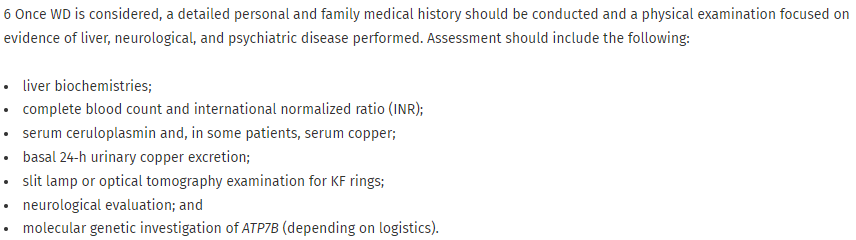




My take: This is a useful guidance and the tables/algorithms should help with both diagnosis and treatment adjustment. In my limited experience with WD, I have had a lot of difficulty with adherence to treatment in the small sample of patients under my care.
Related blog posts:
KR Conover et al. JPGN 2023; 76: 440-446. Fecal Microbiota Transplantation for Clostridioides difficile Infection in Immunocompromised Pediatric Patients
In this multicenter retrospective cohort (n=42), the authors examined the efficacy and safety of fecal microbiota transplantation (FMT) in immunocompromised (IC) children with Clostridioides difficile infection (CDI). Etiology of IC included: solid organ transplantation (18, 43%), malignancy (12, 28%), primary immunodeficiency (10, 24%), or other chronic conditions (2, 5%)
Key findings:
My take: Though there are the potential for significant adverse effects, FMT is effective in a high percentage of immunocompromised children with CDI.
Related blog posts:



Today.com 5/5/23: Should 3rd graders learn how to use tourniquets for school shootings? Texas bill says yes
——
A Arshad et al. JPGN 2023; 76: 424-427. Reduced Presentation of Biliary Atresia During the COVID-19 Lockdown: A Population Based Observational Study
Methods: This population study assessed all confirmed cases of BA, from January 2020 to December 2021 across the 3 UK pediatric liver centers originating from England and Wales. Data was then compared to the incidence of confirmed BA cases from January to December 2017, 2018, and 2019.
Key findings -BA cases:
The authors note that new BA diagnoses were reduce among Danish centers as well. In their discussion, the authors discuss the possibility of missed diagnosis versus an actual drop in BA cases. The later is intriguing due to concerns that perinatal infections could trigger BA.
My take: This study provides a piece of a puzzle regarding the etiology of BA, indicating a good likelihood of environmental/infectious etiologies as a trigger.
Related blog posts:

S Harpavat et al. Hepatology 2023; 77: 862-873. Open Access! Serum bile acids as a prognostic biomarker in biliary atresia following Kasai portoenterostomy
Methods: Participants with biliary atresia from the Childhood Liver Disease Research Network, in a prospective observational cohort, were included if they had normalized bilirubin levels 6 months after KP and stored serum samples from the 6‐month post‐KP clinic visit.
Key Findings:
My take: Only a fraction of children with BA normalize their bilirubin by 6 months after Kasai procedure. In those with normalized bilirubin (T bilirubin <1.5 mg/dL or conjugated <0.2 mg/dL), elevated serum bile acid levels indicate a high risk for progressive liver disease.

Related blog posts:
NPR (5/1/23): Why an NBA star’s response to a reporter’s question about losing hit a nerve
Some excerpts:
Antetokounmpo, after being asked if he considered the past season a failure:
Do you get a promotion every year at your job? No, right? So every year, your work is a failure? No. Every year, you work towards something, which is a goal: It’s to get a promotion, to be able to take care of your family, provide a house for them, or take care of your parents. It’s not a failure, it’s steps to success. There’s always steps to it. Michael Jordan played for 15 years and won 6 championships. The other 9 years were a failure? That’s what you’re telling me.
There’s no failure in sports. There’s good days, bad days, some days you are able to be successful, some days you’re not, some days it’s your turn, some days it’s not your turn. That’s what sport’s about. You don’t always win, some other people are gonna win. And this year, someone else is gonna win. Simple as that.
So 50 years from 1971-2021 that we didn’t win a championship, it was 50 years of failure? No it was not, there were steps to it, and we were able to win one, hopefully we can win another one.
Real Madrid manager Carlo Ancelotti’s reaction:
What Antetokounmpo said was fantastic … Failure is when you don’t try to do something as well as you can. When you try to do your best, you have a clear conscience, and that’s never a failure, not just in sport but in life.
My take: I like Giannis’ response so much (there’s a 2 minute video at the link). His sentiments align with my beliefs. If/when I work hard, this often leads to good outcomes. However, even if the outcome is not what I wanted, I have no regrets.
“When You Reach for the Stars You May Not Quite Get One, But You Won’t Come Up With a Handful of Mud Either” – Leo Burnett

A Rispo et al. Inflamm Bowel Dis 2023; 29: 563-569. David Against Goliath: Direct Comparison of Handheld Bowel Sonography and Magnetic Resonance Enterography for Diagnosis of Crohn’s Disease
Lately, there has been a lot of ‘buzz’ about the potential use of point-of-care bowel sonography (aka intestinal ultrasound). This study (2019-2021) prospectively enrolled patients with a high likelihood of Crohn’s disease (CD) and compared handheld bowel sonography (HHBS), MRE (all patients, n=85, had ileocolonoscopy)
Key findings:
My take: In this study, MRE was clearly superior at defining CD complications. This study suggests that HHBS could be an effective screening tool but is not likely a definitive imaging study. In terms of bedside monitoring, it would be helpful to see how clinical monitoring with HBSS compares with a highly sensitive marker like a calprotectin. I also worry that HBSS could perform more poorly with more widespread application due to potential increase in operator error.

SB Amin. J Pediatr 2023; 254: 91-95. Bilirubin-Displacing Effect of Ceftriaxone in Infants With Unconjugated Hyperbilirubinemia Born at Term
This prospective study with 27 term infants (<7 days) with mild unconjugated hyperbilirubinemia (total bilirubin 6-12 mg/dL) (to convert to micromol/L multiple by 17.1) and with sepsis. Free bilirubin concentrations were measured by the peroxidase method using a UB analyzer and a Zone Fluidics device before (baseline) and 15 minutes after (follow-up) IV ceftriaxone administration on postnatal days 4 to 6.
Key findings:
Ceftriaxone has been considered contraindicated in the presence of neonatal unconjugated hyperbilirubinemia due to concern of bilirubin displacement from albumin, resulting in elevated serum free bilirubin (& risk of kernicterus). However, “most of the evidence for the bilirubin-displacing effect of IV ceftriaxone has been derived from in vitro studies.”
My take: This study indicates that there is no significant effect of ceftriaxone in increasing free bilirubin in term infants with mild unconjugated hyperbilirubin
Related blog posts:

Disclaimer: This blog, gutsandgrowth, assumes no responsibility for any use or operation of any method, product, instruction, concept or idea contained in the material herein or for any injury or damage to persons or property (whether products liability, negligence or otherwise) resulting from such use or operation. These blog posts are for educational purposes only. Specific dosing of medications (along with potential adverse effects) should be confirmed by prescribing physician. Because of rapid advances in the medical sciences, the gutsandgrowth blog cautions that independent verification should be made of diagnosis and drug dosages. The reader is solely responsible for the conduct of any suggested test or procedure. This content is not a substitute for medical advice, diagnosis or treatment provided by a qualified healthcare provider. Always seek the advice of your physician or other qualified health provider with any questions you may have regarding a condition.
M Thanhaeuser et al. J Pediatr 2023; 254: 68-74. Open Access: A secondary Outcome Analysis of a Randomized Trial Using a Mixed Lipid Emulsion Containing Fish Oil in Infants with Extremely Low Birth Weight: Cognitive and Behavioral Outcome at Preschool Age
Methods: This was a retrospective secondary outcome analysis of a randomized controlled trial performed between June 2012 and June 2015. Infants with extremely low birth weight received either a mixed (soybean oil, medium chain triglycerides, olive oil, fish oil) or a soybean oil-based lipid emulsion for parenteral nutrition (up to 3 gm/kd/day). At 5 years 6 months of age, data of 153 of 206 infants (74%) were available for analysis.
Key findings:
My take: The discussion highlights the lack of a positive benefit from the mixed emulsion. However, one of the biggest concerns with lipid emulsions occurs in the setting of lipid emulsion restriction due to parenteral nutrition associated liver disease. Because mixed emulsions are better tolerated, this helps minimize lipid restriction which could result in worsened neurocognitive outcomes.
Related blog posts: