Unknown's avatar

About gutsandgrowth

I am a pediatric gastroenterologist at GI Care for Kids (previously called CCDHC) in Atlanta, Georgia. The goal of my blog is to share some of my reading in my field more broadly. In addition, I wanted to provide my voice to a wide range of topics that often have inaccurate or incomplete information. Before starting this blog in 2011, I would tear out articles from journals and/or keep notes in a palm pilot. This blog helps provide an updated source of information that is easy to access and search, along with links to useful multimedia sources. I was born and raised in Chattanooga. After graduating from the University of Virginia, I attended Baylor College of Medicine. I completed residency and fellowship training at the University of Cincinnati at the Children’s Hospital Medical Center. I received funding from the National Institutes of Health for molecular biology research of the gastrointestinal tract. During my fellowship, I had the opportunity to work with some of the most amazing pediatric gastroenterologists and mentors. Some of these individuals included Mitchell Cohen, William Balistreri, James Heubi, Jorge Bezerra, Colin Rudolph, John Bucuvalas, and Michael Farrell. I am grateful for their teaching and their friendship. During my training with their help, I received a nationwide award for the best research by a GI fellow. I have authored numerous publications/presentations including original research, case reports, review articles, and textbook chapters on various pediatric gastrointestinal problems. In addition, I have been recognized by Atlanta Magazine as a "Top Doctor" in my field multiple times. Currently, I am the vice chair of the section of nutrition for the Georgia Chapter of the American Academy of Pediatrics. In addition, I am an adjunct Associate Clinical Professor of Pediatrics at Emory University School of Medicine. Other society memberships have included the North American Society for Pediatric Gastroenterology Hepatology and Nutrition (NASPGHAN), American Academy of Pediatrics, the Food Allergy Network, the American Gastroenterology Association, the American Association for the Study of Liver Diseases, and the Crohn’s and Colitis Foundation. As part of a national pediatric GI organization called NASPGHAN (and its affiliated website GIKids), I have helped develop educational materials on a wide-range of gastrointestinal and liver diseases which are used across the country. Also, I have been an invited speaker for national campaigns to improve the evaluation and treatment of gastroesophageal reflux disease, celiac disease, eosinophilic esophagitis, hepatitis C, and inflammatory bowel disease (IBD). Some information on these topics has been posted at my work website, www.gicareforkids.com, which has links to multiple other useful resources. I am fortunate to work at GI Care For Kids. Our group has 17 terrific physicians with a wide range of subspecialization, including liver diseases, feeding disorders, eosinophilic diseases, inflammatory bowel disease, cystic fibrosis, DiGeorge/22q, celiac disease, and motility disorders. Many of our physicians are recognized nationally for their achievements. Our group of physicians have worked closely together for many years. None of the physicians in our group have ever left to join other groups. I have also worked with the same nurse (Bernadette) since I moved to Atlanta in 1997. For many families, more practical matters about our office include the following: – 14 office/satellite locations – physicians who speak Spanish – cutting edge research – on-site nutritionists – on-site psychology support for abdominal pain and feeding disorders – participation in ImproveCareNow to better the outcomes for children with inflammatory bowel disease – office endoscopy suite (lower costs and easier scheduling) – office infusion center (lower costs and easier for families) – easy access to nursing advice (each physician has at least one nurse) I am married and have two sons (both adults). I like to read, walk/hike, bike, swim, and play tennis with my free time. I do not have any financial relationships with pharmaceutical companies or other financial relationships to disclose. I have helped enroll patients in industry-sponsored research studies.

START Study: Steroids Not Effective For Biliary Atresia (After Kasai)

A recent multicenter study has shown that steroids are not helpful after hepatoportoenterostomy for Bilairy Atresia (BA) (Bezerra JA et al. Hepatoportoenterostomy for Bile Drainage in Infants With Biliary Atresia. JAMA. 2014 May 7;311(17):1750).  Thanks to Saul Karpen for the reference.  I want to congratulate all of the authors, but particularly Jorge Bezerra, Saul Karpen, and Rene Romero for collaborating on this important study.

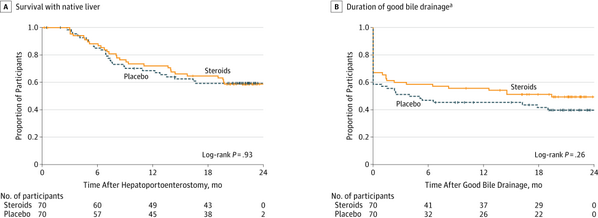
The randomized, double-blind, placebo-controlled START trial from the NIH-supported ChiLDren study enrolled 140 patients (257 were screened) from 2005-2011.  High-dose steroids, starting with methylprednisolone 4 mg/kg/day for 2 weeks and then tapered was compared with placebo.  No statistically significant improvement was noted.  Ultimately, the steroid intervention did not affect transplant-free survival which was 58.7% in the steroid group and 59.4% in the placebo group at 24 months of age.  Figure 2 (see below -from @JAMA twitter feed) shows Kaplan-Meier analysis plots with regard to transplant-free survival and bile drainage; the latter was slightly better in steroid group, but not statistically significant. In addition, steroids were associated with an earlier onset of first serious adverse events, 37% in steroid group compared with 19% in the placebo group within 30 days of Kasai.

Embedded image permalink

With regard to safety, the authors note that both groups were “found to have a high incidence of adverse events, indicating that they were most likely the direct consequences of the severe liver disease typical of biliary atresia. However, steroid therapy was associated with…complications at the sites of surgical anastomoses and intestinal perforation.”

Take-home message: Avoid steroids after Kasai procedure.

Related blog posts:

Something You Probably Have Not Seen with Celiac Disease and Headaches

An “image of the month” in the NEJM shows the association between celiac disease and occipital calcifications in a 24 year-old with a 10 year history of headaches, here’s the link: 

The course and explanation: Treatment with a gluten-free diet, folic acid supplementation, and carbamazepine was initiated, and the patient’s condition improved, with remission of all symptoms. The combination of celiac disease, epilepsy, and cerebral calcification is a rare condition known as the CEC syndrome. Folate malabsorption is a suggested mechanism

——

Also, there is a useful patient celiac education page from JAMA Pediatrics & University of Chicago: http://dlvr.it/55h6Rd 

Considering Cost in Treatment Choices

A recent article indicates a growing trend in medicine –considering the cost of therapy not just the effectiveness.  Physicians, by and large, view the patient sitting in front of them as their top priority, not “bedside rationing.”  On the other hand, policy makers often avoid engaging in cost issues and argue that physicians are best-suited to make decisions for their patients.

Here’s an excerpt:

Some doctors see a potential conflict in trying to be both providers of patient care and financial overseers.

“There should be forces in society who should be concerned about the budget, about how many M.R.I.s we do, but they shouldn’t be functioning simultaneously as doctors,” said Dr. Martin A. Samuels, the chairman of the neurology department at Brigham and Women’s Hospital in Boston. He said doctors risked losing the trust of patients if they told patients, “I’m not going to do what I think is best for you because I think it’s bad for the health care budget in Massachusetts.”

Doctors can face some stark trade-offs. Studies have shown, for example, that two drugs are about equally effective in treating an eye disease, macular degeneration. But one costs $50 a dose and the other close to $2,000. Medicare could save hundreds of millions of dollars a year if everyone used the cheaper drug, Avastin, instead of the costlier one, Lucentis.

But the Food and Drug Administration has not approved Avastin for use in the eye, and using it rather than the alternative, Lucentis, might carry an additional, albeit slight, safety risk. Should doctors consider Medicare’s budget in deciding what to use?

…Generally, Medicare is not supposed to consider cost effectiveness in coverage decisions, and other government attempts to do so are susceptible to criticism as rationing. Insurers do perform cost analyses, but they also risk ire from patients and doctors…

Also, in recent years, as part of a campaign called Choosing Wisely, many medical societies have submitted lists of the top five procedures, tests or products to be questioned because they are considered wasteful…

Dr. Steven D. Pearson, a visiting scientist in the ethics department at the National Institutes of Health, said the move by some societies to incorporate economic analysis “heralds an important shift in the way doctors in America are talking about cost and value.”

He said that having societies do such evaluations was better than having a doctor make such trade-offs while treating an individual patient, which is sometimes called bedside rationing…

Related blog postDo you know about the “Choosing Wisely Campaign …

Why is Celiac Disease Becoming More Prevalent?

A recent editorial helps provide some answers and even explains the term “protopathic bias.”  Ostensibly, the editorial’s task is to explain the potential interaction of maternal serum iron ingestion and the risk of celiac disease (see previous blog post: Is There a Link Between Maternal Iron Supplementation and …).  However, the editorial provides an explanation for the Swedish epidemic and the ongoing slower, wider epidemic.

Here’s the link, http://ow.ly/vQGQ7, and here’s an excerpt:

The Swedish epidemic of CD of 1985–1994 has been extensively documented, and resulted in the development of hypotheses regarding environmental risk factors for this disorder.7 This epidemic was restricted to children younger than 2 years; in that age group, the incidence of diagnosed CD rose from 65 cases per 100,000 person-years to 198 cases per 100,000 person-years. In contrast, incidence data for older children were relatively flat during this period. The epidemic abruptly ended in 1995, although children born during the period of the epidemic have an ongoing increased risk of developing CD. Subsequent investigation led to the hypothesis that infant feeding practices affect the risk of CD in young children. The epidemic occurred during a period of relatively low rates of breastfeeding at the age of 6 months and during the same period of time, the quantity of gluten in infant formula greatly increased. Although it is difficult to separate the relative importance of each feeding practice, it seemed that high quantity of initial gluten intake without overlapping with breastfeeding was responsible for this epidemic. Although a systematic review of the issue has concluded that breastfeeding has not been definitively proved to be associated with risk of CD,8 subsequent research has indicated that the timing of gluten introduction is important in determining risk.9PreventCD, a prospective randomized trial of infants with a family history of CD, is testing specifically whether the introduction of small quantities of gluten beginning at age 4 months of age will induce tolerance to gluten in this high-risk group.

The second epidemic is more diffusely spread over time and space. Studies from the United States and elsewhere have shown that the seroprevalence of CD (as defined by positive tissue transglutaminase and endomysial antibodies) has increased markedly in recent decades. An analysis of stored serum from military recruits at the Warren Air Force Base in the years spanning 1948–1954 found a CD seroprevalence of 0.2%, whereas 2 recent cohorts from Olmsted County (spanning the years 2006–2008) matched by year of birth and age at sampling found a seroprevalence of 0.9% and 0.8%, respectively.11 An analysis of another cohort in this country found a doubling in seroprevalence during adulthood from 1974 (0.21%) to 1989 (0.45%).12 The mode of presentation of CD has changed in the past generation, with rising numbers of patients presenting without diarrhea.13 Patients presenting with anemia may have more severe disease expression (as measured by the degree of villous atrophy and the presence of metabolic bone disease) than patients presenting with diarrhea.14 Because most individuals in the United States with CD are undiagnosed,15 this is largely a hidden epidemic, but there is no reason to believe that the prevalence has peaked. In Finland, which had a higher prevalence of CD than the United States to begin with, the seroprevalence of CD doubled between the years 1978 (1.05%) and 2000 (1.99%).16 It is not known whether this epidemic will subside or if the prevalence of CD will continue to rise to a new set-point. But given the morbidity associated with CD17 and the cost and difficulty of the gluten-free diet1819 these data have sparked interest in identifying the cause of this less visible epidemic.

Certain infections (eg, rotavirus among infants20 and Campylobacter among adults21) have recently been shown to be associated with a increased risk of CD, but rates of these infections have not increased markedly, and so are not likely to be driving this epidemic. In contrast, a lack of exposure to certain microbes is a hallmark of modern times, and the increase in CD disease is congruent with the hygiene hypothesis, which states that decreased exposure to microbes may be driving the rise in autoimmune and atopic conditions. This hypothesis is particularly compelling in light of a recent study that found a dramatically different seroprevalence of CD in Finland (1.4%) and the Russian Karelia (0.6%), geographically proximate areas with a similar prevalence of HLA DQ2 and DQ8 but with major differences in economic development.22

Further evidence implicating the modern relationship with microbes is now accumulating. Children who were born by elective cesarean section are at increased risk of developing CD, whereas those born by emergent cesarean section (and may have had contact with the birth canal) are not.23 In addition, there seems to be an inverse relationship between Helicobacter pylori colonization and CD.24 Drugs are another modern innovation that may be affecting the CD epidemic. Population-based studies from Sweden have shown that prescription of antibiotics25 and proton pump inhibitors26 are each associated with an increased risk of the subsequent development of CD.

The associations identified in these studies are not necessarily causal. Studies of drug exposure in particular may be prone to protopathic bias, wherein early symptoms of the outcome of interest (CD) may lead to the prescription of the exposure (eg, antibiotics or proton pump inhibitors).

From the NY TimesGluten-free, veggie snacks, vegan desserts, spring salads. They’re all in our new recipe finder.

Parenteral Omega-3 Lipid Emulsions and Risk of Bleeding

A recent study indicates that patient’s placed on omega-3 lipid emulsions (eg. Omegaven) may be at risk for bleeding due to platelet dysfunction (J Pediatr 2014; 164: 652-4).

While omega-3 lipid emulsions have received a lot of attention due to improvements in intestinal failure associated liver disease (IFALD) (see previous links to prior posts below), the amount of data supporting their usage and potential advantages compared with standard lipids at similar dosing remains limited.

This case report describes a 9-month old who developed life-threatening hemorrhage following a standard central line placement.  Due to difficulty stopping the bleeding, the patient’s omegaven was discontinued.  Standard workup for bleeding disorders were negative.  Subsequently, the authors investigated clot formation and platelet function in a neonatal animal model.

Key Result: Piglets treated with omegaven had a doubling of time to clot formation and marked platelet agonist inhibition.

The discussion notes that “there is an acknowledged risk of high dose O3FA lipids [omegaven] increasing bleeding time because of competitive inhibition of AA [arachidonic acid] production, hence decreased TxA2 [thromboxane A2].  In addition, platelet-derived growth factor-like protein and endothelial platelet activation factor are decreased.”

Take home points (from the authors):

  • “the case report and piglet studies together demonstrate that there is potential for a significant antiplatelet effect and inhibition of the coagulation cascade with O3FA therapy…”
  • “We would suggest discontinuation of Omegaven therapy 72 hours preoperatively in high-risk cases where bleeding may be difficult to directly control.”
  • “Institutionally, we have abandoned the sole use of Omegaven therapy.”

Related blog posts:

Pulmonary Complications Associated with Chronic Liver Disease

A useful review of “pulmonary complications in chronic liver disease” (Hepatology 2014; 59: 1627-37) has been published.

The main topics included hepatopulmonary syndrome (HPS) , portopulmonary hypertension (POPH), and hepatic hydrothorax (HH).

A few of the key points:

HPS is most common of these conditions and is identified in 5-30% of cirrhosis patients.  It is identified with abnormal oxygenation (screening with pulse ox <96%) due to intrapulmonary vascular dilatations. There is no established medical therapy.  It is reversible with liver transplantation.

The hallmark of POPH is the development of pulmonary arterial hypertension associated with portal hypertension.  It occurs in 5-10% of cirrhosis patients and often presents as dyspnea on exertion/fatigue.  There are numerous pharmacologic treatments that may be useful, include the following:

  • prostacyclin analogs like epoprostenol
  • endothelin receptor antagonists like boesentan
  • phosphodiesterase-5 inhibitors like sildenafil, vardenafil, and tadalafil

Severe POPH is a relative contraindication for liver transplantation.

HH is a transudative pleural effusion seen in 5-10% of cirrhosis patients. Initial management includes salt restriction and diuretics.  Transjugular intrahepatic portosystemic shunt and thoracentesis are second-line options.  Liver transplantation is curative.

Related blog entries:

Disclaimer: These blog posts are for educational purposes only. Specific dosing of medications (along with potential adverse effects) should be confirmed by prescribing physician.  This content is not a substitute for medical advice, diagnosis or treatment provided by a qualified healthcare provider. Always seek the advice of your physician or other qualified health provider with any questions you may have regarding a condition.


The Search for a Dietary Culprit in IBD

Uniformly, patients diagnosed with inflammatory bowel disease (IBD), both ulcerative colitis and Crohn disease, are interested in whether there is a dietary culprit which triggered their IBD and what modifications in their diet can help improve their IBD.  A really good summary of what we know has been published (Inflamm Bowel Dis 2014; 20: 732-41).

A summary of the key points:

Traditional dietary recommendations:  These diets may help decrease symptoms but are not thought to improve disease control.

  • Low-residue: <10-15 g/d of fiver. Potential deficiencies: folate, vitamin A, vitamin C, and potassium.  Overall, this diet is poorly studied.  “One small randomized controlled trial showed that low-residue diet made no difference in symptoms, need for hospitalization, need for surgery…when compared with an unrestricted diet.”
  • Lactose-free: potential deficiencies: calcium, vitamin D

Carbohydrate-restrictive:  Potential deficiencies with all carbohydrate restriction: folate, thiamine, vitamin B6

  • Specific carbodydrate diet: allows only monosaccharides.  Restricts complex sugars, starches, grains and legumes.  This diet was popularized by Elaine Gottschall in 1994 (Breaking the Vicious Cycle) but was developed by Dr. Sidney Haas in 1924.  The premise of SCD is that “complex carbohydrates and legumes are poorly absorbed in gastrointestinal disease…they promote bacterial overgrowth and fermentation.  By-products from bacterial dysbiossis are postulated to contribute to gut inflammation.”  Nevertheless, it “has been poorly studied.”
  • Low FODMAPs (see numerous previous posts).  “A small restrospective study…showed that the low FODMAPs diet resulted in improvement in functional symptoms present in patients with IBD who were in remission.”  This diet is difficult for long-term adherence.
  • Gluten-free: not truly a carbohydrate-restrictive diet, but breads/cereals contain large amounts of carbs. “No evidence that a gluten-free diet has any effect on disease activity in IBD.”

Fat-modified diets

  • Fat-restrictive diets: “On a cellular level, multiple animal studies have shown that prolonged feeding of a high-fat diet seems to promote colitis/ileitis and to perturb barrier function…shifts in microbiome composition…Despite some biologic plausibility, there is a paucity of data evaluating efficacy of fat-restrictive diet for IBD management.”
  • Vegetarian/semi-vegetarian: Potential deficiencies: iron, vitamin B12 (vegans), calcium, vitamin D, ω-3 fatty acids.   A small study of 22 patients with Crohn’s disease who adhered to a semi-vegetarian diet, had lower rate of relapse.  “There does not seem to be sufficient evidence at this time to recommend eliminating meat to patients with IBD as a means to control their disease.”
  • Modified ratio of ω-3/ω-6 polyunsaturated fat: “The efficacy of dietary interventions with ω-3 PUFA has been disappointing..recently, 2 large multicenter clinical trials demonstrated that ω-3 PUFA (fish oil) at a dose of 4 g/day was not significantly better than placebo at maintaining remission in CD.”

Restriction of Multiple food groups

  • Paleolithic: based on the “premise that human genetics have scarcely changed over the past 3000 years, and thus modern humans are genetically adapted to the diet of their Paleolithic ancestors (i.e. Stone Age)…daily calories should come from plant sources (50-65%) and from animal sources (35-45%) with fish preferred over meat.  Most of the restricted foods are carbohydrates..refined salt, and refined oils as well as any “processed foods.”  However, there are “no data that this diet has any effect in IBD.”  Previous reports of improvement in IBD are mainly testimonials (anecdotal evidence).
  • Exclusive enteral nutrition (EEN)/Elemental/Semielemental: In pediatric CD, “EEN has been shown to be as effective as corticosteroids in inducing remission (70-90%)..EEN does not seem to be effective in UC.”  High rate of relapse when diet is stopped.  Formula type does not seem to be very important.

Take-home message: “Clinical trials in all dietary strategies (with possible exception of EEN in pediatric patients) are lacking and further study is needed.” “From the current evidence available, a low FODMAPS or gluten-free diet may be the most helpful in controlling diarrheal and bloating symptoms…However, …symptom improvement does not equate to remission or objective evidence of disease regression.”

Related Blog Posts:

ImproveCareNow has published information on IBD and Nutrition as well.  Here’s an excerpt from their Circle eNewsletter:(initially published April 2013, Stacie Townsend, MS, RD, LDN, CSP)

Diet is an important part of your IBD treatment plan and should be used in conjunction with medications. Proper nutrition plays a critical role in managing IBD. Eating healthfully and in appropriate amounts will improve IBD symptoms, contribute to age-appropriate growth, and decrease risk of anemia, poor bone density, and vitamin/mineral deficiencies. It can also increase effectiveness of IBD medications.

No one diet has been proven to prevent IBD or to prevent flare ups, although several diet books and plans have claimed to “cure IBD”. Unfortunately, there is little scientific evidence to prove that these diet plans, such as the Specific Carbohydrate Diet (still being studied) and the Guts and Glory Program, are effective, and most of these plans avoid entire food groups, which can then lead to vitamin and mineral deficiencies and poor weight gain.

Nutritionists frequently get asked what foods are safe for people with IBD, and creating a diet plan for you is often trial and error… The best diet plan is one that includes all food groups (proteins, grains, fruits, vegetables, dairy, and oils) and in appropriate portions for your age, weight, and physical activity level… If gas, bloating, and diarrhea are among your symptoms, lactose free dairy products may be better tolerated.

So what IS the most appropriate diet for IBD? The United States Department of Agriculture’s food guidance system, MyPlate, is the appropriate diet plan for you… and the SuperTracker within the MyPlate website can help you track what you eat each day, and how your diet measures up to the recommended diet plan for you.

General nutrition guidelines for individuals with IBD include:

  • choose foods from all food groups
  • limit fried/fatty foods, caffeine and spicy foods, especially if these foods worsen symptoms of IBD
  • drink fluids at each meal to maintain hydration
  • consume a multivitamin daily to aid nutrient absorption
  • consume small frequent meals (eat every 2-3 hours while awake) if volume of foods at a meal is an issue

…If you want additional help with your diet, make an appointment to see our nutritionist.

Disclaimer: These blog posts are for educational purposes only. Specific dosing of medications/diets (along with potential adverse effects) should be confirmed by prescribing physician/nutritionist.  This content is not a substitute for medical advice, diagnosis or treatment provided by a qualified healthcare provider. Always seek the advice of your physician or other qualified health provider with any questions you may have regarding a condition.
 

Treating HCV Helps Diabetics

There is more data confirming that HCV treatment helps diabetic patients (Hepatology 2014; 59: 1293-1302).

Using a large National Health Insurance Research Database with more than 2.2 million Taiwanese residents diagnosed with diabetes, the authors were able to identiy 1411 HCV-treated patients, 1411 untreated patients, and 5644 uninfected/untreated controls.

Key results:

The risk of end-stage renal disease (ESRD), ischemic stroke and acute coronary syndrome (ACS) were all lower in the HCV-treated patients compared to untreated patients and compared to uninfected/untreated controls:

  • 84% reduction in the risk of ESRD
  • 47% reduction in the risk of ischemic stroke
  • 36% reduction in the risk of ACS

Why does HCV treatment reduce these diabetic complications? While the mechanisms have not been fully elucidated, it is “most likely mediated via viral clearance” which subsequently improves insulin resistance.

While this study has several limitations inherent to a study using a database, the design took efforts to minimize bias and confounding.

HCV Treatments: “Sticker Shock” or “Low Value”

Two more commentaries/articles on hepatitis C virus treatments help with the perspective of cost.

In the first (Hepatology 2014; 59: 1246-49), the authors note that costs with HCV treatment have escalated along with improvements in SVR rates.  And, though the new 12-week therapy costs will exceed $84,000, they point out that current total cost of “therapy to achieve SVR…including management of complications, the price of treatment actually increases to $172,889 to $188,859 per SVR.”  They also note that HIV therapy averages $2000-$5000 a month and due to lifelong need, this exceeds more than one-half million dollars in treatment cost.  In addition, they note that gents like interferon have side effects that can be life-threatening. “Still, it remains unanswered if the new [HCV] agents are worth their price.”

In the second from GI Hep News, Panel calls new hepatitis C drug ‘low value.

Here is an excerpt:

A panel of California medical experts says two new, once-daily drugs for hepatitis C represent low-value treatment alternatives for the condition because of their high price tags.

The drugs, Gilead Sciences’ sofosbuvir (Sovaldi) and Johnson & Johnson’s simeprevir (Olysio), cost more than $1,000 per pill, pushing the price for the recommended 12-week course of treatment of sofosbuvir to close to $90,000 and treatment with simeprevir to around $66,000, according to the California Technology Assessment Forum (CTAF), an independent group originally convened by the insurance industry to evaluate costs and benefits of treatments….

Replacing current care with sofosbuvir-based regimens would increase drug expenditures by $18-$29 billion per year in California alone, the report estimated. Gilead Sciences has maintained that the drug’s up-front costs are justified given that it could decrease the number of patients who ultimately suffer liver failure and need transplants. However, CTAF said it would take 20 years for payers to recoup two-thirds of the drug’s cost.

Take-home message: The newest and best HCV treatments are costly.  These drugs may really boost medical tourism where these drugs will be sold a lot more cheaply.

Related blog posts:


Taking a Quick Peek

A brief case presentation makes the point that completing the physical exam can help establish the reason for neonatal cholestasis (J Pediatr 2014; 164: 939).

The authors present a 2-month old with cholestasis who had a micropenis with a length of 1 cm (a stretched length of <2 cm [mean -2.5 SD]) and ultimately was diagnosed with hypopituitarism which has been associated with neonatal hepatitis.  “Low thyroid and cortisol levels may impair bile acid synthesis, bile acid secretion and/or bile flow.”  Hormone replacement is associated with improvement in 10 weeks and complete resolution in 3-9 months.

It is worth noting that the authors decided, despite the physical exam findings that  a liver biopsy wa indicated.  Given the likelihood of hypopituitarism, many practitioners may have opted for a HIDA scan to exclude biliary atresia.

Take-home message:  Don’t forget to check the genital exam in jaundice newborns.