I am a pediatric gastroenterologist at GI Care for Kids (previously called CCDHC) in Atlanta, Georgia. The goal of my blog is to share some of my reading in my field more broadly. In addition, I wanted to provide my voice to a wide range of topics that often have inaccurate or incomplete information.
Before starting this blog in 2011, I would tear out articles from journals and/or keep notes in a palm pilot. This blog helps provide an updated source of information that is easy to access and search, along with links to useful multimedia sources.
I was born and raised in Chattanooga. After graduating from the University of Virginia, I attended Baylor College of Medicine. I completed residency and fellowship training at the University of Cincinnati at the Children’s Hospital Medical Center. I received funding from the National Institutes of Health for molecular biology research of the gastrointestinal tract.
During my fellowship, I had the opportunity to work with some of the most amazing pediatric gastroenterologists and mentors. Some of these individuals included Mitchell Cohen, William Balistreri, James Heubi, Jorge Bezerra, Colin Rudolph, John Bucuvalas, and Michael Farrell. I am grateful for their teaching and their friendship. During my training with their help, I received a nationwide award for the best research by a GI fellow.
I have authored numerous publications/presentations including original research, case reports, review articles, and textbook chapters on various pediatric gastrointestinal problems. In addition, I have been recognized by Atlanta Magazine as a "Top Doctor" in my field multiple times.
Currently, I am the vice chair of the section of nutrition for the Georgia Chapter of the American Academy of Pediatrics. In addition, I am an adjunct Associate Clinical Professor of Pediatrics at Emory University School of Medicine. Other society memberships have included the North American Society for Pediatric Gastroenterology Hepatology and Nutrition (NASPGHAN), American Academy of Pediatrics, the Food Allergy Network, the American Gastroenterology Association, the American Association for the Study of Liver Diseases, and the Crohn’s and Colitis Foundation.
As part of a national pediatric GI organization called NASPGHAN (and its affiliated website GIKids), I have helped develop educational materials on a wide-range of gastrointestinal and liver diseases which are used across the country. Also, I have been an invited speaker for national campaigns to improve the evaluation and treatment of gastroesophageal reflux disease, celiac disease, eosinophilic esophagitis, hepatitis C, and inflammatory bowel disease (IBD). Some information on these topics has been posted at my work website, www.gicareforkids.com, which has links to multiple other useful resources.
I am fortunate to work at GI Care For Kids. Our group has 17 terrific physicians with a wide range of subspecialization, including liver diseases, feeding disorders, eosinophilic diseases, inflammatory bowel disease, cystic fibrosis, DiGeorge/22q, celiac disease, and motility disorders. Many of our physicians are recognized nationally for their achievements. Our group of physicians have worked closely together for many years. None of the physicians in our group have ever left to join other groups. I have also worked with the same nurse (Bernadette) since I moved to Atlanta in 1997.
For many families, more practical matters about our office include the following:
– 14 office/satellite locations
– physicians who speak Spanish
– cutting edge research
– on-site nutritionists
– on-site psychology support for abdominal pain and feeding disorders
– participation in ImproveCareNow to better the outcomes for children with inflammatory bowel disease
– office endoscopy suite (lower costs and easier scheduling)
– office infusion center (lower costs and easier for families)
– easy access to nursing advice (each physician has at least one nurse)
I am married and have two sons (both adults). I like to read, walk/hike, bike, swim, and play tennis with my free time.
I do not have any financial relationships with pharmaceutical companies or other financial relationships to disclose. I have helped enroll patients in industry-sponsored research studies.
Thanks to all of you who provided articles, suggestions and encouragement to make this blog better this past year. This has been the 12th year for this blog and it has continued to gain more views each year. Here are links to many of my favorite posts from 2023 along with a few pictures:
Background/Methods: The QUASAR Phase 2b Induction Study evaluated the efficacy and safety of guselkumab, an interleukin-23p19 subunit antagonist, in patients with moderately to severely active ulcerative colitis (UC) with prior inadequate response and/or intolerance to corticosteroids, immunosuppressants, and/or advanced therapy. In this double-blind, placebo-controlled, dose-ranging, induction study, adult patients (n=313), with median disease duration of 7.5 years, were randomized (1:1:1) to receive intravenous guselkumab 200 or 400 mg or placebo at weeks 0/4/8.
Key findings:
Week-12 clinical response percentage was greater with guselkumab 200 mg (61.4%) and 400 mg (60.7%) vs placebo (27.6%; both P < .001). (Patients received IV induction at 0,4, and 8 weeks)
Greater proportions of guselkumab-treated vs placebo-treated patients achieved all major secondary endpoints (clinical remission, symptomatic remission, endoscopic improvement, histo-endoscopic mucosal improvement, and endoscopic normalization) at week 12
Among guselkumab week-12 clinical nonresponders, 54.3% and 50.0% of patients in the 200- and 400-mg groups, respectively, achieved clinical response at week 24 (after another dose of guselkumab (2nd dose SC). Thus, by week 24, 80.2% (81/101) of patients in the 200 mg IV induction and 78.5% *84/107) in the 400 mg IV induction had a clinical response.
Clinical response was noted as early as 2 weeks (first timepoint assessed)
Safety was similar among guselkumab and placebo groups.
My take: This is an era with rapidly expanding medical treatments for inflammatory bowel disease; it should help reduce the problem of individuals who are refractory to available treatments.
The reasons for the recent labor actions appear straightforward. Doctors, nurses and pharmacists said they were being asked to do more as staffing dwindles, leading to exhaustion and anxiety about putting patients at risk…the explanation runs deeper: A longer-term consolidation of health care companies has left workers feeling powerless in big bureaucracies. They say the trend has left them with little room to exercise their professional judgment…
Professionals in a variety of fields have protested similar developments in recent years. Schoolteachers, college instructors and journalists have gone on strike or unionized amid declining budgets and the rise of performance metrics that they feel are more suited to sales representatives than to guardians of certain norms and best practices.
But the trend is particularly pronounced in health care…Over time, however, consolidation and the rise of ever-larger health care corporations left workers with less influence…
Many health systems had increased tensions with doctors and nurses by failing to involve them more in developing and putting in place the system of metrics on which they are judged…
The breaking point came when the height of the pandemic passed, but conditions barely improved, according to many workers…
During an interview in October, while Dr. Smith [a pharmacist] and his colleagues were still awaiting the company’s response, he made clear that his patience had run out. “I’ve been asking and asking and asking for improvements for years,” he said. “Now we’re not asking any more — we’re demanding it.”
In pediatrics, there is often a prevailing view that kids can overcome a lot due to their resiliency. However, just like a a track event, if you trip or fall back in a race, you may never catch up. With many medical conditions, it is unclear whether a delay in diagnosis results in long-term deficits. Recent data have found that a ~1 month delay in the treatment of cystic fibrosis is associated with poorer nutritional/growth outcomes, even 5 years later.
Using the U.S. Cystic Fibrosis Foundation patient registry (CFFPR), the authors examined children born between 2010-2018 who were diagnosed based on newborn screening (NBS). Age at first event (AFE) serves as a proxy for when CF care was likely initiated. Patients were divided into 3 cohorts based on AFE: <14 days (early cohort), 14 days to <33 days, and 33 days or more (late cohort).
Key findings:
Infants in the late cohort were more likely to have a sweat test as their first CF event.
Pulmonary exacerbations were reported as the reason for hospitalization in in 59.1% of late cohort compared with 4.8% of early cohort with hospitalization as their first CF event.
Height-for-age z-scores were consistently lower in the late cohort. At 1 yr and 5 yrs, median z-scores were -0.6 (vs. -0.42) and -0.26 (vs. -0.12 in early group) respectively
The authors note that the early and late groups had differences in parental education attainment which “may be evidence that the late cohort had lower socioeconomic status that could have resulted in barriers to timely evaluation.”
The discussion notes that the introduction of highly effective modulator therapy does not overcome early stunting; which indicates that even with newer therapy, institution of nutritional treatments remains critical.
The study confirms that
NBS/early identification has clear benefits.
There is a need to quickly get suspected patients seen by CF centers.
My take: There was persistently (through at least 5 yrs) reduced height-for-age z-scores in patients with CF who presented just 27 days later.
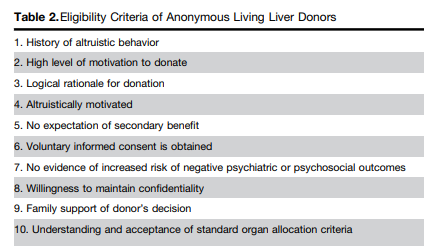
This commentary, from Toronto General Hospital practitioners, discusses the increasing use of anonymous living liver donation (ALLD) in North America and donor altruism which is a term coined and popularized by the French philosopher Auguste Comte in the 1800s. Altruism is the principle and moral practice of concern for the welfare or happiness of others.
Key points:
Living-donor liver transplantation (LDLT) … in Toronto currently makes up 30% of adult and 80% of pediatric liver transplants.
Over the past 4 years, ALLD activity has doubled and now accounts for 15% of our yearly LDLT activity (80–85/year). Similar rates of growth in ALLD have occurred in the USA, whereas it remains rare outside of North America
The Canadian system provides several important advantages for anonymous donors: publicly funded health care that covers the cost of the donor assessment, surgery, and postoperative care; supportive employers and social programs that minimize financial losses; and a provincially funded program (Prelod) that reimburses incidental costs related to travel, accommodation, and meals up to $6000.
Important steps toward supporting living donation have been taken in the USA, such as the development of the National Living Donor Assistance Center as well as the Patient Protection and Affordable Care Act, which makes it illegal for insurance companies to deny health coverage to living donors…
Donors in the USA, however, still face significant obstacles to obtaining life insurance, long term care insurance, and disability insurance. Notably, the National Living Donor Protection act, which aims to rectify this problem (https://www.congress.gov/bill/117th-congress/ house-bill/1255/text) has yet to move through Congress despite pressure from the transplant community
My take: It is definitely a good idea to promote living donors by removing insurance obstacles/discrimination
In October, the FDA approved etrasimod (Velsipity, Pfizer) for moderate to severe active UC in adults. Etrasimod, an oral sphingosine-1-phosphate (S1P) receptor, binds with high affinity to receptors 1, 4, and 5. It is the second agent in the S1P class approved for UC. The other agent, ozanimod (Zeposia, Bristol-Myers Squibb), which was approved for moderate to severe active UC in May 2021, is an S1P receptor modulator that is selective for the S1P1 and S1P5 receptors located on endothelial cells and oligodendrocytes, respectively.
Etrasimod’s approval was based on safety and efficacy data from two randomized, double-blind, placebo-controlled phase 3 trials ― ELEVATE UC 52 trial, and ELEVATE UC 12 trial. The Lancet published full results from the two trials on March 2. Both trials enrolled patients with UC who had previously failed or were intolerant of at least one conventional, biologic, or Janus kinase (JAK) inhibitor therapy.
In ELEVATE UC 52, clinical remission at 12 weeks occurred in 27% of patients taking etrasimod, vs 7% of patients taking a placebo (20% difference; P ˂.001). At week 52, remission rates were 32% with active treatment, vs. 7% with placebo (26% difference; P ˂ .001).
In ELEVATE UC 12, clinical remission was achieved among 26% of patients who received etrasimod, vs 15.0% of patients who received placebo (11% difference; P < .05).
The approved recommended dose is 2 mg once daily. The most common side effects of etrasimod are headache, elevated values on liver tests, worsening of UC, SARS-CoV-2 infection, dizziness, pyrexia, arthralgia, abdominal pain, and nausea
My take: It is not exactly clear where etrasimod or ozanimod should be positioned for ulcerative colitis therapy as several other drug classes have much higher response rates.
Dr. Burrell noted that concerns for EoE are increased in those who have more uniform problems with increased textures (rather than selectivity) and in those with more severe feeding disordersSometimes Caregivers will contribute to nutritional disorders by placing on diets like a gluten-free, casein-free diet
Disclaimer: This blog, gutsandgrowth, assumes no responsibility for any use or operation of any method, product, instruction, concept or idea contained in the material herein or for any injury or damage to persons or property (whether products liability, negligence or otherwise) resulting from such use or operation. These blog posts are for educational purposes only. Specific dosing of medications (along with potential adverse effects) should be confirmed by prescribing physician. Because of rapid advances in the medical sciences, the gutsandgrowth blog cautions that independent verification should be made of diagnosis and drug dosages. The reader is solely responsible for the conduct of any suggested test or procedure. This content is not a substitute for medical advice, diagnosis or treatment provided by a qualified healthcare provider. Always seek the advice of your physician or other qualified health provider with any questions you may have regarding a condition.
In this study, the authors examined 43 potential predictors of outcomes in pediatric patients (n=76) treated with maralixibat (MRX). The median duration of MRX treatment was 4.7 years. Key findings:
There were 10 liver transplantations, 3 decompensations, 2 deaths, and 1 surgical biliary diversion; thus, 16/76 (21%) had liver-related events.
The 6-year event-free survival improved with a clinically meaningful >1-point ItchRO(Obs) reduction from baseline to W48 (88% vs. 57%; p = 0.005), W48 bilirubin < 6.5 mg/dL (90% vs. 43%; p < 0.0001), and W48 serum bile acid < 200 µmol/L (85% vs. 49%; p = 0.001). These parameters were also predictive of 6-year transplant-free survival.
In this cohort, younger children (<36 months) fared worse, though this was likely related to selection bias as they had more severe cholestasis. In the discussion, the authors note that in their cohort, “there is a survivor bias such that older children are inherently healthier or they would have already undergone transplantation.”
Improved event-free survival could be largely related to symptomatic improvement. Many kids with Alagille require transplantation due to refractory pruritus. Since this study did not include histology or noninvasive techniques to assess hepatic fibrosis, it is unclear if there was also improvement in underlying liver function/fibrosis subsequent to reduction in toxic bile acid retention.
46/76 (61%) had improvement in pruritus, 52/76 (68%) had improvement in bilirubin, and 56/76 (74%) had improvement in serum bile acids.
In their discussion, the authors note that in the GALA study, “which included natural history data from >1400 patients, 358 patients required a liver transplant, with 69% being transplanted for intractable pruritus.4“
My take: In patients with moderate to severe pruritus, patients who respond to IBAT inhibitors are likely to have improvement in important clinical outcomes.
This article has 50 recommendations for prevention, diagnosis, and treatment of hepatocellular carcinoma. I will focus on prevention/screening in this post as this is most relevant to pediatric practice.
Figure 1
Figure 3 provides data supporting benefits of hepatocellular carcinoma (HCC) surveillance. HCC surveillance has been shown to significantly reduce HCC-related mortality in a randomized controlled trial among patients with chronic HBV infection and in several cohort studies among patients with cirrhosis from any etiology.
Who to screen for HCC:
Key Recommendations on Surveillance:
My take: This guidance recommends ultrasound and AFP monitoring every 6 months in those at high risk of developing HCC. Most pediatric patients would not require surveillance based on this guidance.
HBV Vaccination Prevents Cancer In Taiwan: HCC incidence per 105 person-years was 0.92 in the unvaccinated cohort and 0.23 in the vaccinated birth cohorts.