Non-Adherence Leads to Treatment Escalation and More on Early Infliximab Trough Levels

Briefly noted: JK Carmody et al. AP&T 2019; first published 02 August 2019: https://doi.org/10.1111/apt.15445 Full text link: Longitudinal non‐adherence predicts treatment escalation in paediatric ulcerative colitis

In this cohort of 268 pediatric patients with ulcerative colitis in the prospective PROTECT study, non-adherence to mesalamine was associated with need for treatment escalation.

Key finding:

  • Declining adherence over time strongly predicted treatment escalation (β = −.037, P = .001). By month 6, adherence rate ≤85.7% was associated with treatment escalation.

As noted in a previous blog (Briefly noted: Induction Inflixmab Levels), a recent study (K Clarkston et al. JPGN 2019; 69: 68-74) identified target early infliximab trough levels for infliximab as≥ 29 for week 2 (infusion 2) and ≥18 for week 6 (infusion 3). Below is an associated figure:

Image courtesy of Michael Rosen twitter feed

IBD Briefs August 2019

A Levine et al. Gastroenterol 2019; 157: 440-50.  This study found that a Crohn’s Disease Exclusion Diet plus partial enteral nutrition induced sustained remission in a 12-week prospective randomized controlled trial with 74 children.  At week 12, “76% of 37 children given CDED plus PEN were in corticosteroid-free remission compared with 14 (45.1%) of 31 children given” EEN followed by PEN.  The associated editorial on pages 295-6 provides a useful diagram of various dietary therapy components for a large number of diets that have been given for IBD.  The editorial recommends:

“For now, simple dietetic recommendations such as consuming a well-balanced diet prepared largely from fresh ingredients and thereby avoidance of emulsifiers and additives and processed foods are appropriate for all patients.  In select patients,…a trial of dietary therapy alone with a diet such as CDED could be attempted for a short period of time, with close follow-up, and with agreement with the patient that failure to fully respond is an indication to escalate therapy.”  More dietary trials are ongoing.

Related blog posts:

NJ Samadder et al Clin Gastroenterol Hepatol 2019; 17: 1807-13. In this cohort from Utah 1996-2011 with 9505 individuals with IBD, 101 developed colorectal cancer.  Standardized incidence ratio (SIR) for CRC in patients with Crohn’s disease was 3.4, in ulcerative colitis 5.2, in patients with primary sclerosing cholangitis 14.8.  A family history of CRC increased the risk of CRC in patients with IBD to 7.9 compared to general population.  Family hx/o CRC increased the SIR by about double the CRC risk in IBD patients without a family hx/o CRC.

CR Ballengee et al. Clin Gastroenterol Hepatol 2019; 17: 1799-1806. In this study with 161 subjects from the RISK cohort, the authors found that elevated CLO3A1 levels in subjects with CD was associated with the development of stricturing disease but was not elevated in those with strictures at presentation and in those who did not develop  strictures.

AL Lightner et al IBD 2019; 25: 1152-68.  Short- and Long-term Outcomes After Ileal Pouch Anal Anastomosis in Pediatric Patients: A Systematic Review.  This review included 42 papers.

  • Rates of superficial surgical site infection, pelvic sepsis, and small bowel obstruction at <30 days were 10%, 11%, and 14% respectively.
  • Rates of pouchitis, stricture, chronic fistula, incontinence and pouch failure were 30%, 17%, 12%, 20% and 8% respectively with followup between 37-109 months.
  • Mean 24-hour stool frequency was 5.

MC Choy et al IBD 2019; 25: 1169-86.  Systematic review and meta-analysis: Optimal salvage therapy in acute severe ulcerative colitis.  Among 41 cohorts (n=2158 cases) with infliximab salvage, overall colectomy-free survival was 69.8% at 12 months.  The authors could not identify an advantage of dose-intensification in outcomes, though this was used more often in patients with increased disease severity, “which may have confounded the results.”

Hood River, OR

“We Have Ruined Childhood” and Possible Link to Depression, Anxiety and Suicide

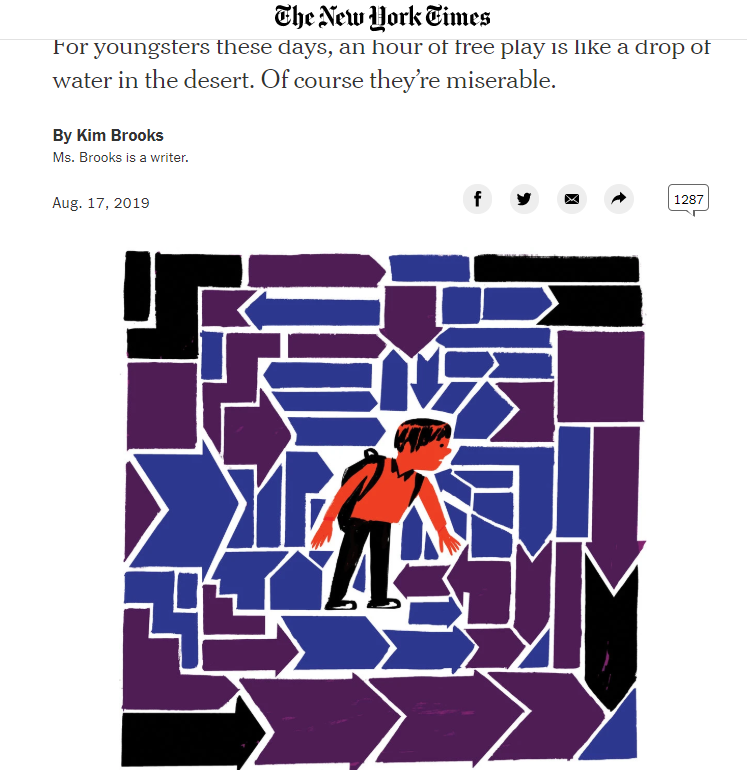
A recent NY Times commentary (We Have Ruined Childhood) details the rising rates of depression, anxiety, and suicide and suggests a link between these mental health issues and a lack of childhood free play.

An excerpt:

No longer able to rely on communal structures for child care or allow children time alone, parents who need to work are forced to warehouse their youngsters for long stretches of time. School days are longer and more regimented…

The role of school stress in mental distress is backed up by data on the timing of child suicide. “The suicide rate for children is twice what it is for children during months when school is in session than when it’s not in session,..

For many children, when the school day is over, it hardly matters; the hours outside school are more like school than ever…

The areas where children once congregated for unstructured, unsupervised play are now often off limits. And so those who can afford it drive their children from one structured activity to another. Those who can’t keep them inside. Free play and childhood independence have become relics, insurance risks, at times criminal offenses

Many parents and pediatricians speculate about the role that screen time and social media might play in this social deficit. But it’s important to acknowledge that simply taking away or limiting screens is not enough. Children turn to screens because opportunities for real-life human interaction have vanished.

Related blog posts:

Jejunal Tube Feeding –ESPGHAN Position Paper

A recent position paper (IJ Borekaert et al. JPGN 2019; 69: 239-58) makes 33 recommendations on the use of jejunal tube feedings.

Full Text Link: The Use of Jejunal Tube Feeding in Children: A Position Paper by the Gastroenterology and Nutrition Committees of the European Society for Paediatric Gastroenterology, Hepatology, and Nutrition 2019.

Here are a few of the recommendations:

  • #1 Jejunal feeding is route of choice for enteral nutrition with failure of oral and intragastric feeds or gastric outlet obstruction
  • #5 Expert group recommends the use of jejunal feeding in children with acute pancreatitis only in cases in which oral or gastric feeding is not tolerated
  • #6 Recommends trial of continuous gastric feeds or a hydrolyzed or elemental formula prior to jejunal feedings
  • #8 & 9 Expert group recommends to consider UGI/SBFT and an upper GI endoscopy in all patients before jejunal tube placement
  • #12 Recommends NOT to use jejunal tube feedings in preterm infants (<37 weeks gestation).  This is based on systemic reviews including Cochrane review which concluded “that there is no evidence of any benefit for transpyloric feeding in preterm infants compared to gastric feeding”
  • #21 Recommends monitoring for nutrient deficiencies –checking copper, zinc, selenium, and iron every 6-12 months (Low level of evidence).  The authors note that some studies have shown reductions in these nutrients; this may be related in part to be due to bypassing the duodenum
  • #24 Avoiding using jejunal tube for medication unless absolutely essential or delivery into the stomach is not possible

Hood River Bridge (crossing Columbia River). Hood River, OR


Sad Truth: Job Security in Hepatology

A recent study (ND Parikh et al. Hepatology 2019; 70: 487-95, and associated editorial JA Marrero. 459-61) provide a forecast of increasing liver disease and liver disease severity, driven mainly by fatty liver disease and obesity.

Key findings:

  • Nonalcoholic fatty liver disease (NAFLD) related additions to the liver transplant waitlist expanded from 391 in 2000 to 1605 in 2014.  This corresponded to an overall increase in obesity of 44.1% during that time period.
  • NAFLD-related wait-list additions were predicted by the prevalence of obesity 9 years prior.
  • The authors anticipate that obesity population will increase to over 92 million adults by 2025.
  • The authors project that NAFLD-related wait-list additions will increase to 2104 by 2030, a 55% increase

Because the decrease in complications related to new treatments for Hepatitis C is not expected “until well into the next decade,” the burden of chronic liver disease will continue to rise.

The editorial notes that overall graft survival rates for obese patients with BMI less than 40 do not appear different than those of lean individuals.  Those with BMI >40 had reduced 5-year graft and survival rates.  Also, obese patients have higher morbidities, even in those without reduced survival.

My take: This study identifies a marked increase in end-stage liver disease in the growing population of obese patients.

Related blog posts:

Blaming Reflux for BRUEs -Not Changing Despite Guideline Recommendations

Briefly noted: DR Duncan et al. J Pediatr 2019; 211: 112-9.

In this retrospective cohort study of infants with brief resolved unexplained events (BRUEs) at Boston Children’s Hospital, the authors examined guideline implementation among 359 subjects in the year before and the year after AAP guidelines.

Key findings:

  • There were no significant changes in practice after guideline publication
  • Only 13% had videofluoroscopic swallow study performed; 72% of these showed aspiration/penetration
  • No subject had reflux testing, “yet reflux was implicated as the cause” for BRUE in 40%. Children continued to be “discharged on acid suppression despite lack of efficacy”

My take: The pendulum is (slowly) starting to swing back from blaming everything (including BRUEs) on reflux but this change is not evident in this study.

Related blog posts:

Ensuring Safe Infant Formula Use -More Complicated Than You Think

A recent commentary (SA Abrams, SR Daniels. J Pediatr 2019; 211: 201-6) highlight some important issues regarding infant formula use/misuse.

The authors indicate that their commentary is not intended to undermine the use of breastmilk in infants.  However, they note that only about 25% of infants are exclusively breastfed until 6 months of age; thus, utilizing formula appropriately is crucial.

Annual Costs per article estimates (based on powder formula):

  • $1109 generic store-brand formula
  • $2021 name-brand routine formula
  • $222 Typical out-of-pocket for WIC clients –store brands (this assumes about 20% of formula is not covered by WIC)
  • $404 Typical out-of-pocket for WIC clients –name brands (this assumes about 20% of formula is not covered by WIC)
  • $215 Whole cow milk (not recommended)

Key points:

  • The authors discuss the role of the WIC program which is a supplemental program –does not provide 100% of an infant’s needs.
  • They describe deceptive formula marketing practices and the difficulty of ascertaining the best value of formulas.  In addition, “marketing of more expensive formula choices as having unique health benefits can easily lead families to spend more money than might be necessary” based on “meaningless” claims of being ‘closest to mother’s milk.’
  • Additives such as oligosaccharides and formulas marketed as organic or free of genetically modified organisms can be used to increase the cost of formula.
  • Use of WIC has decreased by 15% from 2010 to 2017; some may be related to fears related to immigration status of some WIC recipients.
  • Families faced with increased costs may dilute formula or use inadequate substitutes (eg. juice, cow’s milk, prepare home-made alternative)
  • Recent government shutdown placed many infants at risk.

Mistrust Concerns:

  • Many families, abetted by social media, have become distrustful of standard formulas as well as government and even pediatrician advice.
  • There has been an increase in importation of foreign formulas, especially from Europe.  THESE FORMULAS ARE NOT FDA MONITORED OR APPROVED. These illegally imported formulas have no proven advantages and their safety has not been ensured.  They do not undergo routine testing for 30 nutrients which are required by FDA monitored formulas.
  • Raw cow’s milk and raw goat milk have been promoted to ‘improve immune or gastrointestinal function.’ These products have no scientific proof of any advantage and place infants at risk as they are unpasteurized and nutrient deficient.

Author Recommendations:

  • Provide educational programs focused on formula feeding for medical providers and families
  • Increase information and regulation from government and industry about contamination issues
  • Protect the WIC program from consequences of potential government shutdown
  • Mandate improved price clarity
  • Fund research into all aspects of formula feeding, including behavioral interventions to limit inappropriate formula use
  • Monitor social media and provide correct information

Related blog posts:

Outside Portland, OR

Psoriasis Due to Infliximab –Latest Data

Briefly noted: O Courbette et al. JPGN 2019; 69: 189-93. In a retrospective review, among 147 children with inflammatory bowel disease treated with infliximab (IFX) (123 CD, 24 UC), 20 patients (13.6%) developed psoriaform rashes.  14 of 20 were in remission when skin rashes (especially on scalp) occurred and rash developed at median of 355 days.  In this cohort, all were controlled by local steroids; no patients required IFX discontinuation.

Related blog posts:

Wahkeena Falls Trail, OR

Expanding Feeding Programs for Children with Autism

A recent pilot (38 children) study (WG Sharp et al. J Pediatr 2019; 211: 185-92) examined the effectiveness of a less intensive feeding program to help children with autism and food selectivity.

Background:  Many children with autism are extremely picky eaters.

  • They may limit their diet to a ‘beige diet’ consisting of foods like chicken nuggets and fries.
  • They may insist on only pureed textures
  • They may demand only specific foods and limit to specific brands

To normalize these diets, typically intensive structured feeding programs are needed.  However, these types of programs are costly, and not available in all communities. Parental training though the MEAL (Managing Eating Aversions and Limited variety) Plan was studied by the authors.  This program consisted of 10 core and 3 booster sessions.

Key finding:

  • At week 16, positive response rates on the Clinical Global Impression Improvement scale was 47.4%for the MEAL plan compared to 5.3% in a control parent education plan.

My take: This pilot study shows that less intensive programs may be helpful in children with autism and feeding problems.  However, even with this more limited MEAL plan, a multidisciplinary team with a dietitian plan for each child along with behavior management strategies was needed.

Related blog posts:

Artwork near Krog Street Market

What Doctors Could Do Together (Organized)

A recent commentary (recommended by one of my sons) by Eric Topol discusses how doctors could be organized to advance the practice of medicine, address the deterioration in doctor-patient relationships, and focus on the needs of patients, whereas current medical organizations are mainly focused on the business interests of medical practice.

An excerpt from Why Doctors Should Organize:

“It’s possible to imagine a new organization of doctors that has nothing to do with the business of medicine and everything to do with promoting the health of patients and adroitly confronting the transformational challenges that lie ahead for the medical profession. Such an organization wouldn’t be a trade guild protecting the interests of doctors. It would be a doctors’ organization devoted to patients. Its top priority might be restoring the human factor—the essence of medicine—which has slipped away, taking with it the patient-doctor relationship. It might oppose anti-vaxxers; challenge drug pricing and direct-to-consumer advertisements; denounce predatory, unregulated stem-cell clinics; promote awareness of the health hazards of climate change; and call out the false health claims for products advocated by celebrities such as Gwyneth Paltrow and Mehmet Oz. This partial list provides a sense of how many momentous matters have been left unaddressed by the medical profession as a whole…

Because of the unique technological moment at which we live, we may not see an opportunity like this one for generations to come. We have a chance to affect the future of medicine; to advocate for patient interests; to restore the time doctors need to think, to listen, to establish trust, and build bonds, one encounter at a time. For these purposes, and in these times, an organization of all doctors is necessary. Rebuilding our relationships with our patients: that is our lane.

“Pistol Butt” Pine. Tree takes on this shape due to heavy snowfall leaning on tree at early stage. Crater Lake, Oregon.