How Parents Feel After Tracheostomy Decision

A recent study (S Nageswaran et al. J Pediatr 2018; 203; 354-60) examined parents’ perceptions about their decision to proceed with a tracheostomy.  As a GI doctor, I am not directly involved in the discussions about tracheostomy; however, we interact closely with many complex patients whose families have reached this decision.  Many times I have wondered whether families regret this decision and whether a more palliative approach may have been appropriate in some children.

In this study with interviews from 56 caregivers of 41 children, their was very high satisfaction with the decision to proceed with a tracheostomy.  All children in this study had a tracheostomy for 5 years or less.

The parents reported the following reasons:

  • Extending the life of their children.  In fact, many parents reported there were no other options available to ensure their children’s survival; thus, many caregivers felt they did not have a choice other than a tracheostomy.
  • Being able to provide care at home
  • Improvement in respiratory symptoms
  • Improved quality of life
  • Physical and developmental health

Key finding: Among 38 interviews, 38 out of 41 explicitly expressed satisfaction with their decision to pursue a tracheostomy.  In none of the interviews did any caregiver express clear regrets about their decision.

At the same time, the parents acknowledged difficulties like mucus plugs, accidental decannulation, and difficulty of home care with a tracheostomy..


Big Biosimilar Study

Briefly noted: A Meyer et al. Ann Intern Med. 2018. DOI: 10.7326/M18-1512

Abstract link: Effectiveness and Safety of Reference Infliximab and Biosimilar in Crohn Disease: A French Equivalence Study

In this study with 5050 patients, based on review of an administration database, the authors found the following:

  • In multivariable analysis of the primary outcome, CT-P13 (biosimilar) was equivalent to infliximab reference product (RP) (HR, 0.92 [95% CI, 0.85 to 0.99]). 1147 patients in the RP group and 952 patients in the CT-P13 group met the composite end point (including 838 and 719 hospitalizations, respectively).
  • No differences in safety outcomes were observed between the 2 groups: serious infections (HR, 0.82 [CI, 0.61 to 1.11]), tuberculosis (HR, 1.10 [CI, 0.36 to 3.34]), and solid or hematologic cancer (HR, 0.66 [CI, 0.33 to 1.32]).

The authors conclude that “real-world data indicates that the effectiveness of CT-P13 is equivalent to that of RP for infliximab-naive patients with CD.”

Related blog posts:

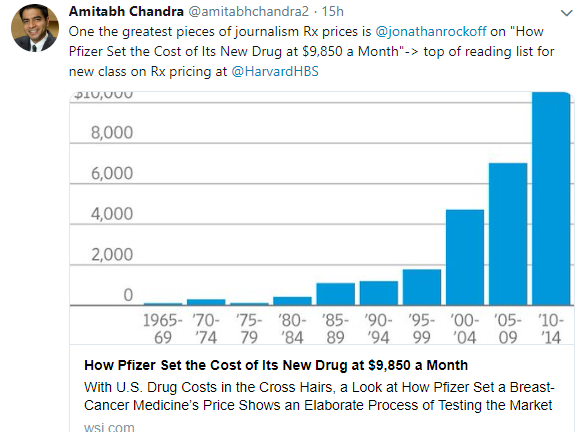
WSJ: How Pfizer Settled on $9,850 per Month for New Drug

WSJ:  How Pfizer Set the Cost of Its New Drug at $9,850 a Month

An excerpt:

The average cost of a branded cancer drug in the U.S. is around $10,000 a month, double the level a decade ago

Pfizer’s multistep pricing process shows drugmakers don’t just pick a lofty figure out of the air. At the same time, its process yielded a price that bore little relation to the drug industry’s oft-cited justification for its prices, the cost of research and development.

Instead, the price that emerged was largely based on a complex analysis of the need for a new drug with this one’s particular set of benefits and risks, potential competing drugs, the sentiments of cancer doctors and a shrewd assessment of how health plans were likely to treat the product…

In 2013, Pfizer hired outside firms to conduct hourlong interviews with more than 125 cancer doctors in six cities…

Pfizer hired firms that surveyed more than 80 health-plan officials such as medical directors and pharmacists…

Pfizer employees say the mock reviews supported a monthly price below $10,000. If it was higher, insurers could start requiring doctors to fill out paperwork justifying its use.

My take: This article makes clear that the driver of higher pharmaceutical prices is based on a shrewd assessment of what the market will bear.

Related blog posts:

My Favorite Posts from the Past Year

Recently, I listed the posts that had the most views in the past year –some dating back to 2012.  The following list includes less viewed but some of my favorite posts from 2018:

GI:

Nutrition:

LIVER:

Miscellaneous:

Flowers in Calgary

Most Popular Posts 2011-2018

Since this blog’s inception, there are now more than 2500 posts; these are the most popular (most views):

Most of these posts are referenced in more recent posts on the same or similar subjects.

Near Banff


PEG-B-ACTIVE Study: Efficacy of Peginterferon for Children with Hep B

A recent randomized controlled, open-label study (S Wirth et al. Hepatology 2018; 68: 1681-94) examined the use of weekly peginterferon alfa-2a (PEG) in 161 children (3-18 yrs) with immune-active HBe-Ag-positive children.  The two main groups were for those without advanced fibrosis: a PEG group (n=101) and a placebo group (n=50).  A third group enrolled 10 patients with advanced fibrosis who all received PEG. The treatment period was 48 weeks with ongoing observation for an additional 24 weeks.

Key findings:

  • The PEG group had HBeAg seroconversion of  8% at 48 weeks and 26% at 72 weeks; the placebo group had HBeAg seroconversion of 6% at both timepoints. At 72 weeks, the odds ratio was 5.43 for the PEG group and P=0.0043.
  • HBsAg clearance rates were higher in the PEG group: 8.9% vs 0% in placebo group.
  • The authors showed response (loss of HBeAg) by age and those <5 years had the highest response 43% (6 of 14).  The rate of seroconversion was 30.2% in those <12 years compared with 20.8% in those ≥12 years.
  • The authors showed response (loss of HBeAg) those with ALT values between 2-<5 had the highest response of 35% (15 of 43).
  • Adverse events were frequent –among the 101 treated patients: 49 with pyrexia, 30 with headache, 19 with abdominal pain, 15 with influenza-like illness, 14 with vomiting, 61 with ALT >5 x ULN, 25 with ALT >10 x ULN, 19 with neutropenia (ANC <750), and two with self-limited increased thyroid-stimulating hormone. These were all much higher than in the placebo group

My take: This study does not answer the question about which treatment is optimal for hepatitis B in children–direct-acting antivirals (eg. entecavir, and tenofovir) or peginterferon.  It does shows that weekly peginterferon alfa-2a was associated with HBeAg seroconversion in 26% of recipients at week 72.  Although a high number of patients experienced adverse effects, there were no new safety signals identified.

Related blog posts:

View from Parker Ridge, near Banff

Most Popular GutsandGrowth Posts from Past Year

These five posts were the most popular (most views) in the past year:

This is a bike path from Canmore to Banff. I had a chance to ride an electric bike which was a lot of fun.

Cirrhosis and Cardiac Function

Briefly noted: M Izzy, J Oh, KD Watt. Hepatology 2018; 68: 2008-2015.  This concise review discusses the outcome of cirrhotic cardiomyopathy after liver transplantation.

Key point: “Although it is often believed that cirrhotic cardiomyopathy resolves post-LT, the data, albeit limited, do not support this postulation…diastolic function may not improve post-transplant and may actually worsen. Improvement in systolic function was suggested by only two of six studies.”

Related blog post: Cholecardia

This figure from Hepatology November cover depicts a cirrhotic liver restricting the heart filling during diastole. (From Wiley Online Library -free access)

Which Diet is Best For a Fatty Liver?

A recent randomized controlled trial (C Properzi et al. Hepatology 2018; 68: 1741-54) compare the Mediterranean diet (MD) and a low-fat (LF) diet for non-alcoholic fatty liver disease.

A total of 48 patients completed the 12-week study and were analyzed; subjects had a mean BMI of 31.  Both groups consumed a 2400-2600 kcal diet.

Key findings:

  • Despite minimal weight loss, both groups had significant reduction in hepatic steatosis as determined by magnetic resonance spectroscopy (MRS): 25.0% in LF and 32.4% in MD.  Both had wide confidence intervals due to the small number of subjects.
  • Liver enzyme improved in both groups.
  • Weight loss was minimal, 1.6 kg and 2.1 kg in LF and MD respectively
  • Framingham Risk Score (FRS), cholesterol, triglycerides, and hemoglobin A1c were improved with MD but not with LF (all P<0.05)

The associated editorial (pg 1668-71) notes the following:

  • “Considering the current evidence, recommending the MD for patients with NAFLD might be an appropriate therapeutic option, not least because …[of the} increased risk of CVD.”
  • Longer-term RCTs are needed
  • “It has to be stressed that, in most cases, any form of healthy diet (eg. LF or MD), which leads to caloric reduction…should be encourage for patients with NAFLD…The importance of weight loss has been highlighted in patients with biopsy-proven NASH.”

My take: If you have to make a dietary recommendation, this study indicates that MD is probably a better diet than LF in patients with NAFLD.

Related blog posts:

Town of Banff


How Important Are Proton Pump Inhibitors for Intensive Care Patients?

A recent randomized, blinded study (M Krag et al. NEJM 2018; 379: 2199-2208, editorial 2263-4) describes the use of proton pump inhibitor (PPI) therapy in adults (n=3298) in the ICU at high risk for gastrointestinal bleeding. High risk features included liver disease, coagulopathy, shock, anticoagulant therapy, renal replacement treatment, and mechanical ventilation.

Key findings:

  • Stress-ulcer bleeding may be less prevalent than in the past, perhaps due to improved ICU care. GI bleeding occurred in 4.2% of placebo-treated patients compared to 2.5% of pantoprazole-treated patients
  • Overall outcomes were essentially identical. At 90 days, 510 patients (31.1%) in the pantoprazole group and 49 (30.4%) in the placebo group had died (RR 1.02).
  • Using a composite event score to weight potential good and adverse effects (eg C diff infection, myocardial infarction, bleeding, pneumonia) of PPI therapy, the authors found that this occurred in 21.9% of pantoprazole group compared with 22.6% of placebo group (22.6%).

Reduction in GI bleeding could be related in part to the more frequent use of enteral feedings.  And, the combination of enteral feeding with the use of PPI treatment may increase the risk of pneumonia.

In the associated commentary, the authors note that “prophylaxis with a PPI, if initiated, should be reserved for seriously ill patients who are at high risk for this complication.” They acknowledge a lack of a uniform definition of high risk and the “admittedly small (1.7%) difference in bleeding rates.”