Best Allergy Articles 2021 -Cow’s Milk Allergy (Part 3)

In Pediatrics, supplement 3 summarizes 76 articles: Synopsis Book: Best Articles Relevant to Pediatric Allergy, Asthma and Immunology

Some of the studies that are most relevant to pediatric GI doctors I am reviewing for this blog over the next/past few days.

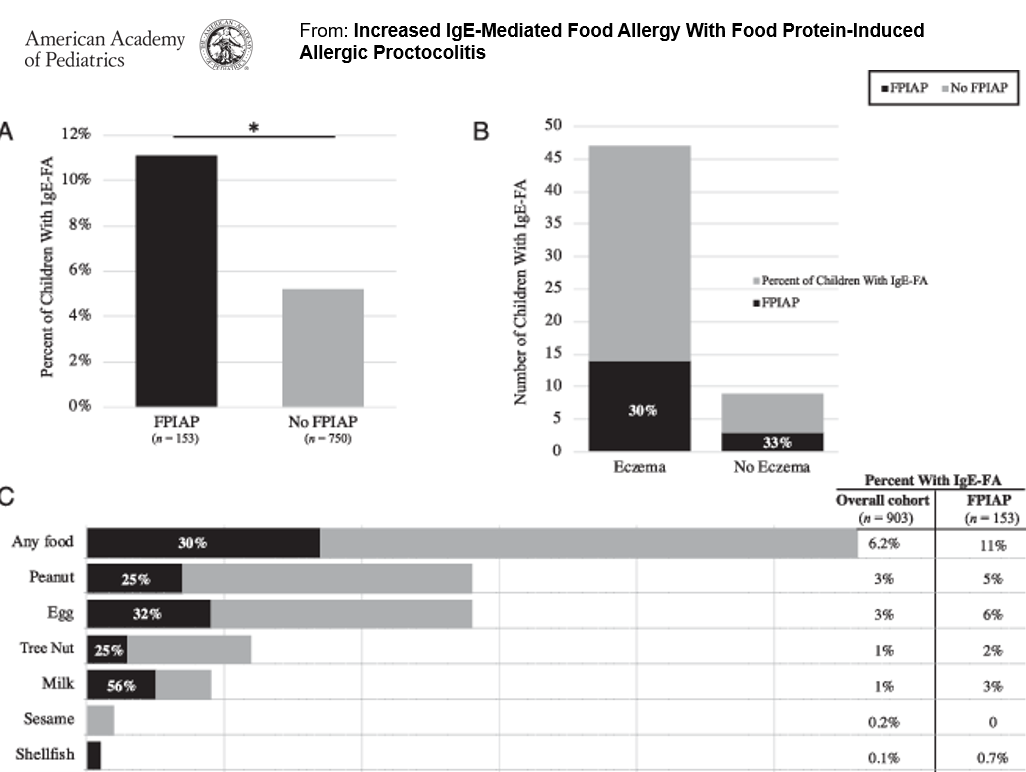
VM Martin et al. Pediatrics 2020; 146: e20200202. Open Access: Increased IgE-Mediated Food Allergy with Food-Protein-Induced Allergic Proctocolitis.

In this study of 153 infants with food protein-induced allergic proctocolitis (FPIAP) with documented blood in the stool, more children with FPIAP developed IgE-Food Allergy (IgE-FA) (11%) compared with healthy children.

Key points (from commentary by MT Kraft and D Stukus):

  • “Although conventional teaching is to wait until 12 months of age to reintroduce dairy to infants with FPIAP, it can likely be introduced much earlier.”
  • The diagnosis of FPIAP was associated with with an increased risk of IgE-FA, “although diagnosis was not confirmed through oral food challenges”

My take: Children with FPIAP are more likely to receive a diagnosis of IgE-FA. Prolonged restriction of milk, when no longer required, could contribute to this; in addition, some children are mislabeled as food allergic without appropriate confirmation (based on faulty testing).

Best Allergy Articles 2021 -Cow’s Milk Allergy (Part 2)

In Pediatrics, supplement 3 summarizes 76 articles: Synopsis Book: Best Articles Relevant to Pediatric Allergy, Asthma and Immunology

Some of the studies that are most relevant to pediatric GI doctors I am reviewing for this blog over the next few days.

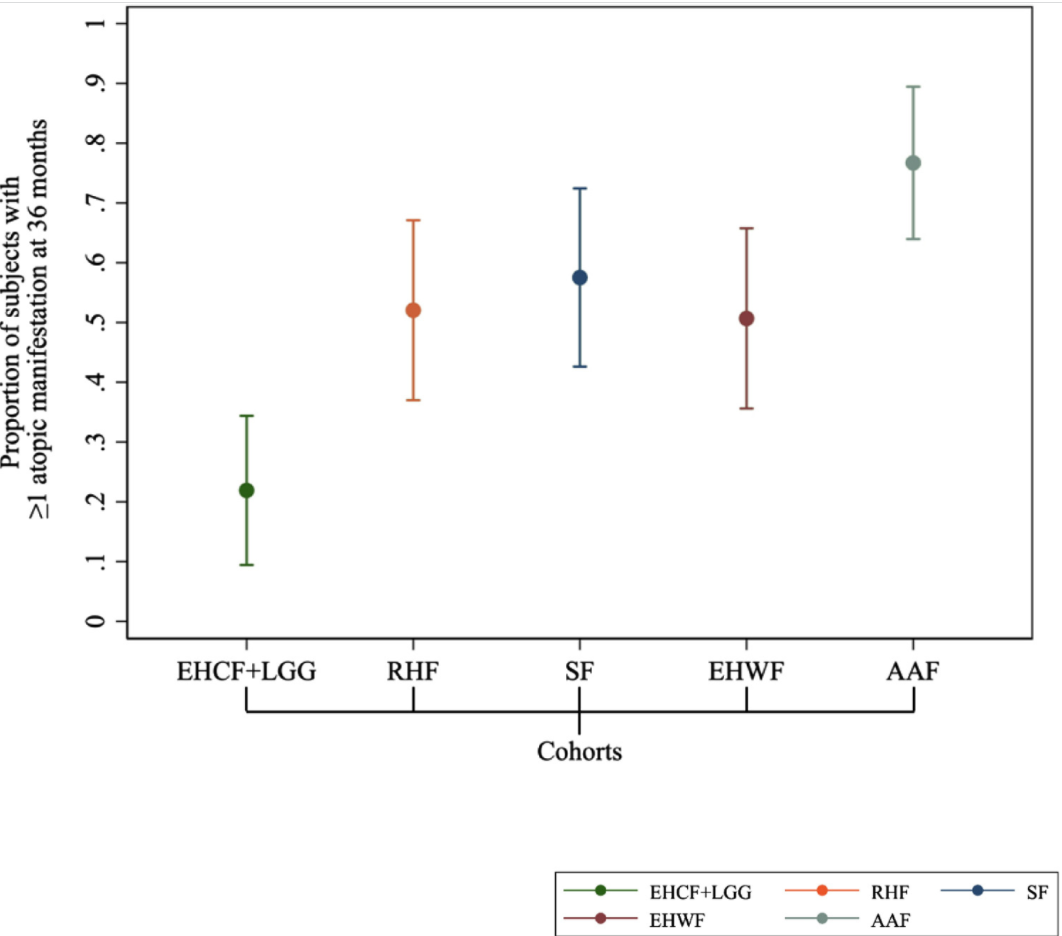
R Nocerino et al. J Pediatr 2021; 232: 183-191. Open Access: The Impact of Formula Choice for the Management of Pediatric Cow’s Milk Allergy on the Occurrence of Other Allergic Manifestations: The Atopic March Cohort Study

Methods: In a 36-month prospective cohort study (n=365), the occurrence of other atopic manifestations (eczema, urticaria, asthma, and rhinoconjunctivitis) and the time of immune tolerance acquisition were comparatively evaluated in children with oral food challenge-confirmed IgE-mediated cow’s milk allergy (CWA). 5 groups were treated with extensively hydrolyzed casein formula containing the probiotic L. rhamnosus GG (EHCF + LGG), rice hydrolyzed formula, soy formula, extensively hydrolyzed whey formula (EHWF), or amino acid–based formula.

Key finding:

  • The use of EHCF + LGG for CMA treatment was associated with lower incidence of atopic manifestations and greater rate of immune tolerance acquisition.

The risk ratios:  

  • 2.37 (1.46-3.86, P < .001) for rice hydrolyzed formula vs EHCF + LGG
  • 2.62 (1.63-4.22, P < .001) for soy formula vs EHCF + LGG
  • 2.31 (1.42-3.77, P < .001) for EHWF vs EHCF + LGG
  • 3.50 (2.23-5.49, P < .001) for amino acid–based formula vs EHCF + LGG

Limitations: non-blinded study, exclusion of patients with anaphylaxis-CMA

Best Allergy Articles 2021-Cow’s Milk Allergy

In Pediatrics, supplement 3 summarizes 76 articles: Synopsis Book: Best Articles Relevant to Pediatric Allergy, Asthma and Immunology

Some of the studies that are most relevant to pediatric GI doctors I am reviewing for this blog over the next few days.

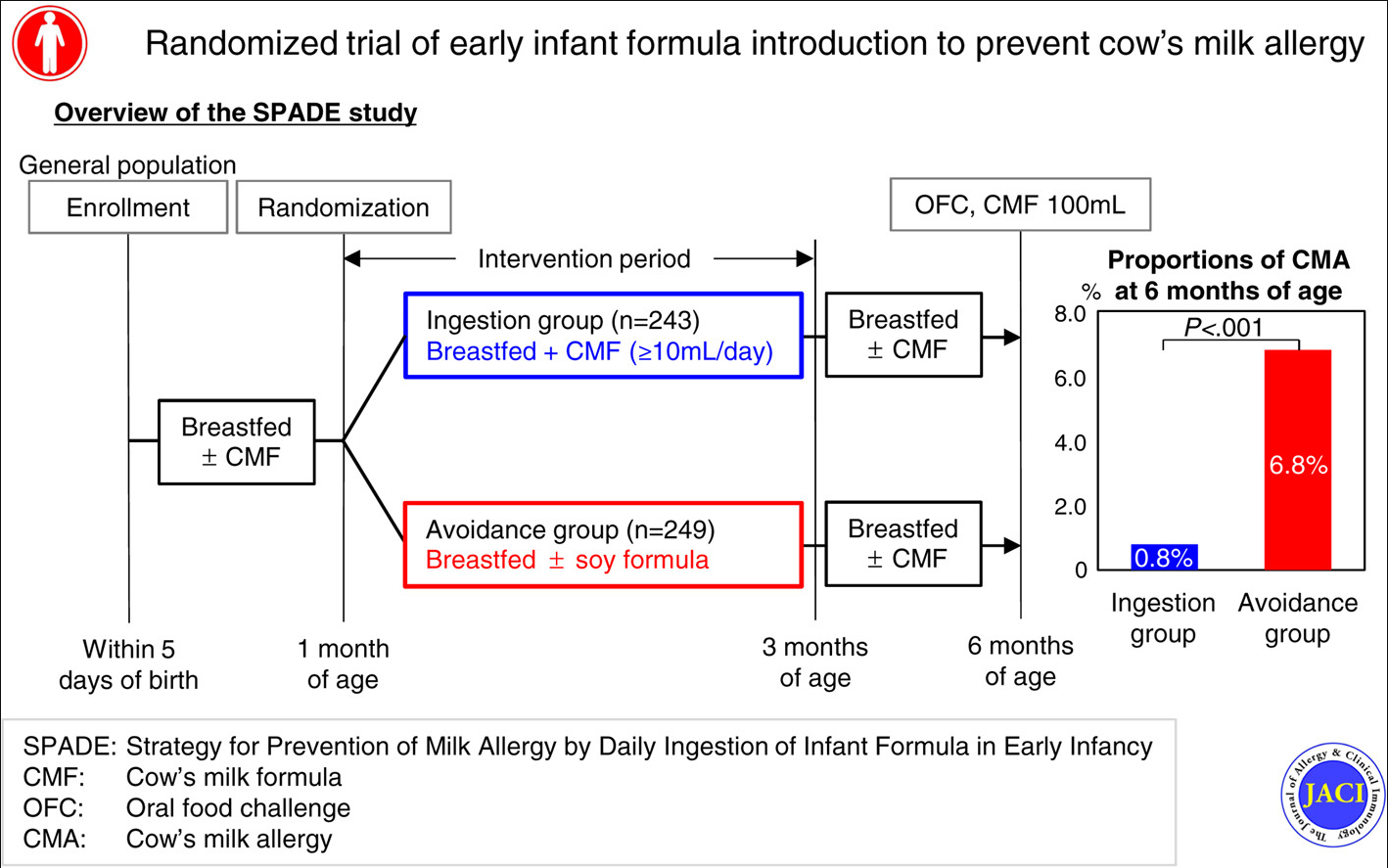
T Sakihara et al. J Allergy Clin Immunol 2021; 147: 224-232.e8. Randomized trial of early infant formula introduction to prevent cow’s milk allergy

In this randomized trial, infants (n=491 enrolled) in Japan were randomly allocated to ingest at least 10 mL of CMF (cow’s milk formula) daily (ingestion group) or avoid CMF (avoidance group) between 1 and 2 months of age. In the avoidance group breast-feeding was supplemented with soy formula as needed. Oral food challenge was performed at 6 months of age to assess CMA development. Continuous breast-feeding was recommended for both groups until 6 months of age.

Key findings:

  • There were 2 CMA cases (0.8%) among the 242 members of the CMF ingestion group and 17 CMA cases (6.8%) among the 249 participants in the avoidance group (risk ratio = 0.12; 95% CI = 0.01-0.50; P < .001).
  • Approximately 70% of the participants in both groups were still being breast-fed at 6 months of age.

My take: This study adds to the growing body of evidence that early introduction of allergenic foods lowers the likelihood of developing food allergies.

Related blog posts:

Disclaimer: This blog, gutsandgrowth, assumes no responsibility for any use or operation of any method, product, instruction, concept or idea contained in the material herein or for any injury or damage to persons or property (whether products liability, negligence or otherwise) resulting from such use or operation. These blog posts are for educational purposes only. Specific dosing of medications (along with potential adverse effects) should be confirmed by prescribing physician.  Because of rapid advances in the medical sciences, the gutsandgrowth blog cautions that independent verification should be made of diagnosis and drug dosages. The reader is solely responsible for the conduct of any suggested test or procedure.  This content is not a substitute for medical advice, diagnosis or treatment provided by a qualified healthcare provider. Always seek the advice of your physician or other qualified health provider with any questions you may have regarding a condition.

Favorite Posts of 2021

I am happy to say that this is the last nightcall that I will have this year!

Today, I’ve compiled some of my favorite posts from the past year. I started this blog a little more than 10 years ago. I am grateful for the encouragement/suggestions from many people to help make this blog better. Also, I want to wish everyone a Happy New Year.

GI:

IBD:

LIVER:

Nutrition:

Other Topics:

Thanks to Jennifer

Timing of Solids and Weight Trajectory

CJ D’Hollander et al. J Pediatr 2022; 240: 102-109. Timing of Introduction to Solid Food, Growth, and Nutrition Risk in Later Childhood

Methods: A longitudinal cohort study was conducted among healthy children 0-10 years of age participating in The Applied Research Group for Kids study between June 2008 and August 2019 in Toronto, Canada.

Key findings:

  • Of 8943 children included, the mean (SD) age of infant cereal introduction was 5.7 (2.1) months
  • Children who were introduced to infant cereal at 4 vs 6 months had 0.17 greater body mass index z score (95% CI 0.06-0.28; P = .002) and greater odds of obesity (OR 1.82; 95% CI 1.18-2.80; P = .006) at 10 years of age. 
  • Earlier cereal introduction was associated with a less-favorable eating behavior score at 18 months to 5 years of age (0.18 units higher; 95% CI 0.07-0.29; P = .001).

Limitation: This study did not randomize children into early vs late cereal introduction; thus, there may be unidentified confounders that contribute to weight gain in children offered cereal at a younger age.

My take: This study indicates that introduction of cereal at 6 months of age, rather than 4 months of age, may be beneficial in limiting excess weight gain.

NASPGHAN Toolbox App

Patrick Reeves passed along the following helpful information about the NASPGHAN toolbox:

The NASPGHAN Fellows committee, working in close partnership with the NASPGHAN Technology and Training committees, has developed an App named, “The NASPGHAN Toolbox”.

The App is equipped with ready access to: clinical calculators, guidelines and algorithms, medication guides, patient education resources, and more. You can access the Toolbox via its URL (https://toolbox.naspghan.org/) on your phone or computer.

The NASPGHAN team hopes this will enhance your day-to-day patient care of children with gastrointestinal disorders.

Some highlights:

Some screenshots:

What’s More Important for Health: Exercise or Weight loss?

GA Gaesser, SS Angadi. iScience 2021; https://doi.org/10.1016/j.isci.2021.102995. Open access: Obesity treatment: Weight loss versus increasing fitness and physical activity for reducing health risks

Key points from this review of more than 200 relevant meta-analyses and individual studies:

  • “A weight-neutral approach to treating obesity-related health conditions may be as, or more, effective than a weight-loss-centered approach, and could avoid pitfalls associated with repeated weight loss failure… Epidemiological studies show that CRF (cardiorespiratory fitness) and PA (physical activity) significantly attenuate, and sometimes eliminate, the increased mortality risk associated with obesity. More importantly, increasing PA or CRF is consistently associated with greater reduction in risk of all-cause and CVD mortality than intentional weight loss.”
  • “The increased prevalence of weight loss attempts in the United States has coincided with the increased prevalence of obesity. Thus, a weight-centric approach to obesity treatment and prevention has been largely ineffective. It is unlikely that continued focus on weight loss as the primary metric for success will reverse the trends in obesity prevalence or result in sustainable weight loss. In fact, chronic weight cycling is the norm for millions of adults and is likely to remain so for as long as weight loss persists as the cornerstone of obesity treatment. Weight cycling is associated with health risks that are very similar to those associated with obesity, including higher all-cause mortality risk, and may contribute to weight gain.”

NY Times (9/29/21): Why Exercise Is More Important Than Weight Loss for a Longer Life “People typically lower their risks of heart disease and premature death far more by gaining fitness than by dropping weight.”

Related blog posts:

Figure 2 from article: “Joint associations between cardiorespiratory fitness (CRF), body mass index (BMI), and all-cause (top) and cardiovascular disease (CVD) (bottom) mortality. Hazard ratios reflect the pooled data from the meta-analyses of Barry et al. for all-cause mortality (Barry et al., 2014) and cardiovascular disease mortality (Barry et al., 2018). For all-cause mortality, the meta-analysis included 6 cohorts of men only, 2 cohorts of women only, and 2 cohorts of both men (~80%) and women. For CVD mortality,
the meta-analysis included 8 cohorts of men only and 1 cohort of both men (89%) and women”

“Pediatric Formula Basics”

CHOA Nutrition Support Core Seminar -Thanks to Kipp Ellsworth for organizing this series and sharing content. This lecture is a really good review and would be a great place to start when discussing formulas with medical students and residents.

Link to Webex (49 min): “Pediatric Formula Basics” by Clancy Bryant, MS, RD (March 2, 2021). Password: FbhSgup5

Also, can reach via: Our first Nutrition Support Core Lecture of 2021: “Pediatric Formula Basics” by Clancy Bryant, MS, RD-20210302 1810-1

Key points:

  • This lecture reviewed selection of formulas for infants, children and adolescents; some of the most common formula choices (but not all) were reviewed
  • This talk reviewed reflux guidelines as reflux symptoms often impact decisions on formula choice in infancy. Thickened formulas like Enfamil AR and Similac Spit Up do not work with acid suppression medications.
  • WIC resources (for children <5 years) -can identify through website: https://dph.georgia.gov/WIC/wic-formula-resources
    • WIC script requires 2 ICD-10 diagnosis which are relevant to chosen formula
    • For standard formula, no prescription is needed; if formula is not on WIC formulary, it will not be covered
    • If child is NPO, write for “patient is NPO, please give maximum formula”
  • For cholestatic liver disease: high MCT formulas include pregestamil (55%), Alimentum (33%) and elemental formulas (33-49%)
  • For chylous effusions, very high MCT formulas (83%, 84%) include enfaport and monogen (needs EFA supplementation)
  • Formulas for children and adolescents come in concentrations of 0.6 kcal/mL to 2.0 kcal/mL
    • Reduced calorie formulas (eg. Pediasure Reduced Calorie or Compleat Pediatric Reduced Calorie) are helpful to provide adequate micronutrients/protein in children with hypocaloric needs
  • Blenderized formulas often helpful for children with retching (when given via gastric route); some of these may increase vitamin A levels and beta-carotene (eg. Nourish, Compleat Pediatric Organic Blends). Real food blends are not nutritionally-complete. Harvest is able to run through enteral tube without dilution.
    • For those older than 10 years of age, Liquid Hope is similar to Nourish and Compleat Organic Blends is similar to Compleat Pediatric Organic Blends
  • Low electrolyte formulas, like Renalcal and Renastart, may be useful for children with kidney dysfunction. Corresponding formulas for >10 years of age include Suplena and Novasource Renal
  • Kate Farms is often a good choice for patients with multiple allergies or eosinophilic esophagitis

Some of the slides:

Formulas for 1-10 years of age.

Adult formulas (>10 years):

Related blog posts:

Nutritional Anemia -Expert Review

At Children’s Healthcare of Atlanta, there has been a long-standing nutritional lecture series coordinated by Kipp Ellsworth.

A recent webinar: Link to WebEx (password PmSU6JPt): Nutrition Support Colloquium featuring Dr. Parmi Suchdev: “The Prevention, Diagnosis, and Treatment of Nutritional Anemia” (30 minute lecture)

Dr. Parmi Suchdev affiliations:

  • Associate Director, Emory Global Health Institute
    Director, Global Health Office of Pediatrics
    Professor of Global Health, Rollins School of Public Health
    Professor of Pediatrics, Emory University School of Medicine
  • BRINDA: BIOMARKERS REFLECTING INFLAMMATION AND NUTRITIONAL DETERMINANTS OF ANEMIA

Here are a few of the slides:

Related blog posts:

Disclaimer: This blog, gutsandgrowth, assumes no responsibility for any use or operation of any method, product, instruction, concept or idea contained in the material herein or for any injury or damage to persons or property (whether products liability, negligence or otherwise) resulting from such use or operation. These blog posts are for educational purposes only. Specific dosing of medications (along with potential adverse effects) should be confirmed by prescribing physician.  Because of rapid advances in the medical sciences, the gutsandgrowth blog cautions that independent verification should be made of diagnosis and drug dosages. The reader is solely responsible for the conduct of any suggested test or procedure.  This content is not a substitute for medical advice, diagnosis or treatment provided by a qualified healthcare provider. Always seek the advice of your physician or other qualified health provider with any questions you may have regarding a condition

High Calorie Infant Formula

Our office has participated in research for a 30 cal infant formula that is heading to the market in 2021. Nutricia is calling the formula Fortini. Link to website: Fortini (I have no financial ties/interest to this product or company).

I think having a commercial high calorie infant formula is advantageous and overcomes some of the limitations of concentrating infant formulas. Advantages:

  • This formula will eliminate problems with incorrect mixing and contamination. Despite careful oral and written instructions, many parents incorrectly prepare high calorie formulas
  • This formula, compared with concentrating a standard formula, is likely to have improved tolerability (less hyperosmolar) and better nutrient balance (eg. proper protein content)

The main potential disadvantage is going to be cost. I do not know the cost of the new formula but would be surprised if it is not significantly higher than concentrating a standard formula. At the same time, if the formula is able to improve tolerance and improve poor growth, there could be ‘downstream’ savings with less medical intervention/hospitalizations.

Related blog post: Rarely Seen and “Do Not Miss” Explanation for Failure to Thrive

Chattahoochee River. Sandy Springs, GA