Scrutiny Over Expertise with Dietary Guidelines

From NY Times: Scientific Panel on New Dietary Guidelines Draws Criticism from Health Advocates

An excerpt:

More than half the members of a panel considering changes to the nation’s blueprint for healthy eating have ties to the food industry…

Marion Nestle, a nutrition expert at New York University who served on the advisory panel in 1995, said the large number of experts with industry ties reflected the dearth of public funding for nutrition science, which forces many researchers to accept funding from food companies and industry associations. “Anyone who thinks it’s not OK to accept corporate money would never get appointed to that committee,” she said. “That’s considered so biased that you’re too biased to function.”

Despite concerns about this year’s process, Ms. Nestle said she believed the new guidelines would likely resemble the recommendations that were issued five years ago. The bigger issue, she said, is that most Americans will find the guidelines hard to decipher and unsure how to apply them to their own eating habits.

“Every five years, the guidelines get longer and more complicated,” she said. “In my view, the advice is the same: Eat your vegetables don’t gain too much weight and avoid junk foods with a lot of salt, sugar and saturated fat.”

My take: Most well-informed individuals lack confidence that this the administration is working to improve dietary guidelines, regardless of who is selected to be on their committees.

Related blog posts:

Fatty Liver Feast (of Articles): NAFLD 2020

An entire issue of Gastroenterology delved into the topics of “NAFLD 2020.”

This special May 2020 issue provides a comprehensive update on Nonalcoholic Fatty Liver Disease.

Here are a few links to some of the articles:

Related blog posts:

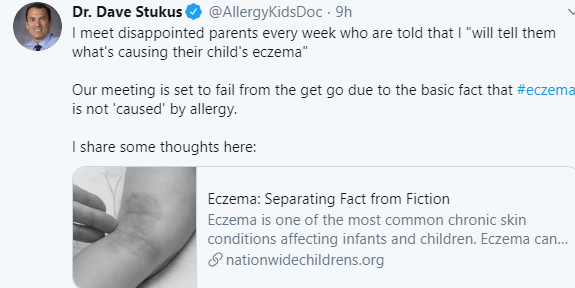
Eczema Rarely Linked to Food Allergy

From Dave Stukus, Nationwide Children’s: Eczema: Separating Fact from Fiction

An excerpt:

Many parents are told that if they can find the ‘cause’ of their child’s eczema and eliminate exposure, then their skin will improve. Unfortunately, this is not the case because the cause of eczema is a disrupted skin barrier, which leads to excessive water loss, dryness and itching.

Parents with a history of allergies or eczema often have babies with eczema. About 40% of children with eczema have a mutation in a protein called filaggrin, which is important in reducing the gap between skin cells. If the skin barrier is disrupted, as in eczema, then irritants and allergens are more likely to pass through and cause irritation, itching, and rash, but this is not the ‘cause’.

Children with eczema, especially those with persistent, severe cases affecting most of their body, are at higher risk to develop allergies and asthma as they get older….

In rare instances, specific foods may be a major contributor to a child’s eczema, but this is the exception and typically affects infants less than one year of age with truly unmanageable, severe eczema, despite good daily skin care.

Breastfeeding mothers everywhere are incorrectly told to stop eating dairy or other foods to ‘treat’ their baby’s eczema. Not only is this unnecessary for most mothers but can lead to significant problems associated with a restricted diet…and not actually treat the eczema.

Related blog posts:


Study May Indicate Biologic Basis for Brain Fog in Persons with Celiac Disease

From The Onion: Dumbass Dog Wearing Face Mask All Wrong

From The Onion


A recent study (ID Croall, et al. Gastroenterol 2020; 158: 2112-22), using a UK Biobank with 500,000 adults, compared 104 participants with celiac disease to 198 healthy age-matched controls (mean age 63 years).

The authors examined cognitive outcomes, mental health outcomes and imaging data (MRI, diffusion tensor imaging).

Key findings: 

  • The celiac cohort had significant deficits in reaction time (P=.004), anxiety (P=.025), depression (P=.015), thoughts of self-harm (P=.025), and health-related unhappiness (P=.01)
  • Imaging studies showed white matter changes “which match up well anatomically with the regions affected in the celiac-related neurologic syndrome gluten ataxia.”

Limitations: study lacked data on celiac treatment status –whether better control or earlier diagnosis/treatment would reduce CNS complications is uncertain.  Also, whether these findings are more or less prevalent in individuals with undiagnosed celiac disease is unclear.

My take: This study provides further evidence that celiac disease results in significant neurologic problems and further reasons for those with celiac disease to adhere to a strict gluten-free diet (as other studies of neurologic outcomes indicate that a GFD can improve/reverse neurologic morbidities).

Related blog posts:


COVID-19: Meat Processing Personnel, School Opening Problem and Nosocomial Infections

It is widely recognized that the meat processing industry has been hit hard; here’s the data: more than 16,000 cases in April-May from 23 reporting states:


School opening decisions are now being worked out.  While reports have indicated that school opening is going fine in many places in Europe, their caseload is much much lower.

From Mike Lukovich’s Twitter Feed:

Related blog post: What Our Office is Recommending: Schools and IBD Patients

Also: this link, RIVM Children and COVID-19, describes experience with opening schools in Europe and Australia


Also, an interesting Wall Street Journal Article (Behind Paywall): Hospitals Struggle to Contain Covid-19 Spread Inside Their Walls

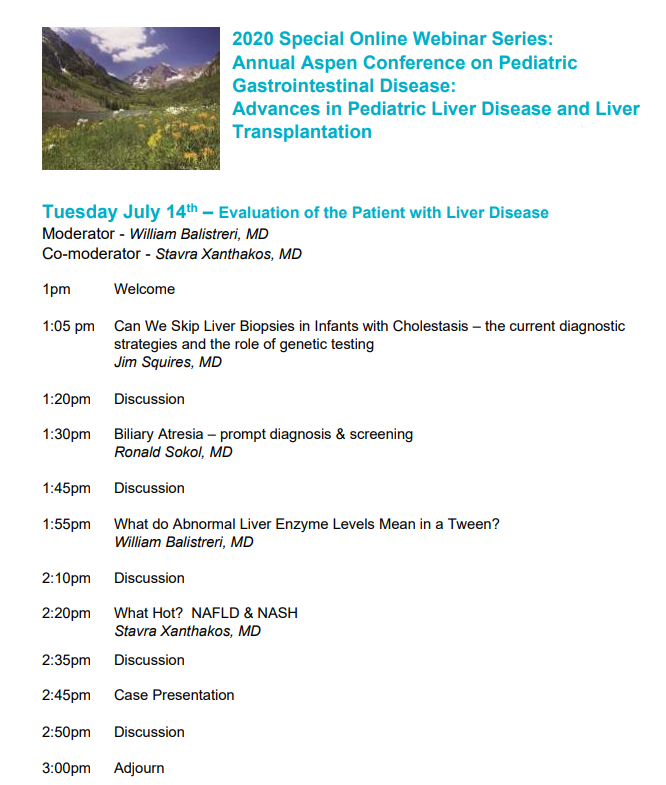
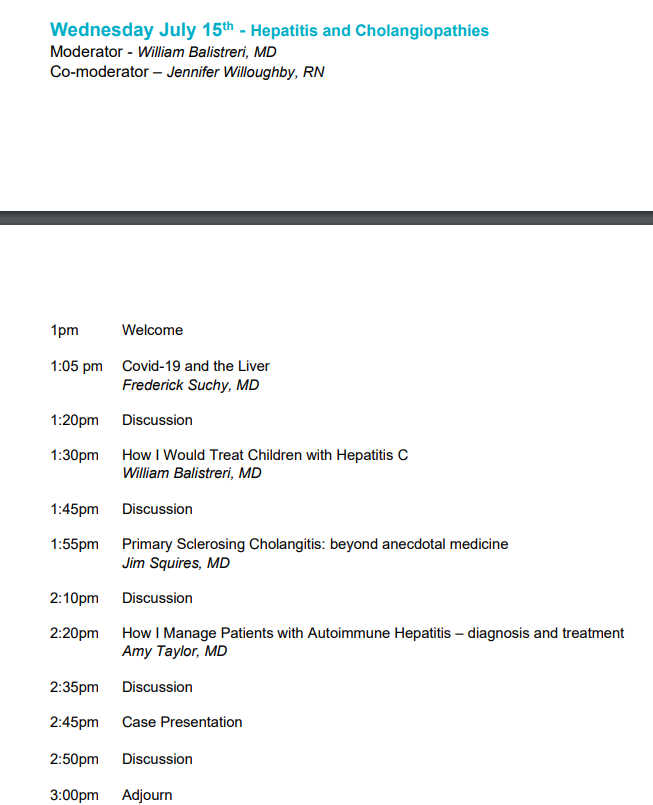
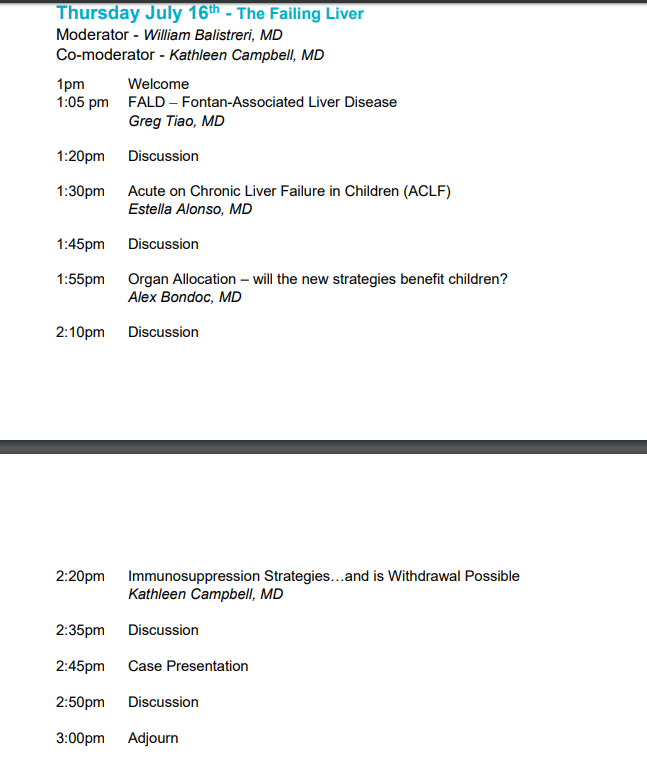
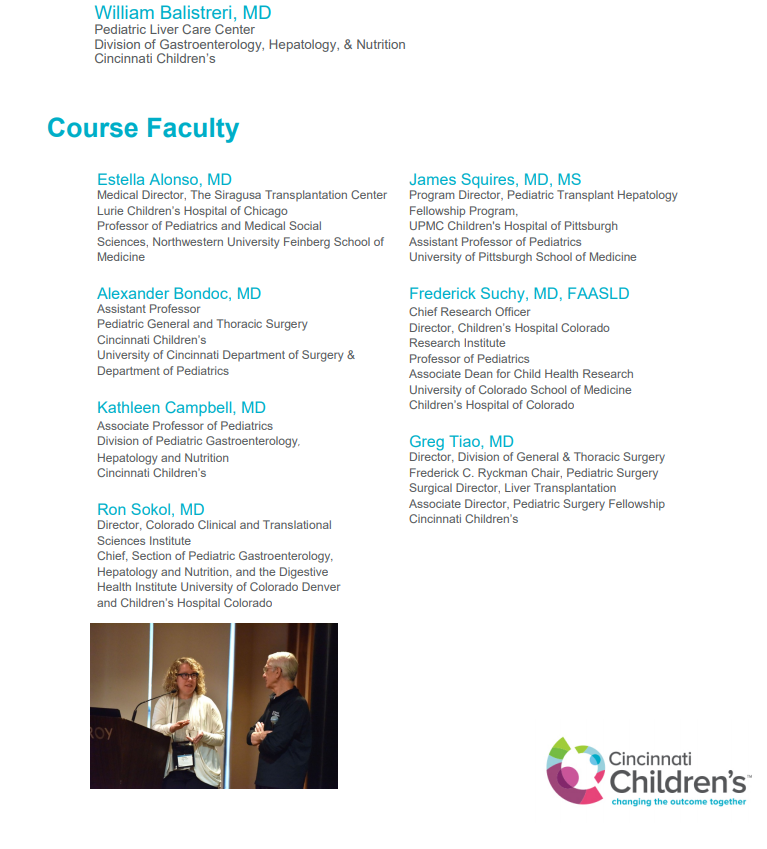
Don’t Miss: Annual Aspen Conference on Pediatric Gastrointestinal Disease: Advances in Pediatric Liver Disease and Liver Transplantation (Online)

This year I had planned to go back to what many consider the best learning conference in our field, the Annual Aspen Conference.  This conference alternates yearly between GI topics and liver topics.  What has made this conference so great:

  • Intimate setting
  • Terrific faculty
  • Chance to enjoy the surroundings with friends and families after the lectures

Due to the pandemic, this year’s course will be curtailed and online.  While this changes the setting, it is still a great opportunity and a heck of a lot easier to attend. It will take place 1:00-2:30 pm Tues, Weds, and Thurs next week (July 14-16).  You can register for a day or for all 3 days. Course description and faculty are listed below.

Also, there is a pre-conference SCAVENGER HUNT.  (This appears to be mainly to help with promotion of the conference sponsors.) By participating, attendees will be eligible for  raffle prizes awarded during the webinar:
•  Snowmass Camelback
•  Snowmass Winter Gloves
•  Snowmass Hat
•  Snowmass Socks
The GRAND PRIZE is FREE 2021 CONFERENCE REGISTRATION!

What Our Office Is Recommending: School and Pediatric IBD Patients

We are getting a lot of calls from families trying to figure out what they should be doing for their children with inflammatory bowel disease in regards to school attendance.  Here is what our ICN team has developed:

School guidance during Covid pandemic:

With the flood of information in the lay and scientific media, GI Care for Kids wanted to assure that our patients and families who had children with inflammatory bowel disease (IBD), Crohn’s or ulcerative colitis, had some guidance in making important decisions about beginning the 2020-2021 school year.  Currently, research shows that just having IBD, DOES NOT put a person more at risk for acquiring (i.e. catching) coronavirus (COVID-19) infection.  In addition, research suggests that biologics (e.g. Remicade, Humira) DO NOT seem to increase the risk for more severe Covid related illnesses.

However, steroids, thiopurines (e.g. 6-MP; azathioprine, immuran) and prograf DO appear to have a larger effect on increasing risk for more severe coronavirus infection and COVID-19 disease.  Additional research is being carried out with oldest patients (e.g. > 65 years of age) who appear to be at increased risk for infection and COVID-related disease, and, other co-morbid conditions (e.g. obesity, diabetes, cardiovascular disease) being at highest risk for COVID-19 disease as well.

All patients should practice good hand hygiene, wear masks at all times outside of the house, and observe social distancing.  If your family does not feel that return to a traditional school building is in your child’s best interest, please let us know, and we will help make sure we support you from a medical standpoint. 

For further information on the status of coronavirus in people with IBD world-wide, young or old, please go to: www.covidibd.org.

Additional information about the status of COVID-19 can be found at the following websites:


Also, this:

Facebook link (1:22 min): This is what happens when a Special Effects guy stays at home with his son during lockdown


Disclaimer: This blog, gutsandgrowth, assumes no responsibility for any use or operation of any method, product, instruction, concept or idea contained in the material herein or for any injury or damage to persons or property (whether products liability, negligence or otherwise) resulting from such use or operation. These blog posts are for educational purposes only. Specific dosing of medications (along with potential adverse effects) should be confirmed by prescribing physician.  Because of rapid advances in the medical sciences, the gutsandgrowth blog cautions that independent verification should be made of diagnosis and drug dosages. The reader is solely responsible for the conduct of any suggested test or procedure.  This content is not a substitute for medical advice, diagnosis or treatment provided by a qualified healthcare provider. Always seek the advice of your physician or other qualified health provider with any questions you may have regarding a condition

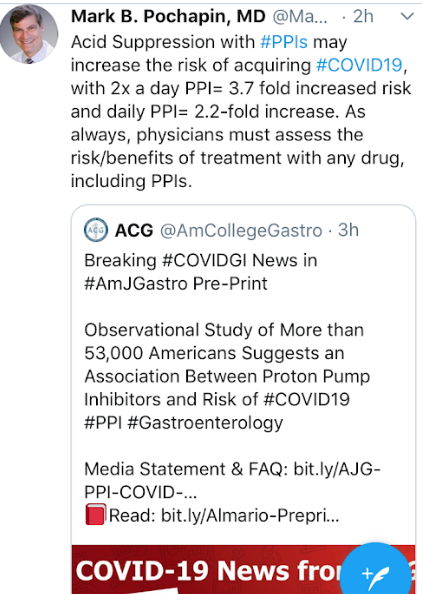
PPIs Associated with Increased Risk of COVID-19 Infection

Here is link to original study: Increased Risk of COVID-19 Among Users of Proton Pump Inhibitors 

Almario CV, Chey WD, Spiegel BMR. Increased risk of COVID-19 among users of proton pump inhibitors. Am J Gastroenterol 2020 (pre-print posted online July 7, 2020)

From ACG:  Information Sheet and FAQs About Proton Pump Inhibitors (PPIs) and Risk of COVID-19

This study shows an association but does not prove that PPIs increase risk of COVD-19.  Patients taking PPIs may have other attributes that increase their risk compared to those who are not taking PPIs.

Here is some more information on twitter thread of this topic:

Emerging IBD Treatment: Selective Jak Inhibitor, Upadacitinib

Two recent large studies examined the use of Upadacitinib, an oral JAK1 inhibitor, for Crohn’s disease and for Ulcerative Colitis.

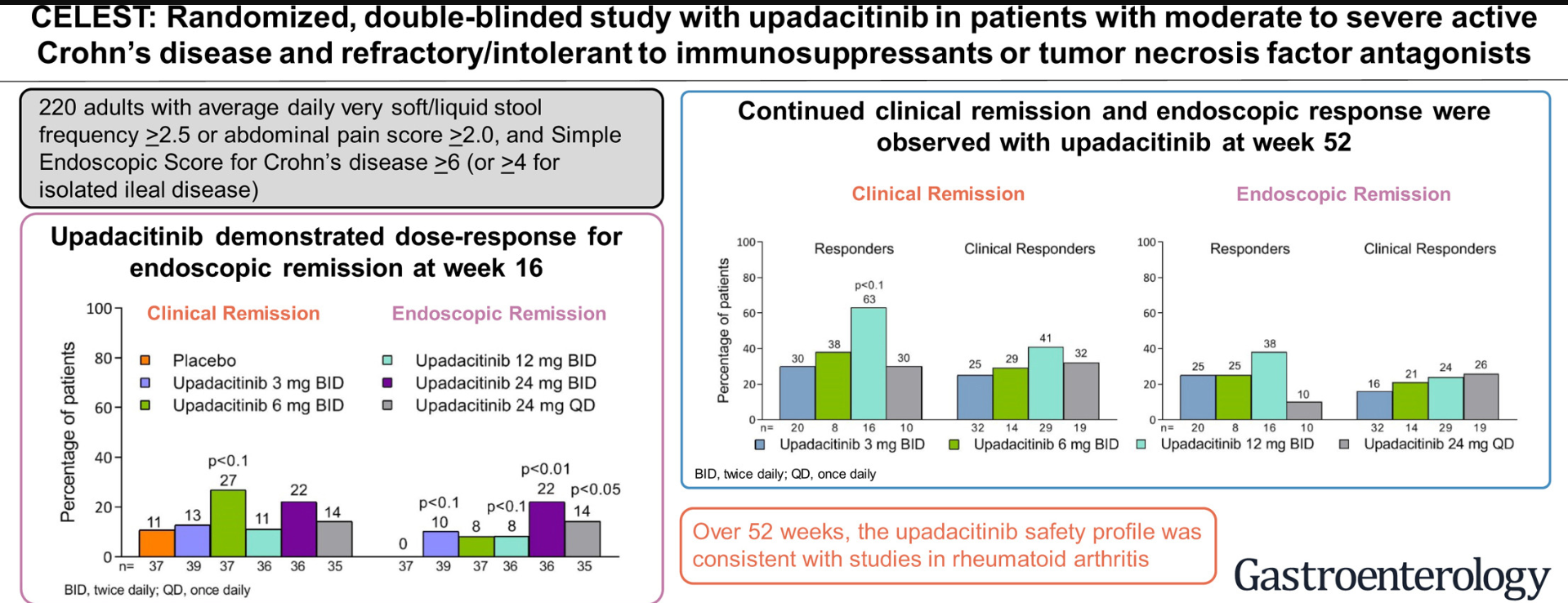
The first study, “CELEST,” (n=220) is the “first to evaluate the efficacy, safety, pharmacokinetics, and dose-response of upadacitinib immediate-release formulation in patients with moderate to severe CD and refractory to TNF antagonist therapy using PRO-based clinical and endoscopic endpoints… Nearly half of the patients enrolled in CELEST (44% [96/220]) were taking oral corticosteroids at baseline and underwent a mandatory taper starting at week 2.” The key findings are noted in the graphical abstract (below). A couple of additional points:

  • During the induction period, the 24-mg twice-daily dose exhibited the most consistent association with meaningful improvements for multiple clinical and endoscopic endpoints at week 12 or 16
  • Clinical remission was achieved by 13% of patients receiving 3 mg upadacitinib, 27% of patients receiving 6 mg upadacitinib (P < .1 vs placebo), 11% of patients receiving 12 mg upadacitinib, and 22% of patients receiving 24 mg upadacitinib
    twice daily, and by 14% of patients receiving 24 mg upadacitinib once daily, vs 11% of patients receiving placebo.
  • Endoscopic remission was achieved by 10% (in 3 mg group) (P < .1 vs placebo), 8% (in 6 mg and 12 mg groups) (P < .1 vs placebo), 22% (in 24 mg BID group) (P < .01 vs placebo), and 14% (in 24 mg QD group) (P < .05 vs placebo) of patients receiving upadacitinib, respectively, vs none of the patients receiving placebo
  • Upadacitinib was also associated with improvements in quality of life, based on IBDQ, observed as early as week 8
  • AEs reported in this study were consistent with those previously observed in clinical trials with JAK inhibitors. Two patients had myocardial infarction events and 1 patient had a mesenteric vein thrombosis.
  • Limitations: sample size, lack of placebo control during maintenance

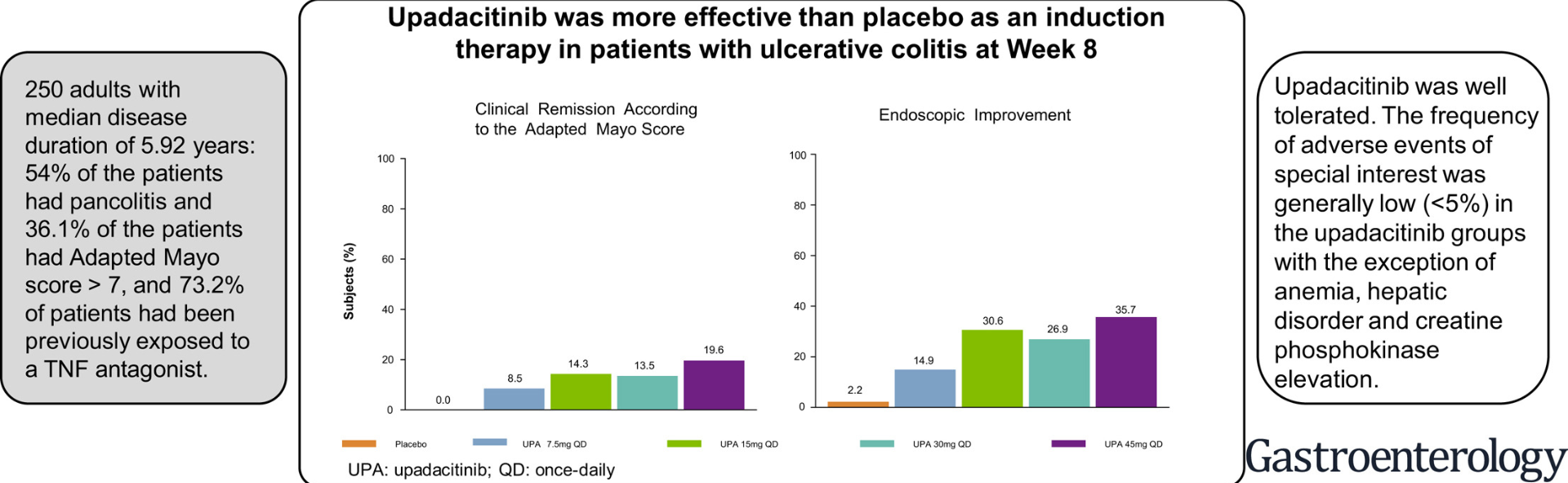
The second study, “U-ACHIEVE,” for ulcerative colitis (n=250) notes that in cellular assays upadacitinib is up to 60-fold selective for JAK1 over JAK2 and >100-fold selective over JAK3.  The study incorporated a new definition for the primary endpoint of clinical remission using the adapted Mayo score with a more stringent criterion than previous studies. A consistent dose-response relationship with upadacitinib for this primary endpoint was observed. Other points:

  • Upadacitinib was more effective than placebo for inducing remission in patients with moderately to severely active ulcerative colitis
  • The onset of action was rapid, as shown by improvement in the partial
    Mayo score at week 2
  • Endoscopic improvement at week 8, defined as endoscopic subscore of 1, was achieved in 14.9%, 30.6%, 26.9%, and 35.7% of patients receiving upadacitinib 7.5 mg, 15 mg, 30 mg, or 45 mg, respectively, compared with 2.2% receiving placebo (P ¼ .033, P < .001, P < .001, and P < .001 compared with placebo, respectively)
  • Histologic improvement was demonstrated in all treatment arms
  • The types of AEs reported in this study were similar to those previously observed in clinical trials with JAK inhibitors. In the 45 mg daily arm, one patient developed herpes zoster and one participant developed deep venous thrombosis/pulmonary embolism (26 days after discontinuation of study medication)

My take: Upadacitinib looks quite promising for ulcerative colitis and is likely to be helpful in a smaller subset of patients with Crohn’s disease.  HIgher doses appear to be more effective but are likely to be associated with higher rates of adverse events. Further studies, including pediatric trials, are needed.


Ustekinumab Over Vedolizumab as 2nd Line Agent for Crohn’s Disease

A recent study: Ustekinumab is associated with superior effectiveness
outcomes compared to vedolizumab in Crohn’s disease patients with prior failure to anti-TNF treatment. VBC Biemans et al. Aliment Pharmacol Ther 2020; 52: 123-134.  Thanks to Ben Gold for this reference.

Methods: Crohn´s disease patients, who failed anti-TNF treatment and started
vedolizumab or ustekinumab in standard care as second-line biological, were
identified in the observational prospective Dutch Initiative on Crohn and
Colitis Registry.  128 vedolizumab- and 85 ustekinumab-treated patients fulfilled
the inclusion criteria. Median age in the cohorts were 37 and 39 respectively.

Key findings (at 52 weeks):

  • After adjusting for confounders, ustekinumab-treated patients were more likely to achieve corticosteroid-free clinical remission (odds ratio [OR]: 2.58, 95% CI: 1.36-4.90, P = 0.004), biochemical remission (OR: 2.34, 95% CI: 1.10-4.96, P = 0.027), and combined corticosteroid-free clinical and biochemical remission (OR: 2.74, 95% CI: 1.23-6.09, P = 0.014).
  • Safety outcomes (infections: OR: 1.26, 95% CI: 0.63-2.54, P = 0.517; adverse events: OR: 1.33, 95% CI: 0.62-2.81, P = 0.464; hospitalisations: OR: 0.67, 95% CI: 0.32-1.39, P = 0.282) were comparable between the two groups

My take: This study indicates that ustekinumab is likely a more effective 2nd line agent for Crohn’s disease.

Related blog posts: