Sclerosing Cholangitis-Like Changes Due to Drug Induced Liver Injury

A recent study (J Ahmad et al. Clin Gastroenterol Hepatol 2019; 17: 789-90) reviewed subjects in enrolled in drug-induced liver injury (DILI) prospective cohort to determine the frequency of sclerosing cholangitis (SC)-like changes in this population.  SC-like changes have previously been noted in up to 10% of DILI cases (Dig Liv dis 2015; 47: 502-7). In this study, 233 of 1487 subjects had underwent an MRI.

Key findings:

  • Four of 56 (7%) with adequate quality images had SC-like images (4 with intrahepatic stricture and 1 with a common hepatic duct stricture as well)
  • Patients with SC-like changes had a more severe initial injury noted and were more likely to develop chronic injury as noted by persistent lab abnormalities at 6 months

My take: This study indicates that a severe DILI can result in secondary sclerosing cholangitis.

Related blog posts:


Dust Mites and Eosinophilic Esophagitis

Given seasonal fluctuation in the activity of eosinophilic esophagitis (EoE), aeroallergens have been considered a trigger in some patients.

Briefly noted: A recent study (A Ravi et al. Gastroenterol 2019; 157: 255-6, editorial 17) showed that dust mite antigen was present in esophageal biopsy specimens at a greater level in adult patients with EoE compared to controls.  With active EoE, patients had dust mite staining in 1.6% of the field which was significantly greater than patients with inactive EoE (0.7). The control group had a complete absence of epithelial dust mite staining.

The editorial (Seena Aceves) notes that these investigators have also shown gluten accumulation in the EoE esophagus.  Whether dust mite antigens or other specific postulated aeroallergens plays a causative role is unclear.  This study shows the presence of these antigens in the esophagus but does not show whether this is an epiphenomenon due to increased permeability or whether these antigens activate the local immune system.

A second study (T Patton et al. JPGN 2019; 69: e43-e48) describes the outcome of coexisting celiac disease and eosinophilic esophagitis in 22 children (from a cohort of 350 children with celiac disease. 17 had repeat biopsies.  Four of 17 (23.5%) had resolution of EoE with a gluten-free diet.  Related blog post: Is there a Link Between Eosinophilic Esophagitis and Celiac Disease?

Sagrada Familia, Barcelona

“Tofacitinib: A Jak of All Trades”

The clever title is derived from an editorial (KE Burke, AN Ananthakrishan. Clin Gastroenterol Hepatol 2019; 17: 1438-40) regarding three recent publications regarding Tofacitinib, a non-selective inhibitor of janus kinase (JAK) enzymes 1,2 and 3 which was FDA-approved in May 2018 for moderate to severe ulcerative colitis. This report was published prior to recent FDA warning regarding blood clots: FDA Warning on Tofacitinib

Two of the reports have been summarized previously on this blog:

The third study examines the safety of tofacitinib: W Sandborn et al. Clin Gastroenterol Hepatol 2019; 17: 1541-50

Methods: This study analyzed data from phase 2 and phase 3 trials with 1157 patients who had a median treatment of 1.4 years (1613 person-years).  More than three-fourths were receiving 10 mg BID.

Findings:

  • Serious infections were infrequent but there was a dose response relationship associated with herpes zoster infections.  At 10 mg BID,  the frequency was 5% whereas the rate was 1.5% in those receiving 5 mg BID and 0.5% in placebo-treated patients. This is likely related to interference of interferon production related to JAK inhibitor disruption.
  • Sandborn et al conclude that the “safety profile of tofacitinib for patients with UC appeared similar to that reported for patients with rheumatoid arthritis and for patients with UC treated with biologic agents, except for the higher incidence rate of herpes zoster infection.”

The editorial recommends NOT using tofacitinib for acute severe ulcerative colitis (ASUC); it “should be encouraged only in selected patients and preferably in the context of a research study.”  “Infliximab and cyclosporine [should be used] for steroid refractory UC;” however, they suggest that “one can consider initiating tofacitinib PRIOR to patients becoming steroid refractory.  “It could be used upfront on day 1.”

Related blog posts -Tofacitinib:

Related blog posts -ASUC:

Ciutedella Park, Barcelona

Disclaimer: These blog posts are for educational purposes only. Specific dosing of medications/diets (along with potential adverse effects) should be confirmed by prescribing physician/nutritionist.  This content is not a substitute for medical advice, diagnosis or treatment provided by a qualified healthcare provider. Always seek the advice of your physician or other qualified health provider with any questions you may have regarding a condition.

Should Pediatric Patients with Celiac Disease Be Screened for Low Bone Mineral Density?

A recent retrospective study (J Webster et al. Clin Gastroenterol Hepatol 2019; 17: 1509-14) with 673 children with newly diagnosed (biopsy-proven) celiac disease (CD) (median age 10.6 y) evaluated DXA studies at time of diagnosis.

Key findings:

  • Approximately 7% (n=46) had a low lumbar spine areal bone mineral density (aBMD) z-score (less than -2)
  • Of those with abnormal aBMDs, 18 had repeat studies.  11 of 18 normalized after institution of dietary management. Mean time for repeat DXA was 2.3 years
  • Of note, mean BMI z-score at time of repeat DXA was 0.005 (this includes 90 who had followup studies after a normal baseline DXA).
  • Low body mass index (BMI) with z-score of -0.4 identified a >10% risk of an abnormal aBMD

The authors acknowledge than DXA screening is controversial.  The current study’s strength is its large size.  Limitations include the inability to correlate with clinical factors including adherence to a gluten-free diet.

My take:

  1. Based on this study, it is likely that only 2-3% of pediatric patients with celiac disease will have a persistently abnormal DXA after institution of a gluten free diet for 2 years; it is likely that even more will improve with time if receiving appropriate dietary treatment.
  2. I am not likely to recommend obtaining a baseline DXA study in pediatric patients with newly diagnosed celiac disease; the treatment for low bone mineral density in the setting of celiac disease is the same as for all children with celiac disease.  If one were inclined to look for low BMD, optimal timing would likely be AFTER being adherent on a gluten free diet for at least two years particularly in those who had low BMI at presentation.

Related blog posts:

Columbus Monument, Barcelona

Disclaimer: These blog posts are for educational purposes only. Specific dosing of medications/diets (along with potential adverse effects) should be confirmed by prescribing physician/nutritionist.  This content is not a substitute for medical advice, diagnosis or treatment provided by a qualified healthcare provider. Always seek the advice of your physician or other qualified health provider with any questions you may have regarding a condition


Briefly noted: Induction Infliximab Levels

K Clarkston et al. JPGN 2019; 69: 68-74. This pediatric study with 72 children/young adults with Crohn’s disease examined infliximab trough levels; 70 received infliximab monotherapy & 88% received “standard” dose of 5 mg/kg

Key findings:

  • Infliximab level ≥18 mcg/mL at week 6 was strongly associated with clinical and biologic response as well as achieving an infliximab level ≥5 mcg/mL at week 14 (AUC 0.85).
  • A week 6 level ≥18 mcg/mL had 82% sensitivity, 82% specificity, 56% PPC, and 94% NPV  for having a therapeutic level at 4th infusion.
  • Median infliximab levels for clinical responders was 27.8 mcg/mL at 2nd infusion and 14 mcg/mL at 3rd infusion.
  • The authors reported that only 22% of their cohort achieved a week 14 infliximab level ≥5 mcg/mL. The median infliximab level at this time point was 2.1 mcg/mL.

My take: In this study, the standard dose of infliximab (5 mg/kg) was not adequate in ~80% of patients in achieving a therapeutic trough level.  If using the standard low-dose, it may be worthwhile to check a trough level prior to 3rd infusion or at week 10 to help determine if the level will be sufficient to start maintenance treatment at week 14 or whether an earlier infusion is warranted.

Related blog posts:

Barcelona

Disclaimer: These blog posts are for educational purposes only. Specific dosing of medications/diets (along with potential adverse effects) should be confirmed by prescribing physician/nutritionist.  This content is not a substitute for medical advice, diagnosis or treatment provided by a qualified healthcare provider. Always seek the advice of your physician or other qualified health provider with any questions you may have regarding a condition.


Combination Therapy Study Points to Central Role of Adequate Drug Levels

A recent study (JF Colombel et al. Clin Gastroenterol Hepatol 2019; 17: 1525-32) examines the effect of combination therapy and drug levels in achieving corticosteroid-free remission at week 26 (CSFR26).

The authors performed a post hoc analysis from 206 patients with Crohn’s disease (CD): 97 monotherapy with infliximab & 109 with combination infliximab/azathioprine

Key findings:

  • The proportions of patients achieving CSFR26 were not significantly greater among those receiving combination therapy vs monotherapy within the same serum infliximab concentrations
  • Mean trough infliximab concentrations in the combination therapy were higher than for monotherapy: 3.54 mcg/mL vs. 1.55 mcg/mL
  • Higher levels of antidrug antibodies were seen with monotherapy: 35.9% vs 8.3% of those with combination therapy.  Antidrug antibodies were detected only in those with lowest quartile of infliximab trough levels.

My take: This study indicates that combination therapy’s higher efficacy is due to  favorable pharmacokinetics rather than drug synergy.  If good infliximab trough levels can be achieved with infliximab monotherapy, this may obviate the need for combination therapy.  The uncertain factor is whether closer attention to trough levels will minimize the development of antidrug antibodies as effectively as the use of combination therapy.

Related blog posts:

Disclaimer: These blog posts are for educational purposes only. Specific dosing of medications/diets (along with potential adverse effects) should be confirmed by prescribing physician/nutritionist.  This content is not a substitute for medical advice, diagnosis or treatment provided by a qualified healthcare provider. Always seek the advice of your physician or other qualified health provider with any questions you may have regarding a condition.

Sagrada Familia, Barcelona

Is There a Way to Prove Which Dietary Factors Trigger Irritable Bowel Syndrome?

In a recent study (A Fritscher-Ravens et al. Gastroenterol 2019; 157: 109-18) uses confocal laser endomicroscopy (CLE) for “real-time detection and quantification of changes in intestinal tissues” related to food challenges. The authors previously had used this technique in a feasibility study (Gastroenterol 2014; 147: 1012-20). In this study, two-thirds of patients with CLE+ IBS showed improvement of IBS symptoms after a 12-month exclusion diet.

In the current study, the authors prospectively examined patients (n=108 completed study) who had irritable bowel syndrome and were convinced that this was triggered by foods (with negative IgE food allergy testing).  The CLE testing evaluated four food components

Key findings:

  • 76 of 108 (70%) had abnormal CLE; 46 of these reactions were to wheat
  • In those with CLE+ reactions, intraepithelial lymphocytes were significantly higher compared to those with CLE-negative (normal evaluations).
  • Other biomarkers associated with CLE+ included increased claudin-2 expression from crypt to villous tip, lower levels of occludin, and higher eosinophilic cationic protein.

Abnormal CLE indicated abnormal mucosal appearance including formation of epithelial leaks/gaps and widening of the intervillous spaces after food challenge.

My take: This study shows that in individuals with a strong suspicion of food-triggered IBS, immediate reactions in the mucosa can be detected with CLE in more than 50%. Whether this type of approach could/should be developed for wider use in targeting a specific diet is unclear.  More studies are needed.

Related blog posts:

Sagrada Familia, Barcelona


Head-to-Head: Budesonide vs Fluticasone for Eosinophilic Esophagitis

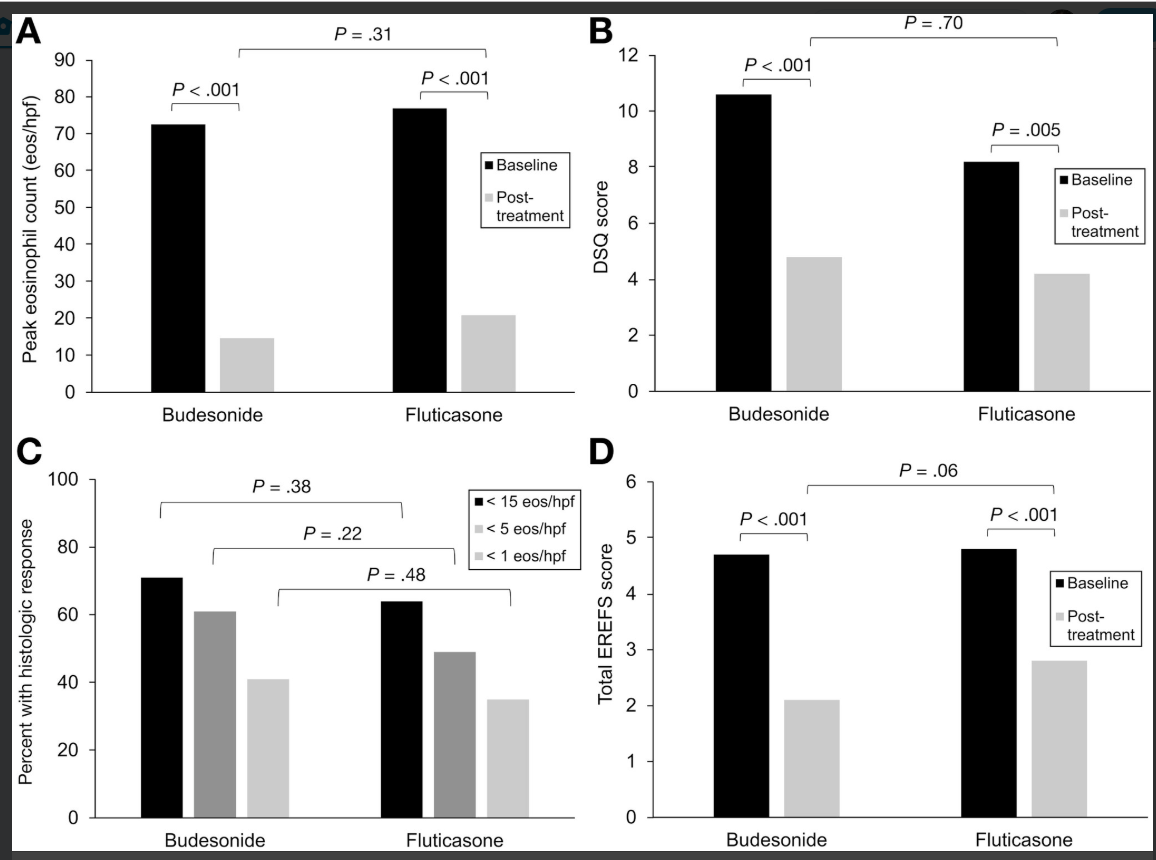
A recent double-blind, double-dummy study (ES Dellon et al. Gastroenterol 2019; 157: 65-73) found similar efficacy between budesonide and fluticasone for newly-diagnosed eosinophilic esophagitis. They had hypothesized that an oral viscous budesonide would be more effective due to increased esophageal contact time.

Methods: The authors compared an oral viscous budesonide OVB) at 1 mg BID (n=56) to fluticasone (swallowed) MDI dosed at 880 mcg BID (n=55).  Patients aged 16-80 years, with mean of 37 years.

Baseline characteristics:

  • ~95% in both groups with dysphagia
  • ~75% with any atopic condition
  • ~50% with dilatation required at baseline

Key findings:

  • Similar drop in eosinophil count: 73 (OVB) and 77 (MDI) eos/hpf at baseline to 15 and 21 respectively
  • Histologic response (<15 eos/hpf) rates of 71% (OVB) and 64% (MDI).
  • Response to <5 eos/hpf occurred in 61% OVB and 49% MDI; response to <1 eos/hpf was noted in 41% and 35% respectively
  • Symptom scores (DSQ) responded similarly as well
  • Similar degree of candidiasis 12% for OVB and 16% for MDI

In the associated editorial, the authors speculate that one reason for similar efficacy was the detailed instructions given for patients taking the MDI.

My take: This study supports both topical steroid therapies; practical issues like cost and insurance coverage could be influential in selecting the specific treatment for an individual patient.

Related blog posts:


From AGA twitter feed

Bariatric Surgery Survival – 5 Countries, 500,000 Participants

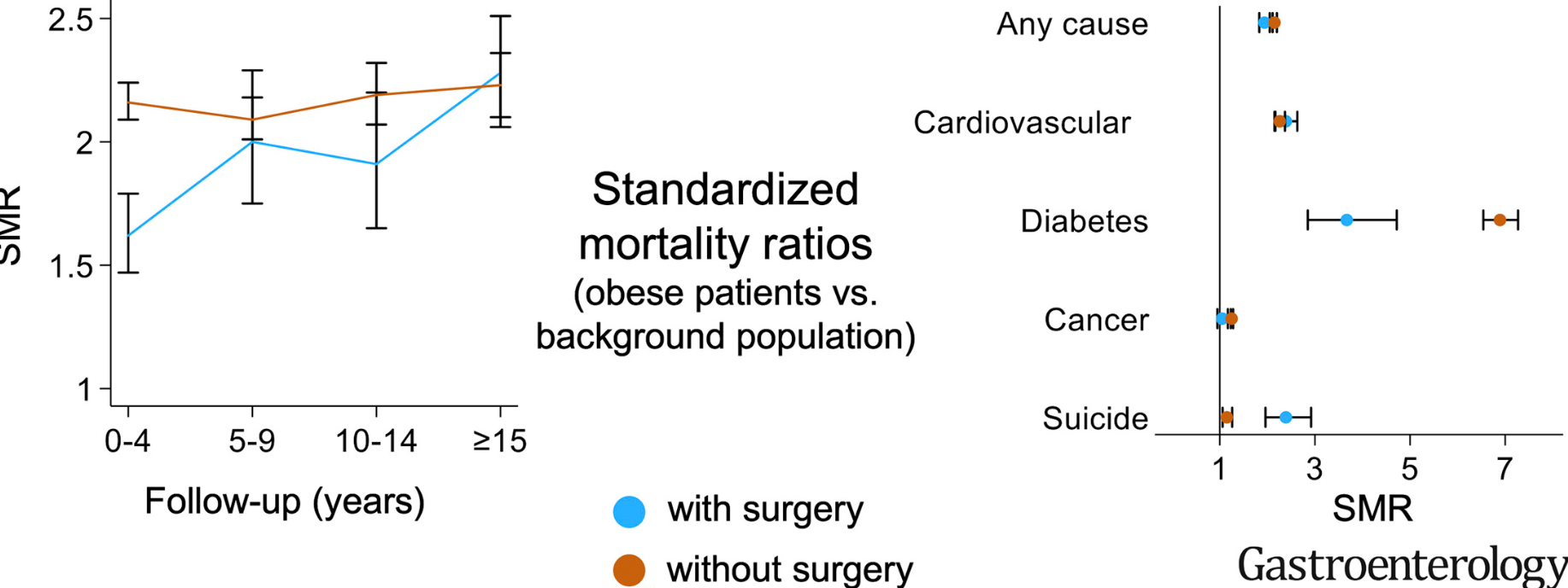
A recent population-based cohort study (JH Kauppila et al. Gastroenterol 2019; 157: 19-27) examined the effects of bariatric surgery on survival from Nordic countries between 1980-2012.

Link: Effects of Obesity Surgery on Overall and Disease-Specific Mortality in a 5-Country Population-Based Study

Among 505,258 obese individuals, 49,977 had bariatric surgery.

Key findings:

  • Overall mortality rates were lower in the surgery group during the first 14 years but higher after 15 years (HR 1.20 with CI 1.02-1.42).  Thus, overall, obese patients who underwent bariatric surgery had longer survival times than obese patients who did not have surgery.  Both groups had higher mortality than the general population
  • The improved survival compared to those without surgery was related to decreased mortality from cardiovascular mortality, diabetes and cancer.  However mortality due to suicide was increased.
  • Limitations: lack of detailed data including BMI, smoking and alcohol consumption

Graphical abstract (available online)

Related blog posts: