FDA Approves Etrasimod for Ulcerative Colitis

GI & Hepatology News, November 2023: FDA OKs two new treatments for UC

An excerpt:

In October, the FDA approved etrasimod (Velsipity, Pfizer) for moderate to severe active UC in adults. Etrasimod, an oral sphingosine-1-phosphate (S1P) receptor, binds with high affinity to receptors 1, 4, and 5. It is the second agent in the S1P class approved for UC. The other agent, ozanimod (Zeposia, Bristol-Myers Squibb), which was approved for moderate to severe active UC in May 2021, is an S1P receptor modulator that is selective for the S1P1 and S1P5 receptors located on endothelial cells and oligodendrocytes, respectively.

Etrasimod’s approval was based on safety and efficacy data from two randomized, double-blind, placebo-controlled phase 3 trials ― ELEVATE UC 52 trial, and ELEVATE UC 12 trial. The Lancet published full results from the two trials on March 2. Both trials enrolled patients with UC who had previously failed or were intolerant of at least one conventional, biologic, or Janus kinase (JAK) inhibitor therapy.

In ELEVATE UC 52, clinical remission at 12 weeks occurred in 27% of patients taking etrasimod, vs 7% of patients taking a placebo (20% difference; P ˂.001). At week 52, remission rates were 32% with active treatment, vs. 7% with placebo (26% difference;
P ˂ .001).

In ELEVATE UC 12, clinical remission was achieved among 26% of patients who received etrasimod, vs 15.0% of patients who received placebo (11% difference; P < .05).

The approved recommended dose is 2 mg once daily. The most common side effects of etrasimod are headache, elevated values on liver tests, worsening of UC, SARS-CoV-2 infection, dizziness, pyrexia, arthralgia, abdominal pain, and nausea

Reference: WJ Sandborn et al. The Lancet 2023; DOI:https://doi.org/10.1016/S0140-6736(23)00061-2. Open Access! Etrasimod as induction and maintenance therapy for ulcerative colitis (ELEVATE): two randomised, double-blind, placebo-controlled, phase 3 studies

My take: It is not exactly clear where etrasimod or ozanimod should be positioned for ulcerative colitis therapy as several other drug classes have much higher response rates.

Related blog posts:

Next time someone says that they are receiving therapy, perhaps I will be able to say ‘me too.’

Food Selectivity in Children with Autism

Our group had a terrific lecture recently by Lindsey Burrell with the Atlanta Children’s Center.

Here are many of the slides:

Dr. Burrell noted that concerns for EoE are increased in those who have more uniform problems with increased textures (rather than selectivity) and in those with more severe feeding disorders
Sometimes Caregivers will contribute to nutritional disorders by placing on diets like a gluten-free, casein-free diet

Related blog posts:

Disclaimer: This blog, gutsandgrowth, assumes no responsibility for any use or operation of any method, product, instruction, concept or idea contained in the material herein or for any injury or damage to persons or property (whether products liability, negligence or otherwise) resulting from such use or operation. These blog posts are for educational purposes only. Specific dosing of medications (along with potential adverse effects) should be confirmed by prescribing physician.  Because of rapid advances in the medical sciences, the gutsandgrowth blog cautions that independent verification should be made of diagnosis and drug dosages. The reader is solely responsible for the conduct of any suggested test or procedure.  This content is not a substitute for medical advice, diagnosis or treatment provided by a qualified healthcare provider. Always seek the advice of your physician or other qualified health provider with any questions you may have regarding a condition.

Six Year Data for IBAT Inhibitor Treatment for Alagille Syndrome

RJ Sokol et al. Hepatology 2023; 78: 1698-1710. Open Access! Predictors of 6-year event-free survival in Alagille syndrome patients treated with maralixibat, an ileal bile acid transporter inhibitor

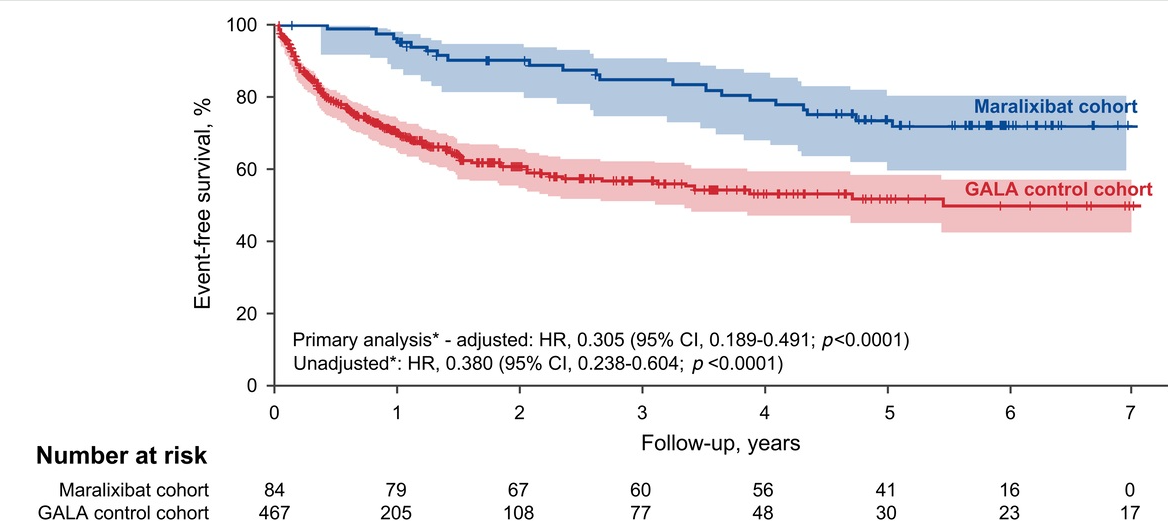
In this study, the authors examined 43 potential predictors of outcomes in pediatric patients (n=76) treated with maralixibat (MRX). The median duration of MRX treatment was 4.7 years. Key findings:

  • There were 10 liver transplantations, 3 decompensations, 2 deaths, and 1 surgical biliary diversion; thus, 16/76 (21%) had liver-related events.
  • The 6-year event-free survival improved with a clinically meaningful >1-point ItchRO(Obs) reduction from baseline to W48 (88% vs. 57%; p = 0.005), W48 bilirubin < 6.5 mg/dL (90% vs. 43%; p < 0.0001), and W48 serum bile acid < 200 µmol/L (85% vs. 49%; p = 0.001). These parameters were also predictive of 6-year transplant-free survival.
  • In this cohort, younger children (<36 months) fared worse, though this was likely related to selection bias as they had more severe cholestasis. In the discussion, the authors note that in their cohort, “there is a survivor bias such that older children are inherently healthier or they would have already undergone transplantation.”
  • Improved event-free survival could be largely related to symptomatic improvement. Many kids with Alagille require transplantation due to refractory pruritus. Since this study did not include histology or noninvasive techniques to assess hepatic fibrosis, it is unclear if there was also improvement in underlying liver function/fibrosis subsequent to reduction in toxic bile acid retention.
  • 46/76 (61%) had improvement in pruritus, 52/76 (68%) had improvement in bilirubin, and 56/76 (74%) had improvement in serum bile acids.

In their discussion, the authors note that in the GALA study, “which included natural history data from >1400 patients, 358 patients required a liver transplant, with 69% being transplanted for intractable pruritus.4

My take: In patients with moderate to severe pruritus, patients who respond to IBAT inhibitors are likely to have improvement in important clinical outcomes.

Related blog posts:

AASLD HCC Guidance – Including Prevention (Who/How to Screen)

AG Singal et al. Hepatology 2023; 78: 1922-1965. Open Access! AASLD Practice Guidance on prevention, diagnosis, and treatment of hepatocellular carcinoma

This article has 50 recommendations for prevention, diagnosis, and treatment of hepatocellular carcinoma. I will focus on prevention/screening in this post as this is most relevant to pediatric practice.

Figure 1

Figure 3 provides data supporting benefits of hepatocellular carcinoma (HCC) surveillance. HCC surveillance has been shown to significantly reduce HCC-related mortality in a randomized controlled trial among patients with chronic HBV infection and in several cohort studies among patients with cirrhosis from any etiology.

Who to screen for HCC:

Key Recommendations on Surveillance:

My take: This guidance recommends ultrasound and AFP monitoring every 6 months in those at high risk of developing HCC. Most pediatric patients would not require surveillance based on this guidance.

Related blog posts:


Is Manometry Useful to Determine if Botox Will Help Nausea/Vomiting?

Before reviewing today’s article, I wanted to make a comment about the blog post on 12/17/23 (Endoscopy of the Ileal Pouch Anal Anastomosis) which was a JPGN topic of the month. The editorial staff encourages author-driven communication and author-driven initiatives for these types of articles. If you have a topic for JPGN, please send an email to the Section Editor Darla Shores (dshores1@jhmi.edu) or to the editor Sandeep Gupta. (skgupta@uabmc.edu). This includes articles that you would like to write (fellow/interested faculty with senior faculty, up to 5 authors, 1500 words, 12 references), or  if you have a topic that you would like to see in JPGN but do not wish to write yourself, please inform the editorial team as well. 

———

PT Osgood et al. JPGN 2023; 77: 726-733. Intrapyloric Botulinum Toxin Injection for Refractory Nausea and Vomiting in Pediatric Patients

In this retrospective review, pediatric patients (n=25) received intrapyloric botox injections: (80-100 IU divided into 4 doses administered via sclerotherapy needle.

Key findings with botox injections:

  • Of 22 patients completing a GE study, 14 had delayed GE with no significant difference between IPBI responders and nonresponders
  • Improvement in vomiting in 80% (16/20), nausea 75% (15/20), abdominal pain 79% (15/19).
  • In those with psychiatric diagnosis, improvement was seen 71%. In those with orthostatic intolerance, improvement was noted in 67%.
  • In those with delayed GE, improvement was noted in 79% compared with 63% (5/8) with normal GE

My take: Botox was associated with improvement in this refractory pediatric group regardless of gastric emptying/manometry. This suggests that relaxation of pylorus is a useful therapeutic modality in a subset of patients.

Related blog posts:

AGA Guidance: Biomarkers for Crohn’s Disease

AN Ananthakrishnan, J Adler et al. Gastroenterol 2023; 165: 1367-1399. Open Access! AGA Clinical Practice Guideline on the Role of Biomarkers for the Management of Crohn’s Disease

Key points:

  • Recommendation #2: In patients in symptomatic remission with recent endoscopic evaluation (w/in 3 yrs), a fecal calprotectin <150 μg/g and normal CRP rules out active inflammation, avoiding endoscopic evaluation for assessment of disease activity. However, elevated biomarkers in this setting merit confirmation with endoscopy before treatment adjustment.
  • Recommendations #6, #7: In patients with CD with mild symptoms, neither normal nor elevated biomarkers alone are sufficiently accurate to determine endoscopic activity.
  • Recommendations #8, #9: In patients with CD with moderate to severe symptoms, elevated fecal calprotectin or serum CRP suggests endoscopic activity, precluding routine endoscopic assessment for disease activity. In those with moderate to severe symptoms but normal biomarkers, endoscopic assessment is recommended rather than empiric adjustment in treatment.
  • Recommendation #10: In patients with CD in surgically induced remission in low-risk patients on pharmacologic prophylaxis, a normal fecal calprotectin (<50 mcg/gm) reliably rules out endoscopic recurrence.

More Recommendations:

#1 In patients with CD in symptomatic remission, the AGA suggests a monitoring strategy that combines biomarkers and symptoms, rather than relying on symptoms alone.

#3 In patients with CD in symptomatic remission without recent confirmation of endoscopic remission, the AGA suggests endoscopic evaluation to rule out active inflammation, rather than relying solely on fecal calprotectin or CRP. 

#5 In patients with symptomatically active CD, the AGA suggests a biomarker-based assessment and treatment adjustment strategy, rather than relying on symptoms alone.

My take: This practical guidance will help target endoscopy in patients with Crohn’s disease. In those who are feeling well with normal biomarkers, frequent endoscopic evaluation is a low-value procedure. Similarly, in those with very elevated biomarkers and who are very symptomatic (with normal infectious studies), endoscopic evaluation is often unnecessary. The AGA expert recommendations should help persuade insurance companies to include biomarkers in their coverage.

Summary of all recommendations -see below from Figure 9 and Table 3.

Related blog posts:

Endoscopy of the Ileal Pouch Anal Anastomosis

A Bousvarous et al. JPGN 2023; 77: 691-694. Endoscopy of the Ileal Pouch Anal Anastomosis

This is a terrific review with some good pictures.

  • The authors note that in their practice in their IBD center, a pouchoscopy is performed 1-2 years after ileostomy closure irrespective of symptoms; in those with symptoms, it is performed sooner.
  • Some complications like strictures and ulcers can occur with few symptoms
  • Table 1 reviews common complications like strictures, cuffitis, infectious pouchitis, Crohn’s disease like pouch inflammation, pouch ischemia, and irritable pouch syndrome. Figure 2 provides useful endosopic picture

Related blog posts:

Another article on pouch management/evaluation:

P Santiago et al. Am J Gastroenterol 2023; 118(11):p 1931-1939 | DOI: 10.14309/ajg.0000000000002348. Open access: Classification and Management of Disorders of the J Pouch

Mesalamine in Pediatric Crohn’s Disease is Still Not Effective

DD Young et al. JPGN Reports 2023; e379. Open Access! Natural History of Pediatric Patients With Crohn’s Disease Treated With Mesalamine Therapy

Background: “Despite their [5-aminosalicylates (5-ASA)] lack of efficacy in Crohn disease (CD), they are still used in real-world practice.”

Methods: In this pediatric retrospective study with 61 patients with ileocolonic disease, 24 received concomitant immunomodulator therapy.

Key findings:

  • The majority of patients (85%) required escalation to biologics. 71% of those receiving an immunomodulator required escalation to a biologic and all but 35 of 37 on mesalamine monotherapy required escalation to a biologic
  • There was no difference between those who continued 5-ASA at time of biologic initiation compared to those who did not continue the medication
  • Patients who discontinued 5-ASA had an average annual cost savings of $6741

My take: In those with very mild Crohn’s disease, the best option may be a dietary approach. Mesalamine therapy remains a good option in patients with ulcerative colitis.

Related blog posts:

Disclaimer: This blog, gutsandgrowth, assumes no responsibility for any use or operation of any method, product, instruction, concept or idea contained in the material herein or for any injury or damage to persons or property (whether products liability, negligence or otherwise) resulting from such use or operation. These blog posts are for educational purposes only. Specific dosing of medications (along with potential adverse effects) should be confirmed by prescribing physician.  Because of rapid advances in the medical sciences, the gutsandgrowth blog cautions that independent verification should be made of diagnosis and drug dosages. The reader is solely responsible for the conduct of any suggested test or procedure.  This content is not a substitute for medical advice, diagnosis or treatment provided by a qualified healthcare provider. Always seek the advice of your physician or other qualified health provider with any questions you may have regarding a condition.

More amazing stone work on walking areas in Lisbon

NASPGHAN YouTube Video for Eosinophilic Esophagitis

NASPGHAN has developed a useful ~6 minute video for families reviewing the treatments (diet and medications) for eosinophilic esophagitis. When I visited the site, it had not garnered much traction yet (very few views). I would recommend this video to families:

NASPGHAN & GIKids -YouTube Video: Ways to Treat Eosinophilic Esophagitis (EoE)

Related links:

Briefly noted: Aerodigestive Medicine and Budesonide for Eosinophilic Esophagitis

A shout out to Ben Gold who is a coauthor on several new publications:

A Krasaelap et al. JPGN 2023; 77: 460-467. Pediatric Aerodigestive Medicine: Advancing Collaborative Care for Children With Oropharyngeal Dysphagia

This is a terrific review of the dysphagia and the multidisciplinary approach to management. Many pearls are in this article. For example, laryngo-tracheo-esophageal cleft (LTEC), “while rare, 1 in 10,000-20,000 live births, the incidence of LTEC is higher (7.6%-22%) in children with aerodigestive issues such as a chronic cough.” [As an aside, this should be repeated given the changing population of patients being seen.]

VA Mukkada, SK Gupta, BD Gold et al. JPGN 2023; 77: 760-768. Pooled Phase 2 and 3 Efficacy and Safety Data on Budesonide Oral Suspension in Adolescents with Eosinophilic Esophagitis

Key finding: Significantly more patients who received BOS (2mg BID) than placebo achieved histologic responses (≤6 eos/hpf: 46.7% vs 6.5%; ≤1 eos/hpf: 42.2% vs 0.0%; <15 eos/hpf: 53.3% vs 9.7%; P < 0.001)

Related blog posts:

View from Rua Augusta Arch in Lisbon