Children’s Healthcare of Atlanta has a good COVID-19 Vaccine information page for families/practitioners, including videos from infectious disease experts:


Children’s Healthcare of Atlanta has a good COVID-19 Vaccine information page for families/practitioners, including videos from infectious disease experts:
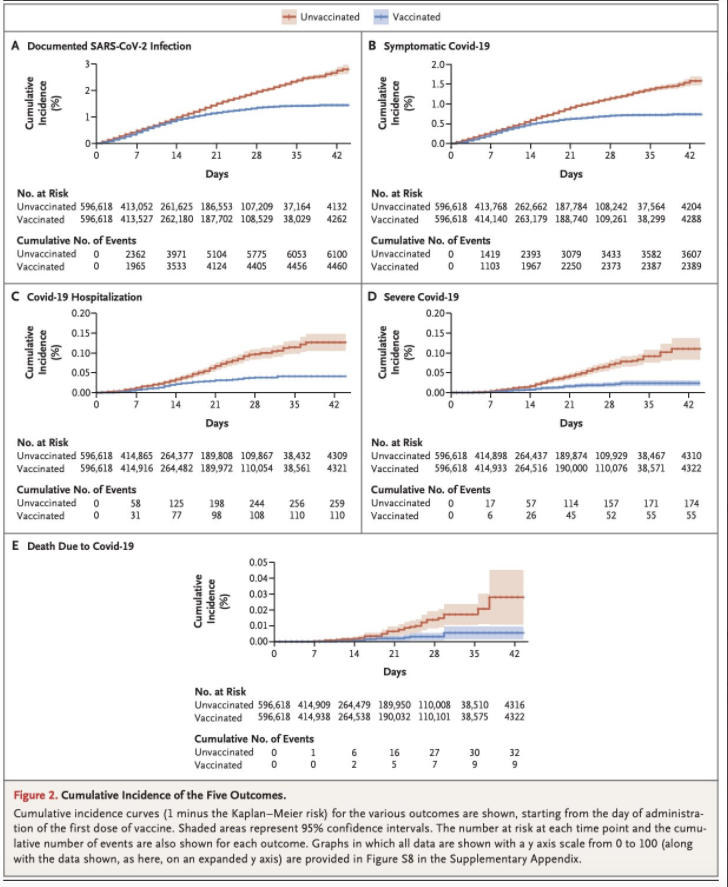
N Dagan et al. NEJM 2021;384:1412-23. DOI: 10.1056/NEJMoa2101765. PDF: BNT162b2 mRNA Covid-19 Vaccine in a Nationwide Mass Vaccination Setting
Each study group (vaccinated and unvaccinated) included 596,618 persons. Key finding:
A recent commentary (A Desmond, P Offit. NEJM 2021; 384: 1081-1083. Full text: On the Shoulders of Giants — From Jenner’s Cowpox to mRNA Covid Vaccines) succinctly describes the five major vaccine-related advances. The link also provides access to an audio interview with Dr. Offit
1st Advance: In 1796, Edward Jenner “found that an animal virus (cowpox) could protect against disease caused by a human virus (smallpox)… Jenner’s work ultimately led to the eradication of a disease that is estimated to have killed more than 300 million people in the 20th century”
2nd Advance: In 1885, Louis Pasteur developed an inactivated virus vaccine for rabies. This has led to the development of many other inactivated vaccines, including the influenza vaccine.
3rd Advance: In 1937, Max Theiler attenuated yellow fever virus by means of serial passage in mouse and chicken embryos. This has led to the development of numerous attenuated vaccines to prevent polio (Sabin, 1960s), measles (1963), mumps (1967), rubella (1969), varicella (1995), and rotavirus (2008).
4th Advance: In 1980, Stanford biochemists Richard Mulligan and Paul Berg developed recombinant DNA technology which led to vaccines containing purified surface proteins. This led to the hepatitis B virus (1986), human papillomavirus (2006), and influenza virus (2013) vaccines.
Some of the notable improvements related to vaccines:
5th Advance: In 2020 “with the recent authorization of mRNA vaccines, we have entered the fifth era of vaccinology. This class of vaccines doesn’t contain viral proteins; rather, these vaccines use mRNA, DNA, or viral vectors that provide instructions to cells on how to make such proteins. The SARS-CoV-2 pandemic will be an important test of whether these new platforms can fulfill their promise of creating safe, effective, and scalable vaccines more quickly than traditional methods.”
Related blog posts:
X Fan et al. Gastroenterol 2021; 160: 455-458. Full text link: Effect of Acid Suppressants on the Risk of COVID-19: A Propensity Score-Matched Study Using UK Biobank
Among 9469 included participants, 1516 (16%) were regular users of acid suppressants, and 7953 (84%) were not…propensity score matching (PSM) was applied to match users of acid suppressants and nonusers.
Key findings:
My take: This study provides reassurance that acid blockers are unlikely to contribute to the risk of SARS-CoV-2 or to related complications.
Related blog post: PPIs Associated with Increased Risk of COVID-19
Other COVID-19 Information:
Link to 38 page guidance, last updated 2/2/21: AASLD EXPERT PANEL CONSENSUS STATEMENT:
VACCINES TO PREVENT COVID-19 INFECTION IN PATIENTS
WITH LIVER DISEASE
Key points:

JF Ludvigsson et al NEJM 2021; 384: 669-671. Full text: Open Schools, Covid-19, and Child and Teacher Morbidity in Sweden In this letter to the editor, the authors report on outcomes in Sweden, which kept schools open during the pandemic; time period: from March 1-June 30, 2020 (schools end around June 10th). Key findings:
My take: This study suggests that school teachers are at similar risk for COVID-19 infection as other essential workers. In Sweden, during this timeframe, distancing but not masking was recommended. Thus, transmission rates could be lowered further.
Related article: SR Kadire et al. NEJM 2021; 384: DOI: 10.1056/NEJMclde2101987. Full text: Delayed Second Dose versus Standard Regimen for Covid-19 Vaccination This article provides rationale for both vaccine options.
Related blog posts:
Briefly noted: S Sultan, SM Siddique et al. Gastroenterol 2020; 159: 1935-1948. Full text: AGA Institute Rapid Review and Recommendations on the Role of Pre-Procedure SARS-CoV-2 Testing and Endoscopy
Table 1 provides a summary of the recommendations and indicates a threshold for which routine pre-procedure testing may not be needed:
My take: Particularly after the rollout of vaccination to health care providers, routine testing for SARS-CoV-2 is not likely to be needed once the prevalence drops to low levels.
Related blog posts:

A large study from Wuhan showed that after 6 months following hospitalization, most still had lingering symptoms.
Full text: C Huang et al. Lancet DOI:https://doi.org/10.1016/S0140-6736(20)32656-8; 6-month consequences of COVID-19 in patients discharged from hospital: a cohort study
Key point: At 6 months after acute infection, COVID-19 survivors (n=1733 enrolled in study) were mainly troubled with fatigue or muscle weakness, sleep difficulties, and anxiety or depression. Patients who were more severely ill during their hospital stay had more severe impaired pulmonary diffusion capacities and abnormal chest imaging manifestations
NY Times analysis (Jan 8, 2021): 6 Months After Leaving the Hospital, Covid Survivors Still Face Lingering Health Issues
NEJM Link: COVID-19 Vaccine: Frequently Asked Questions
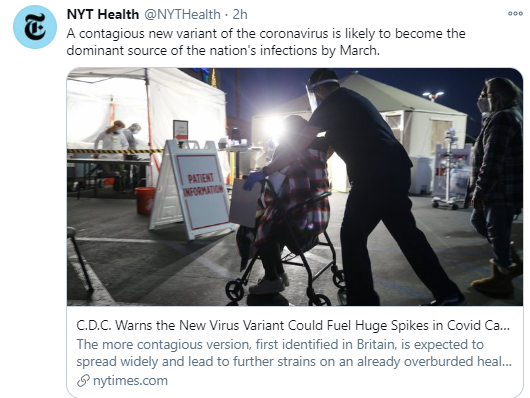
NY Times (1/15/21): C.D.C. Warns the New Virus Variant Could Fuel Huge Spikes in Covid Cases “The new variant, called B.1.1.7, was first identified in Britain, where it rapidly became the primary source of infections, accounting for more than 80 percent of new cases diagnosed in London and at least a quarter of cases elsewhere in the country.”
A recent study (EJ Laserna-Mendieta et al. Clin Gastroenterol Hepatol 2020; 18: 2903-2911. Full text: Efficacy of Therapy for Eosinophilic Esophagitis in Real-World Practice) highlights the disconnect between clinical practice and outcomes.
Key findings:
My take: This data (and others) indicate that topical steroids are most effective pharmacologic therapy; at some point, I expect that they will become the most frequently used.
Related blog posts:
“Layering two less specialized masks on top of each other can provide comparable protection [to N95]. Dr. Marr recommended wearing face-hugging cloth masks over surgical masks, which tend to be made with more filter-friendly materials but fit more loosely. An alternative is to wear a cloth mask with a pocket that can be stuffed with filter material, like the kind found in vacuum bags.”
Unrelated from NY Times: One Mask Is Good. Would Two Be Better? (Yes)
 gutsandgrowth