On network meta-analysis of 14 RCTs, upadacitinib was more effective than all agents in achieving symptomatic remission at weeks 2 (range of RR, 2.85–6.27), 4 (range of RR, 1.78–2.37), and 6 (range of RR, 1.84–2.79).
This study has a number of limitations including the following:
Potential differences in patient-level characteristics between these trials
Symptoms may not always correlate with endoscopic findings
Data from some medications (eg. tofacitinib) were incomplete and not included
My take: This study indicates an impressive early symptomatic response to upadacitinib compared to other agents for ulcerative colitis.
Methods: Consecutive adult patients (n=393) with refractory heartburn/regurgitation symptoms underwent standard 24-hour pH-impedance monitoring and completed questionnaires assessing past and current gastrointestinal and psychological health. Refractory reflux meant that they continued to have symptoms after completing at least 12 weeks of PPI (twice per day) treatment.
Key findings: Psychological symptoms were significantly associated with reflux symptom severity, and physiological reflux variables (eg, number of reflux episodes) were not.
In the discussion, the authors note that ” prior research demonstrates psychological symptoms, including depression, anxiety, and post-traumatic stress, are associated with reflux symptom severity.25, 26, 27 Indeed, psychological processes are believed to impact the brain–gut axis, particularly its central components,28 leading to enhanced esophageal symptom perception and reporting.6,29,30“
My take: Psychological factors (depression, anxiety, post-traumatic stress, and poor sleep) are important factors in refractory reflux and they need to be considered early in the evaluation.
A related article: NY Times Magazine 10/4/23, M Velasques-Manoff. The Mystery of My Burning Esophagus. In this article, the writer describes burning pain associated with his diagnosis of eosinophilic esophagitis. This article has some useful information about eosinophilic esophagitis and about lingering symptoms after responding to treatment.
“My new gastroenterologist had a theory to explain the all-consuming pain under my sternum. Sometimes patients develop a hypersensitivity syndrome, she told me. The original insult — in my case, inflammation of some kind — might be long gone, but the nerves that convey pain can become overactive and begin firing at the slightest provocation…Scientists don’t completely understand how antidepressants help pain syndromes, but certain ones seem to impede pain signals in the nervous system…
Doctors are increasingly aware of these kinds of pain syndromes in many disorders, including GERD. The condition, whose primary symptom is known colloquially as heartburn, is pervasive, afflicting an estimated one in five Americans. Some of these patients continue to feel intense pain even after their stomach acid has been reduced with antacids, a malady most likely caused by a hypersensitivity syndrome similar to mine.”
In 2022, a study in JPGN showed that the rate of Hepatitis B virus (HBV) vaccination and immunity was similar in individuals with and without celiac disease (CD). In addition, there was no increased risk of HBV infection detected in CD patients. Thus, routinely checking hepatitis B status in all patients with CD was no longer justified. (See: Celiac Disease, Hepatitis B and Paul Harvey).
The same researchers in this study expand their findings to inflammatory bowel disease (IBD) and CD. In this retrospective cohort (2000-2019), using the Rochester Epidemiology Project which includes data from 162,847 residents. Key findings:
1264 incident cases of IBD/CD, only 6 HBV infections were diagnosed before the index date; 5 of the 6 had risk factors including IV drug use or living in endemic region.
No new HBV infection developed in any of 1258 patients with IBD/CD during a median follow-up of 9.4 years
The proportion of patients with HBV-protective titers (≥10 mIU/mL) decreased with time before plateauing, with protective titer rates of 45% at 5 up to 10 years and 41% at 15 up to 20 years after the last HBV vaccination. The control population with protective titers also decreased similarly with time though was consistently higher than the levels of patients with IBD/CD within 15 years after the last HBV vaccination
Context/Discussion:
Only 16% of vaccine recipients have measurable protective titers by age 18 years, according to the CDC.32
“Time-related waning of Ab levels to HBV after vaccination has unclear clinical significance. Although screening persons for HBV immunity by using anti-HBs titers is widely accepted, prior study results have shown that cellular immunity can also provide long-term HBV protection, even in the setting of nonprotective titers.”
Reactivation of HBV is a well-documented complication of immunosuppression in patients with IBD, and screening for dormant infection is of paramount importance at diagnosis
Limitations: the study population had a low rate of HBV acquisition; thus, the study findings may not apply to areas with higher risk for HBV.
My take: This study shows that treating low hepatitis B surface antibody levels with reimmunization is likely NOT needed in either the IBD or the celiac disease population, except perhaps in those at high risk. Checking HBV status prior to immunosuppressive therapy, though, is still needed to prevent reactivation of HBV in those at risk.
Disclaimer: This blog, gutsandgrowth, assumes no responsibility for any use or operation of any method, product, instruction, concept or idea contained in the material herein or for any injury or damage to persons or property (whether products liability, negligence or otherwise) resulting from such use or operation. These blog posts are for educational purposes only. Specific dosing of medications (along with potential adverse effects) should be confirmed by prescribing physician. Because of rapid advances in the medical sciences, the gutsandgrowth blog cautions that independent verification should be made of diagnosis and drug dosages. The reader is solely responsible for the conduct of any suggested test or procedure. This content is not a substitute for medical advice, diagnosis or treatment provided by a qualified healthcare provider. Always seek the advice of your physician or other qualified health provider with any questions you may have regarding a condition.
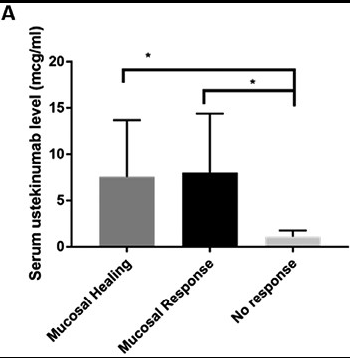
This retrospective trial included thirty three patients with Crohn’s disease (CD) receiving maintenance ustekinumab (UST). The simplified Magnetic Resonance Index of Activity (sMARIA) and biomarkers were correlated with UST levels. The authors utilized a homologous mobility shift assay (HMSA) (Prometheus) for their UST levels.
Key findings:
With UST level greater or equal to 8.4, radiologic remission was seen in 63% compared to 21% in those with levels <8.4. Similarly, the absence of severe inflammation was seen in 78.9% of those with higher levels compared with only 36.8% in those with levels below 8.4. Both findings were clinically-significant P=.01With UST levels greater or equal to 6.1, FCP less than 50 was seen in 72.2% compared to only 12.5% in those with a level less than 6.1. P<.01
My take: This study show the need for higher levels of UST to achieve optimal outcomes. Levels of at least 8.4 appear to be a good target.
Disclaimer: This blog, gutsandgrowth, assumes no responsibility for any use or operation of any method, product, instruction, concept or idea contained in the material herein or for any injury or damage to persons or property (whether products liability, negligence or otherwise) resulting from such use or operation. These blog posts are for educational purposes only. Specific dosing of medications (along with potential adverse effects) should be confirmed by prescribing physician. Because of rapid advances in the medical sciences, the gutsandgrowth blog cautions that independent verification should be made of diagnosis and drug dosages. The reader is solely responsible for the conduct of any suggested test or procedure. This content is not a substitute for medical advice, diagnosis or treatment provided by a qualified healthcare provider. Always seek the advice of your physician or other qualified health provider with any questions you may have regarding a condition.
The authors used data from ASPirin in Reducing Events in the Elderly (ASPREE), a randomized prospective trial of aspirin in the United States and Australia, including 18,934 community-based adults ≥65 years of all races/ethnicities (enrollment 2010-2014). Final cognitive testing was done in 2017. Key Findings:
Baseline PPI use vs nonuse was not associated with incident dementia (multivariable hazard ratio, 0.88, cognitive impairment without dementia (multivariable hazard ratio, 1.00), or with changes in overall cognitive test scores over time.
Also, no associations were observed between H2RA use and all cognitive endpoints.
My take: ” These data provide reassurance about the safety of long-term use of PPIs among older adults.” PPIs are unlikely to have negative effects on cognition.
R Paknikar et al. NEJM 2023; 389: 1321-1326. Digging into the Histology
In this case report, a 33-year-old man (from the midwest) with ulcerative colitis (diagnosis seven years prior) who was receiving treatment with tofacitinib (a Janus kinase inhibitor) presented to the hospital with fatigue (x 8 months) and bloody diarrhea. He also had had fevers (x 4 months), 23 lb weight loss, and drenching night sweats. Before tofacitinib, treatment had included adalimumab and azathioprine. He had undergone a sigmoidoscopy two months prior to presentation.
His workup included a CXR showing diffuse reticulonodular opacities, a CT scan showing thickening in the colon and extensive infection workup. On the third hospital day, he had a perforation and resection which led to the diagnosis of invasive histoplasmosis.
My take: This article is useful for understanding how to workup secondary infections in IBD patients on long-term immunosuppressive agents.
One example: “testing for 1,3-β-d-glucan can serve as an adjunctive test for invasive fungal infections caused by fungi expressing 1,3-β-d-glucan in their cell walls, including candida, aspergillus, Pneumocystis jirovecii, Histoplasma capsulatum, and coccidioides; such testing has a high negative predictive value for infection with these organisms. In contrast, cryptococcus and blastomyces produce very low levels of 1,3-β-d-glucan in their cell walls and are therefore not readily detected by serum testing for the cell-wall antigen.”
CT showed shows diffuse wall thickening in the rectosigmoid colon and extravasation of extraluminal contrast material (arrow) into the area adjacent to the sigmoid colon, with layering of the contrast material, findings that are thought to indicate a perforation.
The authors examined a retrospective cohort study of Kaiser Permanente Northern California members (716,567 individuals) who underwent testing and/or treatment for H pylori between 1997 and 2015 and were followed through December 31, 2018. Key findings:
The adjusted subdistribution hazard ratios of NCGA for H pylori–positive/untreated and H pylori–positive/treated individuals were 6.07 and 2.68, respectively, compared with H pylori–negative individuals.
When compared directly with H pylori–positive/untreated individuals, subdistribution hazard ratios for NCGA in H pylori–positive/treated were 0.95 at <8 years and 0.37 ≥8 years of follow-up.
My take (borrowed from authors): H pylori eradication therapy was associated with a significantly reduced incidence of gastric cancer after 8 years compared with no treatment. The risk among treated individuals became lower than the general population after 7 to 10 years of follow-up. The findings support the potential for substantial gastric cancer prevention in the United States through H pylori eradication.
215 adults with EoE who completed FLIP during endoscopy were included in a cross-sectional study. FLIP helped separate the physiomechanical properties of esophageal function in this cohort. The criteria used to define the PhysioMechanical classification in EoE with a representative FLIP panometry image for each classification. Normal compliance was defined as a DP >17 mm and body compliance >450 mm3/mm Hg; reduced compliance (fibrostenosis) was defined by DP ≤17 mm or compliance ≤450 mm3/mm Hg. Normal EGJ opening was defined as a maximum EGJ diameter ≥16 mm; reduced as maximum EGJ diameter <16 mm. ∗Spastic-reactive contractile response (SRCR) with normal body distensibility and normal EGJ opening was assigned as “achalasia pattern” (n = 1 in this cohort).
Key findings:
FLIP was normal in 50 (23%), weak pattern in 7 (3%), IsoEGJOO stricture pattern in 27 (13%), IsoEGJOO achalasia pattern in 26 (12%), Fibrostenosis with normal reactivity in 61 (28%), spastic reactive fibrostenosis with normal reactivity in 30 (14%), and noreactive fibrostenosis in 14 (7%)
My take: FLIP testing helps define the mechanism of esophageal dysfunction in patients with EoE. Longer duration of symptoms was associated with more severe esophageal dysfunction.
This article is a helpful review on ostomy care. The article reviews approaches to common problems including early high ostomy output, ostomy leakage, stoma retraction, mucocutaneous separation, dermatological problems, chronic high ostomy output, parastomal hernia, and stoma prolapse. A few of their comments:
“An estimated 750,000 Americans live with an ostomy and 130,000 new ostomy surgeries occur in the United States annually.1“
“Reversal [of ostomy] before 6 weeks of the index surgery is associated with an increased risk of complications”
For leakage of ostomy: “Management steps involve thickening the stool with antidiarrheals to facilitate a more solid effluent and pouching techniques to bolster the height of the stoma off the peristomal skin (eg, convex appliance, ostomy belt, paste, or barrier rings). Each of these items is available through the patient’s medical equipment supplier. Additional pearls include heating the appliance with a hair dryer before application, lying flat for several minutes after application, ensuring the peristomal skin is dry before application, and use of a fine dusting of stomal powder followed by skin sealant on the peristomal skin before application.”
Stoma prolapse: “The rate of stomal prolapse is 5% to 10%.12 Acute prolapse can lead to incarceration and ischemia, which presents as pain, obstipation, and purple/black discoloration of the stoma…In the absence of ischemia, the prolapse may be reduced by laying the patient in a relaxed position and gently squeezing the ostomy back into the abdomen. If the stoma cannot be reduced with pressure alone, a cup of sugar applied directly to the stoma and left in place for 20 minutes can reduce stomal swelling and facilitate reduction of the prolapse. Surgery can be avoided if the prolapse is mild, easily reducible, and does not interfere with pouching.”
Medications for High Ostomy Output include bulking agents (fiber, guar gum, marshmellows), antimotility agents (eg. loperamide, diphenoxylate/atropine), and antisecretory agents (PPIs, Octreotide). Treatment of specific underlying disease may help, such as anti-inflammatory agents for IBD and GLP-2 analogues for short bowel.
Disclaimer: This blog, gutsandgrowth, assumes no responsibility for any use or operation of any method, product, instruction, concept or idea contained in the material herein or for any injury or damage to persons or property (whether products liability, negligence or otherwise) resulting from such use or operation. These blog posts are for educational purposes only. Specific dosing of medications (along with potential adverse effects) should be confirmed by prescribing physician. Because of rapid advances in the medical sciences, the gutsandgrowth blog cautions that independent verification should be made of diagnosis and drug dosages. The reader is solely responsible for the conduct of any suggested test or procedure. This content is not a substitute for medical advice, diagnosis or treatment provided by a qualified healthcare provider. Always seek the advice of your physician or other qualified health provider with any questions you may have regarding a condition.