CCFA: Updates in IBD Conference (part 2)

My notes from Georgia Chapter of CCFA’s conference. There could be errors of omission, transcription and/or errors in context based on my understanding.

Sandy Kim, MD –Children’s Hospital of Pittsburgh

Diet in Inflammatory Bowel Disease: Food for Thought

This was a terrific lecture –though much of the topic has been reviewed recently in this blog: Dietary Therapy for Inflammatory Bowel Disease.

Key points:

  • Changes in diet can change microbiome quickly, within 24 hrs
  • Some diets (eg. more fruit/vegetables/fish) may help lower risk of developing IBD
  • Dietary therapy, especially exclusive enteral nutrition (EEN), is effective therapy for Crohn’s disease
  • Why does EEN work?  It is not clear.  There are some changes in microbiome but decrease or little change overall in microbial diversity
  • Reviewed newer dietary approaches: SCD (www.nimbal.org), CD-TREAT, Crohn’s Disease Exclusion Diet

Related blog posts:

Frank Farraye, MD –Mayo Clinic

Health Maintenance in the Adult Patient with IBD

  • Good Practice: Update Vaccinations in IBD population
  • Recent concerns include measles outbreak, and frequent occurrence of Herpes zoster
  • No evidence that vaccination exacerbates IBD
  • New Hepatitis B Recombination Vaccine (Heplisa-B) -2 doses given over one month (for patients older than 18 years. Seroprotective anti-HBs after two doses: 95.4%
  • Shingrix -new recombinant Zoster vaccine.  Overall efficacy 97.2%.  Frequent adverse reactions
  • Women with IBD should undergo annual cervical cancer screening
  • IBD patients should be seen by dermatology
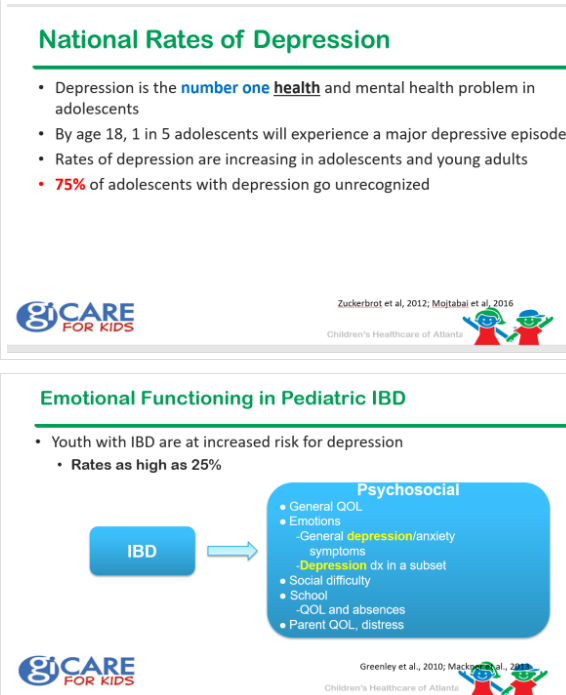
  • Consider depression screening in IBD patients
  • Counsel patients to quit smoking
  • Consider bone density screening in at risk patients

One audience member (Jeff Lewis, MD) pointed out that more attention needs to be paid to depression and anxiety which are much more common and more frequently health-threatening than issues like vaccination.

Related blog posts:

Disclaimer: These blog posts are for educational purposes only. Specific dosing of medications (along with potential adverse effects) should be confirmed by prescribing physician.  This content is not a substitute for medical advice, diagnosis or treatment provided by a qualified healthcare provider. Always seek the advice of your physician or other qualified health provider with any questions you may have regarding a condition.


CCFA: Updates in IBD Conference (part 1)

My notes from a recent Georgia Chapter of CCFA’s conference. There could be errors of omission, transcription and/or errors in context based on my understanding.

Adam Cheifetz, MD Harvard School of Medicine

Optimizing IBD Treatments

  • Earlier treatment with effective therapies
  • Utilizing therapeutic drug monitoring

Goals are clinical and endoscopic remission

  • Imaging if not visible on endoscopy
  • Biomarker remission -adjunctive goal
  • Symptoms and endoscopy do not have good correlation in Crohn’s disease
  • Endoscopic healing associated with better outcomes
  • Treatment –>assessment –> adjust treatment if goal is not met

Biologic Agents:

  • First agent works best; TNF-exposed patients do not respond as well as TNF-naive patients to subsequent biologic
  • High rate of secondary loss of response

Therapeutic Drug Monitoring:

  • Combination therapy in Sonic study was associated with higher infliximab levels. It appears that optimized monotherapy is as effective as combination therapy (Colombel study).
  • Fistula treatment requires higher biologic levels
  • Lower biologic drug levels associated with development of antidrug antibodies
  • Proactive monitoring –recommended
  • Both infliximab and adalimumab are frequently underdosed, especially in pediatrics –>another reason for proactive monitoring
  • If sicker patients, consider checking TDM at week 10; less sick patients, reasonable to consider TDM at week 14

Related blog posts:

Disclaimer: These blog posts are for educational purposes only. Specific dosing of medications/diets (along with potential adverse effects) should be confirmed by prescribing physician/nutritionist.  This content is not a substitute for medical advice, diagnosis or treatment provided by a qualified healthcare provider. Always seek the advice of your physician or other qualified health provider with any questions you may have regarding a condition.

#NASPGHAN19 Postgraduate Course (Part 4)

Here are some selected slides and notes from this year’s NASPGHAN’s postrgraduate course. With my notes, there could be errors of omission and transcription on my part.

Link to the full NASPGHAN PG Syllabus 2019 (Borrowed with permission)

Liver/Pancreas Session

150 Miriam Vos, MD, MSPH, Emory University New news in NAFLD

Dr. Vos gave a terrific lecture. Key points:

  • NAFLD screening: recommended around age 10 years (in children with obesity) based on increasing prevalence with age
  • PNPLA3 encodes adiponutrin –> important for clearing stored triglycerides. Common polymorphism PNPLA3 rs738409‐is associated with NAFLD
  • Who to screen –all obese children >10 years. Overweight children  with risk factors: Type II diabetes,  Hispanic,  Family history,  Pituitary  disorders (GH),  Right sided  abdominal pain
  • ALT and ultrasound are imperfect screens
  • Alcohol worsens NAFLD.  Sugar/juice boxes are also culprits
  • #1 Recommendation: Sugar reduction in diet

Related blog post: “The Paramount Health Challenger for Humans in the 21st Century”

161 Saul J. Karpen, MD, PhD, Emory University School of Medicine/Children’s Healthcare of Atlanta New therapies for chronic cholestatic diseases

  • Limited therapies currently available.  A number of treatments appear promising:  Obeticholic acid, Norursodeoxycholic acid
  • For ABCB4, some drugs used for cystic fibrosis may help as well
  • ASBT inhibitor appears promising for Alagille (see ITCH study)

171 Sohail Husain, MD, Stanford Children’s Hospital Diagnosing drug-induced pancreatitis

  • In patients with IBD, thiopurines and mesalamine/ sulfasalazine (mesalamine have greater risk than sulfasalazine) are associated with pancreatitis
  • ~1/3rd of patients with drug-induced pancreatitis have other risk factors

179 Jaimie D. Nathan, MD, FACS, Cincinnati Children’s Hospital Medical Center Pediatric pancreatic masses: Steroids, surgery or surveillance?

Disclaimer: NASPGHAN/gutsandgrowth assumes no responsibility for any use or operation of any method, product, instruction, concept or idea contained in the material herein or for any injury or damage to persons or property (whether products liability, negligence or otherwise) resulting from such use or operation. The discussion, views, and recommendations as to medical procedures, choice of drugs and drug dosages herein are the sole responsibility of the authors. Because of rapid advances in the medical sciences, the Society cautions that independent verification should be made of diagnosis and drug dosages. The reader is solely responsible for the conduct of any suggested test or procedure. Some of the slides reproduced in this syllabus contain animation in the power point version. This cannot be seen in the printed version.


#NASPGHAN19 Postgraduate Course (Part 3)

Here are some selected slides and notes from this year’s NASPGHAN’s postrgraduate course. There may be some errors of omission or transcription.

Link to the full NASPGHAN PG Syllabus 2019 (Borrowed with permission)

Functional/Motility Session

95 Carlo Di Lorenzo, MD, Nationwide Children’s Hospital. Evaluation Testing for functional disorders: The indispensable, the useless, the dangerous and treatment strategies in NERD and functional dyspepsia.

This was the best lecture of the day!!! (Hence a lot of slides follow)

  • Families never complain about doctors missing irritable bowel syndrome and anxiety. They may complain about missing diagnosis which are controversial with regarding to chronic pain (‘chronic appendicitis, gallbladder dyskinesia, ‘mild’ IBD, median arcuate ligament syndrome, and food allergies)
  • Functional disorders, but not organic disorders, can cause ‘constant’ pain. “Tried everything.”  Functional disorder patients frequently have side effects with everything.
  • Listen to patient and sit while listening.
  • Early diagnosis of functional disorder associated with higher long-term resolution
  • Testing –only tests that are cost-effective: celiac disease and stool calprotectin.  “Don’t get KUB for constipation.”
  • Endoscopy does not improve outcomes in children with functional GI disorder (FGID)
  • Eosinophilic esophagitis (EoE) treatment does not help abdominal pain but can help if patient has dysphagia
  • Abdominal wall pain is often overlooked.  Check Carnett sign.


112 Peter Kahrilas, MD, Northwestern Medicine  Achalasia

  • Achalasia likely develops after an infection in a susceptible host
  • Discussed POEM as newer treatment. It appears to be more effective than either Heller myotomy or pneumatic dilatation in adults.  So far, there is limited experience in pediatrics though it appears to mirror adult experience

124 Julie Khlevner, MD, Morgan Stanley Children’s Hospital Evaluation and treatment strategies in NERD and functional dyspepsia

  • In patients with NERD, hypermetabolizers of PPIs may need higher dosing.
  • Neuromodulators (not FDA approved) used for PPI-nonresponders.  Cognitive behavioral therapies may be helpful as well.
  • Functional dyspepsia with reflux symptoms are more likely to respond to PPIs than those with dyspepsia symptoms
  • A Japanese herb, rikkunshito, may be helpful for functional dyspepsia

136 Robert J. Shulman, MD, Children’s Nutrition Research Center Role of diet in managing of IBS

Key points:

  • Vast majority of low FODMAPs studies show “too much bias” due to lack of blinding in study designs.
  • Nutritionists are needed to guide diet.  Kids (families) do not follow these diets well.
  • Most who are going to respond to diet will do so within 7-10 days.

Disclaimer: NASPGHAN/gutsandgrowth assumes no responsibility for any use or operation of any method, product, instruction, concept or idea contained in the material herein or for any injury or damage to persons or property (whether products liability, negligence or otherwise) resulting from such use or operation. The discussion, views, and recommendations as to medical procedures, choice of drugs and drug dosages herein are the sole responsibility of the authors. Because of rapid advances in the medical sciences, the Society cautions that independent verification should be made of diagnosis and drug dosages. The reader is solely responsible for the conduct of any suggested test or procedure. Some of the slides reproduced in this syllabus contain animation in the power point version. This cannot be seen in the printed version.


#NASPGHAN19 Postgraduate Course (Part 2)

Here are some selected slides and notes from this year’s NASPGHAN’s postrgraduate course. My notes from these lectures may contain errors of omission or transcription.

Link to the full NASPGHAN PG Syllabus 2019 (Borrowed with permission)

9:00 – 10:20 “Potpourri”

46 Alessio Fasano, MD, MassGeneral Hospital for Children  Celiac disease: Beyond diagnosis

  • Reviewed potential non-biopsy option for diagnosis if anti-TG2 >10 x normal. Pediatricians are not following recommendations –>many children placed on gluten-free diet at lower titer antibody-positivity.
  • Recommends checking Hepatitis B antibody because many children with celiac disease do not seroconvert.
  • TTG levels are good for diagnosis but not as helpful for monitoring after diagnosis.
  • Only 10 out of 1000 are true refractory, about 100 out of 1000 are exquisitely sensitive to gluten

56 Meghana Sathe, MD, UT Southwestern Medical Center The role of the gastroenterologist and hepatologist in Cystic Fibrosis (CF) care today

  • Fecal elastase monitoring useful for determining need for PERT.
  • Discussed CF liver involvement.  Multilobular cirrhosis, 7% of individuals, is most important liver disease in CF.
  • Modulator therapy can elevate liver enzymes and may need to hold if ALT >5 ULN or lower elevation if elevated bilirubin (see Stop Rules -Practical Advice on DILI)
  • DIOS -for partial obstruction, polyethylene glycol and/or gastrogastrin enemas could be used.
  • Consider treatment of SBBO as well which is frequent with CF.

67 Sonia Michail, MD, Children’s Hospital Los Angeles Update on C. difficile

The slide I liked the best was showing a change in microbiome after FMT which is not in syllabus.

82 Ed Hoffenberg, MD, Children’s Hospital Colorado  What the pediatric GI provider needs to know about cannabis

Disclaimer: NASPGHAN/gutsandgrowth assumes no responsibility for any use or operation of any method, product, instruction, concept or idea contained in the material herein or for any injury or damage to persons or property (whether products liability, negligence or otherwise) resulting from such use or operation. The discussion, views, and recommendations as to medical procedures, choice of drugs and drug dosages herein are the sole responsibility of the authors. Because of rapid advances in the medical sciences, the Society cautions that independent verification should be made of diagnosis and drug dosages. The reader is solely responsible for the conduct of any suggested test or procedure. Some of the slides reproduced in this syllabus contain animation in the power point version. This cannot be seen in the printed version.

#NASPGHAN19 Postgraduate Course (Part 1)

Here are some selected slides and notes from this year’s NASPGHAN’s postrgraduate course.  My notes from these lectures may contain errors in omission or transcription.

Link to the full NASPGHAN PG Syllabus 2019

8:00 – 9:00 Module 1 – Endoscopy

11  David Brumbaugh, MD, Children’s Hospital Colorado  Management of foreign bodies

Related blog posts:

22 Petar Mamula, MD, Children’s Hospital of Philadelphia Advanced endoscopic techniques for gastrointestinal bleeding

This talk had some terrific videos (not available in syllabus) and useful practical points.  For example, with cautery, the speaker recommended not just quickly taping the lesion, count for several seconds when applying.  For hemospray, the speaker considers this technically much easier but is using this mainly as a backup option.

Here are two screenshots (not from lecture) which provide information from manufacturer on Hemospray use (link to PDF on Hemospray Manufacturer’s PDF on Hemospray)

Related blog posts:

36 Srinadh Komanduri, MD, Northwestern Medicine  Cancer screening top to bottom

Some of the key points:

  • IBD and colorectal cancer (CRC) screening 8-10 years after disease onset
  • ~10% of CRC in general population occurs between 20-49 years
  • Chromoendoscopy results in higher detection rates of dysplasia

Related blog posts:

Disclaimer: NASPGHAN/gutsandgrowth assumes no responsibility for any use or operation of any method, product, instruction, concept or idea contained in the material herein or for any injury or damage to persons or property (whether products liability, negligence or otherwise) resulting from such use or operation. The discussion, views, and recommendations as to medical procedures, choice of drugs and drug dosages herein are the sole responsibility of the authors. Because of rapid advances in the medical sciences, the Society cautions that independent verification should be made of diagnosis and drug dosages. The reader is solely responsible for the conduct of any suggested test or procedure. Some of the slides reproduced in this syllabus contain animation in the power point version. This cannot be seen in the printed version.

Food Safety Lecture–It is Still A Jungle Out There

Yesterday, I posted a blog that tried to summarize some of William Balistreri’s talk on Global Health.  He gave a 2nd Excellent Lecture on Food Safety at the Georgia AAP Nutrition Symposium.  One audience member suggested that this lecture was well-paired with the previous lecture as the awareness of food-borne illnesses might deter gluttony.

This lecture was packed with information regarding food safety; he highlighted the extensive and frequent food-borne illnesses.

Key points:

  • The problem of food-borne illness was put under a spotlight by Upton Sinclair in The Jungle (1906) which led to reforms in meat packing industry.  However, more work is needed
  • FSMA -Food Safety Modernization Act was signed into law in 2011; it’s aim is to create a proactive rather than reactive approach, Historic opportunity to increase food safety
  • Food-borne illnesses: 1 in 10 persons worldwide will be sick every year & leads to 1/2 million deaths worldwide each year.  125,000 deaths in children
  • Food-borne illnesses: 48 million cases in U.S. each year (CDC estimates) and 3000 deaths (MMWR 64:2, 2015)
  • Besides significant mortality rates for food-borne illnesses, they also contribute to post-infectious irritable bowel syndrome (~13% of all cases) and these illnesses can be indefinite
  • Social media, including “IwasPoisoned.com” and Yelp, will likely help identify outbreaks more quickly.  Newer molecular technologies during food processing has the potential to improve food safety.

Resources:

  • For those who want to keep up food-borne illnesses, Dr. Balistreri recommended food safety news, which provides daily emails. Link to subscribe: Food Safety News
  • Two books that were recommended: The Poison Squad by Deborah Blum and Outbreak by Timothy Lytton
  • The CDC has plenty of advice and a useful pamphlet regarding the key 4 steps with food preparation: Clean, Separate, Cook, Chill. https://www.cdc.gov/foodsafety/keep-food-safe.html
  • Another resource: FoodSafety.gov

Link to full talk slides PDF: FOOD SAFETY (10-10-19)  I have placed about 20 slides below which summarize much of the information that he conveyed.


Anti-TNF Therapy: Might Save Your Health But Not Your Wallet

A recent study (LE Targownik, EI Benchimol, J Witt et al. Inflamm Bowel Dis 2019; 25: 1718-28) shows that direct health care costs are increased with anti-TNF therapy.

In this retrospective study using the Manitoba IBD Database, the authors examined the direct costs associated with anti-TNF therapy initiation in 928 patients (676 CD, 252 UC).  Only 84 subjects were <18 years.

Key findings:

  • The median costs for health care in the year of anti-TNF initiation increased compared to prior year.  In year prior to initiation, median costs were $4698 for CD and $6364 for UC; in the first year of anti-TNF treatment, costs rose to $39,749 and $49,327 respectively.
  • Costs remained elevated through 5 years of anti-TNF therapy for continuous users with total median of $210,956 and $245,260 respectively
  • There were reductions in non-drug costs. Inpatient and outpatient costs decreased in the year after anti-TNF initiation by 12% and 7% respectively, when excluding the costs of anti-TNFs.  These observed savings are considerably less than the medication expenditures.

Discussion:

  • Costs for medications are likely to improve with the introduction of biosimilars.  Currently these are being used mainly in persons with a new diagnosis due to reticence to switch from originator product in established patients.
  • The authors note that costs were overall higher with infliximab (IFX) than adalimumab (ADA) though “it is possible that patients with higher-severity disease are channeled toward IFX over ADA.”
  • Indirect costs like ability to go to work and achieve educational potential could offset some of the direct costs.  In a prior study in the U.S., ADA treatment was estimated to reduce indirect costs of “nearly $11,000 per person treated.”

Limitations:

  • Some costs were not measured in the study including emergency room visits, over the counter medications and alternative health care use.
  • This was not a randomized study; thus, it is impossible to know what costs of persons with similar disease who were untreated would have been.

My take: This study shows that saving money is not the main reason to use anti-TNF therapies; rather, their effects on improved health and fewer complications.

Related blog posts:

Haystack Rock, Cannon Beach OR

IBD Shorts -October 2019

Briefly noted:

D Piovani et al. Gastroenterol 2019; 157: 647-59.  This study examined environmental risk factors for inflammatory bowel disease after extensive literature review and assessment of meta-analysis.

9 factors that were associated with increased risk of IBD:

  • smoking (CD)
  • urban living (CD & IBD)
  • appendectomy (CD)
  • tonsillectomy (CD)
  • antibiotic exposure (IBD)
  • oral contraceptive use (IBD)
  • consumption of soft drinks (UC)
  • vitamin D deficiency (IBD)
  • Heliobacter species (non-Helicobacter pylori-like) (IBD)

7 factors that associated with reduced risk of IBD:

  • physical activity (CD)
  • breatfeeding (IBD)
  • bed sharing (CD)
  • tea consumption (UC)
  • high folate levels (IBD)
  • high vitamin D levels (CD)
  • H pylori infection (CD, UC, and IBD)

EL Barnes et al. Inflamm Bowel Dis 2019; 1474-80. In this review which identified 12 studies and 4843 with an IPAA ( ileal pouch-anal anastomosis) for ulcerative colitis, 10.3% were ultimately diagnosed with Crohn’s disease. Link to full text and video explanation: The Incidence and Definition of Crohn’s Disease of the Pouch: A Systematic Review and Meta-analysis

EV Loftus et al. Inflamm Bowel Dis 2019; 1522-31. In this study with 2057 adalimumab-naive patients, “the proportion of patients in HBI remission increased from 29% (573 of 1969; baseline) to 68% (900 of 1331; year 1) and 75% (625 of 831; year 6). Patients stratified by baseline immunomodulator use had similar HBI remission rates.”  Full text: Adalimumab Effectiveness Up to Six Years in Adalimumab-naïve Patients with Crohn’s Disease: Results of the PYRAMID Registry

The following study was summarized in previous blog: Oral Antibiotics For Refractory Inflammatory Bowel Disease  Full text link: Efficacy of Combination Antibiotic Therapy for Refractory Pediatric Inflammatory Bowel Disease

Washington Park, Portland, OR