Is Deamidated Gliadin Serology a Useful Adjunct in Screening for Celiac Disease?

A recent multicenter retrospective study (MJ Gould et al. JPGN 2019; 68: 20-5) shows that deamidated gliadin peptide (DGP) is rarely helpful in screening for celiac disease when tissue transglutaminase IgA is negative. The study identified 40 patients who had a mean age of 6.5 years at time of intestinal biopsy.

Key findings:

  • Of the 40 patients with DGP (IgG) positivity, only 1 patient (2.5%) had celiac disease; this patient was IgA deficient.
  • Among the five IgA deficient patients, only 1 with DGP positivity had celiac disease.
  • The cohort included 6 patients with DGP levels >250 U/mL (refernece <12).
  • Only 5 patients in this DGP positive cohort were younger than 2 years.  None had celiac disease

My take: This retrospective study indicates that DGP is rarely helpful in patients with negative TTG IgA results. However, this study had too few patients who were  <2 years of age and/or IgA-deficient patients to determine its utility in these groups..

Related study: AK Verma et al. JPGN 2019; 68: 26-29. This study from Italy examined oral hygiene products and determined that 62 (94%) were gluten-free (gluten level <20 ppm). Among the 4 with detectable gluten, 3 were toothpastes and 1 lipstick with values between 20.7 adn 35 ppm. My take: Oral hygiene products have very low rates of gluten contamination.

Related blog posts:

Golden Gulch Trail, Death Valley

Blood Test is Better Than a Liver Biopsy for Biliary Atresia

A recent study (L Yang et al. Hepatology 2018; 68: 2069-72) confirms the utility of Serum Matrix Metalloproteinase-7 (MMP-7) as a biomarker for biliary atresia (BA). The authors studied MMP-7 among healthy controls (n=72 with 54 <6 months) and among 135 with cholestasis (75 with BA, 60 with non-BA).  BA samples were taken at a median age of 54 days.

Key findings:

  • Median concentration for MMP-7 was 2.86 ng/mL in healthy controls, 11.47 ng/mL for non-BA cholestasis, and 121.1 ng/mL for BA.
  • Using a cutoff value of 52.85 ng/mL, the diagnostic sensitivity and specificity were 98.67% and 95.0% respectively.
  • The AUC for MMP-7 in BA was 0.99 compared for AUC for GGT of 0.72.  The sensitivity and specificity for GGT was much lower at 64% and 72% respectively with a cutoff of 314 U/L.
  • The predictive value for MMP-7 was particularly impressive, 74 of 75 BA  subjects were correctly identified as having BA.  Only 3 non-BA patients were incorrectly assigned a BA diagnosis based on MMP-7 values.
  • The authors noted that MMP-7 testing indicates that there are no substantial changes in its values for normal subjects extending to 54 years of age.
  • One limitation the authors note is the relatively small number of patients with non-BA syndromatic intrahepatic cholestasis which made up less than 30% of their non-BA cohort.  Thus, more testing in specific populations is needed.

My take: The diagnostic performance of MMP-7** appears to be superior to that of a liver biopsy (though this was not directly compared in this study) in predicting BA and could obviate the need for most liver biopsies in infants with cholestasis.  Those with high MMP-7 values would proceed directly to intraoperative cholangiogram with possible hepatoportojejunostomy. Those with non-BA MMP-7 values and persistent cholestasis could undergo additional investigation with genetic panels and/or other metabolic/infectious testing.

**This assay is likely to be commercially-available in the coming weeks according to a colleague at Cincnnati Children’s Hospital.  The expectation is an approximagely 2-day turnaround.

Related blog posts:

Moon over Zabriskie Point, Death Valley before Sunrise

NASPGHAN Toolbox App -Review

To all my colleagues and to others who follow this blog, I wish you a happy new year.  Thank you to all of you, especially to those who provide feedback to help improve the content and usefulness.

Recently NASPGHAN released an App, titled NASPGHAN Toolbox.  There are some very useful features but also some areas where more work is needed.

Work in progress: Many of the algorithms that are listed are dated and no longer accurate.  To list a few examples:

  • The UC Algorithm suggests holding off on anti-TNF therapy in severe disease for 7-14 days
  • The EoE Algorithm lists only diet treatments and topical steroids and does not list PPIs as a treatment option
  • The GERD guidelines are from 2001 rather than more recent recommendations

Also, this ‘algorithms’ section should probably be renamed into ‘algorithms and tables’ as a large amount of the information is not algorithmic.

What I Like:

  • Scores and Calculators for items like MELD score, PUCAI score, Mayo score
  • Extensive patient education handouts and image atlas -this could facilitate “airdrop”ing or messaging of these items to families.  (To be picky –the normal esophagus image could be better)
  • Formula charts –though the lists for infants and older children could be more comprehensive
  • Bristol charts (especially children version) -listed in algorithm section

My take: This is a very good start and a very helpful toolbox for pediatric gastroenterologists but I would not rely on the algorithms.


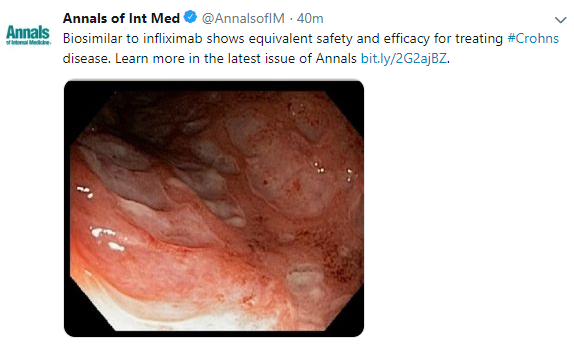
Big Biosimilar Study

Briefly noted: A Meyer et al. Ann Intern Med. 2018. DOI: 10.7326/M18-1512

Abstract link: Effectiveness and Safety of Reference Infliximab and Biosimilar in Crohn Disease: A French Equivalence Study

In this study with 5050 patients, based on review of an administration database, the authors found the following:

  • In multivariable analysis of the primary outcome, CT-P13 (biosimilar) was equivalent to infliximab reference product (RP) (HR, 0.92 [95% CI, 0.85 to 0.99]). 1147 patients in the RP group and 952 patients in the CT-P13 group met the composite end point (including 838 and 719 hospitalizations, respectively).
  • No differences in safety outcomes were observed between the 2 groups: serious infections (HR, 0.82 [CI, 0.61 to 1.11]), tuberculosis (HR, 1.10 [CI, 0.36 to 3.34]), and solid or hematologic cancer (HR, 0.66 [CI, 0.33 to 1.32]).

The authors conclude that “real-world data indicates that the effectiveness of CT-P13 is equivalent to that of RP for infliximab-naive patients with CD.”

Related blog posts:

My Favorite Posts from the Past Year

Recently, I listed the posts that had the most views in the past year –some dating back to 2012.  The following list includes less viewed but some of my favorite posts from 2018:

GI:

Nutrition:

LIVER:

Miscellaneous:

Flowers in Calgary

Most Popular Posts 2011-2018

Since this blog’s inception, there are now more than 2500 posts; these are the most popular (most views):

Most of these posts are referenced in more recent posts on the same or similar subjects.

Near Banff


Most Popular GutsandGrowth Posts from Past Year

These five posts were the most popular (most views) in the past year:

This is a bike path from Canmore to Banff. I had a chance to ride an electric bike which was a lot of fun.

Overdiagnosis of Cow’s Milk Protein Allergy in Infants and Formula Industry Influence

From BMJ: -Link: Overdiagnosis and industry influence: how cow’s milk protein allergy is extending the reach of infant formula manufacturer

This article provides a detailed discussion of this topic. Two key points:

  • Because the diagnosis of non-IgE mediated cow’s milk protein allergy is based mainly on a formula trial/reintroduction, it is susceptible to overdiagnosis
  • Expert guidelines have been authored mainly by those with conflicts of interest

An excerpt:

Clinicians and patients who spoke to The BMJ are concerned at the wide availability of industry funded online information promoting non-specific symptoms potentially indicating cow’s milk allergy as a diagnosis in exclusively breastfed infants. Although there is evidence that cow’s milk and other food proteins can be transferred from mother to infant in breastmilk, the quantities transferred are likely to be too small to cause symptoms in most infants.


December Liver Briefs

B Wildman-Tobriner et al. Gastoenterol 2018; 155: 1428-35.  This retrospective study which pooled data from 3 phase 2a trials with 370 subjects with nonalcoholic fatty liver disease (NAFLD) found that MRI iwth proton density fat fraction (PDFF) “did not accurately identify patients with NAS ≥4 (AUROC – 0.72) or fibrosis stage ≥3 (AUROC =0.66).”  Thus, this study indicates that currently liver histology remains the gold standard to determine severity of liver damage in paitents with NAFLD.

Related blog posts

P Nahon et al. Gastroenterol 2018; 155: 1436-1450. This study looks closer at whether direct-acting antivirals (DAA) for hepatitis C could increase the risk of hepatocellular carcinoma (HCC) in patients (n=1270) with cirrhosis. The authors found that the crude 3-year cumulative incidence of HCC were 5.9% in the DAA and 3.1% in the SVR-IFN group. However, after Cox analysis, “we found no statistically significant increase in risk of HCC associated with DAA use (HR 0.89).”  The authors indicated that patient characteristics (age, diabetes, reduced liver function) and lower screening intensity were the reasons for the increased crude rates of HCC.

Related blog post: Liver Short Takes December 2017

Love this sign –it indicates the truth of the saying:  ‘common sense is not that common’ (attributed to Voltaire)