Ustekinumab for Ulcerative Colitis (UNIFI Trial)

A landmark study (BE Sands et al. NEJM 2019; 381: 1201-14) shows that ustekinumab (Stelara) can be an effective therapy for moderate-to-severe ulcerative colitis (UC); it is already an approved, established therapy for Crohn’s disease. This randomized placebo-controlled study included an 8-week induction trial (n=961) followed by a 44-week maintenance trial (n=523) for patients with response.

Clinical remission was defined as a total socre of ≤2 on the Mayo scale (range 0-12) and no subscore >11 on any of the four Mayo scale components.

Key findings:

  • During induction, there was a similar clinical remission rate between those who received 130 mg fixed intravenous dose compared to those who received 6 mg/kg: 15.6% and 15.5% compared to 5.3% for placebo group.
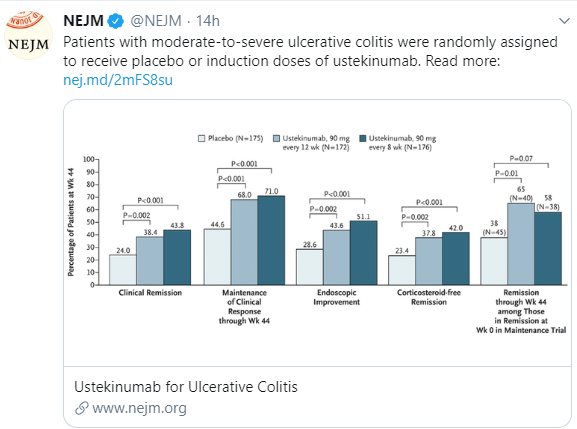
  • During maintenance, among patients receiving 90 mg every 8 weeks the clinical remission rate at 44 weeks was 43.8%, in those with 90 mg every 12 weeks the rate was 38.4%; placebo group was 24.0%.
  • The response to ustekinumab occurred in those with or without previous treatment failure with biologic agents, though response was lower in both induction and maintenance in those with prior treatment failure.  In both phases, at least 59% of participants had failed either or both anti-TNF agents or vedolizumab.
  • In this study, there were similar serious adverse events with ustekinumab compared to placebo.  In the treatment groups, there were two deaths (one from ARDS, one from esophageal varices) and 7 cases of cancer (3 nonmelanoma skin cancer, two colon cancer, one prostate, one renal).  There was one death from testicular cancer in the placebo group. Also four patients in the ustekinumab group had opportunistic infections including CMV in two, legionella in one and HSV in one.

In terms of dosing, the authors note that there was greater improvement in calprotectin values during induction in the group who received 6 mg/kg compared to those who received 130 mg.  At week 44, using more objective and stringent end points (eg. endoscopic improvement), greater clinical benefit was observed with the every 8 week regimen.

Visual abstract from NEJM Twitter Feed:

The following image depicts patients response during the maintenance phase –the lightest color is placebo, followed by every 8 weeks, and then the darkest color is every 12 weeks.  The x-axis measures (left to right) are clinical remission, maintenance of clinical response at week 44, endoscopic improvement, corticosteroid-free remission, and remission at 44 weeks in those with remission after induction.
My take: Ustekinumab is more effective for placebo in patients with ulcerative colitis.  More experience is needed to understand its long-term safety.

Related blog posts:

IBD Shorts: September 2019

S Olivia et al (including Stanley Cohen from GI Care for Kids) Clin Gastroenterol Hepatol 2019; 17: 2060-7.A Treat to Target Strategy Using Panenteric Capsule Endoscopy in Pediatric Patients with Crohn’s Disease”  In this prospective study with 48 children with Crohn’s disease, pan-enteric capsule endoscopy (PCE) detected inflammation in 34 (71%) at baseline, 22 (46%) at week 24, and 18 (39%) at week 52.  PCE results were used to manage treatment and resulted in change in therapy in 71% at baseline and 23% at week 24.  Furthermore, PCE increased the proportions of patients in deep remission, up to 58% at week 52.

M Wright, et al. J Pediatr 2019; 210: 220-5. This case report of a 4 year-old boy with a perianal abscess and granulomatous colitis identified a NCF4 mutation causing severe neutrophil dysfunction.  He developed osteomyelitis with anti-TNF therapy and did not respond to vedolizumab. He had an excellent outcome following a hematopoietic stem cell transplantation. This study reinforces the potential benefit of investigating VEO-IBD which could allow more targeted therapy. Related blog post:

P Zapater et al. Inflamm Bowel Dis 2019; 25: 1357-66. This study with 112 patients with Crohn’s disease showed that serum interleukin-10 levels were directly related to infliximab and adalimumab levels.  This suggests that serum anti-TNF levels are significantly influenced by immunological activation.

JE Axelrad et al. Clin Gastroenterol Hepatol 2019; 17: 1311-22.  This study, using the Swedish National Patient Register, showed that gastrointestinal infection increased the odds of developing IBD in a nationwide case-control study.  “Of the patients with IBD, 3105 (7%) had a record of previous gastroenteritis compared with 17,685 control subjects (4.1%). IBD cases had higher odds for an antecedent episode of gastrointestinal infection (aOR 1.64), bacterial gastrointestinal infection (aOR 2.02) and viral gastrointestinal infection (aOR 1.55)…a previous episode of gastroenteriitis remained associated with odds for IBD more than 10 years later (aOR 1.26).”  The authors note that they cannot formally exclude misclassification bias, but it appears that enteric infections contribute to the development of IBD in susceptible individuals.

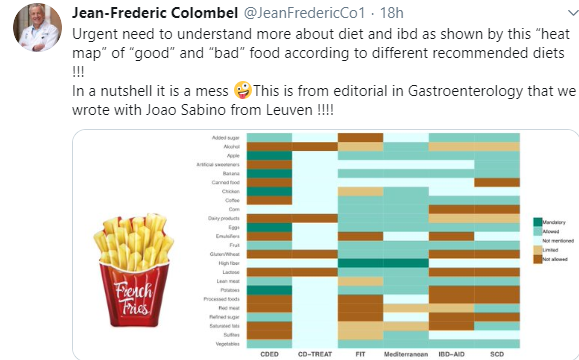
Good Food and Bad Food for Crohn’s Disease -No Agreement

As noted in a previous blog (IBD Briefs August 2019), there have been numerous diets proposed to help with Crohn’s disease.   The chart below illustrates the lack of any consensus.

Related blog posts:

Integrating Mental Health into Pediatric IBD Care

WE Bennett, MD Pfefferkorn. JAMA PediatrPublished online August 19, 2019. doi:10.1001/jamapediatrics.2019.2669

Full Link: Editorial: “Mental Health Screening as the Standard of Care in Pediatric Inflammatory Bowel Disease” Thanks to Ben Gold for this reference.

An excerpt:

Butwicka and colleagues1 have published a fascinating, landmark cohort study in this issue of JAMA Pediatricsassessing the prevalence of psychiatric diagnoses and symptoms among children with inflammatory bowel disease (IBD) in Sweden. The authors used a rigorous design that compared a cohort of more than 6000 pediatric patients with IBD with hundreds of thousands of healthy controls, as well as a separate cohort comprising the patients’ own siblings who did not have IBD. Butwicka et al1 computed hazard ratios for any psychiatric disorder, as well as for multiple specific disorders, and found a hazard ratio of 1.6 for any psychiatric diagnosis when comparing children with IBD with healthy controls. The statistical analysis is stellar and represents the best data we currently have on the intersection of pediatric IBD and mental health. Their study highlights a substantial risk in a vulnerable population and should trigger revision of guidelines and allocation of resources to support widespread screening and treatment for these dangerous conditions.

Related Article:

A Butwicka et al. JAMA Pediatr. Published online August 19, 2019. doi:10.1001/jamapediatrics.2019.2662 

Full Text Link: Association of Childhood-Onset Inflammatory Bowel Disease With Risk of Psychiatric Disorders and Suicide Attempt

Related blog posts:

Crater Lake, OR

Combination Therapy Associated with Treatment Persistence

Another large retrospective ‘real-world’ study (C Chen et al. Inflamm Bowel Dis 2019; 1417-27) examined persistence profiles of biologic therapies in newly diagnosed IBD patients.  This study, based on Truven Health MarketScan data (2008-2015) included 5612 patients with Crohn’s disease (CD) and 3533 with ulcerative colitis (UC). There were 1156 persons (20.6%) in the pediatric age range (0-18)

Key findings:

  • Less than half of the patients continued using their initial biologic treatment after 1 year (48.5% of CD cohort and 44.8% of UC cohort).
  • For infliximab (IFX) in the CD cohort, the 1 year continued rate was 47.6% and the 5 year rate was 20.0%. In the UC cohort, the rates were 44.9% and 15.7% respectively.
  • For adalimumab (ADA) in the CD cohort, the 1 year continued rate was 50.9% and the 5 year rate was 9.1%. In the UC cohort, the rates were 45.4% and 7.7% respectively.
  • Combination therapy with immunomodulators (IMM) significantly decreased the risk of discontinuation, especially if IMM was started more than 30 days before the biologic agent (HR 0.22).  Simultaneous starting had HR of 0.32.
  • The major predictors for noncompliance included infection and hospitalization.

Why did combination therapy result in higher medication persistence rates?

  • Potential reasons included improved efficacy by direct inflammatory effects and reduced drug antibodies to TNF antagonists.  It is possible that patients receiving combination therapy had more severe disease and thus less likely to discontinue therapy.

Limitation: This study may overestimate drug discontinuation as some patients may simply have had a dosing delay.

My take: This study shows a higher-than-expected rate of drug discontinuation indicating dissatisfaction related to efficacy, cost or complications. Those receiving immunomodulators (combination therapy) were much less likely to discontinue treatment.

Related blog posts:

Wizard Island, Crater Lake, OR

Disclaimer: These blog posts are for educational purposes only. Specific dosing of medications/diets (along with potential adverse effects) should be confirmed by prescribing physician/nutritionist.  This content is not a substitute for medical advice, diagnosis or treatment provided by a qualified healthcare provider. Always seek the advice of your physician or other qualified health provider with any questions you may have regarding a condition

Combination Therapy Still Works for Inflammatory Bowel Disease (Part 1)

There is speculation that the use of therapeutic drug monitoring (TDM) may obviate the advantages of combination therapy. However, there is plenty of data supporting combination therapy including a recent retrospective population-based study (LE Targownik et al. Clin Gastroenterol Hepatol 2019; 17: 1788-98).

This ‘real-world’ study (2001-2016) utilized the Manitoba IBD database and included 852 persons with Crohn’s disease (CD) and 303 with ulcerative colitis (UC).

Key findings: 

  • In persons with CD, combination therapy (immunomodulator with a TNF antagonist) was associated with lower treatment ineffectiveness with an adjusted hazard ratio (aHR) for ineffectiveness at 0.62.  The ineffectiveness in UC persons was lower at 0.82 but did not reach statistical significance.
  • When looking at specific time frames, among patients with CD, at 1 year, combination therapy the rate of ineffectiveness-free treatment was 74.2% for combination therapy compared to 68.6% for monotherapy; at 2 years, the rates were 64.0% and 54.5% respectively.
  • Combination therapy in CD was associated with increased time to first IBD-related hospitalization with aHR of 0.53 and with lower rates of switching anti-TNF agents (aHR 0.63).  Lower rate of surgery (aHR 0.76) did not reach statistical significance.
  • The choice of immunomodulator (6-MP/AZA vs MTX) and the choice of anti-TNF agent (IFX or ADA) did not significantly influence the overall benefit of combination therapy.  Though, AZA was the main concomitant treatment (92%).
  • 90% of the patients in the study who received combination therapy had received immunomodulator therapy prior to combination therapy.  This is in contrast to the SONIC study in which patients were naive to both agents.
  • 57% of IFX users and 43% of ADA users received concomitant therapy.

My take: Combination therapy has been associated with higher response rates to IBD therapy.  This advantage has to be weighed against potential adverse effects.

Related blog posts:

Disclaimer: These blog posts are for educational purposes only. Specific dosing of medications/diets (along with potential adverse effects) should be confirmed by prescribing physician/nutritionist.  This content is not a substitute for medical advice, diagnosis or treatment provided by a qualified healthcare provider. Always seek the advice of your physician or other qualified health provider with any questions you may have regarding a condition.

Wizard Island. Crater Lake, OR

Modeling Trough Levels to Predict Optimal Infliximab Dosing

A recent study for optimizing infliximab  dosing: LE Bauman et al.  2019 Jul 9. pii: izz143. doi: 10.1093/ibd/izz143. [Epub ahead of print]

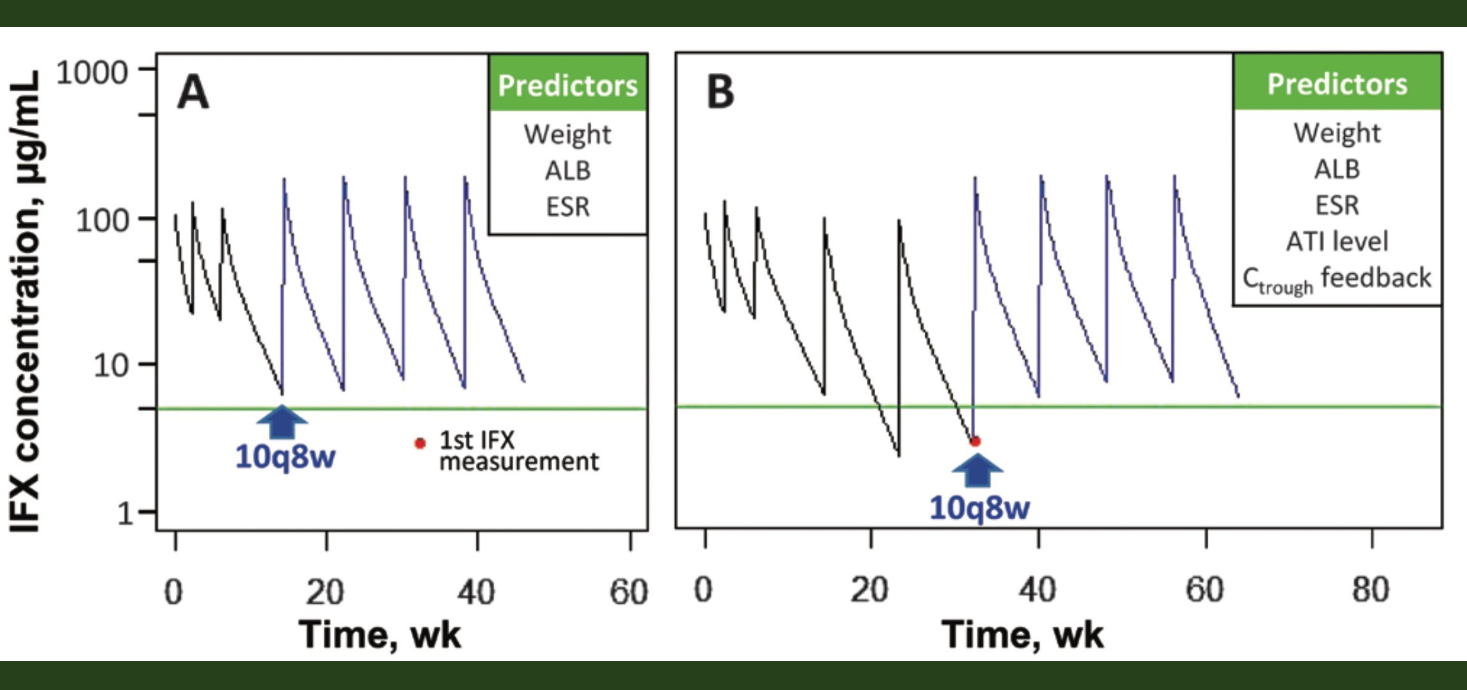
The authors identified 228 pediatric patients with IBD and developed a pharmocokinetic model using weight, albumin, sedimentation rate and antibodies to infliximab (ATI) to help predict infliximab dosing that would achieve a therapeutic trough level (>5 mcg/mL).

In their study, they also simulated 1000 patients and found that only 24% of patients receiving 5 mg/kg q8weeks achieved a therapeutic level; this increased to 56% for 10 mg/kg q8weeks.  Shortening dose interval more reliably achieved therapeutic levels: 5 mg/kg q4 weeks had a target level in 84% and 10 mg/kg q6 weeks had a target level in 80%.

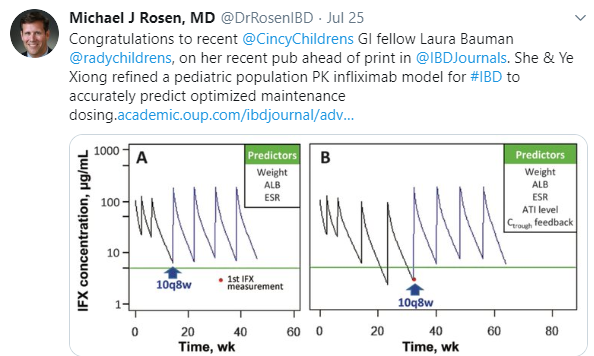
The image above corresponds to Figure 5 in the manuscript.  This figure shows the difference between proactive and reactive dosing strategy.  In the first panel, a higher initial dose prevents suboptimal dosing whereas the second panel shows suboptimal troughs until adjustment of dose after identifying a low trough.  Avoiding low troughs may reduce the likelihood of developing antibodies to infliximab and therapeutic failure

My take: This study and several others indicate that most pediatric patients need either more frequent inflixmab dosing or higher initial doses to achieve therapeutic levels and to improve outcomes.

Proactive Therapeutic Drug Monitoring -Different Time Points

Yesterday’s post outlined expert recommendations for proactive therapeutic drug monitoring (pTDM).  Today’s post reviews a study (NV Casteele et al. Clin Gastroenterol Hepatol 2019; 17: 1814-21) which identifies optimal levels at earlier time points. The authors note that “higher infliximab (IFX) concentrations during induction therapy  are correlated with long-term relapse-free and colectomy-free survival.”

The authors analyzed data from 484 patients with active ulcerative colitis (UC) from two double-blind, placebo-controlled, parallel group studies: ACT-1 and ACT-2.

Key findings:

  • IFX levels ≥18.6 mcg/mL at week 2, ≥10.6 mcg/mL at week 6, and ≥34.9 mcg/mL at week 8 were associated with Mayo endoscopic scores (MES) of ≤1 at week 8.
  • IFX level of ≥5.1 mcg/mL at week 14 was associated with MES of ≤1 at week 30
  • IFX level of ≥6.7 mcg/mL at week 14 was associated with MES of 0 at week 30

My take: In pediatric patients receiving monotherapy with an anti-TNF agent, checking earlier levels (week 6, week 8, or week 10) may help avoid low troughs which are associated with a higher likelihood of treatment failure.  This study provides guidance on target levels at earlier time points.

Related blog posts:

Disclaimer: These blog posts are for educational purposes only. Specific dosing of medications/diets (along with potential adverse effects) should be confirmed by prescribing physician/nutritionist.  This content is not a substitute for medical advice, diagnosis or treatment provided by a qualified healthcare provider. Always seek the advice of your physician or other qualified health provider with any questions you may have regarding a condition.

Crater Lake, OR. The blue color is amazing !


Toronto Consensus Guidelines for Luminal Crohn’s Disease

The recommendations from the Canadian Association of Gastroenterology for luminal Crohn’s Disease in adults were published in two journals.  R Panaccione et al. Clin Gastroenterol Hepatol 2019; 17: 1680-1713 and R Panaccione et al . 2019 Aug; 2(3): e1–e34.

Full text link : Canadian Association of Gastroenterology Clinical Practice Guideline for the Management of Luminal Crohn’s Disease

A few of the 41 statement recommendations:

  • 6. In patients with mild to moderate ileal and/or right colonic Crohn’s disease, we suggest oral budesonide beginning at 9 mg/day as first-line therapy to induce complete remission. GRADE: Conditional recommendation, low-quality evidence
  • 20. In patients with moderate to severe luminal Crohn’s disease with risk factors of poor prognosis, we recommend anti-TNF therapy (infliximab, adalimumab) as first-line therapy to induce complete remission. GRADE: Strong recommendation, moderate-quality evidence
  • 23. In patients with active Crohn’s disease, when starting anti-TNF therapy, we suggest it be combined with a thiopurine or methotrexate over monotherapy to improve pharmacokinetic parameters. GRADE: Conditional recommendation, very low-quality evidence for infliximab, very low-quality evidence for adalimumab
  • 29. We suggest against switching between anti-TNF therapies in patients who are doing well on anti-TNF therapy. GRADE: Conditional recommendation, low-quality evidence
  • 30. In patients with moderate to severe Crohn’s disease who fail to achieve complete remission with any of corticosteroids, thiopurines, methotrexate, or anti-TNF therapy, we recommend vedolizumab to induce complete remission. GRADE: Strong recommendation, moderate-quality evidence
  • 34. In patients with moderate to severe Crohn’s disease who fail to achieve complete remission with any of corticosteroids, thiopurines, methotrexate, or anti-TNF therapy, we recommend ustekinumab to induce complete remission. GRADE: Strong recommendation, moderate-quality evidence
  • 37-41: Authors against the use of probiotics, omega-3 fatty acids, marijuana, naltrexone and enteral nutrition/diet therapies.

Crater Lake and Wizard Island

Canadian Pediatric Guidelines for Crohn’s Disease

DR Mack et al. Gastroenterol 2019; 157: 320-48Full Text: Canadian Association of Gastroenterology Clinical Practice Guideline for the Medical Management of Pediatric Luminal Crohn’s Disease

“When the consensus group met in October 2017, the most recent consensus guidelines for the treatment of CD in pediatric patients were those from” ESPGHAN/ECCO in 2014 with data from June 2013. Thus, the guideline attempts to provide more updated information and recommendations based on incorporating the latest studies.

The authors provide 25 consensus statements.  Here are a few of interest:

  • Recommendation 9: In patients with CD, we suggest exclusive enteral nutrition to induce clinical remission (Recommendation 6 recommends steroids as a treatment for clinical remission; adult Canadian guidelines recommended against using exclusive enteral nutrition)
  • Recommendation 11: In patients with CD in remission, we suggest that if partial enteral nutrition is used it should be combined with other medications to maintain clinical remission.
  • Recommendation 20: When starting infliximab in males, we suggest against using it in combination with a thiopurine.
  • Recommendation 24: In patients with moderate to severe CD who fail to achieve or maintain clinical remission with anti-TNF–based therapy, we suggest ustekinumab to induce and maintain clinical remission.
  • Recommendation 25: In patients with CD, we recommend against cannabis or derivatives to induce or maintain remission.

In addition, the authors provide 13 statements with no recommendations -here are two of them:

  • No consensus J: When starting infliximab in females, the consensus group does not make a recommendation (for or against) regarding combining it with a thiopurine to maintain a durable clinical remission.
  • No consensus L: In patients with CD who have achieved a clinical remission with anti-TNF therapy, the consensus group does not make a recommendation (for or against) regarding assessment for mucosal healing within the first year to determine the need to modify therapy.

Crater Lake, OR