IBD Updates November 2019

M Lowenberg et al. Gastroenterol 2019; 157: 997-1006. This LOVE-CD study, a prospective study with 110 patients with active Crohn’s disease, found that treatment with vedolizumab resulted in 29% and 31% corticosteroid-free clinical remission at weeks 26 and 52 respectively (CDAI <150).  Endoscopic remission, based on intent-to-treat analysis, was 33% and 36% at weeks 26 and 52.  Serum vedolizumab levels above 10 mg/L at week 22 were associated with endoscopic remission at week 26.

S Danese et al. Gastroenterol 2019; 157: 1007-18.  This VERSIFY trial, a phase 3b, open-label, single-group study of 101 patients with Crohn’s disease, found that treatment with vedolizumab resulted in 11.9% and 17.9%  endoscopic remission at week 26 and 52 respectively. Remission by MRE was 21.9% and 38.1% at those respective time points. No notable safety issues were reported.

N Khan et al. Clin Gastroenterol 2019; 17: 2262-8. Using a retrospective cohort of 54,919 patients with IBD followed by the VA System (2000-2018), the authors identified 467 patients with incident squamous cell cancer (SCC); median age ~70 years.  11 patients with SCC died from related-complications.  In this group, 8 had been exposed to thiopurines.   Thus, exposure to thiopurines increased mortality related to SCC compared to those exposed to mesalamine therapy, though the absolute risk among the entire cohort was less than 1 in 5000.  My take: Long-term use of thiopurines should be paired with dermatology evaluation and good skin care.

Pics from Mechandise Mart Light Show, Chicago

What is the Calprotectin Threshold for Disease Progression in Crohn’s Disease?

A recent retrospective study (NA Kennedy et al. Clin Gastroenterol Hepatol 2019; 17: 2269-76) with 918 patients with Crohn’s disease (CD) examined calprotectin levels and disease progression. Median followup was 50.6 months.

Key findings:

  • A calprotectin level cut-off of 115 mcg/g was identified as optimal for separation of those with and without disease disease progression.
  • The authors noted: “Several studies have identified a cut-off value of 250 mcg/g as being useful to distinguish active from inactive disease.  In the present study,…a lower threshold of 115 mcg/g (was identified) suggesting that lower levels of inflammatory activity still may be associated with an adverse outcome.”
  • The authors’ figure 2, as estimated by the empiric transition matrix method, shows disease progression over 30 years.  At that point,  the groups were nearly equally divide between stricturing disease, penetrating disease and inflammatory disease; in contrast at disease onset, ~80% had inflammatory disease behavior.

My take: As more effective therapies have become available, our goals for disease control have changed and focus on altering the disease course with more stringent endpoints.  For calprotectin, the lower number (115 compared to 250) indicates a much lower risk for disease progression.

Related blog posts:

Chicago

Here’s The Proof That Proactive Drug Monitoring Improves Outcomes in Children With Crohn’s Disease

A nonblinded randomized controlled trial (A Assa et al. Gastroenterology 2019; 157: 985-06) with 78 children who had Crohn’s disease provides some of the best evidence to date that proactive therapeutic drug monitoring (pTDM) is important for anti-TNF therapy. The trial was called the PAILOT =Paediatric Crohn’s disease Adalimumab-Level-based Optimisation Treatment.  This is the first RCT of pTDM that actually achieved its primary end point.

In this study, children were divided into a pTDM group (n=38) who received adalimumab levels at weeks 4 and 8 along with every 8 weeks unitl week 72.  The control group (n=31) had reactive monitoring.  The investigators aimed for a trough concentrations above 5 mcg/mL.

Key findings:

  • The primary endpoint of sustained corticosteroid-free clinical remission (CFCR) was achieved in 82% of the pTDM group compared to 48% in the reactive monitoring group (p-.002).
  • The pTMD also  had a higher rate of the composite outcome (CFCR, CRP ≤0.5 mg/dL, and calprotectin ≤150): 42% compared to 12% in the control group (p=.003)
  • 87% of pTDM had dose intensification compared to 60% in control group.

The editorial by Papamichael and Cheifetz (pg 922-4) highlights some additional observations:

  • “The study actually showed that a 10.0 mcg/mL threshold performed better than 7.5 and 5.0 mcg/mL” with respect to PCDAI and CRP levels.
  • “The recent prospective Personalized anti-TNF therapy in Crohn’s disease study (PANTS) showed that the optimal week 14 adalimumab concentration …at both week 14 and 54 was 12 mcg/mL”

My take: Most pediatric gastroenterologist understand the importance of pTDM, especially as conventional dosing of anti-TNF agents is often too low.  This study provides some needed proof and hopefully will aid our efforts to get adequate insurance coverage.  The optimal frequency and timing of pTDM still needs work.

Related blog posts:

I really enjoyed my recent trip to Chicago. Here’s a picture from Lincoln Park Zoo from my favorite photographer

#NASPGHAN19 Selected Abstracts (Part 2)

Link to full NASPGHAN 2019 Abstracts.

Here are some more abstracts/notes that I found interesting at this year’s NASPGHAN meeting.

A study (poster below) from Cincinnati found that a vedolizumab level ≥34.8 mcg/mL at week 6 (prior to 3rd infusion) predicted clinical response at 6 months

Related blog posts:

The poster below reported a high frequency of eosinophilic disorders in children who have undergone intestinal transplantation. Related blog post: Eosinophilic disease in children with intestinal failure

This study from Boston indicates that acid suppression was not associated with improved outcomes in infants with laryngomalacia (eg. lower supraglottoplasy rates or lower aspiration rates.

Related blog posts:

The study below showed that “less than half of children who started the low FODMAP diet were able to complete the elimination phase.” This indicates the need for careful dietary counseling when attempting this therapy.

Related blog posts:

The abstract below showed that the dietary intake of children with inflammatory bowel disease, who were not receiving enteral nutrition therapy, was similar to healthy control children.

The next two studies provide some pediatric experience with tofacitinib in teenagers with inflammatory bowel disease (14-18 years of age).  The first poster had 12 children and reported a 67% clinical response rate (cohort with 5 with CD, 5 with UC, and 2 with IC).  The second poster had 4 of 6 with a clinical response and 3 in remission.

Related blog posts -Tofacitinib:

Disclaimer: This blog, gutsandgrowth, assumes no responsibility for any use or operation of any method, product, instruction, concept or idea contained in the material herein or for any injury or damage to persons or property (whether products liability, negligence or otherwise) resulting from such use or operation. These blog posts are for educational purposes only. Specific dosing of medications (along with potential adverse effects) should be confirmed by prescribing physician.  Because of rapid advances in the medical sciences, the gutsandgrowth blog cautions that independent verification should be made of diagnosis and drug dosages. The reader is solely responsible for the conduct of any suggested test or procedure.  This content is not a substitute for medical advice, diagnosis or treatment provided by a qualified healthcare provider. Always seek the advice of your physician or other qualified health provider with any questions you may have regarding a condition.

#NASPGHAN19 Selected Abstracts (Part 1)

Link to full NASPGHAN 2019 Abstracts.

Here are some abstracts that I found interesting at this year’s NASPGHAN meeting:

NAFLD:

  1. Off-label use of topiramate may be helpful in stabilizing weight and improving NAFLD
  2. Socioeconomic barriers are frequent in NAFLD patients (the 2nd poster did not appear to show a control population):

Primary Sclerosing Cholangitis -Use of Vedolizumab for PSC did not appear to help

Eosinophilic Esophagitis

  1. EoE is four times more likely in this cohort with inflammatory bowel disease
  2. 2nd poster describes very early-onset EoE

Inflammatory Bowel Disease:

  1. Use of infliximab in VEO IBD.  Used in 46/122 (38% of patients) and 50% had persistent use 3 years later

Enteral nutrition –poster from our group describing good tolerance of plant-based formula (with Ana Ramirez).

Celiac disease.  This poster indicates low yield of additional serology for celiac disease besides TTG IgA and serum IgA. This includes testing in young patients (< 2 years) with celiac disease.

CCFA: Updates in IBD Conference (Part 3)

My notes from Georgia Chapter of CCFA’s conference. There could be errors of omission, transcription and/or errors in context based on my understanding.

Evan Feldman, MD –Atlanta Colorectal Surgery

Surgical Management of Fibrostenotic Crohn’s Disease

Key Points:

  • Endoscopic dilation (by colorectal surgery or GI) may alleviate symptomatic strictures in selected patients and obviate surgery; dilate to 20 mm if possible.  Needs to be a short segment (<5 cm).  Consider biopsies to exclude malignancy.
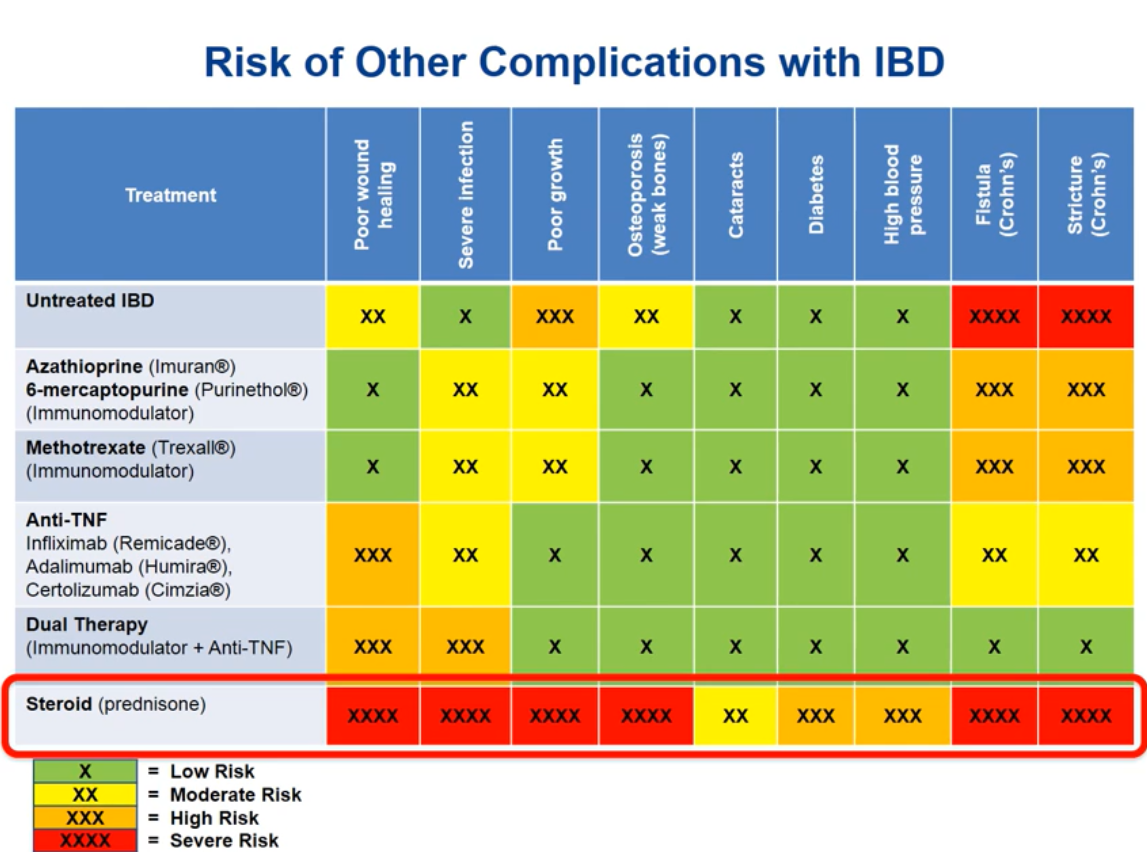
  • In adults, higher risk with steroid treatment, particularly if more than 20 mg per day.
  • In symptomatic patients who need surgery …Preserve as much small bowel disease as possible.  Crohn’s disease is not curable. No need for microscopically-negative disease.
  • Stricturoplasty techniques and indications reviewed.  No role for stricturoplasty in the colon.
  • For gastroduodenal disease, gastrojejunostomy is procedure of choice.
  • Discussed perianal fistulas briefly.
    • 1st two steps: 1. control sepsis/exam under anesthesia 2. control disease process.
    • Then several options: continued use of seton, remove seton and see if better disease control leads to fistula closure, surgical procedure (eg. LIFT procedure) –preferably one with low risk of incontinence.  Injection of stem cells (when disease is under control) can be considered but is off-label in U.S. and Dr. Feldman has noted low response rates in his experience.

The slide above depicts a Michelassi stricturoplasty which is rarely performed, but considered for long segments of strictured bowel.

Related blog post:

Disclaimer: These blog posts are for educational purposes only. Specific dosing of medications (along with potential adverse effects) should be confirmed by prescribing physician.  This content is not a substitute for medical advice, diagnosis or treatment provided by a qualified healthcare provider. Always seek the advice of your physician or other qualified health provider with any questions you may have regarding a condition.


CCFA: Updates in IBD Conference (part 2)

My notes from Georgia Chapter of CCFA’s conference. There could be errors of omission, transcription and/or errors in context based on my understanding.

Sandy Kim, MD –Children’s Hospital of Pittsburgh

Diet in Inflammatory Bowel Disease: Food for Thought

This was a terrific lecture –though much of the topic has been reviewed recently in this blog: Dietary Therapy for Inflammatory Bowel Disease.

Key points:

  • Changes in diet can change microbiome quickly, within 24 hrs
  • Some diets (eg. more fruit/vegetables/fish) may help lower risk of developing IBD
  • Dietary therapy, especially exclusive enteral nutrition (EEN), is effective therapy for Crohn’s disease
  • Why does EEN work?  It is not clear.  There are some changes in microbiome but decrease or little change overall in microbial diversity
  • Reviewed newer dietary approaches: SCD (www.nimbal.org), CD-TREAT, Crohn’s Disease Exclusion Diet

Related blog posts:

Frank Farraye, MD –Mayo Clinic

Health Maintenance in the Adult Patient with IBD

  • Good Practice: Update Vaccinations in IBD population
  • Recent concerns include measles outbreak, and frequent occurrence of Herpes zoster
  • No evidence that vaccination exacerbates IBD
  • New Hepatitis B Recombination Vaccine (Heplisa-B) -2 doses given over one month (for patients older than 18 years. Seroprotective anti-HBs after two doses: 95.4%
  • Shingrix -new recombinant Zoster vaccine.  Overall efficacy 97.2%.  Frequent adverse reactions
  • Women with IBD should undergo annual cervical cancer screening
  • IBD patients should be seen by dermatology
  • Consider depression screening in IBD patients
  • Counsel patients to quit smoking
  • Consider bone density screening in at risk patients

One audience member (Jeff Lewis, MD) pointed out that more attention needs to be paid to depression and anxiety which are much more common and more frequently health-threatening than issues like vaccination.

Related blog posts:

Disclaimer: These blog posts are for educational purposes only. Specific dosing of medications (along with potential adverse effects) should be confirmed by prescribing physician.  This content is not a substitute for medical advice, diagnosis or treatment provided by a qualified healthcare provider. Always seek the advice of your physician or other qualified health provider with any questions you may have regarding a condition.


CCFA: Updates in IBD Conference (part 1)

My notes from a recent Georgia Chapter of CCFA’s conference. There could be errors of omission, transcription and/or errors in context based on my understanding.

Adam Cheifetz, MD Harvard School of Medicine

Optimizing IBD Treatments

  • Earlier treatment with effective therapies
  • Utilizing therapeutic drug monitoring

Goals are clinical and endoscopic remission

  • Imaging if not visible on endoscopy
  • Biomarker remission -adjunctive goal
  • Symptoms and endoscopy do not have good correlation in Crohn’s disease
  • Endoscopic healing associated with better outcomes
  • Treatment –>assessment –> adjust treatment if goal is not met

Biologic Agents:

  • First agent works best; TNF-exposed patients do not respond as well as TNF-naive patients to subsequent biologic
  • High rate of secondary loss of response

Therapeutic Drug Monitoring:

  • Combination therapy in Sonic study was associated with higher infliximab levels. It appears that optimized monotherapy is as effective as combination therapy (Colombel study).
  • Fistula treatment requires higher biologic levels
  • Lower biologic drug levels associated with development of antidrug antibodies
  • Proactive monitoring –recommended
  • Both infliximab and adalimumab are frequently underdosed, especially in pediatrics –>another reason for proactive monitoring
  • If sicker patients, consider checking TDM at week 10; less sick patients, reasonable to consider TDM at week 14

Related blog posts:

Disclaimer: These blog posts are for educational purposes only. Specific dosing of medications/diets (along with potential adverse effects) should be confirmed by prescribing physician/nutritionist.  This content is not a substitute for medical advice, diagnosis or treatment provided by a qualified healthcare provider. Always seek the advice of your physician or other qualified health provider with any questions you may have regarding a condition.

Anti-TNF Therapy: Might Save Your Health But Not Your Wallet

A recent study (LE Targownik, EI Benchimol, J Witt et al. Inflamm Bowel Dis 2019; 25: 1718-28) shows that direct health care costs are increased with anti-TNF therapy.

In this retrospective study using the Manitoba IBD Database, the authors examined the direct costs associated with anti-TNF therapy initiation in 928 patients (676 CD, 252 UC).  Only 84 subjects were <18 years.

Key findings:

  • The median costs for health care in the year of anti-TNF initiation increased compared to prior year.  In year prior to initiation, median costs were $4698 for CD and $6364 for UC; in the first year of anti-TNF treatment, costs rose to $39,749 and $49,327 respectively.
  • Costs remained elevated through 5 years of anti-TNF therapy for continuous users with total median of $210,956 and $245,260 respectively
  • There were reductions in non-drug costs. Inpatient and outpatient costs decreased in the year after anti-TNF initiation by 12% and 7% respectively, when excluding the costs of anti-TNFs.  These observed savings are considerably less than the medication expenditures.

Discussion:

  • Costs for medications are likely to improve with the introduction of biosimilars.  Currently these are being used mainly in persons with a new diagnosis due to reticence to switch from originator product in established patients.
  • The authors note that costs were overall higher with infliximab (IFX) than adalimumab (ADA) though “it is possible that patients with higher-severity disease are channeled toward IFX over ADA.”
  • Indirect costs like ability to go to work and achieve educational potential could offset some of the direct costs.  In a prior study in the U.S., ADA treatment was estimated to reduce indirect costs of “nearly $11,000 per person treated.”

Limitations:

  • Some costs were not measured in the study including emergency room visits, over the counter medications and alternative health care use.
  • This was not a randomized study; thus, it is impossible to know what costs of persons with similar disease who were untreated would have been.

My take: This study shows that saving money is not the main reason to use anti-TNF therapies; rather, their effects on improved health and fewer complications.

Related blog posts:

Haystack Rock, Cannon Beach OR