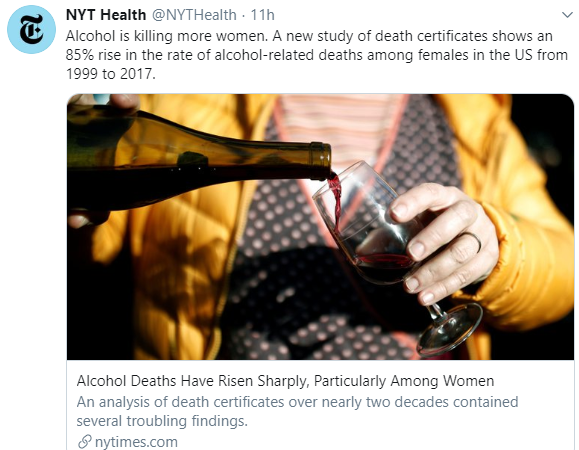
Study: Soda (even diet soda) May Increase Mortality

From Reuters –Link: Soft drinks – sugared or low-calorie – may raise the risk of early death

Link to abstract: Association Between Soft Drinks Consumption and Mortality in 10 European Countries

Excerpt:

In a study that followed more than 400,000 European adults for more than 16 years, the risk of premature death was heightened in those who consumed 2 or more glasses per day of soft drinks, according to the report published in JAMA Internal Medicine…

The new findings don’t mean that soft drinks cause early death, because “in these types of studies (observational epidemiology) there are other factors which may be behind the association we observed,” Murphy added in an email. “For instance, high soft drink consumption may be a marker of overall unhealthy diet”…

Participants who consumed two or more glasses of soft drinks per day were 17% more likely to die early compared to those who drank less than a single serving of soft drinks per month…

Those who consumed two or more glasses of artificially sweetened soft drinks a day were 26% more likely to die prematurely compared to those who drank less than a glass per month.

My take: Whether drinking soda directly impacts one’s health or is a marker for an unhealthy lifestyle is not settled by this study.  Yet, I feel confident that preferentially drinking water is a healthy habit.

Related blog posts:

Proactive Therapeutic Drug Monitoring -Different Time Points

Yesterday’s post outlined expert recommendations for proactive therapeutic drug monitoring (pTDM).  Today’s post reviews a study (NV Casteele et al. Clin Gastroenterol Hepatol 2019; 17: 1814-21) which identifies optimal levels at earlier time points. The authors note that “higher infliximab (IFX) concentrations during induction therapy  are correlated with long-term relapse-free and colectomy-free survival.”

The authors analyzed data from 484 patients with active ulcerative colitis (UC) from two double-blind, placebo-controlled, parallel group studies: ACT-1 and ACT-2.

Key findings:

  • IFX levels ≥18.6 mcg/mL at week 2, ≥10.6 mcg/mL at week 6, and ≥34.9 mcg/mL at week 8 were associated with Mayo endoscopic scores (MES) of ≤1 at week 8.
  • IFX level of ≥5.1 mcg/mL at week 14 was associated with MES of ≤1 at week 30
  • IFX level of ≥6.7 mcg/mL at week 14 was associated with MES of 0 at week 30

My take: In pediatric patients receiving monotherapy with an anti-TNF agent, checking earlier levels (week 6, week 8, or week 10) may help avoid low troughs which are associated with a higher likelihood of treatment failure.  This study provides guidance on target levels at earlier time points.

Related blog posts:

Disclaimer: These blog posts are for educational purposes only. Specific dosing of medications/diets (along with potential adverse effects) should be confirmed by prescribing physician/nutritionist.  This content is not a substitute for medical advice, diagnosis or treatment provided by a qualified healthcare provider. Always seek the advice of your physician or other qualified health provider with any questions you may have regarding a condition.

Crater Lake, OR. The blue color is amazing !


Appropriate Proactive Therapeutic Drug Monitoring

This blog post and tomorrow’s post highlights two articles on proactive therapeutic drug monitoring (pTDM) for inflammatory bowel disease.  The first article (K Papmichael et al.  Clin Gastroenterol Hepatol 2019; 17: 1655-68) summarizes a meeting of 13 international IBD specialists who reached consensus on 24 statements after a review of the literature.

Full Text Link:  Appropriate Therapeutic Drug Monitoring of Biologic Agents for Patients With Inflammatory Bowel Diseases

Key Recommendations:

  • For anti-tumor necrosis factor (anti-TNF) therapies, proactive TDM was found to be appropriate after induction and at least once during maintenance therapy, but this was not the case for the other biologics.
  • Reactive TDM was appropriate for all biologic agents both for primary non-response and secondary loss of response

Background/Rationale for pTDM:

  • “Numerous studies have demonstrated a positive correlation between serum biologic drug.concentrations and favorable therapeutic outcomes”
  • “Low or undetectable drug concentrations can lead to immunogenicity and treatment failures”
  • “TDM…is an important tool for optimizing biologic therapy…Data suggest that pTDM, with drug titration to a target trough concentration, performed in patients with clinical response/remission can also improve the efficacy of anti-TNFs”

Table 4  Scenarios of Applying Therapeutic Drug Monitoring of Biological Therapy in Patients With Inflammatory Bowel Disease

1-4: Anti-TNFs:

  • It is appropriate to order drug/antibody concentration testing in responders at the end of induction for all anti-TNFs.
  • It is appropriate to order drug/antibody concentration testing at least once during maintenance for patients on all anti-TNFs.
  • It is appropriate to order drug/antibody concentration testing of anti-TNFs at the end of induction in primary non-responders.
  • It is appropriate to order drug/antibody concentration testing for all anti-TNFs in patients with confirmed secondary loss of response.

5-8: Vedolizumab -agreement only on ordering TDM in non-responders or those with loss of response

9-12: Ustekinumab  -agreement only on ordering TDM in non-responders or those with loss of response

From Table 5: Biological Drug Concentrations and Anti-Drug Antibodies When Applying Therapeutic Drug Monitoring in Inflammatory Bowel Disease

  • Infliximab: 15. In the presence of adequate trough drug concentrations, anti-drug antibodies are unlikely to be clinically relevant.
  • Infliximab: 19. The minimal trough concentration for infliximab post-induction at week 14 should be greater than 3 μg/mL, and concentrations greater than 7 μg/mL are associated with an increased likelihood of mucosal healing.
  • Adalimumab: 22. The minimum drug concentration at week 4 for adalimumab should at least be 5 μg/mL. Drug concentrations greater than 7 μg/ml are associated with an increased likelihood of mucosal healing.
  • Certolizumab: 24 & 25: The minimum concentrations for certolizumab pegol at week 6 should be greater than 32 μg/mL and 15 μg/mL during maintenance.
  • Golimumab 26 & 27: The minimum drug concentration at week 6 for golimumab should at least be 2.5 μg/mL and 1 μg/mL.during maintenance

My take: This article provides extensive literature to reinforce their recommendations.  Most of the trough levels mentioned are minimum levels that need to be achieved.


Toronto Consensus Guidelines for Luminal Crohn’s Disease

The recommendations from the Canadian Association of Gastroenterology for luminal Crohn’s Disease in adults were published in two journals.  R Panaccione et al. Clin Gastroenterol Hepatol 2019; 17: 1680-1713 and R Panaccione et al . 2019 Aug; 2(3): e1–e34.

Full text link : Canadian Association of Gastroenterology Clinical Practice Guideline for the Management of Luminal Crohn’s Disease

A few of the 41 statement recommendations:

  • 6. In patients with mild to moderate ileal and/or right colonic Crohn’s disease, we suggest oral budesonide beginning at 9 mg/day as first-line therapy to induce complete remission. GRADE: Conditional recommendation, low-quality evidence
  • 20. In patients with moderate to severe luminal Crohn’s disease with risk factors of poor prognosis, we recommend anti-TNF therapy (infliximab, adalimumab) as first-line therapy to induce complete remission. GRADE: Strong recommendation, moderate-quality evidence
  • 23. In patients with active Crohn’s disease, when starting anti-TNF therapy, we suggest it be combined with a thiopurine or methotrexate over monotherapy to improve pharmacokinetic parameters. GRADE: Conditional recommendation, very low-quality evidence for infliximab, very low-quality evidence for adalimumab
  • 29. We suggest against switching between anti-TNF therapies in patients who are doing well on anti-TNF therapy. GRADE: Conditional recommendation, low-quality evidence
  • 30. In patients with moderate to severe Crohn’s disease who fail to achieve complete remission with any of corticosteroids, thiopurines, methotrexate, or anti-TNF therapy, we recommend vedolizumab to induce complete remission. GRADE: Strong recommendation, moderate-quality evidence
  • 34. In patients with moderate to severe Crohn’s disease who fail to achieve complete remission with any of corticosteroids, thiopurines, methotrexate, or anti-TNF therapy, we recommend ustekinumab to induce complete remission. GRADE: Strong recommendation, moderate-quality evidence
  • 37-41: Authors against the use of probiotics, omega-3 fatty acids, marijuana, naltrexone and enteral nutrition/diet therapies.

Crater Lake and Wizard Island

Canadian Pediatric Guidelines for Crohn’s Disease

DR Mack et al. Gastroenterol 2019; 157: 320-48Full Text: Canadian Association of Gastroenterology Clinical Practice Guideline for the Medical Management of Pediatric Luminal Crohn’s Disease

“When the consensus group met in October 2017, the most recent consensus guidelines for the treatment of CD in pediatric patients were those from” ESPGHAN/ECCO in 2014 with data from June 2013. Thus, the guideline attempts to provide more updated information and recommendations based on incorporating the latest studies.

The authors provide 25 consensus statements.  Here are a few of interest:

  • Recommendation 9: In patients with CD, we suggest exclusive enteral nutrition to induce clinical remission (Recommendation 6 recommends steroids as a treatment for clinical remission; adult Canadian guidelines recommended against using exclusive enteral nutrition)
  • Recommendation 11: In patients with CD in remission, we suggest that if partial enteral nutrition is used it should be combined with other medications to maintain clinical remission.
  • Recommendation 20: When starting infliximab in males, we suggest against using it in combination with a thiopurine.
  • Recommendation 24: In patients with moderate to severe CD who fail to achieve or maintain clinical remission with anti-TNF–based therapy, we suggest ustekinumab to induce and maintain clinical remission.
  • Recommendation 25: In patients with CD, we recommend against cannabis or derivatives to induce or maintain remission.

In addition, the authors provide 13 statements with no recommendations -here are two of them:

  • No consensus J: When starting infliximab in females, the consensus group does not make a recommendation (for or against) regarding combining it with a thiopurine to maintain a durable clinical remission.
  • No consensus L: In patients with CD who have achieved a clinical remission with anti-TNF therapy, the consensus group does not make a recommendation (for or against) regarding assessment for mucosal healing within the first year to determine the need to modify therapy.

Crater Lake, OR

“Intestinal Microbiota Transplant” -New Terminology for Fecal Transplant

A recent letter to the editor (A Khoruts, LJ Brandt, Am J Gastroenterol 114: 1176) suggests that the terms “Fecal Transplant” or “Fecal Microbiota Transplantation” (FMT) should be abandoned in favor of “intestinal microbiota transplant.”

  • First of all, the authors argue that the word “fecal” is no longer accurate as some transplants occur by swallowing capsules of purified microbiota and the days of “blending raw stool near the bedside are largely over.”
  • Secondly, the term “fecal” is highly problematic.  “We are hard-wired to perceive feces to be disgusting.”
  • Third, the media sensation from the terms FMT or fecal transplant “has not translated into substantial positive consequences, such as funding research…[or] philanthropic fundraising.”

Thus, the authors advocate “Intestinal Microbiota Transplant” or IMT.

My take: (borrowed from authors) It is time to “abandon the scatologic humor that is arguably threatening further development of this promising therapeutic approach.”

Related blog posts:

Sunrise at Crater Lake, OR

NY Times: “Our Food is Killing Too Many of Us”

NY Times: D Mozaffarian, D Glickman Our Food is Killing Too Many of Us

“Improving American nutrition would make the biggest impact on our health care”

An excerpt:

“Instead of debating who should pay for all this, no one is asking the far more simple and imperative question: What is making us so sick, and how can we reverse this so we need less health care? … our food…

Poor diet is the leading cause of mortality in the United States, causing more than half a million deaths per year. Just 10 dietary factors are estimated to cause nearly 1,000 deaths every day from heart disease, stroke and diabetes alone…

Taxes on sugary beverages and junk food can be paired with subsidies on protective foods like fruits, nuts, vegetables, beans, plant oils, whole grains, yogurt and fish….Levels of harmful additives like sodium, added sugar and trans fat can be lowered through voluntary industry targets or regulatory safety standards

Nutrition standards in schools, which have improved the quality of school meals by 41 percent, should be strengthened; the national Fresh Fruit and Vegetable Program should be extended beyond elementary schools to middle and high schools…

Coordinated federal leadership and funding for research is also essential. This could include, for example, a new National Institute of Nutrition at the National Institutes of Health. Without such an effort, it could take many decades to understand and utilize exciting new areas, including related to food processing, the gut microbiome, allergies and autoimmune disorders, cancer, brain health, treatment of battlefield injuries and effects of nonnutritive sweeteners and personalized nutrition.”

Related blog posts:

Crater Lake, OR


EoP –Biomarker or Balderdash?

One of the categories in the game of balderdash is abbreviations.  Someone with extra time on their hands should invent a medical version with obscure acronyms as one of the categories.

An acronym that I recently discovered, EoP, which stands for eosinophil progenitor came to my attention from Dr. Benjamin Enav and Dr. Oral Alpan. they suggested two articles (both letters to the editor) related to EoP as a biomarker for eosinophilic esophagitis:

  • DW Morris et al. J Allergy Clin Immunol 2016;138: 915-8.
  • JT Schwartz et al. J Allergy Clin Immunol 2019; 143: 1221-3.

Both of these articles came from researchers at the Cincinnati Children’s Hospital.  In the first, the authors studied 31 children (17 with active eosinophilic esophagitis [EoE], and 14 with inactive EoE).  Key findings:

  • With a cutoff of 15.5 EoPs/mL, there were none of the 17 patients with active EoE below this threshold and 8 of 14 (57%) with inactive EoE were below this threshold.
  • At this cutoff, this pilot study predicted active EoE with a sensitivity of 100%, specificity of 57%, positive predictive value of 74% and negative predictive value of 100%.

The second study, also with 31 children, showed that the peripheral blood EoP levels were significantly increased in patients with active disease and correlated with the
EoEHSS (EoE histologic scoring system) composite ratio.

My take: These studies show that a blood level of EoP is a promising biomarker which could help avoid endoscopy in those with low levels of EoP.

Related blog posts:

Liver Shorts August 2019

JB Talcott et al. JPGN 2019; 69: 145-51.  This small study showed an association with prolonged cholestastic liver disease in children and poorest cognitive outcomes despite successful transplantation.  There were 28 participating children in this study, only 12 with chronic liver disease. Acute liver disease was not associated with deficits in cognitive function.  This study “reinforces the need for timely intervention.”

AA Butt et al. Gastroenterol 2019; 156: 987-96.  This study which used a Veterans database for chronic hepatitis C (HCV) infection (n=242,680) found that treatment with direct-acting antiviral therapy (hazard ratio 0.57) was associated with a significant decrease in risk of cardiovascular disease events.

F DiPaola et al JPGN 2019; 69: 152-59.  This study from the drug induced liver injury (DILI) network (2004-2017) with just 57 cases found that antimicrobials (51%) and antiepileptics (21%) were the leading causes of DILI in children. Related blog: Liver toxicity –Where to Look Online

P Huelin et al. Hepatology 2019; 70: 319-33. This study with 320 consecutive cases of acute kidney injury (AKI) in patients hospitalized for cirrhosis found that urinary neutrophil gelatinase-associated lipocalin (NGAL) (best at day 3) helped differentiate acute tubular necrosis from other types of AKI.