Why Didn’t Screening for Biliary Atresia Improve Outcome In This Study?

ZJ Kastenberg et al J Pediatr 2023; 257: 113339. Fractionated Bilirubin Among 252 892 Utah Newborns with and Without Biliary Atresia: A 15-year Historical Birth Cohort Study

This retrospective study (2005-2019) used an administrative data from a large integrated healthcare network in Utah to identify newborns with abnormal fractionated bilirubins. since 2005, all newborns at this healthcare system had a fractionated bilirubin measured.

Key findings:

  • There were 252 892 newborns with fractionated bilirubin assessed, including 26 of those subsequently confirmed to have biliary atresia (BA).
  • Conjugated or direct bilirubin was elevated in all 26 infants with BA and an additional 3246 newborns (1.3%) without BA. The lowest direct bilirubin in the BA group was 0.6, just above cutoff value of 0.5 mg/dL. The conjugated bilirubin cutoff value wa 0.2 mg/dL.
  • The 15-year crude birth prevalence of BA was 0.68 per 10,000 births in this cohort
  • Median time to Kasai HPE was 69.5 days

This study found that all infants with BA have elevated conjugated or direct bilirubin at birth. The authors estimate that a healthcare system with about 30,000 deliveries per year, would have between 450 and 630 newborns that would require a second screen. In this group, 96 per 100,000 screened newborns (~1 in 1000) will have a positive second screen at 2-week well check and need further evaluation.

What I don’t understand about this paper is how the authors omit a discussion of the age of Kasai HPE. How is it that all of these newborns received a fractionated bilirubin and the age of Kasai HPE is not improved compared to other U.S locations that have not implemented universal testing? (Previous data from 15 ChiLDReN sites indicate age of Kasai HPE 65-70 days and unchanged over past 30 years, see blog post: Online Aspen Webinar (Part 5) -Biliary Atresia Diagnosis and Screening).

The authors note that implementation of screening could be improved with newer tests (eg. MMP-7) but that more analysis is needed to determine if screening is cost-effective and avoids harm (eg. subjecting healthy newborns to invasive testing).

My take: If universal screening is implemented, it is imperative to show that it helps and to set up the needed infrastructure to arrange appropriate followup. The first surrogate marker of this effort would be improving the age of surgical intervention.

As an aside, I find the new page numbering by The Journal of Pediatrics to be quite annoying. When you are going through the hard copy of the Journal, it is more difficult to find the articles that are listed in the table of contents because the articles are not ordered by lowest to highest numbered page. Each article is given a single page number like 113339 in this article but inside the article it is numbered page 1–10 (or however long the pages). The article prior could be a lower or higher page number. Until hard copies are eliminated, it would be an improvement if the articles could at least be ordered such that the next article would not have a lower page reference than the preceding article.

Related blog posts:

Castle Hill Park, Nice France

Be Careful with Biliary Atresia Diagnostic Biomarkers

B Aleiri et al. JPGN 2023; 77: 97-102. Matrix Metalloproteinase-7 and Osteopontin Serum Levels as Biomarkers for Biliary Atresia

In this study, serum was assessed from 32 biliary atresia (BA) patients and 27 controls.

Key findings:

  • Median MMP-7 was higher in BA (96.4 vs 35 ng/mL; P < 0.0001) with an optimal cut-off value of 69 ng/mL. Sensitivity and specificity was 68% and 93%, respectively [negative predictive value (NPV) = 71%]
  • Median osteopontin (OPN) was higher in BA (1952 vs 1457 ng/mL; P = 0.0001) and an optimal cut-off of 1611 ng/mL. Sensitivity and specificity was 84% and 78%, respectively (NPV = 81%)

The authors note that numerous studies from Asian countries have shown very high sensitivity and specificity for MMP-7. These studies used different cut-offs based on the testing kit. One limitation of this study was that samples were stored for a median of 12 years and perhaps this affected the results (some prior studies also used banked specimens).

My take: When these levels are very elevated, they are highly suggestive of BA. This study serves as a caution to note that the sensitivity at typical cut off values could be suboptimal

Related blog posts:

Le Jardin Exotique in Eze, France

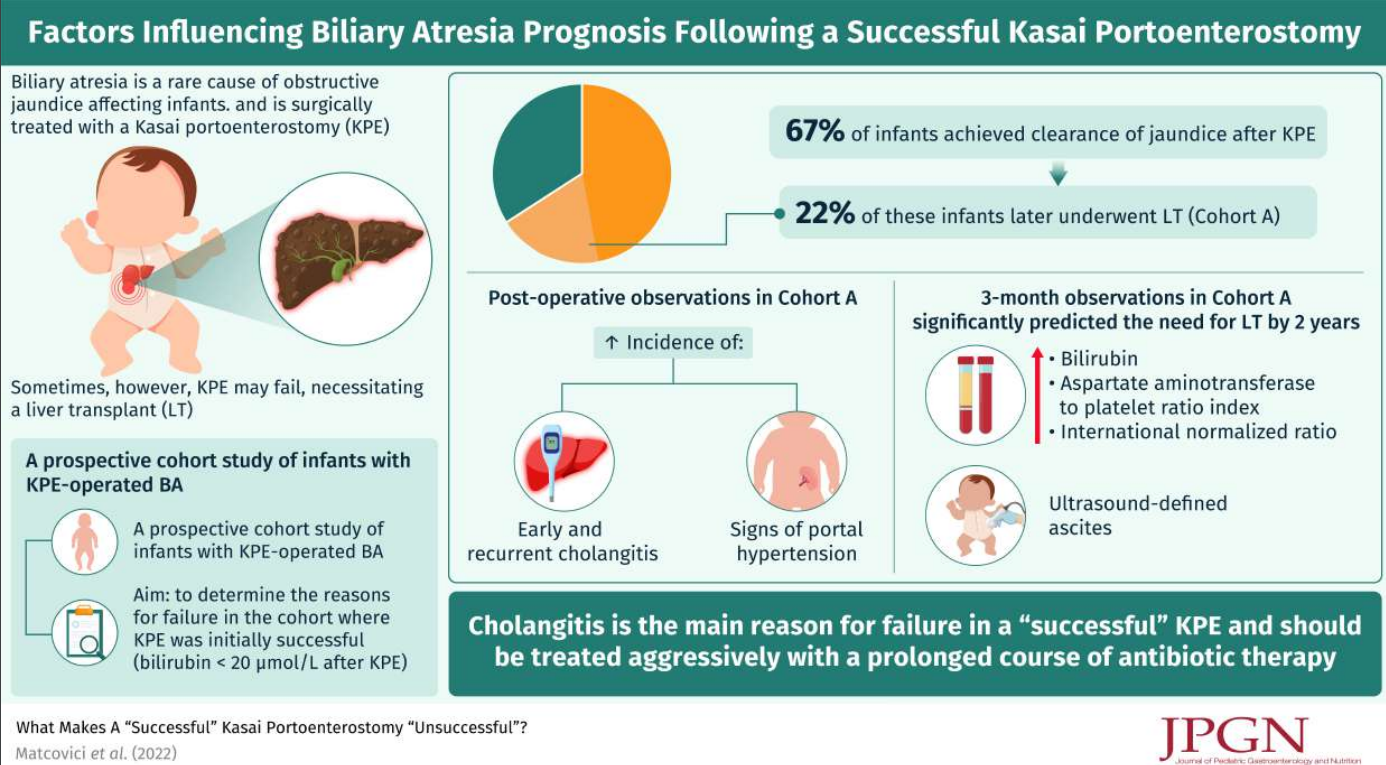
“What Makes A “Successful” Kasai Portoenterostomy “Unsuccessful”?

M Matcovici et al. JPGN 2023; 76: 66-71. What Makes A “Successful” Kasai Portoenterostomy “Unsuccessful”?

Methods: This review of a single-center prospective biliary atresia (BA) database examined which factors were associated with long-term success of a Kasai portoenterostomy (KPE). Successful KPE was defined by achieving a postoperative bilirubin of ≤20 µmol/L. Cholangitis was based on Tokyo (Adult) Guidelines (Calculator MD Calc: Tokyo Guidelines for Acute Cholangitis 2018). Explanation of Tokyo Guidelines: Tokyo Classification Cholangitis

Key findings:

  • 90 (67%) achieved clearance of jaundice after KPE. From these 20 (22%) (Cohort A) underwent LT with the remainder continuing with native liver (Cohort B) (median follow-up of 4.15 years)
  • Postoperatively, both cholangitis [any episode, 18/20 (90%) vs 15/70 (21%); P < 0.0001] and portal hypertension (PHT) [gastrointestinal (GI) bleed, 10/20 (50%) vs 2/70 (2.8%); P < 0.0001] were significantly more common in cohort A

My take: The authors assert that “failure is not preordained at KPE but due to recurrent cholangitis and/or symptoms of PHT.” In my view, this study shows an association but not causation of cholangitis/PHT with increased likelihood of KPE failure. It is quite possible that the cholangitis develops in those with suboptimal bile flow; thus, cholangitis (as well as PHT) may be an indicator that the KPE is not working as well, rather than the reason. Yet, it is also likely that episodes of cholangitis exacerbate any underlying problems.

Related blog posts:

MMP-7 Helps Sort Out Biliary Atresia from Parenteral Nutrition-Associated Liver Disease

PS Salvi et al. J Pediatrics 2022; 249: 97-100. Open access! Comparing Serum Matrix Metalloproteinase-7 in Parenteral Nutrition-Associated Liver Disease and Biliary Atresia

In this single-center retrospective study with 19 patients, MMP-7 and GGT values were compared in children who were diagnosed with Parenteral Nutrition-Associated Liver Disease (PNALD, n=15) and Biliary atresia (n=4). Key findings:

  • Median MMP-7 values for PNALD patients 37.8 ng/mL was much lower than MMP-7 values for biliary atresia 112.3 ng/mL.
  • GGT values were not statistically significantly different 116 for PNALD vs 248 for biliary atresia
  • In this cohort, a MMP-7 threshold of 52.8 ng/mL had a sensitivity of 100% and specificity of 93.5% for biliary atresia.

My take: MMP-7 values reduce diagnostic uncertainty between PNALD and biliary atresia. However, there are infrequent cases of biliary atresia with lower values of MMP-7.

Related blog posts:

Two Sisters Pierre-August’s Renoir

Liver Shorts: Malnutrition in Biliary Atresia, Cholestasis with ECMO, Impaired Cognition After Pediatric Liver Transplantation

JM Boster et al. Liver Transplantation 2022; 28: 483-492. Malnutrition in Biliary Atresia: Assessment, Management, and Outcomes Good review article. Malnutrition and sarcopenia negatively impact pretransplant, peritransplant, and posttransplant outcomes and survival in children with BA.

E Alexander et al. JPGN 2022; 74: 333-337. Clinical Implications for Children Developing Direct Hyperbilirubinemia on Extracorporeal Membrane Oxygenation Key findings: 36/106 (34%) children developed direct hyperbilirubinemia (DHB) on ECMO. Illness acuity scores were significantly higher in the DHB group on ECMO day 2 (P = 0.046) and day 7 (P = 0.01). Mortality rate was higher in the DHB group 72%, versus 29% in the control group (P < 0.001).

A Ostensen et al. J Pediatr 2022; 243: 135-141. Open Access: Impaired Neurocognitive Performance in Children after Liver Transplantation In this study with 65 participants, key findings:

  • Compared with the patients who underwent transplantation a age >1 year (n = 35), those who did so at age <1 year (n = 30) had a lower FSIQ (87.1 ± 12.6 vs 96.6 ± 13.8; P = .005) and lower verbal comprehension index (87.3 ± 13.8 vs 95.4 ± 13.0; P = .020).
  • Transfusion of >80 mL/kg (P = .004; adjusted for age at transplantation: P = .046) was also associated with detrimental effects on FSIQ.
  • No difference in IQ between tests was found in those patients tested more than once, indicating no significant improvement with more time after transplantation (first testing was at median of 4.1 years after transplantation and the second testing was at a median age of 6.7 years after transplantation)
  • “Our findings indicate that transplantation at early age has a pronounced effect on later neurocognitive impairment, and that this effect is separate from and more pronounced than the effect of cholestasis before transplantation.”

Related blog posts:

Onion Headline:

Liver Shorts: Biliary Atresia Organoids, AIH Pregnancy Outcomes, ALT Levels in Primary Care, Polyreactive IgG for AIH

SP Amarachintha et al. Hepatology 2022; 75: 89-103. Open Access: Biliary organoids uncover delayed epithelial development and barrier function in biliary atresia

This is a super cool article documenting a new human model for studying biliary atresia. The authors “generated biliary organoids from liver biopsies of infants with biliary atresia and normal and diseased controls…Organoids from biliary atresia are viable and have evidence of halted epithelial development. The induction of developmental markers, improved cell-cell junction, and decreased epithelial permeability by EGF and FGF2 identifies potential strategies to promote epithelial maturation and function.”

The authors note that delayed development of cholangiocytes impair barrier function and leave the liver susceptible to various insults which can trigger an inflammatory response with potential progression to obliteration of the bile ducts.

CW Wang et al. Hepatology 2022; 75: 5-12. Open Access: Outcomes of pregnancy in autoimmune hepatitis: A population-based study

Among 18,595,345 pregnancies, 935 (<0.001%) had AIH (60 with cirrhosis) and 120,100 (0.006%) had other CLD (845 with cirrhosis). Key findings:

  • AIH was not associated with postpartum hemorrhage, maternal, or perinatal death
  • AIH was associated with preterm births when compared with women without CLD (OR: 2.0)
  • The odds of gestational diabetes (GDM) and hypertensive complications (pre-eclampsia, eclampsia, or hemolysis, elevated liver enzymes, low platelets) were significantly higher in AIH compared to other CLD (GDM: OR 2.2 and hypertensive complications: OR: 1.8) and also compared to no CLD in pregnancy (GDM: OR: 2.4 and  hypertensive complications: OR: 2.4)

SJ Wu et al. J Pediatr 2022; 240: 280-283. The Prevalence of Elevated Alanine Aminotransferase Levels Meeting Clinical Action Thresholds in Children with Obesity in Primary Care Practice

In this brief report, the authors identified 7.8% of children from a cross-sectional California cohort (n=12,945) with ALT >44 U/L and BMI in the 95% or higher (2012-2014). Males were twice as likely to have elevated ALT. Ethnicity rates were higher in hispanics, asians than white and black children (in males: 12%, 10.4%, 7.3% and 3.1%, respectively)

R Taubert et al. Hepatology 2022; 75: 13-27. Quantification of polyreactive immunoglobulin G facilitates the diagnosis of autoimmune hepatitis

Key findings: Polyreactive IgGs (pIgGs) are a common finding in untreated AIH and have “the highest overall accuracy for the distinction between AIH and non-AIH LD compared to the most common conventional autoantibodies.” In addition, in this study with 1568 adutls, pIgGs were present in “up to 88% of patients with seronegative AIH and in up to 71% of AIH patients with normal IgG levels. Under therapy, pIgG returns to background levels of non-AIH-LD.”

Neurologic Impairment with Biliary Atresia at Time of Diagnosis

Previous studies have indicated that prolonged cholestasis before liver transplantation is associated with adverse neurodevelopmental outcomes. LH Rodijk et al (JPGN 2021; 72: 592-596. Full text: Early Motor Repertoire in Infants With Biliary Atresia: A Nationwide Prospective Cohort Study) prospectively investigate early neurologic impairment in infants with biliary atresia (n=35).

The author’s utilized Prechtl’s General Movement (GM) Assessment which is a noninvasive, cost-effective, and worldwide used method to identify infants who are at risk of neurodevelopmental impairments. This requires video recordings of 10 minutes; this was avoided in the 24 hours following liver biopsy or general anesthesia.

Key finding:

  • The proportion of infants with atypical GMs was significantly higher in BA (46%) than in 2 reference groups of healthy infants (vs 10%, P < 0.001; vs 18%, P < 0.001).

My take (from authors): “At the time of diagnosis, almost half of the infants with BA showed an atypical early motor repertoire, suggesting that neurological impairment is present already in early infancy. Compared to healthy infants, approximately 2 to 3 times more infants showed an atypical motor repertoire.”

Related blog posts:

Arlington, VA -February 2021. Thanks to Seth for this image

Liver Shorts -February 2021 (part 2)

M Biewenga et al. Liver Transplantation 2020; 26: 1573-1581. Full text: Early Predictors of Short-Term Prognosis in Acute and Acute Severe Autoimmune Hepatitis

Key points:

  •  After the start of immunosuppressive therapy, bilirubin, albumin, and INR normalized in 70%, 77%, and 69%, respectively, in a median of 2.6 months, 3 months, and 4 weeks, respectively, in patients with A-AIH and AS-AIH
  • Deterioration of liver function (bilirubin, INR) after 2 weeks of treatment should lead to rapid evaluation for LT and consideration of second-line medication.

I Ziogas et al. J Pediatr 2021; 228: 177-182. Mortality Determinants in Children with Biliary Atresia Awaiting Liver Transplantation

Key points:

  • The cumulative incidence of waitlist mortality was 5.2%. Median waitlist time was 83 days.
  • In multivariable analysis (n = 2253), increasing bilirubin level ( P < .001), portal vein thrombosis ( P = .03), and ventilator dependence ( P < .001) at listing were associated with a higher risk, whereas weight ≥10 kg at listing ( P = .009) was associated with a lower risk of waitlist mortality. 

References Only:

HM DuBrokc, MJ Krowka. Hepatology 2020; 1455-1460. The Myths and Realities of Portopulmonary Hypertension

Related blog posts:

H Oh et al. Clin Gastroenterol Hepatol 2020; 18: 2793-2802. Full text: No Difference in Incidence of Hepatocellular Carcinoma in Patients With Chronic Hepatitis B Virus Infection Treated With Entecavir vs Tenofovir Related blog post: Is Tenofovir the Best Medication for HBV?

Evanston, IL

Favorite Posts of 2020

These are some of my favorite posts of the past year.

Humor:

GI:

Endoscopy:

Liver:

Nutrition

COVID-19:

Other:

From Picnic Island, Tampa Bay

Bone Health in Children with Biliary Atresia

S Ruuska et al. JPGN 2020; 71: 707-712. Impaired Bone Health in Children With Biliary Atresia

This retrospective study from Finland details the bone health of children with biliary atresia (BA). Key findings:

  • Out of 49 patients, 7 (14%) were diagnosed with rickets during infancy. Clearance of jaundice [odds ratio 0.055, 95% confidence interval [CI] 0.00266–0.393; P < 0.01] was a protective factor against rickets.
  •  In DXA measurements, median lumbar spine aBMD anthropometrically adjusted z-scores were as follows:
    • in native liver survivors 0.8 (interquartile range [IQR] −1.9 to 1.4) at 5 and −0.3 (IQR −1.3 to 0.8) at 10 years
    • in liver transplanted patients 0.4 (IQR −0.2 to 1.1) at 5 and 0.6 (IQR −0.1 to 1.3) at 10 year.
  • Most BA patients have aBMD within normal range between 5 and 10 years of age irrespective of liver transplantation status.

My take: This study shows that early in life there is frequent bone impairment in children with BA. This generally improves in most children as cholestasis resolves (with or without liver transplantation).

Related blog posts:

Indian Rocks Beach, FL