AGA Guidance: Biomarkers for Crohn’s Disease

AN Ananthakrishnan, J Adler et al. Gastroenterol 2023; 165: 1367-1399. Open Access! AGA Clinical Practice Guideline on the Role of Biomarkers for the Management of Crohn’s Disease

Key points:

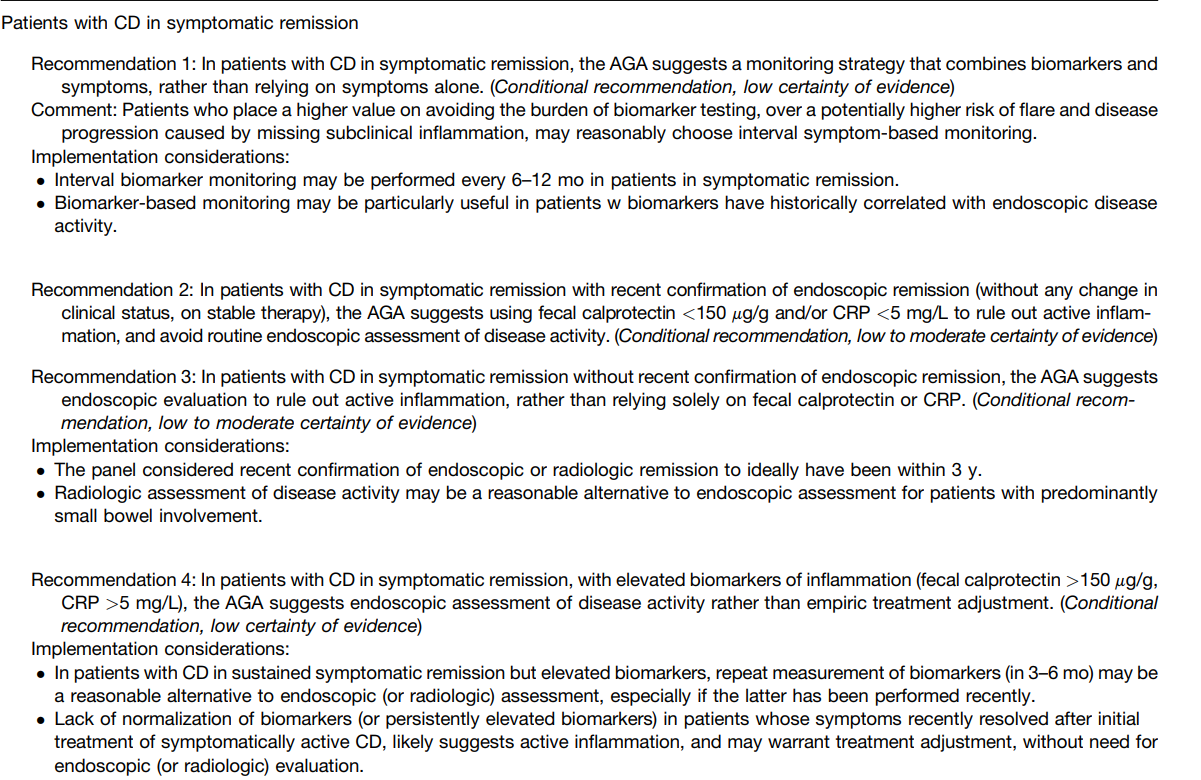
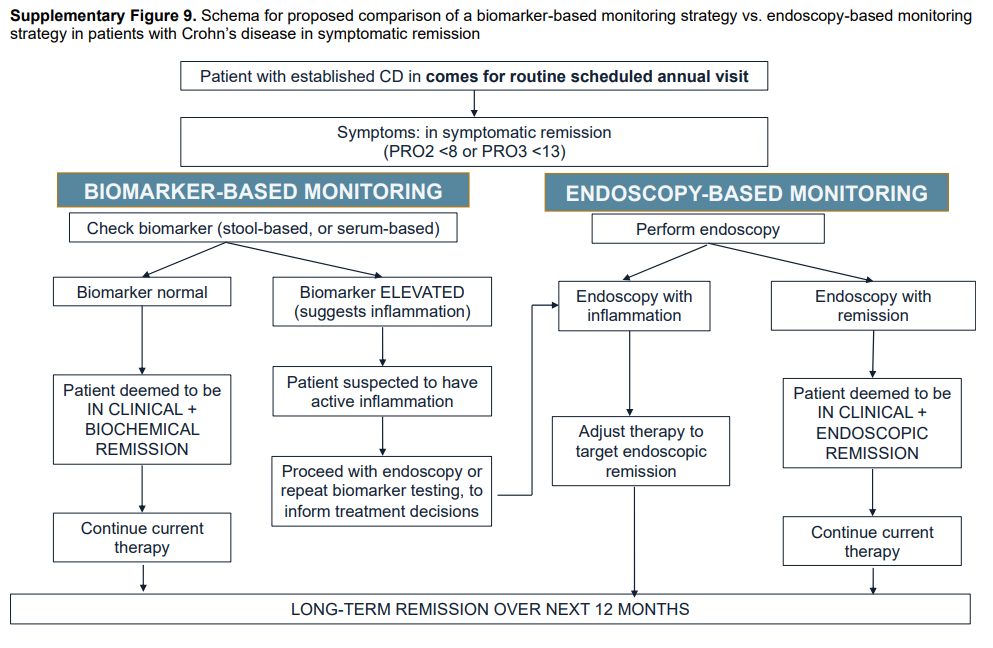
  • Recommendation #2: In patients in symptomatic remission with recent endoscopic evaluation (w/in 3 yrs), a fecal calprotectin <150 μg/g and normal CRP rules out active inflammation, avoiding endoscopic evaluation for assessment of disease activity. However, elevated biomarkers in this setting merit confirmation with endoscopy before treatment adjustment.
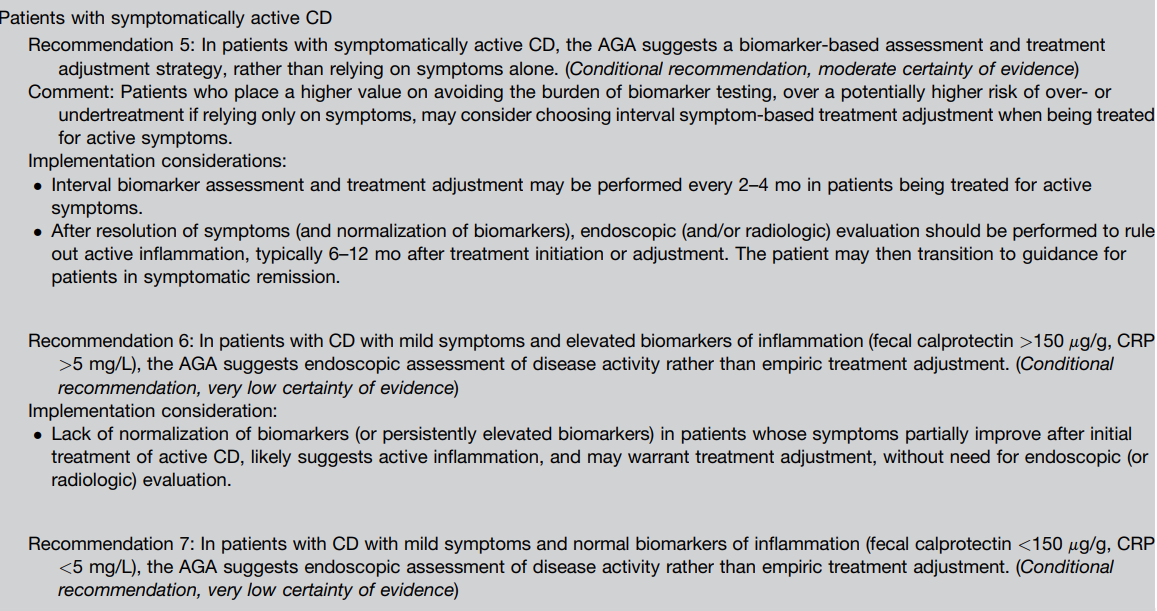
  • Recommendations #6, #7: In patients with CD with mild symptoms, neither normal nor elevated biomarkers alone are sufficiently accurate to determine endoscopic activity.
  • Recommendations #8, #9: In patients with CD with moderate to severe symptoms, elevated fecal calprotectin or serum CRP suggests endoscopic activity, precluding routine endoscopic assessment for disease activity. In those with moderate to severe symptoms but normal biomarkers, endoscopic assessment is recommended rather than empiric adjustment in treatment.
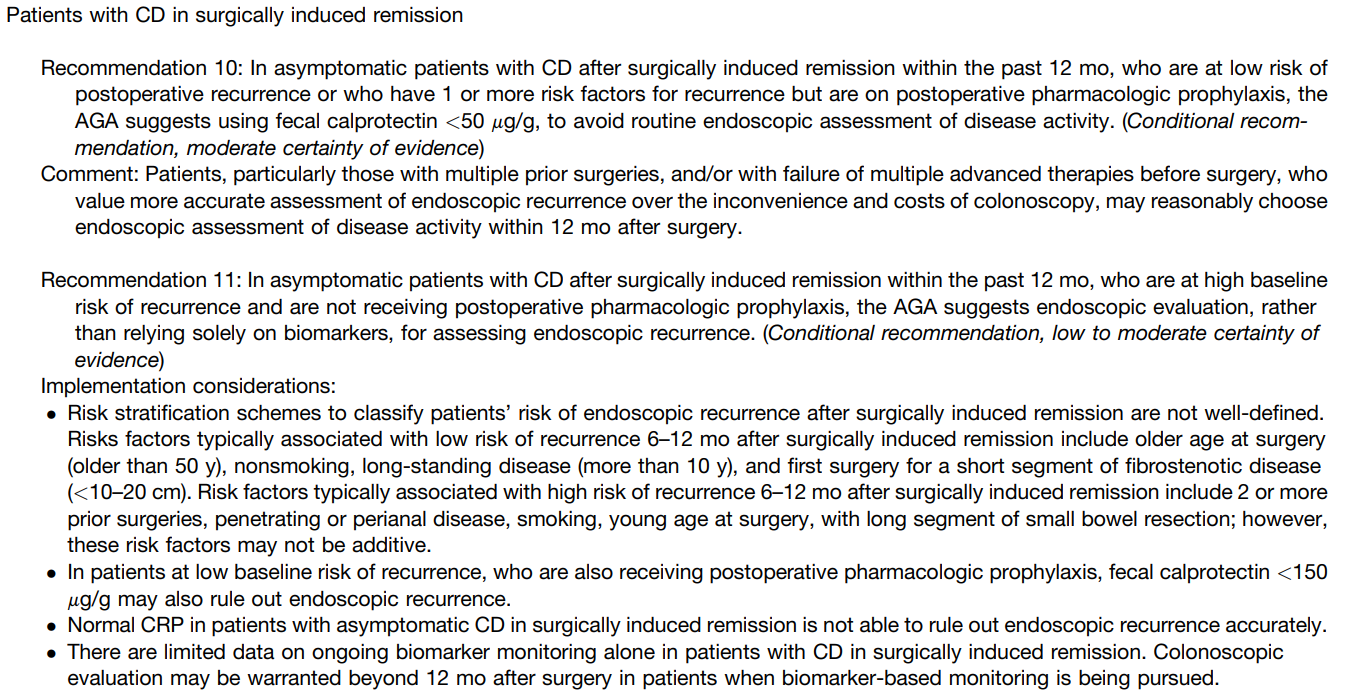
  • Recommendation #10: In patients with CD in surgically induced remission in low-risk patients on pharmacologic prophylaxis, a normal fecal calprotectin (<50 mcg/gm) reliably rules out endoscopic recurrence.

More Recommendations:

#1 In patients with CD in symptomatic remission, the AGA suggests a monitoring strategy that combines biomarkers and symptoms, rather than relying on symptoms alone.

#3 In patients with CD in symptomatic remission without recent confirmation of endoscopic remission, the AGA suggests endoscopic evaluation to rule out active inflammation, rather than relying solely on fecal calprotectin or CRP. 

#5 In patients with symptomatically active CD, the AGA suggests a biomarker-based assessment and treatment adjustment strategy, rather than relying on symptoms alone.

My take: This practical guidance will help target endoscopy in patients with Crohn’s disease. In those who are feeling well with normal biomarkers, frequent endoscopic evaluation is a low-value procedure. Similarly, in those with very elevated biomarkers and who are very symptomatic (with normal infectious studies), endoscopic evaluation is often unnecessary. The AGA expert recommendations should help persuade insurance companies to include biomarkers in their coverage.

Summary of all recommendations -see below from Figure 9 and Table 3.

Related blog posts:

Endoscopy of the Ileal Pouch Anal Anastomosis

A Bousvarous et al. JPGN 2023; 77: 691-694. Endoscopy of the Ileal Pouch Anal Anastomosis

This is a terrific review with some good pictures.

  • The authors note that in their practice in their IBD center, a pouchoscopy is performed 1-2 years after ileostomy closure irrespective of symptoms; in those with symptoms, it is performed sooner.
  • Some complications like strictures and ulcers can occur with few symptoms
  • Table 1 reviews common complications like strictures, cuffitis, infectious pouchitis, Crohn’s disease like pouch inflammation, pouch ischemia, and irritable pouch syndrome. Figure 2 provides useful endosopic picture

Related blog posts:

Another article on pouch management/evaluation:

P Santiago et al. Am J Gastroenterol 2023; 118(11):p 1931-1939 | DOI: 10.14309/ajg.0000000000002348. Open access: Classification and Management of Disorders of the J Pouch

Mesalamine in Pediatric Crohn’s Disease is Still Not Effective

DD Young et al. JPGN Reports 2023; e379. Open Access! Natural History of Pediatric Patients With Crohn’s Disease Treated With Mesalamine Therapy

Background: “Despite their [5-aminosalicylates (5-ASA)] lack of efficacy in Crohn disease (CD), they are still used in real-world practice.”

Methods: In this pediatric retrospective study with 61 patients with ileocolonic disease, 24 received concomitant immunomodulator therapy.

Key findings:

  • The majority of patients (85%) required escalation to biologics. 71% of those receiving an immunomodulator required escalation to a biologic and all but 35 of 37 on mesalamine monotherapy required escalation to a biologic
  • There was no difference between those who continued 5-ASA at time of biologic initiation compared to those who did not continue the medication
  • Patients who discontinued 5-ASA had an average annual cost savings of $6741

My take: In those with very mild Crohn’s disease, the best option may be a dietary approach. Mesalamine therapy remains a good option in patients with ulcerative colitis.

Related blog posts:

Disclaimer: This blog, gutsandgrowth, assumes no responsibility for any use or operation of any method, product, instruction, concept or idea contained in the material herein or for any injury or damage to persons or property (whether products liability, negligence or otherwise) resulting from such use or operation. These blog posts are for educational purposes only. Specific dosing of medications (along with potential adverse effects) should be confirmed by prescribing physician.  Because of rapid advances in the medical sciences, the gutsandgrowth blog cautions that independent verification should be made of diagnosis and drug dosages. The reader is solely responsible for the conduct of any suggested test or procedure.  This content is not a substitute for medical advice, diagnosis or treatment provided by a qualified healthcare provider. Always seek the advice of your physician or other qualified health provider with any questions you may have regarding a condition.


More amazing stone work on walking areas in Lisbon

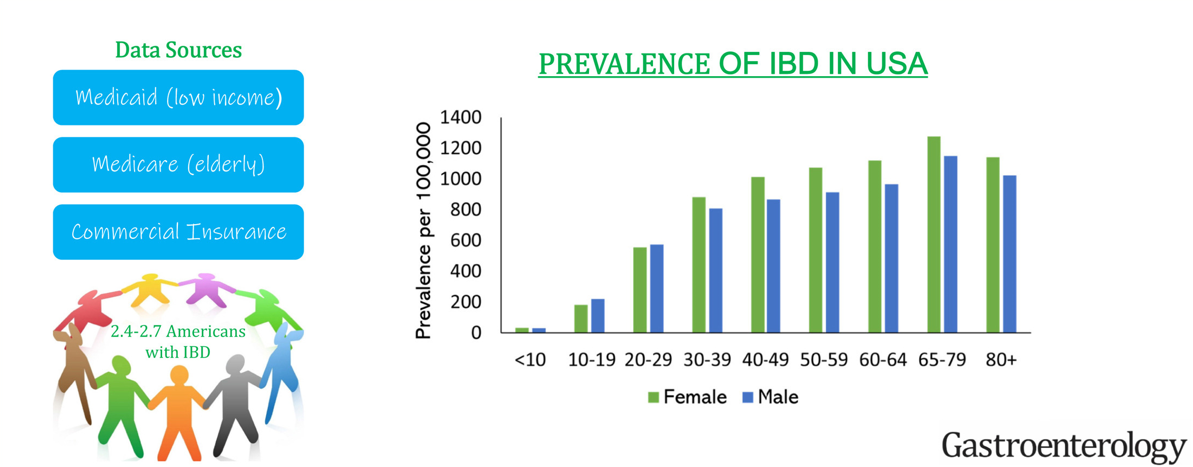
U.S. IBD Prevalence: 7 in 1000

JD Lewis et al. Gastroenterology 2023 Nov;165(5):1197-1205.e2. doi: 10.1053/j.gastro.2023.07.003. Incidence, Prevalence, and Racial and Ethnic Distribution of Inflammatory Bowel Disease in the United States

This “INPUT” (INcidence, Prevalence, Treatment and OUTome in Patients with IBD) study used 4 different data sets to provide “the clearest depiction to date of IBD [epidemiology] in the U.S.

Key findings:

  • The age-, sex- and insurance-standardized prevalence of IBD was 721 per 100,000 population. This equates to estimated 2.39 million Americans with IBD.
  • Sub-category prevalence: the prevalence of IBD per 100,000 population was 812 in White, 504 in Black, 403 in Asian, and 458 in Hispanic Americans.

My take: The prevalence of IBD continues to increase and the U.S. has one of the highest rates in the world.

Related blog posts:

Granulomatous Lung Disease: Case for GI Doctors

JB McCannon et al. NEJM 2023; 389: 1902-1911. Case 35-2023: A 38-Year-Old Woman with Waxing and Waning Pulmonary Nodules

In this case report, A 38-year-old woman was evaluated because of dyspnea, chest discomfort, and waxing and waning pulmonary nodules. She had a prior history of ulcerative colitis. This article reviews reasons for pulmonary nodules including cancer, infection, vasculitis, connective tissue disorders, sarcoidosis and inflammatory bowel disease (IBD) which has a number of pulmonary manifestations including necrobiotic nodules.

In this case, the granulomatous lung disease was attributed to be an extraintestinal manifestation of IBD. She was treated with TNF-alpha targeted therapy which has been effective in a prior case report (J Crohns Colitis 202; 14: 480-489).

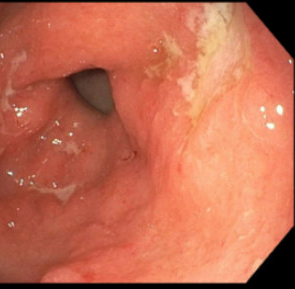
My first reaction to this article — I have seen this! However, our case was atypical in that the 15 year old patient presented with respiratory symptoms (no preceding GI diagnosis). It was noted that her gastric wall was severely thickened as an incidental finding on her chest CT which showed extensive tiny pulmonary nodules. Her endoscopy showed disease isolated to her stomach. Both her gastric findings and CT of her chest resolved with infliximab treatment. This included mucosal healing of her stomach on followup endoscopy.

CT scan showing severely thickened gastric wall
Mucosal appearance of stomach with erythema and numerous ulcerations prior to treatment

Related blog post: IBD Update January 2015 (Part 1) NEJM 2014; 371: 2418-27 -case report of 9 yo with  Crohn’s Disease and pulmonary nodules

Genetic Test to Help Determine Need for Combination Therapy with Anti-TNF

V Solitano et al. Clin Gastroenterol Hepatol 2023; 21: 3019-3029. HLA-DQA1∗05 Genotype and Immunogenicity to Tumor Necrosis Factor-α Antagonists: A Systematic Review and Meta-analysis

Key findings:

  • On meta-analysis of 13 studies (3756 patients; median follow-up, 12 months; 41% with variants), HLA-DQA1∗05 variants were associated with 75% higher risk of immunogenicity compared with non-carriers (relative risk, 1.75) with considerable heterogeneity (I2 = 62%) (low certainty evidence).
  • In addition, patients with HLA-QQA1*05 variants had clinical loss of response (LOR) in 67% compared to 30% in those without this variant (wild-type); thus, a 124% higher risk of LOR.
  • Positive and negative predictive values of HLA-DQA1∗05 variants for predicting immunogenicity were 30% and 80%, respectively
  • Proactive therapeutic drug monitoring, but not concomitant use of IMMs, IMIDs, and TNF-α antagonist-type, modified this association.

My take:

  • The ~40% of individuals with HLA-DQA1*05 variants are at higher risk of LOR and are more likely to benefit from both therapeutic drug monitoring and probably from use of combination (with immunomodulator) therapy.
  • The positive predictive value (30%) is low indicating that the majority of patients with these variants will not develop anti-drug antibodies within 12 months.
  • In those with negative testing for HLA-DQA1*05 (~60%), the higher negative predictive value indicates a patient is more likely to do well with monotherapy.
  • HLA-DQA1*05 testing is available commercially (usually part of Celiac HLA typing).

Related blog posts:

This is the Initiation Well at Quinta da Regaleira in Sintra, Portugal.
It is pretty cool because it seems to start at ground level and then goes down many floors.
There is an exit to a number of tunnels at the lower level.

What’s Changing in IBD Care: Hospitalization Rates and Authorizations

The Good News:

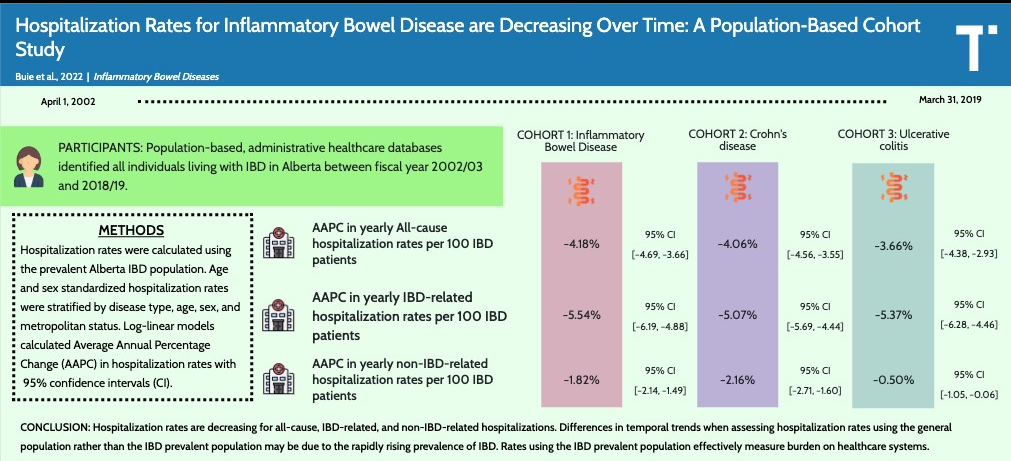
MJ Buie et al. Inflamm Bowel Dis 2023; 29: 1536-1545. Open Access! Hospitalization Rates for Inflammatory Bowel Disease Are Decreasing Over Time: A Population-based Cohort Study

This population-based administrative data cohort study provides annual IBD hospitalization rates in Alberta, Canada.

Key findings:

  • From 2002-2003 to 2018-2019, all-cause hospitalization rates decreased from 36.57 to 16.72 per 100 IBD patients (Average Annual Percentage Change (AAPC), −4.18%)
  • Inflammatory bowel disease–related hospitalization rate decreased from 26.44 to 9.24 per 100 IBD patients (AAPC, −5.54%)
  • The absolute number of hospitalizations, however, likely did not improve because this is affected by the increase in IBD prevalence. In Alberta, there was a 3-fold increase from 2002 to 2018 (general population increased 1.4 fold during this period)

“The last 2 decades have seen the introduction of several advanced therapies with novel mechanisms of action.22 The introduction of these therapies has been accompanied by changes in management strategies that include earlier introduction of advanced therapies based on risk stratification, treat-to-target, and monitoring strategies.5,23–26 These advancements include risk stratification, allowing for earlier introduction of advanced therapies; proactive clinical management algorithms to monitor disease activity; and therapeutic drug monitoring allowing for continued concentration-based dosing.23–26The net effect of these medical advances shifted IBD management from the hospital to the outpatient setting.27

The Bad News:

DK Choi et al. Inflamm Bowel Dis 2023; 29: 1658-1661. Delays in Therapy Associated With Current Prior Authorization Process for the Treatment of Inflammatory Bowel Disease

This retrospective study of 1693 prior authorizations (PAs) from 2020-2021. Key findings:

  • 1397 PA initially approved, 209 first-level PAs approved, 23 second-level PAs approve, and 11 external review requests approved. In total 97% (1640 of 1697) were approved
  • Dose escalations had the lowest approval rate of 67.6%
  • FDA approval had favorable OR for PA approval of 4.45
  • The median time to biologic initiation was 21 days, with appeals causing further delays to initiation

Median Days to Determination by Insurance Level:

  • Prior authorization: 11 days
  • First level appeal: 29 days
  • Second level appeal: 51 days
  • External review request: 73 days

My take: The PA process usually results in few denials (if pursued) but does result in significant delays in therapy. At the same time, these newer therapies have been associated with improvement in hospitalizations rates.

Related blog posts:

COMBO-IBD Study -Combination Immunomodulator Use and Thresholds

AJ Yarur et al. Clin Gastroenterol Hepatol 2023; 21: 2908-2917. Open Access! Combination Therapy With Immunomodulators Improves the Pharmacokinetics of Infliximab But Not Vedolizumab or Ustekinumab

In this prospective cohort with 369 patients, treatment included the following 113 infliximab, 133 vedolizumab, and 123 ustekinumab. All patients received standard dosing (eg. 5 mg/kg/dose every 8 weeks with infliximab). Per Table 1, dose of thiopurine was 100 mg (range 50-150, “using a 2:1 ratio of azathioprrine and mercaptopurine”); most patients received methotrexate at a dose of 12.5 mg. Key findings:

  • Infliximab levels were much improved in patients receiving combination therapy with either a thiopurine or methotrexate. In those patients receiving a thiopurine, a threshold of 6-TGN ≥146 was considered optimal.
  • Patients receiving combination therapy with methotrexate or a thiopurine and a 6-TGN concentration ≥146 pmol per 8 × 108 RBCs, and those with baseline infliximab level ≥12.3 μg/mL had a lower rate of secondary nonresponse when compared with those on monotherapy, thiopurine with 6-TGN <146 pmol per 8 × 108 RBCs, and baseline infliximab level <12.3 μg/mL (88.2 vs 11.8% [P = .04], 71.2 vs 45.5% [P = .04])
  • Ustekinumab and vedolizumab levels were NOT increased in patients receiving an immunomodulator

My take: This study reinforces the idea that there are pharmacokinetic benefits of combination therapy with infliximab (and extrapolated to other anti-TNF agents); there is a lack of benefit for most patients receiving ustekinumab and vedolizumab. Even with ustekinumab and vedolizumab, it is possible that patients with more severe disease may still benefit independent of pharmacokinetic effects on biologic agent.

Higher doses of infliximab monotherapy with therapeutic drug monitoring may achieve similar results as combination therapy. However, patients switching from one anti-TNF to another due to immunogenicity/antidrug antibodies are particularly likely to benefit from combination therapy. In addition, a recent ImproveCareNow study showed better outcomes for pediatric patients who received methotrexate with adalimumab (see below).

Related blog posts:

Disclaimer: This blog, gutsandgrowth, assumes no responsibility for any use or operation of any method, product, instruction, concept or idea contained in the material herein or for any injury or damage to persons or property (whether products liability, negligence or otherwise) resulting from such use or operation. These blog posts are for educational purposes only. Specific dosing of medications (along with potential adverse effects) should be confirmed by prescribing physician.  Because of rapid advances in the medical sciences, the gutsandgrowth blog cautions that independent verification should be made of diagnosis and drug dosages. The reader is solely responsible for the conduct of any suggested test or procedure.  This content is not a substitute for medical advice, diagnosis or treatment provided by a qualified healthcare provider. Always seek the advice of your physician or other qualified health provider with any questions you may have regarding a condition.

How Much Ustekinumab (Stelara) Is Needed to Get a Good Response

K Chen et al. Inflamm Bowel Dis 2023; 29: 1499-1503. Serum Ustekinumab Concentrations Are Associated With Improved Outcomes With the Magnetic Resonance Index of Activity for Crohn’s Disease

This retrospective trial included thirty three patients with Crohn’s disease (CD) receiving maintenance ustekinumab (UST). The simplified Magnetic Resonance Index of Activity (sMARIA) and biomarkers were correlated with UST levels. The authors utilized a homologous mobility shift assay (HMSA) (Prometheus) for their UST levels.

Key findings:

With UST level greater or equal to 8.4, radiologic remission was seen in 63% compared to 21% in those with levels <8.4. Similarly, the absence of severe inflammation was seen in 78.9% of those with higher levels compared with only 36.8% in those with levels below 8.4.
Both findings were clinically-significant P=.01
With UST levels greater or equal to 6.1, FCP less than 50 was seen in 72.2% compared to only 12.5% in those with a level less than 6.1. P<.01

My take: This study show the need for higher levels of UST to achieve optimal outcomes. Levels of at least 8.4 appear to be a good target.

Related blog posts:

Disclaimer: This blog, gutsandgrowth, assumes no responsibility for any use or operation of any method, product, instruction, concept or idea contained in the material herein or for any injury or damage to persons or property (whether products liability, negligence or otherwise) resulting from such use or operation. These blog posts are for educational purposes only. Specific dosing of medications (along with potential adverse effects) should be confirmed by prescribing physician.  Because of rapid advances in the medical sciences, the gutsandgrowth blog cautions that independent verification should be made of diagnosis and drug dosages. The reader is solely responsible for the conduct of any suggested test or procedure.  This content is not a substitute for medical advice, diagnosis or treatment provided by a qualified healthcare provider. Always seek the advice of your physician or other qualified health provider with any questions you may have regarding a condition.
When Patients Have an IBD Flare, It Might Be Something Else -Case in Point

R Paknikar et al. NEJM 2023; 389: 1321-1326. Digging into the Histology

In this case report, a 33-year-old man (from the midwest) with ulcerative colitis (diagnosis seven years prior) who was receiving treatment with tofacitinib (a Janus kinase inhibitor) presented to the hospital with fatigue (x 8 months) and bloody diarrhea. He also had had fevers (x 4 months), 23 lb weight loss, and drenching night sweats. Before tofacitinib, treatment had included adalimumab and azathioprine. He had undergone a sigmoidoscopy two months prior to presentation.

His workup included a CXR showing diffuse reticulonodular opacities, a CT scan showing thickening in the colon and extensive infection workup. On the third hospital day, he had a perforation and resection which led to the diagnosis of invasive histoplasmosis.

My take: This article is useful for understanding how to workup secondary infections in IBD patients on long-term immunosuppressive agents.

One example: “testing for 1,3-β-d-glucan can serve as an adjunctive test for invasive fungal infections caused by fungi expressing 1,3-β-d-glucan in their cell walls, including candida, aspergillus, Pneumocystis jiroveciiHistoplasma capsulatum, and coccidioides; such testing has a high negative predictive value for infection with these organisms. In contrast, cryptococcus and blastomyces produce very low levels of 1,3-β-d-glucan in their cell walls and are therefore not readily detected by serum testing for the cell-wall antigen.”

CT showed  shows diffuse wall thickening in the rectosigmoid colon and extravasation of extraluminal contrast material (arrow) into the area adjacent to the sigmoid colon, with layering of the contrast material, findings that are thought to indicate a perforation.

Related blog posts: