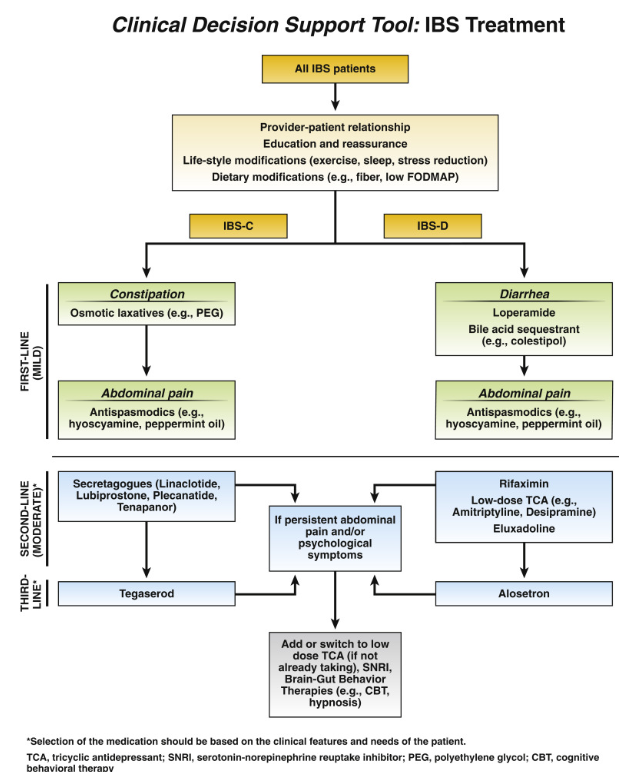
AGA Guidelines for Pharmacologic Therapy of IBS-D and IBS-C

A Lembo, S Sultan et al. Gastroenterol 2022; 162: 137-151. Open access PDF: AGA Clinical Practice Guideline on the Pharmacological Management of Irritable Bowel Syndrome With Diarrhea

LChang, S Sultan et al. Gastroenterol 2022; 162: 118-136. Open access: AGA Clinical Practice Guideline on the Pharmacological Management of Irritable Bowel Syndrome With Constipation

The associated 1-page summary (“Spotlight: IBS Treatment“) on pg 153 reviews society guidelines on testing in IBS. This includes for IBS-D celiac serology, calprotectin/lactoferrin, CRP, possilby Giardia antigen (if in endemic area) and possibly bile acid diarrhea testing. Not recommended include food allergy/sensitivity testing, colonoscopy if <45 years and lactulose or glucose hydrogen breath testing. This 1-page summary details therapeutic dosing and costs. Monthly costs of selected medications according to this report:

  • Lubiprostone (Amitiza): $374
  • Linaclotide (Linzess): $523
  • Pleacnatide (Trulance): $528
  • Tegaserod (Zelnorm): $480
  • Tenapanor (IBSRELA): $1680
  • Rifaximin (Xifaxan) $1544 (for 14 day course)
  • Eluxadoline (Viberzi): $1550
  • Alosetron (Lotronex): $1457-1929 (starting dose), $2915-3859 (max dose)

My take: These guideline publications provide comprehensive information regarding potential pharmacological therapies.

Related blog posts:

Implications of Serene Studies

In a previous post, this blog highlighted SERENE-CD which showed that higher induction doses of adalimumab did not improve outcomes compared to standard dosing (SERENE Study: Does a Higher Induction Dose of Adalimumab Help for Crohn’s Disease?)

However, there was a 2nd SERENE study: SERENE-UC: J Panes et al. Gastroenterol 2022; 162: 1891-1910. Open Access: Higher vs Standard Adalimumab Induction and Maintenance Dosing Regimens for Treatment of Ulcerative Colitis: SERENE UC Trial Results The online version includes supplementary material (link: supplement) which is needed to understand the response rate more fully.

The main component of this double-blind, randomized (no placebo) study allocated 512 patients with ulcerative colitis to a higher induction regimen (HIR) of adalimumab and 340 patients to a standard induction regimen (SIR). A maintenance phase continued with 374 main patients who were clinical responders at week 8 (n=757 who completed induction). The study results are presented in a confusing manner, in part because of a subgroup from Japan as well as a great deal of data from both the induction phase and the maintenance phase.

Key findings:

  • In the main study, 13.3% vs 10.9% of patients receiving the higher induction regimen (HIR) vs standard induction regimen (SIR) achieved clinical remission (full Mayo score ≤2 with no subscore >1) at week 8 (induction primary end point; P = .265)
  • Among week-8 responders, 39.5% vs 29.0% receiving 40 mg ew vs 40 mg eow achieved clinical remission at week 52 (maintenance primary end point; P = .069).
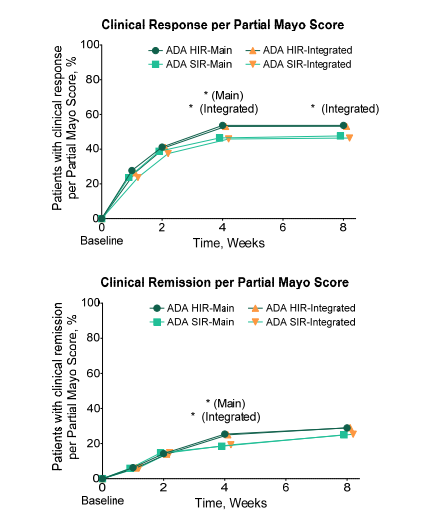
  • Figure S2 below shows that approximately 50% of patients treated with adalimumab had a clinical response at week 8

My takes on this study:

  1. Fairly low response to adalimumab: the clinical remission rate for adalimumab is low at week 8 (10-13%) and the 8-week response rate is less than 50%
  2. Higher doses during induction were not helpful & did not result in significantly better responses at week 8
  3. Therapeutic drug monitoring was not beneficial in this study
  4. Higher doses during maintenance were associated with improved responses: patients receiving weekly adalimumab during maintenance treatment had improved week 52 remission. The editorial (pages 1831-1832) note that this effect was demonstrated in those with “elevated C-reactive protein, low albumin, extensive UC or long disease burden”
Figure S2: Clinical response was defined as Partial Mayo Score decrease from baseline ≥ 2 and ≥ 30% plus ≥ 1-point
decrease from baseline in rectal bleeding subscore or absolute rectal bleeding subscore of 0 or 1.
Clinical remission was defined as Partial Mayo Score ≤ 2 with no subscore > 1.
ADA, adalimumab; HIR, higher induction regimen; SD, standard deviation; SIR, standard induction regimen

Related blog posts:

Disclaimer: This blog, gutsandgrowth, assumes no responsibility for any use or operation of any method, product, instruction, concept or idea contained in the material herein or for any injury or damage to persons or property (whether products liability, negligence or otherwise) resulting from such use or operation. These blog posts are for educational purposes only. Specific dosing of medications (along with potential adverse effects) should be confirmed by prescribing physician.  Because of rapid advances in the medical sciences, the gutsandgrowth blog cautions that independent verification should be made of diagnosis and drug dosages. The reader is solely responsible for the conduct of any suggested test or procedure.  This content is not a substitute for medical advice, diagnosis or treatment provided by a qualified healthcare provider. Always seek the advice of your physician or other qualified health provider with any questions you may have regarding a condition.

Ustekinumab Efficacy in Crohn’s Disease With Concurrent Autoimmune Skin Disease

E Fradkov et al. Inflamm Bowel Dis 2022; 28: 895-904. Efficacy of Ustekinumab in Crohn’s Disease With and Without Concurrent Autoimmune Skin Disease

This retrospective study reviewed 395 CD patients received ustekinumab therapy (79 CD-ASD (autoimmune skin disease), 316 CD-none). ASD included atopic dermatitis, eczema, psoriasis/psoriaform dermatitis and alopecia. The skin disease group also included those with cutaneous manifestations of Crohn’s disease: erythema nodosum, pyoderma gangrenosum, pyostomatitis vegetans, Sweet’s syndrome, granulomatous vasculitis, and leukocytoclastic vasculitis. 55 of the 79 with CD-ASD had psoriatic disease, 20 had eczema, 11 had erythema nodosum, 8 had pyoderma gangrenosum.

Key findings:

  • Ustekinumab had greater efficacy in CD-ASD when evaluated by fecal calprotectin (P = .0337) and CRP (P = .078). For calprotectin, the values decreased by 61% after at least 5 months of therapy (394 to 164) in the CD-ASD group compared to 11% in the group without skin disease (365 to 265)
  • The CD-ASD group also showed better outcomes in Likert scores of endoscopy (P = .016), histopathology (P = .074), and imaging (P = .094). 

My take: Ustekinumab appears to be particularly effective in patients with concurrent skin disease.

Related posts:

Chattahoochee River near Morgan Falls

Safety of Preoperative Tumor Necrosis Factor  Inhibitor Exposure in Patients With Inflammatory Bowel Disease Undergoing Intra-abdominal Surgery

BL Cohen et al. Gastroenterol; 2022; 163: 204-221. Prospective Cohort Study to Investigate the Safety of Preoperative Tumor Necrosis Factor Inhibitor Exposure in Patients With Inflammatory Bowel Disease Undergoing Intra-abdominal Surgery

Key finding:

  • Preoperative TNFi exposure was not associated with postoperative infectious complications in a large prospective multicenter cohort. Any infection (18.1% vs 20.2%, P = .469) and SSI (12.0% vs 12.6%, P = .889) rates were similar in patients currently exposed to TNFis and those unexposed.

Updated Microscopic Colitis Epidemiology (2011-2019)

J Tome et al. Clin Gastroenterol Hepatol 2022; 20: 1085-1094. Open Access: The Epidemiology of Microscopic Colitis in Olmsted County, Minnesota: Population-Based Study From 2011 to 2019

Key points:

  • “The overall incidence of MC in Olmsted County, MN, increased from 1985 to 2001, stabilized between 2002 and 2010, and continues to show a plateau between 2011 and 2019.”
  • Medications associated with a risk of microscopic colitis (MC) include statins, SSRIs, PPIs, aspirin, other NSAIDs, and histamine H2-receptor antagonists within 3 months of diagnosis. “A recent US multicenter cohort study found an inverse association with PPIs and histamine H2-receptor antagonists when compared with controls with chronic diarrhea; only NSAID use was associated with MC. 31 It is plausible these medications do not cause MC, but instead aggravate diarrhea and bring the diagnosis to clinical attention.”

Related blog post/related article:

Increased Risk, Increased Reward (possibly) with Tofacitinib

T Straatmijer et al. Clin Gastroenterol Hepatol 2022; Full text Pre-Proof PDF: Superior effectiveness of tofacitinib compared to vedolizumab in anti-TNF experienced ulcerative colitis patients: a nationwide Dutch Registry study. DOI:https://doi.org/10.1016/j.cgh.2022.04.038

Methods: Ulcerative colitis patients who failed anti-TNF treatment and initiated vedolizumab (n=83) or tofacitinib (n=65) treatment, were identified in the ICC Registry in the Netherlands.

Key findings:

  • Tofacitinib treated patients were more likely to achieve corticosteroid-free clinical remission and biochemical remission at week 12, 24 and 52 compared to vedolizumab treated patients (OR: 6.33, OR: 3.02, and OR 1.86 and OR: 3.27, OR: 1.87, and OR:1.81, respectively).
  • There was no difference in infection rate or severe adverse events.

My take: The response rates with tofacitinib were significantly better than vedolizumab at all time points; however, by 52 weeks, the differences were less pronounced. Nevertheless, the safety profile of vedolizumab is much more favorable than tofacitinib and this is a very important consideration.

Related blog posts -Tofacitinib:

GI Bleeding -Forrest Classification

My take: Good images on twitter for classification of ulcers/bleeding risk

Related blog posts:

Risankizumab Receives FDA Approval for Crohn’s Disease

Abbvie Press Release: SKYRIZI® (risankizumab-rzaa) Receives FDA Approval as the First and Only Specific Interleukin-23 (IL-23) to Treat Moderately to Severely Active Crohn’s Disease in Adults

– Third approved indication for SKYRIZI (risankizumab-rzaa) is supported by safety and efficacy data from two induction and one maintenance clinical trials evaluating SKYRIZI in moderately to severely active Crohn’s disease, ADVANCE, MOTIVATE and FORTIFY1-4

– As early as week 4 in the induction studies, clinical response and clinical remission were achieved by significantly more subjects treated with SKYRIZI versus placebo, as were co-primary endpoints of endoscopic response and clinical remission at week 12 and week 521-4

About SKYRIZI® (risankizumab-rzaa)
SKYRIZI is an interleukin-23 (IL-23) inhibitor that selectively blocks IL-23 by binding to its p19 subunit.9,10 IL-23, a cytokine involved in inflammatory processes, is thought to be linked to a number of chronic immune-mediated diseases, including Crohn’s disease.10 The approved dose to treat adults with moderately to severely active Crohn’s disease is 600 mg administered by intravenous infusion over at least one hour at week 0, week 4, and week 8, followed by 360 mg administered by subcutaneous injection at week 12, and every 8 weeks thereafter.4 SKYRIZI is also approved in the U.S. to treat moderate to severe plaque psoriasis in adults who are candidates for systemic therapy or phototherapy, as well as to treat active psoriatic arthritis in adults, and the recommended dosage is 150 mg administered by subcutaneous injection at week 0, week 4, and every 12 weeks thereafter.4 Phase 3 trials of SKYRIZI in psoriasis, Crohn’s disease, ulcerative colitis and psoriatic arthritis are ongoing

Related blog posts:

The Curtain or The Box: Therapeutic Dilemmas

X Roblin et al. Inflamm Bowel Dis 2022; 28: 720-727. Swapping Versus Dose Optimization in Patients Losing Response to Adalimumab With Adequate Drug Levels

Many times, treatment decisions are like on “Let’s Make a Deal.” That is, should I stick with what I’ve got or should I try for something better & sometimes wind up with a goat. In this referenced article, patients were under maintenance therapy with adalimumab (ADA) monotherapy (40 mg every 14 days) and had experienced a secondary loss of response (LOR) despite trough levels > 4.9 μg/mL. In this nonrandomized prospective study, patients were either swapped to vedolizumab (VDZ) or optimized on adalimumab (ADA) treatment.

Key findings:

  • At 24 months, 11 out of 70 patients (16%) in the swap group discontinued treatment compared with 36 out of 61 (59%) patients in the optimization group (P < 0.001)
  • In the optimization group, treatment discontinuation was positively associated with baseline fecal calprotectin >500 μg/g (HR, 3.5)
  • In patients selected for optimization, 56% (34/61) remained on ADA at 1 year and 41% (25/61) at 2 years

In their discussion, the authors state “current guidelines recommend switching to another class of biologics in case of LOR to ADA with therapeutic drug levels.” However, the authors note that their therapeutic level cut-off of >4.9 mcg/mL is lower than the latest recommendations. In addition, in their conclusion, they note that due to limited biologic options, “ADA optimization strategy might be considered” in a subgroup.

My take: Despite better results in the patients that swapped to VDZ in this study, I think it is important to assure adequate drug levels before choosing a new drug class. For ADA, expert recommendations have suggested a level of 8-12 as therapeutic and to avoid discontinuation if ADA level is less than 10. In this study, more than 40% remained on ADA two years after LOR in those with dosing optimization.

Related blog post:

Disclaimer: This blog, gutsandgrowth, assumes no responsibility for any use or operation of any method, product, instruction, concept or idea contained in the material herein or for any injury or damage to persons or property (whether products liability, negligence or otherwise) resulting from such use or operation. These blog posts are for educational purposes only. Specific dosing of medications (along with potential adverse effects) should be confirmed by prescribing physician.  Because of rapid advances in the medical sciences, the gutsandgrowth blog cautions that independent verification should be made of diagnosis and drug dosages. The reader is solely responsible for the conduct of any suggested test or procedure.  This content is not a substitute for medical advice, diagnosis or treatment provided by a qualified healthcare provider. Always seek the advice of your physician or other qualified health provider with any questions you may have regarding a condition.

Panoramic View -Sandia Mountain, NM

IBD -Briefly Noted: Intestinal U/S and Anxiety/Depression Not Worsening Pediatric IBD Activity

EA van Wassenaer et al. Inflamm Bowel Dis 2022; 28: 783-787. Open Access PDF: Intestinal Ultrasound in Pediatric Inflammatory Bowel Disease: Promising, but Work in Progress

Key points from this review:

  • Research has shown that IUS has the potential to be a valuable additional point-of-care tool to guide treatment choice and to monitor and predict treatment response, although evidence of its accuracy and value in clinical practice is still limited
  • The utility may be operator-dependent as well

My take: Due to low upfront costs, IUS would be appealing adjunct to current monitoring. However, one could envision IUS leading to more downstream studies (& costs), especially if its sensitivity and specificity are not very high.

EJ Brenner et al. Inflamm Bowel Dis 2022; 28: 728-733. Anxiety and Depressive Symptoms Are Not Associated With Future Pediatric Crohn’s Disease Activity

In this internet-based cohort of 9-17 yr olds (n=159, 96% white), the authors found no association between baseline PROMIS Pediatric anxiety score and subsequent sCDAI (change in sCDAI for 3-point change in PROMIS Pediatric −0.89; 95% CI −4.81 to 3.03). This study is in contrast to studies in adults which have shown a bidirectional relationship between anxiety/depression and IBD activity.

My take: It is difficult to know with certainty whether anxiety/depression may trigger IBD activity; more studies are needed. Treatment of mental health is important regardless of its effects on IBD activity.

Related blog posts: