‘Little’ Knowledge Exists Regarding Medicines for Neonates

Despite federal legislation encouraging the study of products used in the pediatric population, very little of these studies has translated into meaningful information regarding neonates (JAMA Pediatr 2014; 168: 130-36, thanks to Ben Gold for this reference).

This publication reviewed studies submitted to the FDA between 1997-2010.  The authors identified all drugs with pediatric studies that included neonates.  Subsequently, the use of these drugs was examined in a oohort of neonates admitted to 290 neonatal intensive care units (NICU) (Pediatrix Data Warehouse) in the U.S. form 2005-2010.

Key findings:

  • 28 drugs (in 41 studies) were examined in neonates. This led to 24 labeling changes.
  • 11 of 24 neonatal labeling changes included an approval for use in neonates, including 4 for HIV and 3 for anesthesia.
  • 13 of 24 labeling changes were the following: “safety and effectiveness have not been established.”  These drugs included several reflux medications: esomeprazole, lansoprazole, pantoprazole, and ranitidine.
  • In the Pediatrix database involving 446,335 hospitalized neonates, there were 399 different drugs identified that had been administered.  Of the 28 studied drugs, the gastroesophageal reflux medicines were used most frequently.  13 of the 28 studied drugs were not used at all in the NICUs.
  • Of the 11 drugs with a neonatal indication, 7 were never used in the Pediatrix neonatal population and the other 4 drugs were used infrequently.

Conclusions:

  • Neonates are a vulnerable and an understudied population
  • Most of the exposure to drugs was off-label for neonates.
  • Most often, off-label drugs were prescribed “despite studies indicating they were not effective…For example, ranitidine, lansoprazole, and inhaled nitric oxide (for the prevention of bronchpulmonary dysplasia) were the top 3 drugs used in neonates…none have FDA labelling for the indication studied because of lack of efficacy.”
  • Furthermore, drugs like ranitidine and lansoprazole” are associated with serious adverse effects in neonates.” (Clin Perinatol 2012; 39: 99-109)

Related blog entries:
UC SUCCESS

The results of the “UC SUCCESS” trial show that combination therapy with infliximab and azathioprine is more effective than either medication as monotherapy in ulcerative colitis (UC) (Gastroenterol 2014; 146: 392-400). This study findings are similar to the SONIC trial in Crohn’s disease (CD).

Study Design: randomized, double-blind trial with evaluation at 16 weeks with a total of 239 patients.  In patients assigned to infliximab (IFX) alone, they were given daily oral placebo pills. In patients with azathioprine monotherapy (AZA), dosed at 2.5 mg/kg/day, they also received placebo infusions.  Patients had moderate to severe UC as defined by Mayo scores at baseline and had not responded adequately to a course of corticosteroids.  All patients were naive to tumor necrosis factor α antagonists (anti-TNFα).  Mean age was approximately 40 years.

Results:

  • IFX/AZA had a 39.7% corticosteroid-free remission at week 16 compared with 22.1% with IFX monotherapy and 23.8% with AZA monotherapy.
  • Mucosal healing at week 16 was evident in 62.8% of combination group compared with 54.6% IFX monotherapy and 36.8% with AZA monotherapy.
  • Serious adverse events were noted more frequently in the AZA monotherapy group, though this did not reach statistical significance.
  • A subset of patients had antibodies to infliximab (ATIs) measured.  ATI-positivity was more common with IFX monotherapy (19%, 7 of 37) than for IFX/AZA combination (3%, 1 of 31)

While this study indicates that for moderate to severe UC combination therapy with IFX/AZA was superior in this age group, there were several limitations.  Given the slow onset of action of azathioprine, more patients may have responded to this therapy if longer treatment duration was studied.

Take-home message: Combination therapy for UC, like CD, is more effective.  In this small study population, the adverse events were not increased. In the pediatric population, particularly males, the concern for malignancy in patients (especially males) treated with combination therapy may limit the frequency of combination therapy.

Related blog posts:

Other recent IBD articles of interest:

Inflamm Bowel Dis 2014; 20: 291-300. “Malignancy and Mortality in Pediatric Patients with Inflammatory Bowel Disease”  This article presented the results of a survey of 20 European countries and Israel.  Key finding: 18 cases of cancer and 31 deaths in 44 children. 5 of the deaths were due to cancer; the most common cause of mortality was infectious (n=14).  In this cohort, all HSTCL or EBV-positive lymphomas were treated with thiopurine monotherapy.

Inflamm Bowel Dis 2014; 20: 196-212.  “Opportunistic Infections Due to Inflammatory Bowel Disease Therapy”  This review article covers a broad range of pathogens and includes recommendations for prophylaxis and treatment (Table 3).  In addition the authors  provide suggestions for checking for several infections prior to treatment and vaccinations.

Sometimes more is not better

‘More is not better’ may be the case with trimethoprim/sulfamethoxazole (TMP/SMX) Pneumocystis prophylaxis (PCP) (J Pediatr 2014; 164: 389-92).  This study indicates that a single-day course of TMP/SMX prophylaxis is as effective as other regimens.

Design: Prospective survey of 20 centers with newly diagnosed cancer between 2009-2011.  This included 1093 with solid tumors and 1373 with leukemia/lymphoma.  55.6% received 3-day/week prophylaxis, 16.5% received 2-day/week regimen, and 27.9% received 1-day/week regimen (5-10 mg/kg/day into 2 doses).

Key result:

  • Incidence of PCP at 3 years was 0.09% overall.  The two cases occurred in the 2-day regimen (though both had withdrawn from treatment)

The authors note the need for PCP prophylaxis has been questioned for solid tumor patients.  However, the lack of PCP among the 439  children with leukemia/lymphoma indicates that a single day per week regimen is effective.

Bottomline: In GI/liver patients who need TMP/SMX prophylaxis, 1-day per week regimen is likely effective (as it is in leukemia/lymphoma patients).  One-day/week is easier and should help with compliance, which is the key to preventing PCP.

Why an ERCP Study Matters to Pediatric Care

While there are pediatric patients who undergo endoscopic retrograde cholangiopancreatography (ERCP), this is a relatively infrequent occurrence. Nevertheless, a recent study has a couple useful clinical pearls that may have broader application.

  1. Clin Gastroenterol Hepatol 2014; 12: 303-07.
  2. Clin Gastroenterol Hepatol 2014; 12: 308-10 Associated editorial
  3. Gastroenterol 2014; 146: 581-82. Associated summary

Key points/Implications:

  • Aggressive hydration may prevent post-ERCP pancreatitis. In the study, the treatment group received an average of 3290 mL over the 9-hour period compared with 945 mL in the standard infusion group.
  • Implication: The speculation from the study and the editorials is that improved pancreatic perfusion will result in better oxygenation and reduce the likelihood of  pancreatitis. In the 2nd reference, the author states that his practice is to administer “at least 3 L of crystalloid in recovery to young, healthy patients who have undergone high-risk ERCP and an additional 3 to 5 L within the first 12 hospital hours to those admitted with postprocedure pain”
  • The best fluid (for post-ERCP and acute pancreatitis) may be lactated Ringer’s (LR).
  • Implication: The lactate in LR may help reduce pancreatitis by avoiding acidosis which could promote zymogen activation and pancreatic inflammation. A previous small trial (n=40) of acute pancreatitits from any cause showed lesser degrees of systemic inflammatory response with LR in compared with normal saline (Clin Gastroenterol Hepatol 2011; 9: 710-17e1).
  • This study adds aggressive IVFs as another intervention to prevent ERCP.  Rectal indomethacin and prophylactic stent placement (in high-risk patients) are other accepted treatments.

Study details:

This pilot study randomly assigned 39 patients to aggressive hydration and 23 to standard hydration; all patients were inpatients who were not at risk for fluid overload. The aggressive group received 3 mL/kg/h during the procedure, a 20 mL/kg bolus after the procedure, and then continued on 3 mL/kg/hr for 8 hours.  In contrast, the standard group received LR at 1.5 mL/kg/h during and for 8 hours afterwards.

Demographics: The average age was 43 years in the aggressive hydration group and 45 years in the standard group. 78% were hispanic.  The ERCP procedures were mostly “average risk.”  74% had ERCP for choledocholithiasis.  Only 2 subjects needed precut sphinterotomy (3%).

Results:

  • No patients in the aggressive hydration group developed acute pancreatitis compared with 4 (17%) in the standard hydration group
  • Elevated amylase (23% vs. 39%) and epigastric pain (8% vs 22%) were also less frequent in the aggressive hydration group.

Numerous Limitations: This was a small pilot study with an atypical population; thus, the findings are difficult to generalize.  A false-positive (type 1 error) can easily occur due to the small numbers, especially as the standard hydration group had a rate of acute pancreatitis that was about double from previous studies. In addition, this study was not blinded and could have been susceptible to bias.  Furthermore, the authors defined acute pancreatitis differently than in previous studies.  In this study, the authors required enzyme increases 2 or 8 hours after ERCP with new abdominal pain; in previous studies, the definition of acute pancreatitis relied on enzyme increases for at least 24 hours after the ERCP.

Take-home message for those not doing ERCPs: Think about using lactated ringer’s and aggressive hydration in otherwise-well patients who present with acute pancreatitis.

Related blog entries:

Eosinophilic Esophagitis and Psychosocial Dysfunction

There are many medical challenges in treating patients with eosinophilic esophagitis (EoE) and this has been discussed extensively in this blog (some links below).  What is striking in managing these patients and families is how often there are significant psychosocial problems.  Does this disorder serve as an excuse for other issues? Does the altered diet create enormous stress and isolation? Is the diagnosis of EoE an epiphenomenon for many of these patients?

While these questions are not answered, a recent retrospective study from a tertiary care center does provide some data on the frequency of psychosocial dysfunction in children and adolescents with EoE (JPGN 2013; 57: 500-05).

Psychosocial evaluation was offered as part of these patients’ clinical evaluation; this took place in 64 of 152 patients during the study timeframe.  Subsequently, a retrospective review of these patients, who had been offered a 1-hour behavioral health assessment by either a psychologist or social worker, were analyzed.

Key findings:

  • 69% had some psychosocial impairment
  • 64% had social difficulties
  • 41% had anxiety
  • 33% had sleep difficulties
  • 28% had depression
  • 26% had school problems
  • 44% had adjustment problems; this was more common in older children and in children with gastrostomy tubes

The main limitations of this study are its retrospective nature and the fact that only a minority of patients were analyzed; the latter indicates a high likelihood of a selection bias. The severity of EoE was not correlated with these problems, but could have been higher  at a tertiary center.

Take-home message: As with other chronic diseases, EoE patients have frequent psychosocial health problems –this study starts to define the extent of the problem.

The Genius of Breastmilk

While there has been a lot of talk about how breastmilk improves IQ/development (see links below), there are many other reasons why breastmilk is amazing.  For example, breastmilk reduces the risk of necrotizing enterocolitis (NEC).  A recent study on this effect: J Pediatr 2013; 163: 1592-5.

In this multicenter randomized controlled trial involving 7 NICUs, the authors studied extremely premature infants whose mothers did not provide their breastmilk.  Infants were fed either a cows-milk based preterm formula (COW, n=24) or pasteurized donor human milk (HUM, n=29). Birth weight and gestational age were similar in both groups, approximately 990 g and 27.5 weeks respectively.

Results:

  • HUM patients had fewer days of parenteral nutrition: 27 vs. 36, P=.04
  • HUM patients had fewer bouts of NEC: 1 (3%) vs. 5 (21%), P=.08; surgical NEC occurred 4 times in COW group compared with 0 in HUM patients (P=.04)

Take-home message: The data from this study are in line with recent American Academy of Pediatrics policy statement that recommends the following: “premature infants should receive only human milk from their mother and that, if it is not available, pasteurized donor human milk should be used.”

Another relevant study: J Pediatr 2010; 156: 562-7.

Related blog posts:

Polyps: Clinical Decision Tool

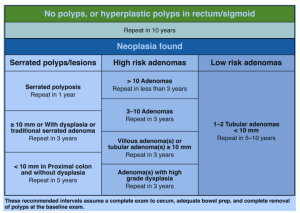
The best approach to polyps from the U.S. Multi-Society Task Force: Gastroenterology 2014; 146: 305-306.  This paper’s simple chart on page 306 could help reduce many follow-up colonoscopies that are performed at shorter than recommended intervals.

Polyp Guideline

Related blog post:  Consensus guidelines after polypectomy | gutsandgrowth)

Clostridium difficile: Colonization vs. Symptomatic Infection

A recent study provides another way to distinguish individuals colonized with Clostridium difficile from those with symptomatic infection (J Pediatr 2013; 163: 1697-704).

Methods: This study comprised two designs. “The first is a case-control study comparing children with a positive C difficile test (cases), children with diarrhea but no C difficile (symptomatic controls), and asymptomatic controls, some of whom were colonized with C difficile.  The second is a prospective-cohort study where we followed our cases for the duration of their illness.”

Results: Fecal cytokines (CXCL-5 and IL-8 mRNA) were elevated in samples from symptomatic children, whether cases or controls.

Bottomline: Inflammatory cytokines can help distinguish C difficile colonization from disease.  Of course, this may have limited utility in patients with underlying inflammatory bowel disease.

Recent posts regarding C difficile:

Teaching an Old Drug New Tricks

A couple recent articles focused on the new uses of methotrexate (MTX) and how to handle potential hepatotoxicity:

  1. J Pediatr 2014; 164: 231-36
  2. Inflamm Bowel Dis 2014; 20: 47-59

In the first medical review article, the authors note the efficacy of MTX for the following:

  • Juvenile idiopathic arthritis
  • Uveitis
  • Psoriasis
  • Crohn disease
  • Juvenile dermatomyositis
  • Localized scleroderma
  • Vasculitis

This review article discusses mechanism of action which is poorly understood along with pharmacogenomics and practical issues in usage.  The latter includes the need for supplemental folic acid.  Other points:

  • “The long-term safety of MTX is remarkable”
  • “The issue of nausea and vomiting…can be especially disturbing.”  They note that one study demonstrated that ondansetron 1 hour prior to MTX from the first injection prevented nausea, which was often difficult to treat once developed.
  • “Liver enzyme abnormalities occur frequently (up to 30% of patients) but are usually of minimal clinical significance.”  Best to draw blood tests 1-2 days before MTX dosing.
  • “In children, unlike adults, MTX-related pulmonary adverse events are very rare.”
  • “In recent years it was shown that live vaccine boosters are effective and safe during MTX use (caution may be needed if MTX is used with other immunosuppression medications)” Ref: JAMA 2013; 309: 2449–56.
  • “Use during pregnancy or within 3 months of planning pregnancy is contraindicated”

The second article was a systemic review which identified 12 high-quality studies which focused on MTX hepatotoxicity in children.  Key findings:

  • 57 of 457 developed some degree of abnormal liver biochemistries.
  • Due to hepatotoxicity, dose reductions were undertaken in 6.4% and 4.5% discontinued MTX.

The authors note that studies of MTX in adults with IBD have not demonstrated cumulative liver toxicity from MTX.  In addition, many of the patients with hepatotoxicity may have had  other reasons for abnormal liver biochemistries including other medications (eg. glucocorticoids).  “Confirmation of MTX hepatotoxicity with a liver biopsy is seldom performed in children;” as a consequence, the exact rate of MTX hepatotoxicity is unknown.

The authors propose that liver biochemistry monitoring occur at baseline, biweekly x 2, then every 2-3 months.  Also, the authors recommend:

  • If ALT < 2 times upper limit of normal (ULN), check liver biochemistries every 2 weeks
  • If persistent abnormalities, the authors recommend an ultrasound
  • If ALT ≥ 2 times ULN, repeat testing should be obtained and consider consultation with a hepatologist

Bottomline: Methotrexate is an important medication for Crohn disease –there are not very many available.  If there are persistent liver enzyme elevations, dose reduction of MTX (or cessation) may be necessary.  As a practical matter, it is advisable to obtain blood draws 1-2 days prior to MTX rather than afterwards. Nausea can be minimized with ondansetron and weekend dosing.

Related blog posts:

“Can you identify the six saltiest foods in American diets?”

From the American Heart Association Twitter Feed: http://bit.ly/SVnguk 

  1. Breads and rolls. We all know breads add carbohydrates and calories, but salt, too? It may not seem like it because a lot of bread doesn’t even taste salty, but one piece can have as much as 230 milligrams of sodium. That’s 15 percent of the recommended amount from only one slice, and it adds up quickly. Have a sandwich and muffin in one day? The bread alone could put you at about 1,000 milligrams of salt – or two-thirds of the American Heart Association’s recommended daily sodium limit of 1,500 milligrams.  Be sure to check the nutrition label as different brands of the same foods may have differing sodium levels.
     
  2. Cold cuts and cured meats. Even foods that would otherwise be considered healthy may have high levels of sodium. Deli or pre-packaged turkey can contain as much as 1,050 milligrams of sodium.  They have so much because most cooked meats would spoil in only a few days without the added sodium solution. Look for lower sodium varieties.
     
  3. Pizza. OK, everybody knows pizza’s not exactly a health food. But you’re probably thinking the big concerns are cholesterol,fat and calories. But pizza’s plenty salty, too. One slice can contain up to 760 milligrams of sodium. It doesn’t take a whole lot of math to realize two or three slices alone can send you way over the daily sodium recommendation. You may want to have fewer slices of pizza topped with vegetables and less cheese.
     
  4. Poultry. Surely chicken can’t be bad for you, right? Well, it depends on how the chicken is prepared. Reasonable portions of lean, skinless grilled chicken are great. But when you start serving up the chicken nuggets or poultry injected with added sodium solutions/marinades, the sodium starts adding up. Just 3 ounces of frozen and breaded nuggets can add nearly 600 milligrams of sodium. (And most kids probably aren’t stopping at 3 ounces.)  Check labels to be sure you are selecting the lower sodium version and that there are no added sodium solutions.
     
  5. Soup. This is another one of those foods that seems perfectly healthy. It can’t be bad if Mom gave it to you for the sniffles, right? But when you take a look at the nutrition label for some products, though, it’s easy to see how too much soup can quickly turn into a sodium overload. One cup of canned chicken noodle soup can have up to 940 milligrams of sodium.  Look for lower sodium options that taste just as great!
     
  6. Sandwiches. This covers everything from grilled cheese to hamburgers. We already know that breads and cured meats are heavy on the sodium. Add them together, and you can pretty easily surpass 1,500 milligrams of sodium in one sitting.   Top sandwiches with plenty of vegetables, such as lettuce, tomato and cucumbers.

Nice graphic: The-Salty-Six-Infographic_UCM_446591_SubHomePage.jsp

Related blog link:

Will salt intake make you fat? | gutsandgrowth