First Year of Life Antibiotics and Celiac Disease

Briefly noted:

A recent study (SD Sander et al. Gastroenterol 2019; 156: 2217-29) found an association between antibiotics in the first year of life and celiac disease.

The authors “collected medical information on 1.7 million children, including 3346 with a diagnosis of celiac disease” using nationwide register-based cohorts from Norway and Denmark.

Key finding:

  • “Exposure to systematic antibiotics in the first year of life was positively associated with diagnosed celiac disease,” pooled odds ratio 1.26.  Furthermore, there was a dose-dependent relationship with increasing number of exposures increasing the risk of celiac disease.

My take: The increase in prevalence of celiac disease over that past few decades is likely related to changes in our environment.  These changes affect nearly everyone, but some are more susceptible to immune-related disease that may be triggered by these environmental changes.  This study shows that early exposure to antibiotics is likely to be one of the environmental factors that increase the risk of celiac disease.

Related blog posts:


Retiro Park, Glass Palace
Madrid
Liver Briefs -July 2019

NH Ebel et al. JPGN 2019; 68: 788-92Hepatic venous pressure gradient (HVPG) did not correlate with the risk of complications from portal hypertension in this pediatric cohort (n=41); this is in contrast to studies in adults showing the utility of HVPG measurements.

AG Singal et al. Gastroenterol 2019; 156: 2149-57. AGA Practice Update on Direct-Acting Antivirals for Hepatitis C and Hepatocellular Carcinoma. There are 12 best practice advice –here are the first three:

  • BEST PRACTICE ADVICE 1: DAA treatment is associated with a reduction in the risk of incident HCC. The relative risk reduction is similar in patients with and without cirrhosis.
  • BEST PRACTICE ADVICE 2: Patients with advanced liver fibrosis (F3) or cirrhosis should receive surveillance imaging before initiating DAA treatment.
  • BEST PRACTICE ADVICE 3: Patients with advanced liver fibrosis (F3) or cirrhosis at the time of DAA treatment represent the highest-risk group for HCC after DAA-induced sustained virologic response. These patients should stay in HCC surveillance

N Hamdane et al. Gastroenterol 2019; 156: 2313-29. This study found that chronic HCV infection induced specific genome-wide-changes in H3K27ac which correlated with expression of mRNAs and proteins.  These epigenetic changes persisted after an SVR to DAAs or interferon-based therapies. These changes could explain some of the reason why HCC remains a risk after successful treatment with DAAs.

DT Dieterich et al. Gastroenteroloy & Hepatology 2019; 15S: 3-11 Link: “A simplified algorithm for the management of Hepatitis C Infection”  An excerpt:

“The algorithm begins with universal HCV screening and diagnosis by testing for HCV antibody with reflex to polymerase chain reaction to detect HCV RNA. The pretreatment evaluation uses platelet-based stratification to initially assess fibrosis, and the pan-genotypic regimens glecaprevir/pibrentasvir or sofosbuvir/velpatasvir are recommended for treatment. Unless clinically indicated, on-treatment monitoring is optional. Confirmation of cure (undetectable HCV RNA 12 weeks posttreatment) is followed by harm-reduction measures, as well as surveillance for hepatocellular carcinoma every 6 months in patients with advanced fibrosis/cirrhosis.”  My take: This algorithm is much simpler than the expanded recommendations from HCVguidelines.org website, though these agents, to my knowledge, do not yet have a pediatric indication.


“Rude Surgeons May Have Worse Outcomes”

NPR: When Surgeons Are Abrasive To Co-Workers, Patients’ Health May Suffer

An excerpt:
A study published Wednesday in JAMA Surgery challenges these ideas. The study, which looked at interactions between surgeons and their teams, found that patients of surgeons who behaved unprofessionally around their colleagues tended to have more complications after surgery. Surgeons who model unprofessional behavior can undermine the performance of their teams, the authors write, potentially threatening patients’ safety.

For the study, researchers gathered data on nearly 13,700 patients and 202 surgeons from the National Surgical Quality Improvement Program, a system designed to track and improve surgical care…

The researchers found that when surgeons had one or more reports of unprofessional behavior over the previous 36 months, their patients were 12% to 14% more likely to experience complications in a 30-day period following surgery. These complications included infections, pneumonia, stroke and kidney failure.

Full text article: Association of Coworker Reports About Unprofessional Behavior by Surgeons With Surgical Complications in Their Patients WO Cooper et al. JAMA Surg. Published online June 19, 2019. doi:10.1001/jamasurg.2019.1738

My take: It is interesting to speculate about why rude behavior may affect long-term outcomes.  My suspicion would be that team members would be more hesitant to offer advice or to call quickly if concerns arose.  Alternatively, it could be that if someone is not considerate enough to work well with their colleagues/other health professionals that they could be less attentive in their care.

Related blog post: How Rudeness Affects Performance in Medicine (and probably elsewhere)

Improving Obesity Trend in Young Children?

Link (YouTube): William Meyers Inaugural Conference Lecture

Related blog post: William Meyers

———————————

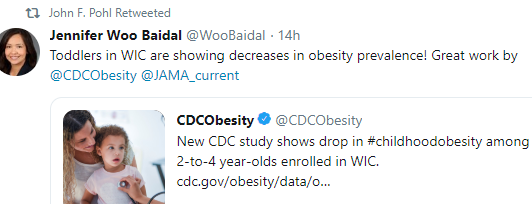
CBS News: Study shows declining obesity rate for preschoolers who receive government food aid

An excerpt:

The obesity rate for preschoolers who receive government food aid has declined, according to a study released Tuesday in the Journal of the American Medical Association. Obesity rates dropped steadily to about 14% in 2016 — the latest data available — from 16% in 2010, the Centers for Disease Control and Prevention reported.

The improvement affected youngsters ages 2 through 4 who receive food vouchers and other services in the federal Women, Infants and Children nutrition program. About 1 in 5 U.S. kids that age were enrolled in 2016…

My take:  This is good news. Hopefully, this report will be one of many indicating that the rates of obesity could actually improve.

Related blog posts:

Vedolizumab More Effective Than Adalimumab for Ulcerative Colitis

Gastroendonews: Tea Leaves No More: Biologics Head-to-Head Produces a Winner

An excerpt:

In the first head-to-head trial of biologic treatments for inflammatory bowel disease, vedolizumab (Entyvio, Takeda) was nearly 50% more effective than adalimumab (Humira, AbbVie) in inducing clinical and mucosal remission in patients with moderate to severe ulcerative colitis…

They enrolled 771 patients with moderate to severe ulcerative colitis in the VARSITY study and randomly assigned them to receive 52 weeks of treatment with either vedolizumab or adalimumab…

They had failed other conventional therapies, including 25% in each group that had received an anti–tumor necrosis factor (TNF) agent…

  • 31.3% of vedolizumab recipients and 22.5% of those taking adalimumab were in clinical remission after 52 weeks (P=0.0061). Clinical remission was defined as a complete Mayo score of 2 or lower and no subscore greater than 1
  • Nearly 40% of patients who received vedolizumab achieved mucosal healing at 52 weeks, compared with 27.7% of adalimumab recipients (P=0.0005).

My take: This study provides a rationale for vedolizumab to be used as a first-line biologic agent for ulcerative colitis.

Related posts:

Is Red Meat More Likely to Cause High Cholesterol than White Meat?

A recent study -full text link: N Bergeron et al. Effects of red meat, white meat, and nonmeat protein sources on atherogenic lipoprotein measures in the context of low compared with high saturated fat intake: a randomized controlled trial. The American Journal of Clinical Nutrition, nqz035, https://doi.org/10.1093/ajcn/nqz035

This study which randomized 177 patients to 4 week trials of each protein source: red meat, white meat, or non-meat protein found no significant differences in cholesterol levels.

From CNN:  White meat is just as bad for you as red beef when it comes to your cholesterol level, study says

An excerpt:

The red meat or white meat debate is a draw: Eating white meat, such as poultry, will have an identical effect on your cholesterol level as eating red beef, new research indicates.

The long-held belief that eating white meat is less harmful for your heart may still hold true, because there may be other effects from eating red meat that contribute to cardiovascular disease, said the University of California, San Francisco researchers. This needs to be explored in more detail, they added.
Non-meat proteins such as vegetables, dairy, and legumes, including beans, show the best cholesterol benefit, according to the new study published Tuesday in the American Journal of Clinical Nutrition.
From Twitter -CDC Messaging on Dangers of Smoking While Pregnant:


Vaccine Injury Claims Are Rare

NY Times: Vaccine Injury Claims Are Few and Far Between

An excerpt:

The data comes from the National Vaccine Injury Compensation Program, a no-fault system begun in 1988 after federal law established it as the place where claims of harm from vaccines must be filed and evaluated. It currently covers claims related to 15 childhood vaccines and the seasonal flu shot.

Over the past three decades, when billions of doses of vaccines have been given to hundreds of millions of Americans, the program has compensated about 6,600 people for harm they claimed was caused by vaccines. About 70 percent of the awards have been settlements in cases in which program officials did not find sufficient evidence that vaccines were at fault…

The Centers for Disease Control and Prevention has estimated that vaccines prevented more than 21 million hospitalizations and 732,000 deaths among children over a 20-year period….

There were about two claims of injury for every one million doses of all vaccines distributed in the United States from 2006 through 2017, the period for which the injury compensation program has dosage data. It says more than 3.4 billion vaccine doses were distributed during that time.

The rarity of claims is especially notable because the program aims to make it easy to file a petition…

A growing proportion of recent claims, about half of all petitions since 2017, do not involve the content of vaccines themselves. Instead, they refer to shoulder injuries, usually in adults, that occurred because a health provider injected a vaccine too high on the shoulder, or into the joint space instead of into muscle tissue. That may cause an inflammatory response leading to shoulder pain and limited motion.

My take (from Paul Offit, MD): “The most dangerous aspect of giving your child vaccines is driving to the office to get them.”

Related blog posts:

Do Anti-TNF Agents Reduce Surgeries and Hospitalizations?

Briefly noted:

A recent study (http://dx.doi.org/10.1136/gutjnl-2019-318440; SK Murthy et al. BMJ indicates that anti-TNF therapy has not been effective in significantly lowering CD-related hospitalizations or surgeries.

Full Text Link (from Eric Benchimol twitter feed): Introduction of anti-TNF therapy has not yielded expected declines in hospitalisation and intestinal resection rates in inflammatory bowel diseases: a population-based interrupted time series study)

My take: While big changes in the frequency of these outcomes were not demonstrated in this large study, prior studies, including the RISK study, have shown that anti-TNF therapy can be disease-modifying and reduce the risk of penetrating disease in Crohn’s disease.

Related blog post: CCFA Updates in IBD


Gun Carrying Adolescents –Why We Are Going to See More School Shootings

A recent cross-sectional study (RMC Kagawa et al. J Pediatr 2019; 209: 198-203) shows a high rate of gun carrying among adolescents in the U.S.

Key findings:

  • Based on a sample of 10,112 adolescent who completed surveys, 2.4% of adolescents reported carrying a gun in the prior 30 days.
  • Carrying a gun was more common among adolescents with a conduct disorder (adjusted prevalence ratio 1.88), drug use disorders (APR 1.91) and patients with specific phobias (APR 1.54)
  • The authors estimate that 1.1% of adolescents with a disorder associated with self- or other-directed violence also carry guns.  This extrapolates to 272,000 adolescents with both risk factors.
  • Nearly two-thirds of adolescents who report gun carrying had a mental health disorder

My take:

  1. Guns are everywhere.  Gun carrying among adolescents, while only a small percentage of all adolescents, represent a grave risk; especially, since the majority who report carrying guns (in this study) have mental health issues.
  2. Safe storage needs to be a requirement of gun ownership.  Gun access and misuse by adolescents is a ‘clear and present danger’ (apologies to Tom Clancy).

Related blog posts:

El Retiro Park, Madrid