No One Would Design U.S. Healthcare System This Way

S Corlette, CH Monahan. NEJM 2022; 387: 2297-2300.

There are a lot of problems with the U.S. Healthcare system. This article focuses on healthcare coverage.

The U.S. has a patchwork system of health insurance coverage “in which people’s access to services and level of financial protection — not to mention whether they have coverage at all — varies depending on their birthplace, age, job, income, location, and health status…Many people in the United States work for employers that do not offer insurance or do not sufficiently subsidize it, making it unaffordable for lower-income workers.”

No one would purposefully design the system we have. Unlike many of our peer countries, the United States has never had a centrally planned, cohesive system to help its citizens obtain and pay for health care services. Ours is a system built on happenstance, unintended consequences, and gap filling…”

“The United States has made sporadic efforts at creating a national system of health coverage…These efforts all foundered in the face of opposition from health insurers, the American Medical Association, and other health industry stakeholders, as well as concerns about the proposals’ costs.”

“Americans who have “good” insurance today may be surprised to learn that they, too, are vulnerable. Underinsurance is a growing problem, as fewer and fewer Americans are able to afford their share of costs. Premiums and deductibles continue to increase as health care costs rise, straining the budgets of families, employers, and state and federal governments. Unless and until policymakers curtail the power of health care monopolies to drive up costs and do more to limit health care prices across our array of public and private coverage systems, virtually everyone’s access to affordable care is at risk the primary reason millions of Americans remain uninsured or have insurance coverage that leaves them financially exposed is the high costs in our health care system. Constraining the growth of costs while reducing inequities in access and outcomes will require new but difficult reforms.” 

My take: There are no simple solutions to the high costs of our health care or to assuring adequate coverage. At every level, there are excessive costs which undermine these goals:

  • Hospitals charge exorbitant fees and try to monopolize markets
  • Insurance companies have split loyalties and often deny expensive but necessary care
  • Pharmaceutical companies charge as much as the market will bear even with older generics. Increasingly, newer medications are very expensive
  • Health care providers have no incentives to constrain costs. Even salaried physicians may feel complicit by being part of systems owned by hospitals and venture capital firms which have excessive charges.
  • Wasteful (low value) practices are widespread

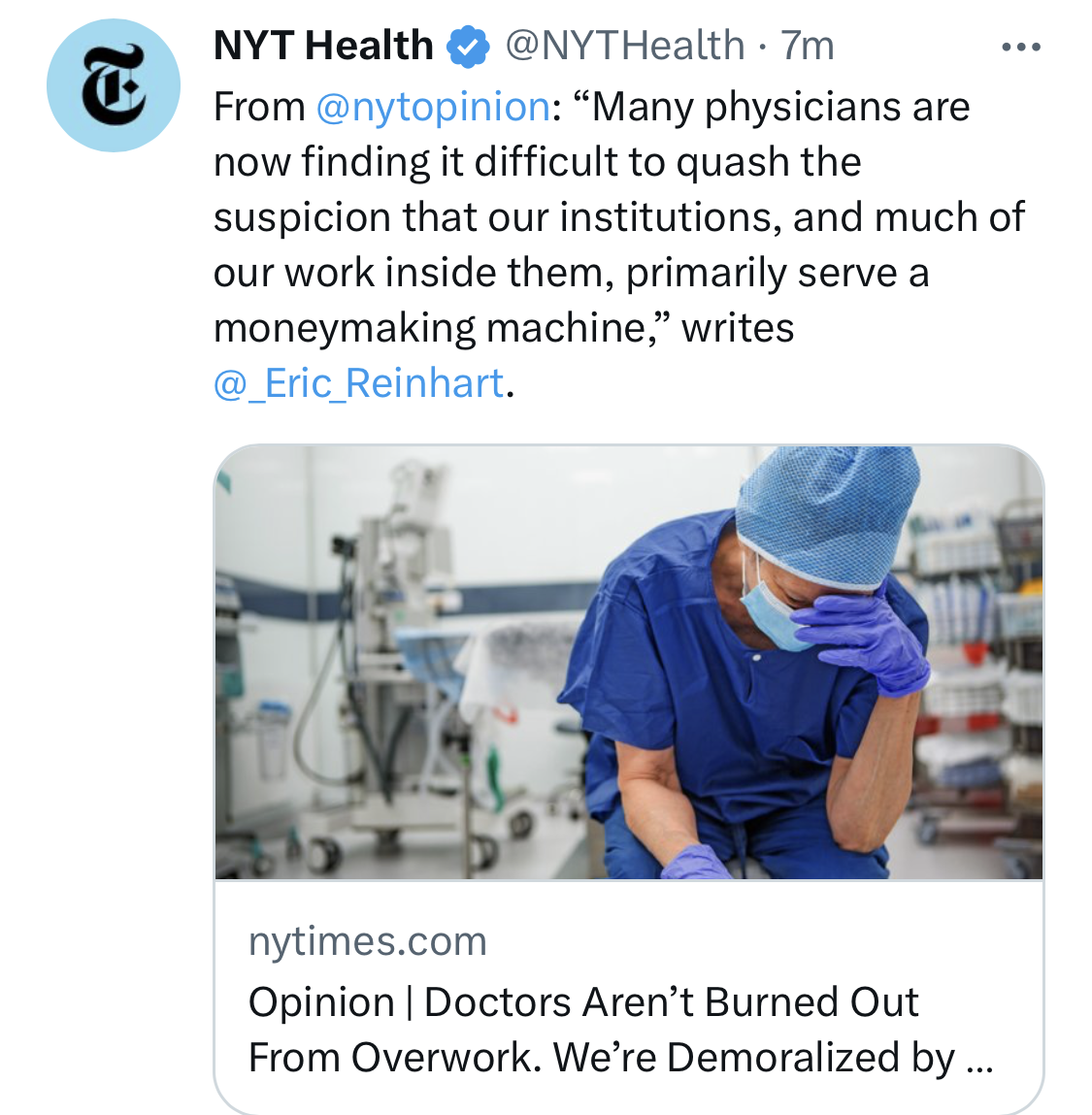
Related article: NY Times, Eric Reinhart 2/5/23: Doctors Aren’t Burned Out From Overwork. We’re Demoralized by Our Health System.

Excerpts:

“For decades, ‌at least tens of thousands of preventable deaths have occurred each year because health care here is so expensive…

Although deaths from Covid have slowed, the ‌disillusionment among health workers has ‌only increased. Recent exposés have further laid bare the structural perversity of our institutions‌‌. For instance, according to an investigation in The New York Times, ostensibly nonprofit‌ charity hospitals have illegally saddl‌ed poor patients with debt for receiving‌‌ care to which they were entitled without cost and have exploited tax incentives meant to promote care for poor communities to turn ‌‌large profits. Hospitals are deliberately understaffing themselves and undercutting patient care while sitting on billions of dollars in cash reserves. Little of this is new, but doctors’ sense of our complicity in putting profits over people has ‌grown more difficult to ignore…

And many physicians are now finding it difficult to quash the suspicion that our institutions, and much of our work inside them, primarily serve a moneymaking machine…Our health care institutions as they exist today are part of the problem rather than the solution.”

Related blog posts:

What’s Wrong with Noncompete Clauses

NY Times (1/9/23): Lina Khan: Noncompetes Depress Wages and Kill Innovation

This editorial provides a rationale for the FTC’s proposal to eliminate non-compete clauses.

Background: “When you’re subject to a noncompete clause, you lose your right to go work for a competing company or start your own, typically within a certain geographic area and for a certain period of time…In theory, noncompete clauses promote investment and innovation by assuring companies that their employees can’t run off with valuable secrets. And, again in theory, workers should be paid more in exchange for agreeing to sign a contract that restricts their autonomy. But the reality looks very different.”

Key points:

  • About 1 in 5 U.S. workers are subject to noncompete clauses.
  • “Noncompete clauses systemically drive down wages, even for workers who aren’t bound by one.”
  • Employees do not receive additional compensation for signing a noncompete clause. “Employers often spring them on workers after they’ve accepted a job, when their bargaining power is effectively zero.”
  • “Noncompetes reduce entrepreneurship and start-up formation…and keep innovative ideas from breaking into the market.”
  • “Noncompetes are the type of restriction that Section 5 of the F.T.C. Act, a federal law passed by Congress more than a century ago, is supposed to prevent.”
  • There are alternative ways to protect company secrets like nondisclosure agreements
  • California does not allow noncompete clauses (since 19th century) and this “hasn’t kept the California economy — the world’s fifth-largest — stuck in the Stone Age.”

My take: Elimination of noncompete clauses would be good for doctors (and other workers) and for the economy as well. Established business with market dominance will need to use other ways besides coercion to keep talented employees when noncompete clauses go away.

Siesta Key Beach, FL

Favorite Posts 2022

Thank you to those who have helped me this past year with this blog –colleagues, friends and family. Wishing all of you a good 2023. Here are some of my favorite posts from this past year:

GI:

Nutrition:

Liver:

Endoscopy:

Health Policy:

Humor:

Most Popular 2022 Posts

The list of the most viewed gutsandgrowth blog posts in 2022.

Links to Posts:

Fewer Malpractice Cases Per National Practioner Data Bank

DM Studdert, MA Hall. NEJM 2022; 387: 1533-1537. Medical Malpractice Law — Doctrine and Dynamic

This article reviews the topic of malpractice and the hurdles for plaintiffs to establish liability. Some of the interesting points:

  • “Patients lose about 80% of medical malpractice trials.3 However, fewer than 1 in 20 claims end in courtroom verdicts; about one third are settled out of court with a payment to the patient, and the remainder are dropped or dismissed.3
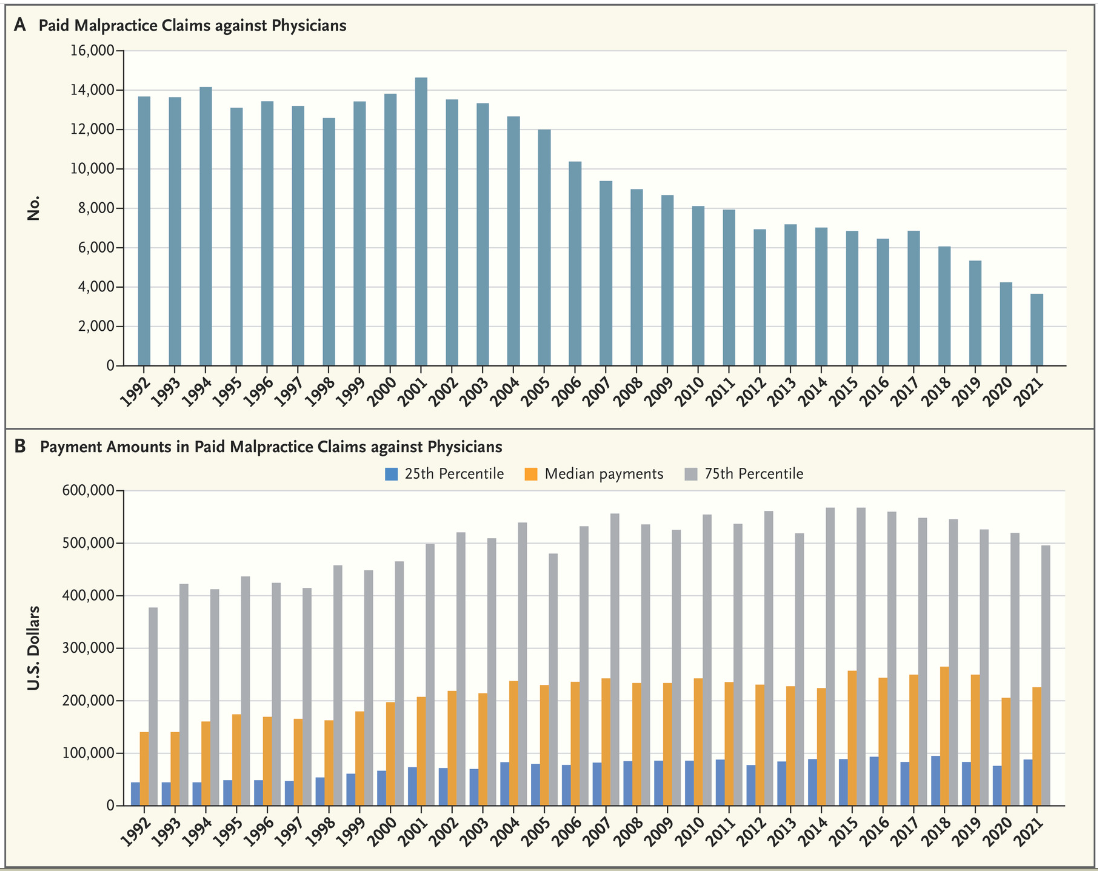
  • “NPDB data reveal a remarkable phenomenon: the number of paid claims against physicians has decreased by 75% in the past 20 years.” The potential reasons include tort reform, greater openness about medical errors may have reduced patients’ inclination to sue, better medical care (no evidence of this), and incomplete NPDB data. With regard to incomplete data, this can occur with “corporate shielding” in which institutions assume liability and payment responsibility in claims against physicians, thus averting reporting requirements).

In the graph, “payments have been adjusted to 2021 dollars using the consumer price index for all urban consumers (https://data.bls.gov/PDQWeb/cu. opens in new tab).”

Related blog post: “Physician-Patient Relationship is Not Necessary to Sue Docs for Malpractice”

“Gaming” U.S. Patent System by Big Pharma

NBC News: ‘Gaming’ of U.S. patent system is keeping drug prices sky high, report says 

Excerpts:

Drugmakers are able to extend the patents on their drugs, keeping generics off the market, through a process known as “evergreening”… The excessive use of the patent system — by drugmakers Bristol-Myers Squibb, AbbVie, Regeneron and Bayer — keeps the prices of the medications at exorbitant levels, often at the expense of American consumers, according to the report from the Initiative for Medicines, Access & Knowledge, or I-MAK, a nonprofit organization that advocates drug patent reform.

“They get the power, they get the monopoly and they start hiking their prices,” said Priti Krishtel, a health justice lawyer and a co-founder of I-MAK…

The U.S. patent system is meant to reward innovation by permitting drug companies to sell new medications on the market and barring other manufacturers from making generic versions for a set period of time — usually 20 years. Once the patent expires, generics are allowed on the market, often at a lower list price than the brand-name drug.

But drugmakers often extend their patents by making small tweaks to the drugs, sustaining their monopolies for several years...

Humira, a rheumatoid arthritis drug from the Chicago-based biotech firm AbbVie, generated $17.3 billion in annual sales in 2021. There are 311 patent applications for the drug, 94% of which were sought after FDA approval. AbbVie’s original patent on the drug expired in 2016, but it won’t face competition until 2023...

The practice of extending patents doesn’t always go unchallenged. In some cases, generic manufacturers sue the drugmakers to get their drugs on the market, Lemley said. However, he added, those lawsuits often end in settlements between the companies.

My take: As bioethicist Arthur Caplan states, this is an unethical practice and “we need to be rethinking the rules of patenting.” There is no good reason why patients in the U.S. need to be paying 5 times as much for adalimumab as patients in Europe.

Related blog posts:

Knik River, AK

A$$inine Pricing of Indomethacin Suppositories

K McKee et al. Gastroenterol 2022; 163: 543-546. Open access! Rectal Nonsteroidal Anti-inflammatory Drugs for Post-Endoscopic Retrograde Cholangiopancreatography Pancreatitis Prophylaxis: A Case Study in a Price-Escalation Era

During the pandemic, several of the pharmaceutical companies have helped improve the reputation of the industry by expeditiously developing life-saving therapies and vaccines. At the same time, many have continued with outrageous price increases of generic medications. An example of this is rectal indomethacin which is used for the prevention of pancreatitis after ERCP. In this commentary, the key points:

  • The current price in the U.S. for this previously inexpensive medication is now $429 (in 2021) (previously $17). For patients, this charge is often multiplied by hospital billing departments and is frequently NOT covered by insurance as the manufacturer has not filed a new drug application with the FDA (new indication).
  • The authors note that rectal diclofenac would be a suitable alternative with similar (?better) effectiveness but is currently not available in U.S.
  • The government could allow importation of either diclofenac or indomethacin (see Table below for costs of these medications in other countries). “If the government used the powers granted in the Medicare Modernization Act of 2003, the price gouging problem caused by rectal NSAIDs could be swiftly solved without the need for expanding the US manufacturing market.” This would drop the “price of this potentially lifesaving prophylaxis by 99.24%.”

My take: I am still grateful to Mark Cuban (Why I No Longer Need to Be A Billionaire | gutsandgrowth) who is much more likely to fix the generic drug pricing problem than our government which has been reluctant to take measures against big pharma.

Related blog posts:

Do Health Care Workers Need Peace Agreements?

I have not paid close attention to the movement to unionize health care workers in the U.S. As such, I learned a few things in this past weekend NY Times article: Doctors and Nurses Shouldn’t Have to Strike (online version titled “When Health Care Workers Are Protected, Patients Are, Too”)

Excerpts:

Since the pandemic began, the health care work force — the country’s largest industry by employment — has shrunk by nearly 2 percent… Now, with astronomical turnover and rising demand as patients seek care that they may have put off during the height of the pandemic, hospitals, clinics, nursing homes and home care agencies across the country lack sufficient staff members to adequately care for patients…

Most hospitals might be private companies in their formal legal identity, but the reality is that government has shaped the health care system every step of the way of its modern existence…

Unionized health care workers all over the country are fighting back against untenable conditions in the health care industry, and they are often met with harsh treatment by employers for doing so…

Peace agreements are popular with unions because they help prevent the type of devastating reprisals that drive many workers out of their jobs, but employers often refuse to accept them…

By giving weight to workers’ on-the-job needs, while eliminating strikes, labor peace policies in health care facilities benefit patients because they give workers more power to manage their work environments. They also make establishing unions easier for workers, and data suggests that unionization in health care improves patient care.

My take: In our hospital system, recent staffing shortages have forced the hospital to close a significant number of intensive care unit beds. This will inevitably lead to postponement or cancellation (often at last minute) of needed surgical procedures (that often require availability of an ICU bed). The fix for some of the ills in our hospital system is going to be difficult. Adequate staffing with highly-trained health care workers needs to be the top priority.

Another sign that helps keep folks on the designated walking areas
–this one was at the Valley of Fires State Park, NM

America’s Formula Shortages –The Bigger Picture

A recent article (The Dispatch, Scott Lincicome: America’s Infant Formula Crisis and the ‘Resiliency’ Mirage) explains that the reasons we are facing formula shortages go beyond the Abbott recall.

Excerpts:

The infant formula crisis isn’t simply another case of a one-off event causing pandemic-related supply chain pressures to boil over. Instead, U.S. policy has exacerbated the nation’s infant formula problem by depressing potential supply….all part of our government’s longstanding subsidization and protection of the politically powerful U.S. dairy industry…

[Additionally, there] are strict FDA labeling and nutritional standards that any formula producer wishing to sell here must meet….These regulatory barriers are probably well-intentioned, but that doesn’t make them any less misguided—especially for places like Europe, Canada, or New Zealand that have large dairy industries and strict food regulations

The combination of trade and regulatory barriers to imported infant formula all but ensures that our almost $2 billion U.S. market is effectively captured by a few domestic producers—despite strong demand for foreign brands. What German company, for example, is willing to spend the time and money meeting all the FDA requirements—registration, clinical trials, labeling and nutritional standards, inspections, etc.—only to then face high import taxes that make its product uncompetitive except during emergencies? The answer: almost none…

Meanwhile, Abbott is in full-on crisis mode and has turned to flying in formula produced at an FDA-registered Irish affiliate…

WIC program’s use of sole supplier contracts has created a problem specific to the current crisis because … the big FDA recall just happened to hit the very producer—Abbott—holding most of the WIC contracts. 

My take: This article explains why there is not a simple switch to flip to fix the current formula bottlenecks.

Related blog posts:

White Sands National Park, New Mexico

How Industry Manipulates Physicians For Product Promotion

As an homage to May 4th, I wanted to highlight an AAP report that reminded me of Yoda telling Luke Skywalker: “If once you start down the dark path, forever will it dominate your destiny, consume you it will, as it did Obi-Wan’s apprentice.”

DS Diekema. AAP Committee on Bioethics. Pediatrics 2022; 149: e2022056549. Open Access. Health Care Clinicians and Product Promotion by Industry.

Background:

  • “In 2016, pharmaceutical companies spent $29.9 billion on marketing, of which $20.3 billion (68%) was directed toward health care clinicians in the form of prescriber detailing ($5.6 billion), free samples ($13.5 billion), direct physician payments related to specific drugs ($979 million), and disease education ($59 million)”
  • “In 2019, 615 000 physicians received payments or investment interests worth $3.6 billion (an average of $5854 per physician recipient), and 1194 teaching hospitals accepted payments totaling $2.63 billion”
  • “Despite their own sense of invulnerability to persuasive techniques, physicians do consider other physicians to be vulnerable.125  This phenomenon is what social scientists refer to as the “bias blind spot.”147  As a general rule, individuals underestimate the degree to which they are influenced by cognitive and motivational bias and overestimate the degree to which others are influenced by the same things.147 

Key points:

“In his book, Influence: The Psychology of Persuasion, Cialdini summarizes this literature and describes 6 basic categories of effective persuasive techniques.57

  • Commitment and Consistency…Industry representatives are trained to get health care clinicians to make a verbal commitment to use their products…once the health care clinician has tried the drug on 5 patients, he or she is more likely to continue to use the drug.7 
  • Social Proof…When told that almost all of the physicians in the region are now using drug A to treat disease B, a health care clinician will be hard-pressed not to join the group”
  • Liking… Humans tend to be more responsive and receptive to individuals who are friendly, likeable, and attractive”
  • Appeals to Authority…The use of opinion leaders and experts to give lectures supporting the use of a product”
  • Scarcity…Opportunities to engage in consulting and speaking opportunities fall into this category”
  • Reciprocation…A sense of obligation to reciprocate accompanies the receipt of any favor, gift, or kindness. Gifts can take many forms and need not be valuable.”

Reciprocation Elaborated:

  • “Much cognitive activity occurs without conscious awareness, and the most effective marketing and persuasion strategies are designed to engage the subconscious aspects of decision making…Decision making appears to rely on dual systems within the brain, a socioemotional system” and the cognitive control system.
  • “The socioemotional system tends to involve rapid, automatic processing that is often reactive, intuitive, unconscious, and sensitive to social norms…Effective marketing strategies, including the use of incentives and gifts and the nurturing of relationships, are designed to engage the socioemotional decision-making areas of the brain”
  • “The cognitive control system, on the other hand, tends to be consciously controlled, reasoned, and analytic and requires more time and conscious effort”
  • “Most health care clinicians believe they cannot be bribed and that they would never trade a small gift for changing their prescribing behavior…Gifts may subtly and subconsciously affect the way the receiver of the gift evaluates the information provided by the gift giver, and these feelings of indebtedness may ultimately lead to changes in prescribing behavior”

“With regard to the receipt of gifts from the industry, the American Academy of Pediatrics (AAP) has endorsed the AMA guidelines, which do not prohibit gifts outright but offer the following basic principles for managing them:198 

  • Physicians should decline cash gifts in any amount from an entity that has a direct interest in physicians’ treatment recommendations.
  • Physicians should decline any gifts for which reciprocity is expected or implied.
  • Physicians should accept an in-kind gift for the physician’s practice only when the gift is of minimal value and will directly benefit patients, including patient education.
  • Academic institutions and residency and fellowship programs may accept special funding on behalf of trainees to support their participation in professional meetings, including educational meetings, provided the program identifies recipients based on independent institutional criteria and funds are distributed to recipients without specific attribution to sponsors”

As a final incentive,  “in late 2020, the Department of Health and Human Services Office of the Inspector General issued a special fraud alert highlighting concerns … in connection with speaker programs.” The Office of the Inspector General warned both companies and health care professionals that such arrangements may, under certain circumstances, violate antikickback statutes.”

My take (from the report): “At a minimum, health care clinicians should be cognizant of the techniques used to attempt to alter their behavior and guard against them.”

Related blog posts: