Is There An Increased Risk of Infections with Anti-TNF Therapy?

J Holmgren et al. Inflamm Bowel Dis 2023; 29: 339-348. Open Access! The Risk of Serious Infections Before and After Anti-TNF Therapy in Inflammatory Bowel Disease: A Retrospective Cohort Study 

Methods: Retrospective study with 980 patients at 5 centers participating in the Swedish IBD Quality Register. Serious infections, defined as infections requiring in-patient care, the year before and after the start of anti-TNF treatment were evaluated.

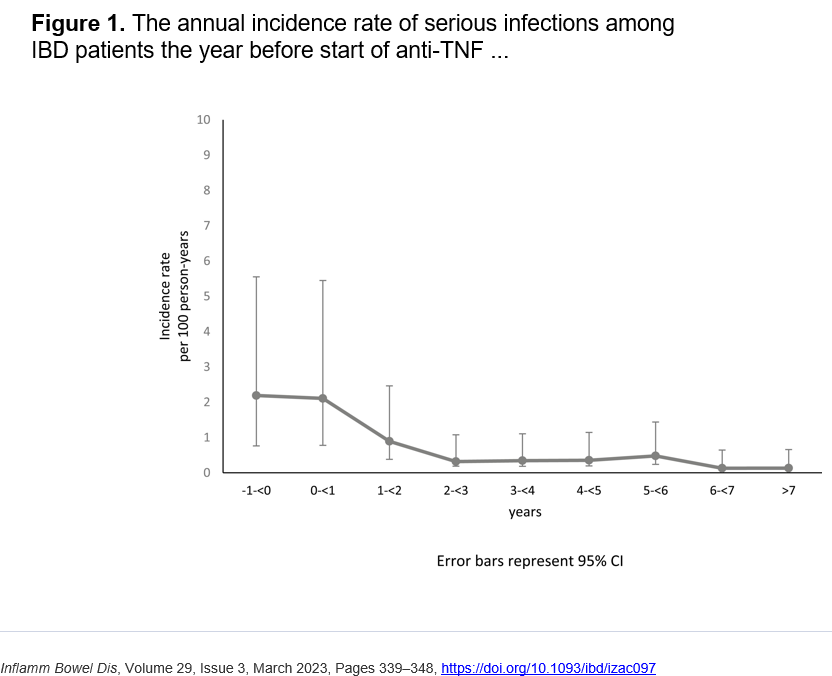
A decline in the incidence rate can first be seen beyond 1 year of treatment with anti-TNF, with an incidence rate of 1.22 (95% CI, 0.90-1.66) events per 100 person year compared with 2.19 (95% CI, 1.43-3.36) events per 100 person year the year before treatment. This is a significant reduction of infections, with an incidence rate ratio of 0.56 (95% CI, 0.33-0.95; P = .030).

Key findings:

  • A 72.0% reduction in the incidence rate of perianal abscesses and intra-abdominal abscesses during treatment with anti-TNF was found compared with before treatment.
  • Figures 2 & 3 show than most infection rates decreased with treatment. CMV infection did not change significantly with 0.10 per 100 person-years prior to treatment and 0.14 per 100 person-years after starting anti-TNF therapy
  • ” In the current study, patients younger than 20 years old experienced a substantial decrease of infection incidence rate ratio (0.11) with the introduction of anti-TNF treatment. The results could be explained by the fact that young patients have a more active disease with increased risk of infection before treatment with anti-TNF.”
  • “The most common type of infection after anti-TNF treatment was pneumonia. The high incidence of pneumonia confirms earlier data.9,36,37” However, the authors show that the rate of pneumonia dropped from 0.51 to 0.27 per 100 person-years after starting anti-TNF therapy.

The authors note that a prior study by “Zabana et al showed that patients with IBD had an increased risk for serious infection after starting immunosuppressive treatment compared with before treatment (median follow-up 3 years before and 5 years after)… the discrepancy in the result may be explained by selection bias. We included all patients starting anti-TNF treatment. However, Zabana et al included only patients who suffered from infections during immunosuppressive treatment and retrospectively examined the risk of infection before start of treatment.24

Limitations of study: several other important factors affecting infections were not captured in this study including steroid exposure and nutritional status.

My take (from authors): “The incidence rate of serious infection among IBD patients did not increase with anti-TNF therapy. Instead, serious infections seemed to decrease more than 1 year after initiation of anti-TNF treatment.”

Related blog posts:

Immune Dysregulation and Inflammatory Bowel Disease

At our center, we are fortunate to work with an immune dysregulation clinic (Dr. Shanmuganathan Chandrakasan, Dr. Taylor Fitch) that helps sort out patients with inflammatory bowel disease with underlying monogenetic disorders. This is very important as specific treatments, including hematopoietic stem cell transplants (HCST), may be needed. The likelihood of an underlying monogenetic disorder is much more frequent in the VEO population. A recent talk on this topic by Taylor Fitch was given to our group. Here are some of the slides:

Generally, about 2% of those older than 6 years of age have monogenetic disorders, but it is much higher in those with severe or refractory disease.

This slide shows six major categories of immune defects.

This slide shows the high frequency of extraintestinal manifestations in patients with monogenetic disorders, particularly recurrent infections, skin/hair abnormalities, and autoimmunity. Perianal disease is also frequent in this population.

In the discussion, it was noted that DHR testing is often unreliable, especially if the specimen is not run promptly.

My take: I have had several patients with IBD/immune dysregulation, including a patient with CTLA4 and a patient with TTC7A. Making these diagnoses led to specific treatment recommendations. The patient with CTLA4 is doing well with abatacept therapy.

For those in Atlanta, a referral can be made via EPIC order and/or via contact with immune dysregulation team members. Epic order:

Related blog posts:

Disclaimer: This blog, gutsandgrowth, assumes no responsibility for any use or operation of any method, product, instruction, concept or idea contained in the material herein or for any injury or damage to persons or property (whether products liability, negligence or otherwise) resulting from such use or operation. These blog posts are for educational purposes only. Specific dosing of medications (along with potential adverse effects) should be confirmed by prescribing physician.  Because of rapid advances in the medical sciences, the gutsandgrowth blog cautions that independent verification should be made of diagnosis and drug dosages. The reader is solely responsible for the conduct of any suggested test or procedure.  This content is not a substitute for medical advice, diagnosis or treatment provided by a qualified healthcare provider. Always seek the advice of your physician or other qualified health provider with any questions you may have regarding a condition.


IBD Updates: Low Lymphoma Risk, Fewer Biopsies for Ulcerative Colitis, MRE Distinguishes Backwash Ileitis, Beta-Fructans and IBD Activity

M Egberg et al. AJC 2023: 118: 354-359. Low Risk of Lymphoma in Pediatric Patients Treated for Inflammatory Bowel Disease

Key finding:

  • Using a database with 10,777 pediatric patients (2007-2018) with more than 28,000 patient years, there were 5 lymphomas reported. 4 had received thiopurines and none received anti-TNF monotherapy.

My take: This is a very reassuring study for the safety of anti-TNF agents.

AE Mikolajczyk et al. Inflamm Bowel Dis 2023; 29: 222-227. Assessment of the Degree of Variation of Histologic Inflammation in Ulcerative Colitis

  • In this retrospective study with 92 patients (182 colonoscopies), the authors found “minimal variability between degree of inflammation among biopsy fragments within and among different colorectal segments in UC, suggesting that even a single biopsy would adequately reflect the inflammation of the entire colorectum.”

My take: This study suggests that taking biopsies from every segment of the colon (when it looks uniform) is usually not needed, unless the purpose is to look for dysplasia. Also, it is worth recognizing that individuals with primary sclerosing cholangitis often have greater histologic activity in the right colon.

References only:

“Is Salt at Fault?” in Inflammatory Bowel Disease

R Kuang et al. Inflamm Bowel Dis 2023; 29: 140-150. Is Salt at Fault? Dietary Salt Consumption and Inflammatory Bowel Disease

This review looks at the potential role of salt in relation to the epidemiology of inflammatory bowel disease. The general focus is that the prevalence/incidence of IBD has been increasing and there must be environmental/dietary factors involved. Could salt be one of those causal factors or is it merely a temporal association?

Key points:

  • Ultra-processed foods make up more than half of the daily caloric intake in developed countries such as the United States! and Canada and between one-third to one-fifth of diets in middle-income countries such as Brazil and Mexico.. Ultra-processed foods involve “fractioning of whole foods into substances, chemical modifications of these substances, frequent use of cosmetic additives and sophisticated packaging that allow producers to create highly profitable, convenient, and hyperpalatable products.” Ultra-processed foods are typically high in sugar, unhealthy fats, and salt and low in dietary fiber, protein, vitamins, and minerals. They are also calorie dense. For Americans, the primary source of sodium in the diet is from commercially processed foods.
  • At present, the typical American consumes over 40% more salt on a daily basis than is re-commended. Added salt is a key component of UPFs, whose increased consumption has been closely linked to this rise in the IBD incidence. Even though salt is a key component of UPFs, it has received limited attention in the investigation of IBD...Excess salt contributes to greater monocyte and T-cell-driven inflammation and a parallel loss of immunoregulatory mechanisms involving M2 macrophages and Tregs in the Th17 axis.
  • The authors argue that improvement in IBD with exclusive enteral nutrition is another factor indicating a potential role for salt reduction as beneficial. “Although these ultra-processed liquid nutrition formulas were high in sugars, emulsifiers, and carrageenan, they were very low in sodium content.”

My take: It is not clear what impact salt has on IBD. However, too much salt causes problems well beyond hypertension and may contribute to several inflammatory conditions, including IBD, asthma, and rheumatoid arthritis.

Related blog posts:

Unrelated website information: IBD-EII is a website which has tried to organize/summarize some of the more important IBD articles including a timeline of these publications and evidence for specific medications.

Atlanta Botanical Gardens. Garden Nights, Holiday Lights exhibit

Precision Dosing with Vedolizumab in Pediatrics

RJ Colman et al. AP&T 2022; https://doi.org/10.1111/apt.17277. Open access! Real world population pharmacokinetic study in children and young adults with inflammatory bowel disease discovers novel blood and stool microbial predictors of vedolizumab clearance

“The study included data from 463 observed vedolizumab concentrations (59 peaks and 404 troughs) from 74 patients with IBD (52 with Crohn’s disease and 22 with ulcerative colitis or unclassified IBD, median age 16 years)…This study was part of the multicentre REFINE study, which aimed to investigate paediatric PK factors among different biological therapies. Both induction and maintenance doses were between 6 and 10 mg/kg for patients less than 30 kg and 300 mg for patients above 30 kg.”

Key findings:

  • “Using the new model in a simulation analysis of standard vedolizumab infusions (0, 2 and 6 weeks followed by every 8 weeks), we demonstrate that the expected cTrough at week 22 (infusion-5) in the majority of patients would result in drug exposure below current cTrough targets..The dosing simulations in our current study found that receiving standard dosing would lead to <20% of patients achieving a cTrough of 20 μg/ml at infusion-5.”
  • “The severity of hypoalbuminemia resulted in higher drug CL (lower cTrough) than the inflammatory burden (elevated ESR).”
  • Infusion-3 cTrough of at least 37 μg/ml and infusion-4 cTrough of at least 20 μg/ml best predicted SFCR (steroid-free clinical remission) at infusion-4. In contrast, we showed inadequate drug exposure during induction (AUCweek 14 of <134,580 μg h/ml) was associated with clinical non-response

My take: This study shows that therapeutic drug monitoring (TDM) is likely to be beneficial in improving outcomes in pediatric patients receiving vedolizumab. Low albumin in particular is associated with increased drug clearance. From this study, it looks like most pediatric patients will need dosing every 4 to 6 weeks to achieve good levels. The authors in their discussion reinforce the utility of TDM to “guide anti-TNF dose optimisations has been shown to improve durability and reduce both immunogenicity and loss of response.”

References:

13 Dubinsky MC, Mendiolaza ML, Phan BL, Moran HR, Tse SS, Mould DR. Dashboard-driven accelerated infliximab induction dosing increases infliximab durability and reduces immunogenicity. Inflamm Bowel Dis. 2022; 28: 1375– 85.

51 Strik AS, Löwenberg M, Mould DR, Berends SE, Ponsioen CI, van den Brande JMH, et al. Efficacy of dashboard driven dosing of infliximab in inflammatory bowel disease patients: a randomized controlled trial. Scand J Gastroenterol 2021; 56: 145– 154.

Related blog posts:

Disclaimer: This blog, gutsandgrowth, assumes no responsibility for any use or operation of any method, product, instruction, concept or idea contained in the material herein or for any injury or damage to persons or property (whether products liability, negligence or otherwise) resulting from such use or operation. These blog posts are for educational purposes only. Specific dosing of medications (along with potential adverse effects) should be confirmed by prescribing physician.  Because of rapid advances in the medical sciences, the gutsandgrowth blog cautions that independent verification should be made of diagnosis and drug dosages. The reader is solely responsible for the conduct of any suggested test or procedure.  This content is not a substitute for medical advice, diagnosis or treatment provided by a qualified healthcare provider. Always seek the advice of your physician or other qualified health provider with any questions you may have regarding a condition.

Validated SEMA-CD Score For Crohn’s Disease

J Adler et al. Inflamm Bowel Dis 2022; Open Access! Validating the Simplified Endoscopic Mucosal Assessment for Crohn’s Disease: A Novel Method for Assessing Disease Activity

“The SEMA-CD is scored by assigning a numerical value ranging from 0 (endoscopic remission) to 4 (severe disease) for each bowel region (ileum and colon). The overall colon is scored as a whole based on the most severe colonic segment.  The number of colonic segments with any degree of active disease is recorded, regardless of the severity of individual segments. The overall colon score is then multiplied by the number of involved colonic segments, and the result is added to the ileum score.”

Related blog post: The Really Simplified Endoscopy Scoring

IBD Updates: SC Vedolizumab, PRODUCE study: Specific Carbohydrate Diet, Racial Epidemiology of IBD, and Microbiome in UC

Briefly noted –all of these articles are open access:

A Volkers et al. AP&T 2022; https://doi.org/10.1111/apt.17153 Open access: Real-world experience of switching from intravenous to subcutaneous vedolizumab maintenance treatment for inflammatory bowel disease. In this prospective cohort study, patients (n=135) with IBD who had ≥4 months IV vedolizumab were switched to SC vedolizumab. 

Key findings:

  • 4 patients with Crohn’s disease had loss of response.
  • 9% of patients were switched back to IV vedolizumab due to adverse events or fear of needles.
  • Median clinical and biochemical disease activity remained stable after the switch. Median vedolizumab serum concentrations increased from 19 μg/ml at the time of the switch to 31 μg/ml 12 weeks after the switch (p < 0.005).

Related blog posts:

HC Kaplan et al. Am J Gastroenterol 2022 Jun 1;117(6):902-917. Open access: Personalized Research on Diet in Ulcerative Colitis and Crohn’s Disease: A Series of N-of-1 Diet Trials. In this study, 21 patients (completed trial) were randomized to 1 of 2 sequences of 4 alternating 8-week SCD (specific carbohydrate diet) and MSCD (modified specific carbohydrate diet) periods.

Key findings: “SCD and MSCD did not consistently improve symptoms or inflammation.” “Some individuals had improvement in symptoms and fecal calprotectin compared with their UD, whereas others did not.” The authors note that it took 18 months to recruit 54 patients for this study across 19 research sites.

Related blog posts:

EL Barnes et al. Inflamm Bowel Dis 2022; 28: 983-987. Open access: Racial and Ethnic Distribution of Inflammatory Bowel Disease in the United States The authors electronic health records from 337 centers from January 2013 to December 2018 with nearly 40 million patients in U.S.

Key findings:

  • Black adult patients were significantly less likely than White patients to have a diagnosis of CD (odds ratio [OR], 0.53) or UC (OR, 0.41). Pediatric Black patients were also less likely to have a diagnosis of CD (OR, 0.41) or UC (OR, 0.38)
  • Adult Hispanic patients were less likely to have a diagnosis of CD (OR, 0.33) or UC (OR, 0.45) compared with non-Hispanic patients. Similarly, pediatric Hispanic patients were less likely to have a diagnosis of CD (OR, 0.34) or UC (OR, 0.50).
  • Thus, these data suggest that CD and UC are modestly less prevalent among patients of non-White races and Hispanic ethnicity

M Frioirksmork et al. Inflamm Bowel Dis 2022; 28: 1081-1089. Open access: Similar Gut Bacterial Composition Between Patients With Ulcerative Colitis and Healthy Controls in a High Incidence Population: A Cross-sectional Study of the Faroe Islands IBD Cohort. This cross-sectional study from the Faroe Islands (which has very high incidence of IBD) consisted of 41 patients with established ulcerative colitis and 144 age- and sex-matched healthy controls.

Key findings: There was a similarity in bacterial community composition and absence of the beneficial Akkermansia genus in both groups.

Biologics in Children with Very Early Onset Inflammatory Bowel Disease

B Kerur et al. JPGN 2022; 75: 64-69. Utilization of Antitumor Necrosis Factor Biologics in Very Early Onset Inflammatory Bowel Disease: A Multicenter Retrospective Cohort Study From North America

In this retrospective study, 120 of 294 children with VEO-IBD (diagnosed 2008 and 2013, PRO-KIDS network) received anti-TNF therapy (96% infliximab). 101 of these 120 had adequate data recorded. It is noted that additional data on this cohort has been previously published (IBD Updates: Outcomes of VEO-IBD, PIANO Study Update, and Insurance-Disparity Relationship). Key findings:

  • Anti-TNF durability was 90% at 1 year, 75% at 3 years, and 55% at 5 years
  • Patients with Crohn’s disease had better durability than those with UC/IBD-U (Hazard ratio 0.17)
  • The most common reason for discontinuation of anti-TNF were loss of response in 24 (57%) children
  • 67 (66%) received combined therapy with an immunomodulator and this was associated with improved anti-TNF durability (Hazard ratio 0.30). However, authors note this was in era preceding widespread therapeutic drug monitoring.
  • The majority of children in the current study did not undergo testing for monogenic mutations

My take: Data for use of anti-TNF agents in this age group (< 6 yrs) has been limited. This study suggests similar effectiveness of anti-TNF agents in VEO-IBD compared to older groups. Given this groups increased risk for monogenic mutations, it is still a good idea, if feasible, to test for these disorders.

Related blog posts:

Outcomes with Enteral Nutrition

Notice: At this time, gutsandgrowth intends to post blogs 2-3 times per week rather than daily.

——————————————————————————————————————

N Davidson et al. JPGN 2022; 75: 70-75. 6- and 12-Month Outcomes after 90:10 Enteral Nutrition Induction Therapy in Pediatric Crohn’s Disease

In this retrospective study (2013-2018), the authors examined outcomes in 105 children treated with a 90:10 enteral feeds (90% formula).

Key findings:

  • 44/105 (42%) patients completed 8–12 weeks
  • After induction, 18 continued EN maintenance with a 80:20 then 70:30 protocol; however, only 10 remained on EN at 6 months and 4 remained on EN at 12 months

The associated editorial (pg: 1-2) make several points:

  1. While EEN is effective and safe, this study and others have shown poor adherence
  2. It is unclear how exclusive enteral nutrition needs to be in order to be effective. And, many patients instructed to receive 90% of their calories as formula are likely consuming higher amounts of table foods
  3. We still are working out which foods need to be excluded

My take: This study shows that EEN is NOT a practical option for most patients beyond induction. Only 4 patients remained on EEN at 12 months.

Related blog posts: